BIOAEROSOL SAMPLING- METHOD OF AIR
SAMPLING ANALYSIS
PRESENTED BY
C.Sujithra
M.Sc., Microbiology
Vivekananda Arts and Science College for Women
Sankagiri,Salem.
SUBJECT INCHARGE
Dr .V. Bharathi
Assistant professor
Department of Microbiology
DEPARTMENT OF MICROBIOLOGY
Content
• Bioaerosol sampling
• Types
• Techniques
• Air samplers
• Method of air sampling analysis
• Culture media
• CFU
• Identification of Air sampling
• Application
• Prevention
• Conclusion
Bioaerosol Sampling
Bioaerosol sampling is the process of collecting airborne biological particles (e.g., bacteria,
fungi, viruses, pollen, and allergens) from the air to identify, quantify, and analyze them. It is
commonly used in environmental monitoring, public health, industrial hygiene, and indoor air
quality studies.
Objectives of Bioaerosol Sampling
• Assess air quality and microbial contamination.
• Monitor airborne pathogens in healthcare or industrial settings.
• Investigate disease outbreaks caused by airborne microorganisms.
• Ensure compliance with safety and regulatory standards in cleanrooms or food industries.
Types of Bioaerosol
Sampling Methods
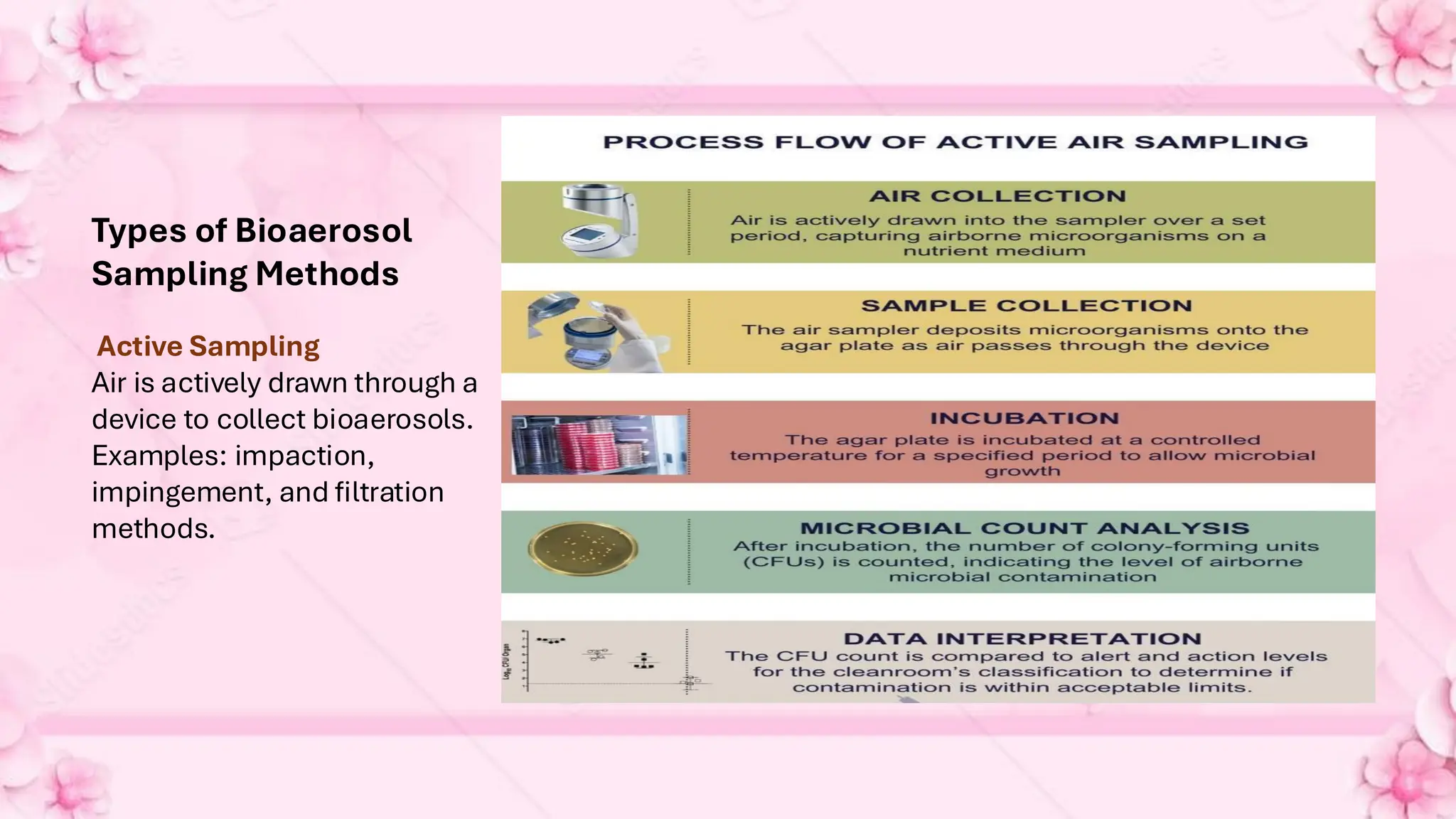
Active Sampling
Air is actively drawn through a
device to collect bioaerosols.
Examples: impaction,
impingement, and filtration
methods.
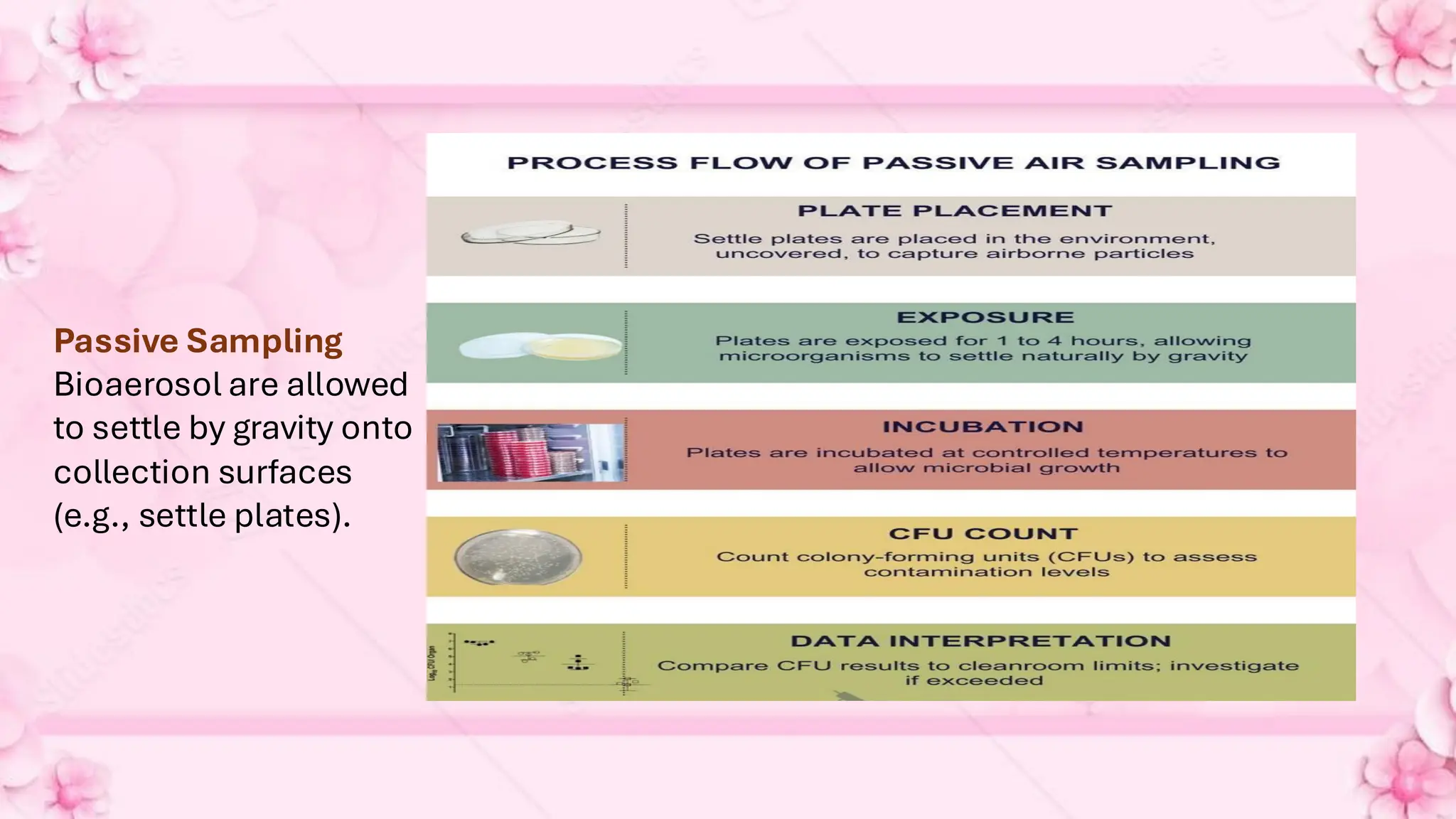
Passive Sampling
Bioaerosol are allowed
to settle by gravity onto
collection surfaces
(e.g., settle plates).
Techniques for Bioaerosol Sampling
• Impaction Sampling
Air is forced through a nozzle or slit, and particles are impacted onto agar plates.
Common devices: Andersen air sampler, MAS-100.Suitable for viable (cultivable) microorganisms.
• Impinger Sampling
Air is bubbled through a liquid medium (e.g., phosphate buffer) that captures microorganisms.
Common devices: SKC Biosampler.
• Filtration Sampling
Air is passed through a filter that traps bioaerosols. Filters are then cultured or analyzed directly.
• Gravimetric Sampling (Settle Plates)
Petri dishes containing culture media are exposed to air for a set time.
Effective for qualitative assessment but lacks quantitative precision.
• Cyclone Sampling
Uses centrifugal force to separate bioaerosols from the air stream into a collection medium.
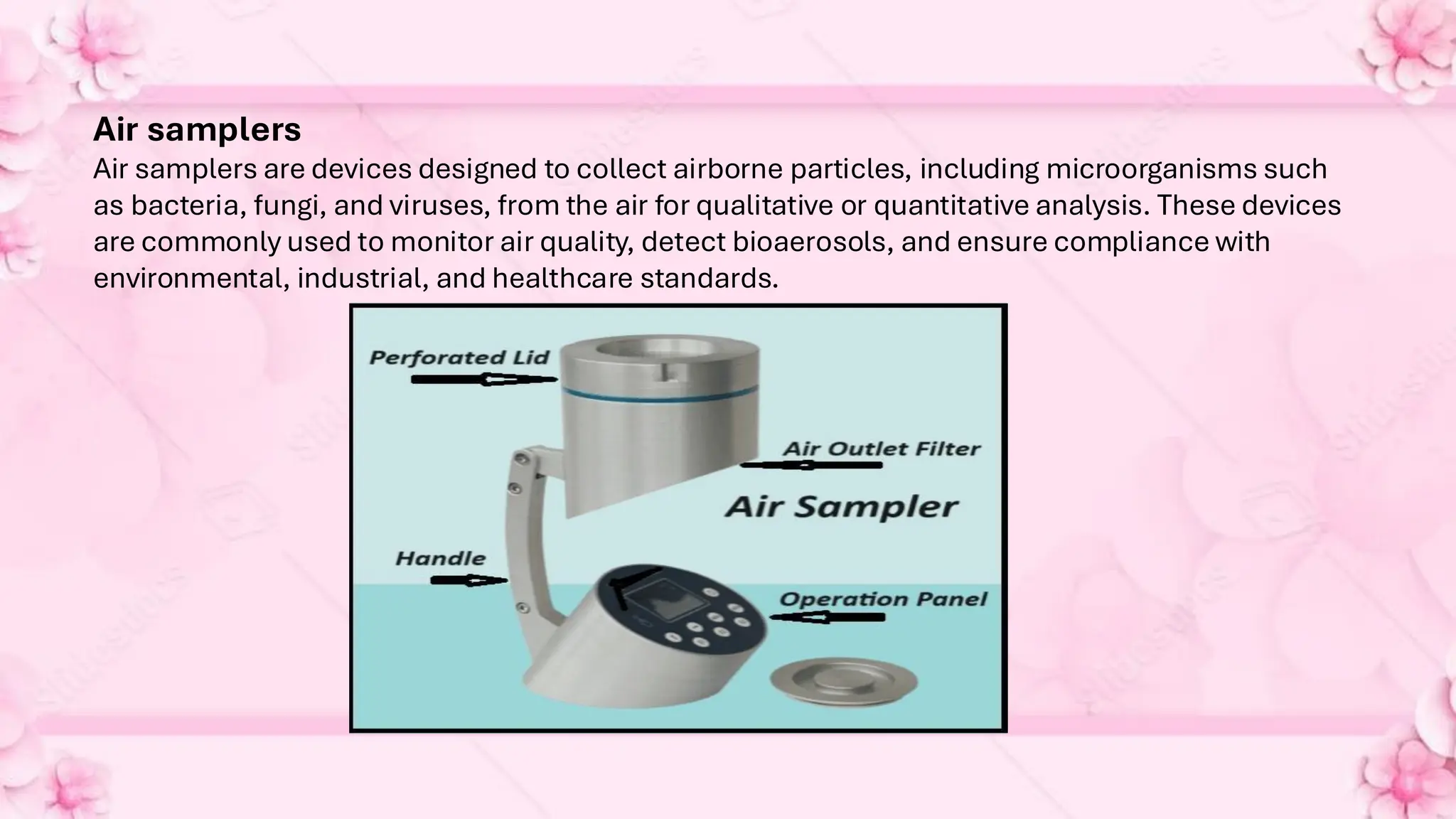
Air samplers
Air samplers are devices designed to collect airborne particles, including microorganisms such
as bacteria, fungi, and viruses, from the air for qualitative or quantitative analysis. These devices
are commonly used to monitor air quality, detect bioaerosols, and ensure compliance with
environmental, industrial, and healthcare standards.
Air Samplers for Bioaerosols
Air samplers are devices designed to capture bioaerosols.
Common types include:
• Impaction Samplers
Use a high-velocity air stream to force particles onto a culture medium.
Examples: Andersen sampler, MAS-100.
• Impinger Samplers
Trap particles in liquid media (e.g., phosphate buffer).
Example: SKC Biosampler.
• Filtration Samplers
Use filters (e.g., cellulose or HEPA) to collect bioaerosols for subsequent analysis.
• Cyclone Samplers
Use centrifugal force to separate particles from air.
Example: BioSampler.
• Gravimetric Samplers
Collect bioaerosols by sedimentation onto solid surfaces (e.g., Petri dishes).
Example: Settle plates.
Method of analysis
The method of analysis of air sampling involves a series of steps to evaluate the microbial
content in the air, including sample collection, processing, and identification.
Sample Collection
Using appropriate air samplers (e.g., impaction, impinger, filtration):Airborne
microorganisms are collected onto a medium (agar plate, liquid, or filter).Ensure sterile
handling and maintain airflow rates according to sampler specifications
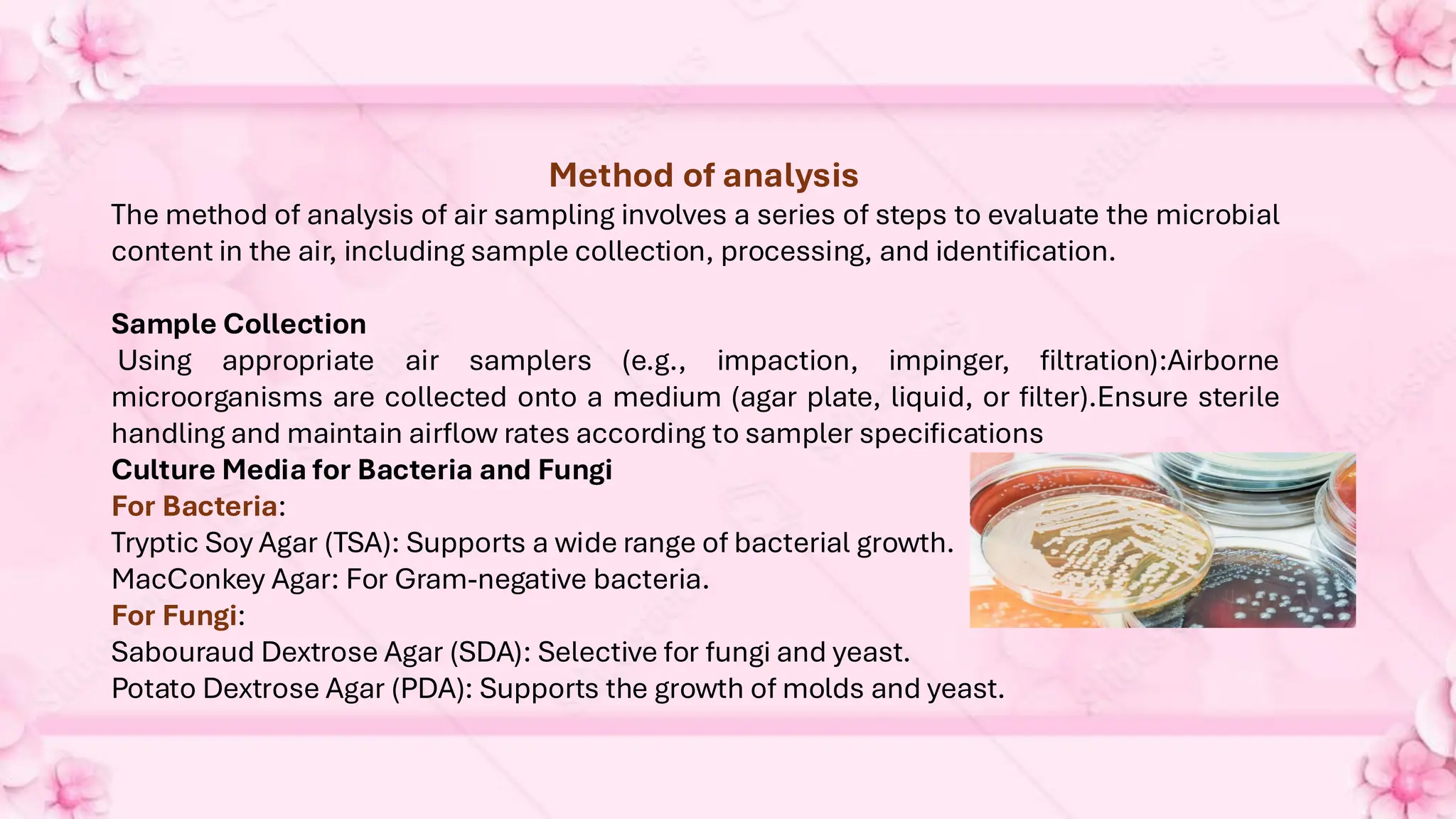
Culture Media for Bacteria and Fungi
For Bacteria:
Tryptic Soy Agar (TSA): Supports a wide range of bacterial growth.
MacConkey Agar: For Gram-negative bacteria.
For Fungi:
Sabouraud Dextrose Agar (SDA): Selective for fungi and yeast.
Potato Dextrose Agar (PDA): Supports the growth of molds and yeast.
Incubation
The collected sample (e.g., agar plate or filter) is incubated under suitable conditions for
microbial growth:
Bacteria: 35–37°C for 24–48 hours.
Fungi: 25–28°C for 3–7 days.
CFU:
CFU (Colony-Forming Unit) is a unit used to estimate the number of viable
microorganisms, such as bacteria or fungi, in a sample. It represents microorganisms
capable of forming visible colonies on solid culture media under appropriate growth
conditions.
Unit of Measurement:
Expressed as CFU per unit of volume, area, or weight.
In air sampling: CFU/m³ (colony-forming units per cubic meter of air).
Cfu/m3 – No.of colonies counted*100/volume of samples
Identification of Microorganisms (Qualitative Analysis)
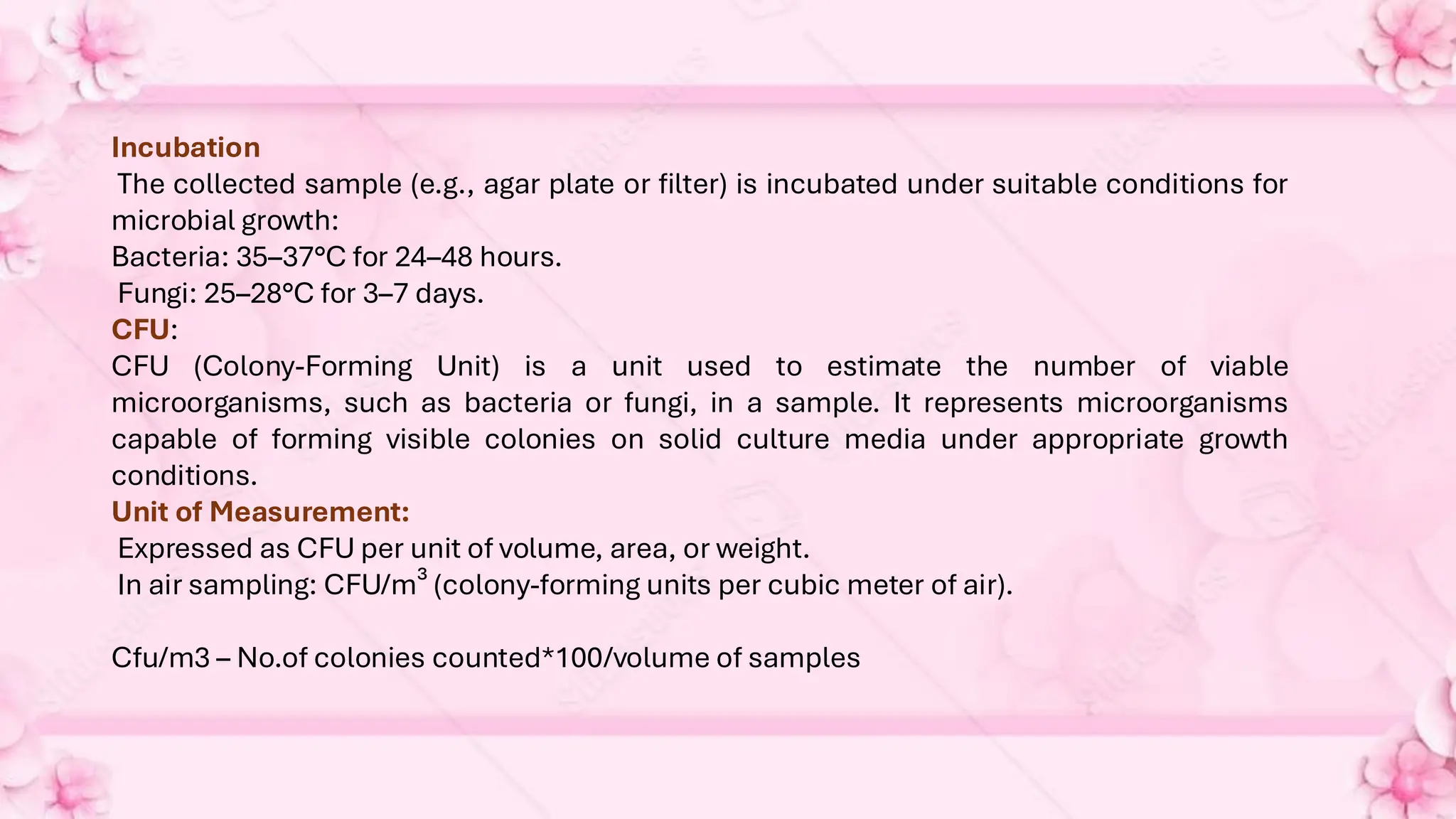
Morphological Examination:
Observe colony characteristics such as size, shape, color, and
texture.
Microscopy:
Perform Gram staining for bacteria or lactophenol cotton blue
staining for fungi.
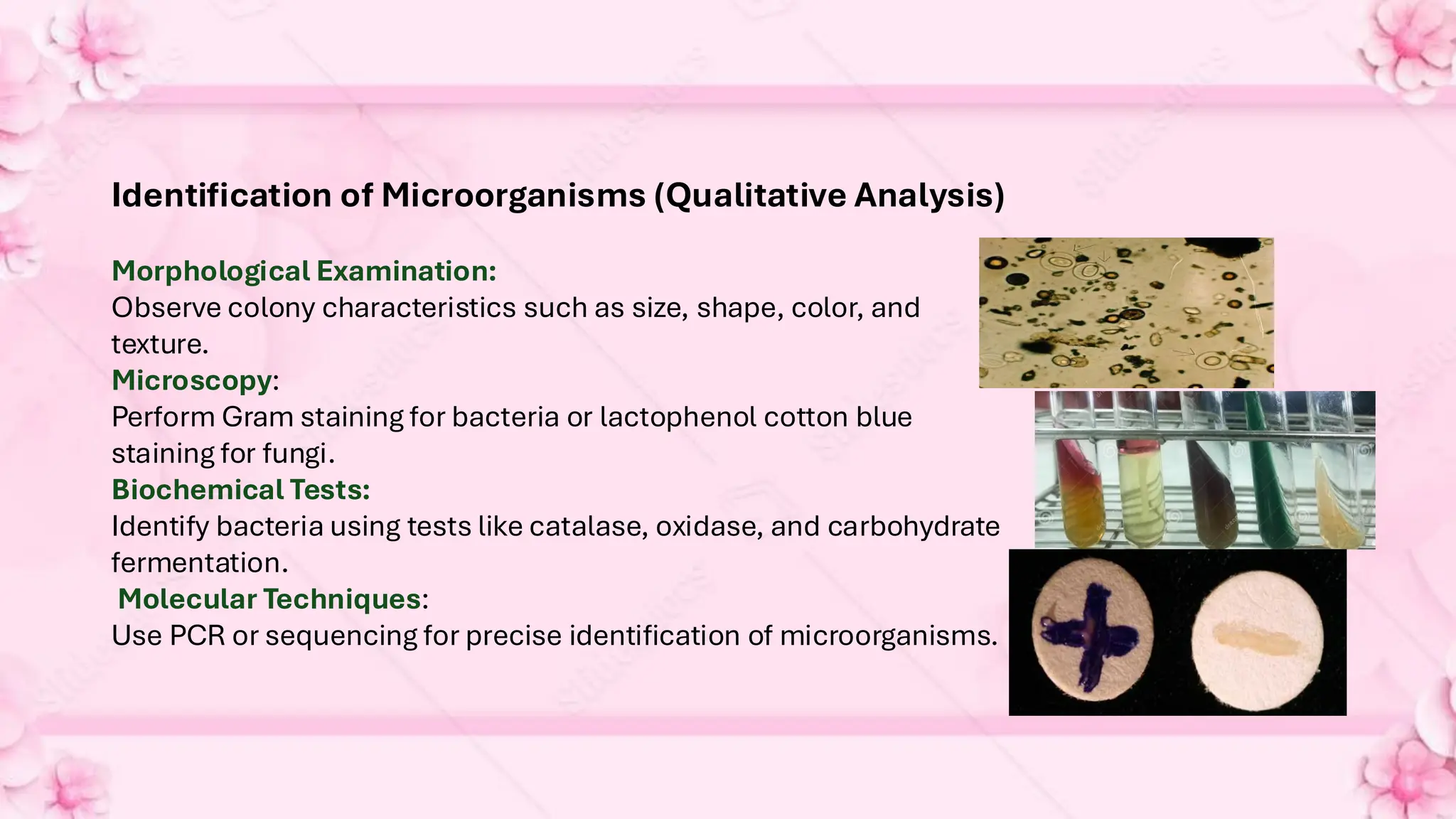
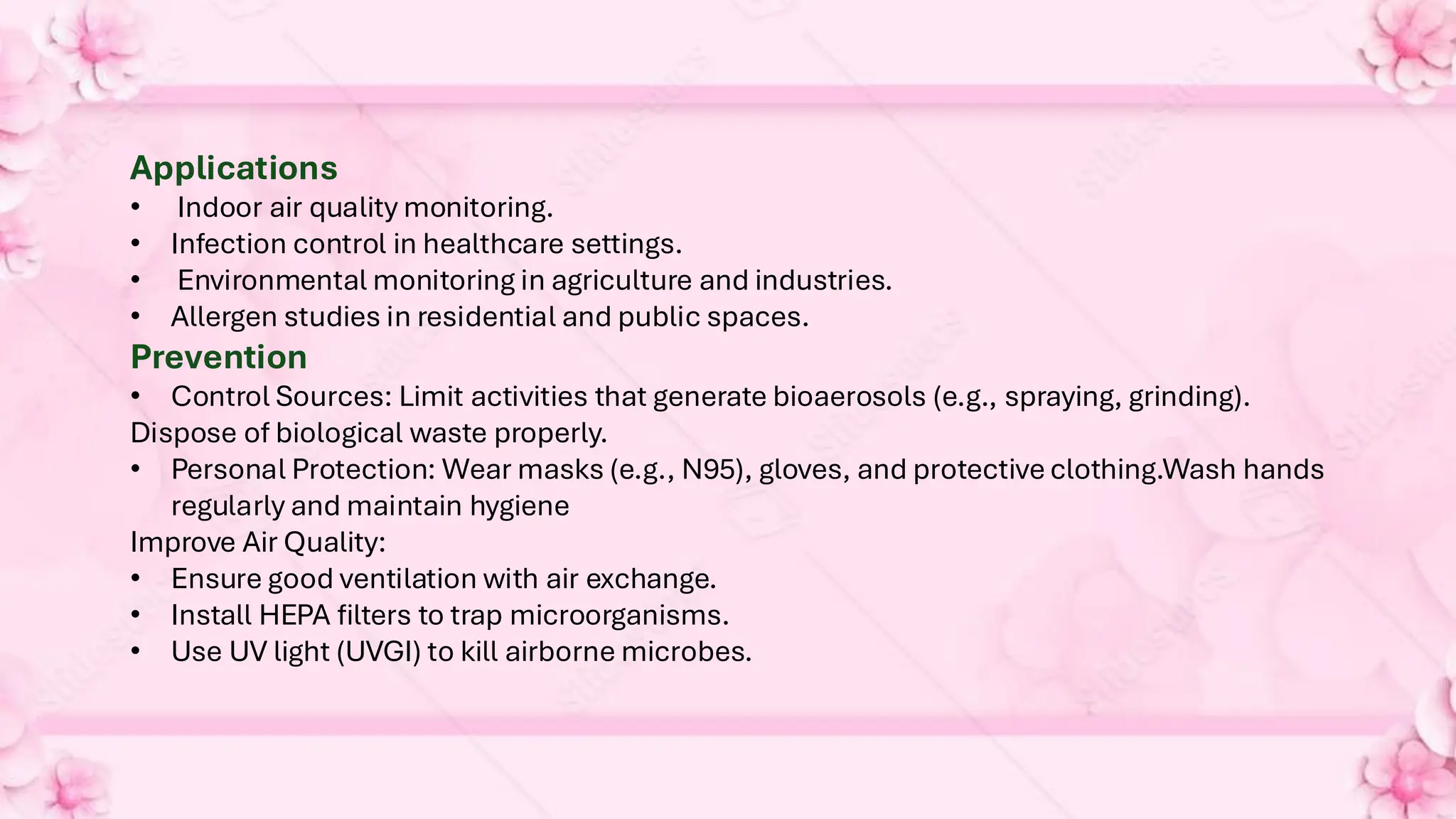
Biochemical Tests:
Identify bacteria using tests like catalase, oxidase, and carbohydrate
fermentation.
Molecular Techniques:
Use PCR or sequencing for precise identification of microorganisms.
Applications
• Indoor air quality monitoring.
• Infection control in healthcare settings.
• Environmental monitoring in agriculture and industries.
• Allergen studies in residential and public spaces.
Prevention
• Control Sources: Limit activities that generate bioaerosols (e.g., spraying, grinding).
Dispose of biological waste properly.
• Personal Protection: Wear masks (e.g., N95), gloves, and protective clothing.Wash hands
regularly and maintain hygiene
Improve Air Quality:
• Ensure good ventilation with air exchange.
• Install HEPA filters to trap microorganisms.
• Use UV light (UVGI) to kill airborne microbes.
Conclusion
Bioaerosol sampling is essential for monitoring airborne microorganisms, ensuring
air quality, and preventing health risks. It enables early detection of contaminants in
environments like healthcare, industries, and agriculture, supporting effective
contamination control and improving overall environmental and occupational
safety. Preventing bioaerosols is crucial for maintaining air quality and safeguarding
health. Effective source control, ventilation, filtration, and hygiene practices reduce
airborne microbial risks
Thank you

Bioaerosol Sampling - Methods Of Analysis

  • 1.
    BIOAEROSOL SAMPLING- METHODOF AIR SAMPLING ANALYSIS PRESENTED BY C.Sujithra M.Sc., Microbiology Vivekananda Arts and Science College for Women Sankagiri,Salem. SUBJECT INCHARGE Dr .V. Bharathi Assistant professor Department of Microbiology DEPARTMENT OF MICROBIOLOGY
  • 2.
    Content • Bioaerosol sampling •Types • Techniques • Air samplers • Method of air sampling analysis • Culture media • CFU • Identification of Air sampling • Application • Prevention • Conclusion
  • 3.
    Bioaerosol Sampling Bioaerosol samplingis the process of collecting airborne biological particles (e.g., bacteria, fungi, viruses, pollen, and allergens) from the air to identify, quantify, and analyze them. It is commonly used in environmental monitoring, public health, industrial hygiene, and indoor air quality studies. Objectives of Bioaerosol Sampling • Assess air quality and microbial contamination. • Monitor airborne pathogens in healthcare or industrial settings. • Investigate disease outbreaks caused by airborne microorganisms. • Ensure compliance with safety and regulatory standards in cleanrooms or food industries.
  • 4.
    Types of Bioaerosol SamplingMethods Active Sampling Air is actively drawn through a device to collect bioaerosols. Examples: impaction, impingement, and filtration methods.
  • 5.
    Passive Sampling Bioaerosol areallowed to settle by gravity onto collection surfaces (e.g., settle plates).
  • 6.
    Techniques for BioaerosolSampling • Impaction Sampling Air is forced through a nozzle or slit, and particles are impacted onto agar plates. Common devices: Andersen air sampler, MAS-100.Suitable for viable (cultivable) microorganisms. • Impinger Sampling Air is bubbled through a liquid medium (e.g., phosphate buffer) that captures microorganisms. Common devices: SKC Biosampler. • Filtration Sampling Air is passed through a filter that traps bioaerosols. Filters are then cultured or analyzed directly. • Gravimetric Sampling (Settle Plates) Petri dishes containing culture media are exposed to air for a set time. Effective for qualitative assessment but lacks quantitative precision. • Cyclone Sampling Uses centrifugal force to separate bioaerosols from the air stream into a collection medium.
  • 7.
    Air samplers Air samplersare devices designed to collect airborne particles, including microorganisms such as bacteria, fungi, and viruses, from the air for qualitative or quantitative analysis. These devices are commonly used to monitor air quality, detect bioaerosols, and ensure compliance with environmental, industrial, and healthcare standards.
  • 8.
    Air Samplers forBioaerosols Air samplers are devices designed to capture bioaerosols. Common types include: • Impaction Samplers Use a high-velocity air stream to force particles onto a culture medium. Examples: Andersen sampler, MAS-100. • Impinger Samplers Trap particles in liquid media (e.g., phosphate buffer). Example: SKC Biosampler. • Filtration Samplers Use filters (e.g., cellulose or HEPA) to collect bioaerosols for subsequent analysis. • Cyclone Samplers Use centrifugal force to separate particles from air. Example: BioSampler. • Gravimetric Samplers Collect bioaerosols by sedimentation onto solid surfaces (e.g., Petri dishes). Example: Settle plates.
  • 9.
    Method of analysis Themethod of analysis of air sampling involves a series of steps to evaluate the microbial content in the air, including sample collection, processing, and identification. Sample Collection Using appropriate air samplers (e.g., impaction, impinger, filtration):Airborne microorganisms are collected onto a medium (agar plate, liquid, or filter).Ensure sterile handling and maintain airflow rates according to sampler specifications Culture Media for Bacteria and Fungi For Bacteria: Tryptic Soy Agar (TSA): Supports a wide range of bacterial growth. MacConkey Agar: For Gram-negative bacteria. For Fungi: Sabouraud Dextrose Agar (SDA): Selective for fungi and yeast. Potato Dextrose Agar (PDA): Supports the growth of molds and yeast.
  • 10.
    Incubation The collected sample(e.g., agar plate or filter) is incubated under suitable conditions for microbial growth: Bacteria: 35–37°C for 24–48 hours. Fungi: 25–28°C for 3–7 days. CFU: CFU (Colony-Forming Unit) is a unit used to estimate the number of viable microorganisms, such as bacteria or fungi, in a sample. It represents microorganisms capable of forming visible colonies on solid culture media under appropriate growth conditions. Unit of Measurement: Expressed as CFU per unit of volume, area, or weight. In air sampling: CFU/m³ (colony-forming units per cubic meter of air). Cfu/m3 – No.of colonies counted*100/volume of samples
  • 11.
    Identification of Microorganisms(Qualitative Analysis) Morphological Examination: Observe colony characteristics such as size, shape, color, and texture. Microscopy: Perform Gram staining for bacteria or lactophenol cotton blue staining for fungi. Biochemical Tests: Identify bacteria using tests like catalase, oxidase, and carbohydrate fermentation. Molecular Techniques: Use PCR or sequencing for precise identification of microorganisms.
  • 12.
    Applications • Indoor airquality monitoring. • Infection control in healthcare settings. • Environmental monitoring in agriculture and industries. • Allergen studies in residential and public spaces. Prevention • Control Sources: Limit activities that generate bioaerosols (e.g., spraying, grinding). Dispose of biological waste properly. • Personal Protection: Wear masks (e.g., N95), gloves, and protective clothing.Wash hands regularly and maintain hygiene Improve Air Quality: • Ensure good ventilation with air exchange. • Install HEPA filters to trap microorganisms. • Use UV light (UVGI) to kill airborne microbes.
  • 13.
    Conclusion Bioaerosol sampling isessential for monitoring airborne microorganisms, ensuring air quality, and preventing health risks. It enables early detection of contaminants in environments like healthcare, industries, and agriculture, supporting effective contamination control and improving overall environmental and occupational safety. Preventing bioaerosols is crucial for maintaining air quality and safeguarding health. Effective source control, ventilation, filtration, and hygiene practices reduce airborne microbial risks
  • 14.