OT STERILITY TESTING
Dr. Nilanjana Mukherjee
MD Microbiology
Dr. V.M.G.M.C. Solapur
BPMT OT NOTES
METHODS
AIR SURVEILLANCE-
1) Settle Plate method
2) Slit sampler method
SURFACE SAMPLING-
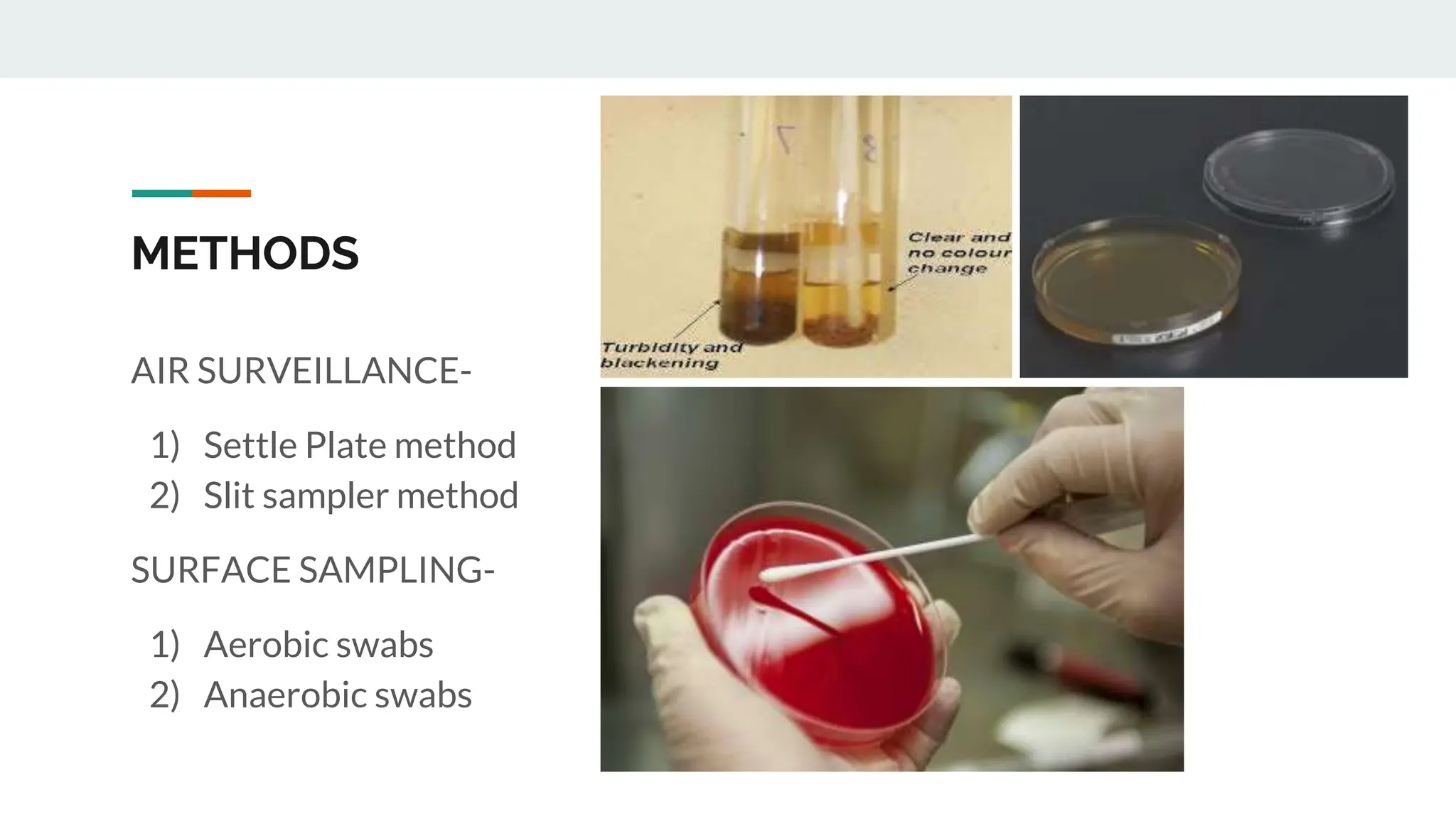
1) Aerobic swabs
2) Anaerobic swabs
AIR SURVEILLANCE
Pre requisites-
- The ventilation system should run continuously for 24 hours before
sampling.
- Single or multiple samples should be collected from each OT.
- Doors should be closed prior and during sampling method.
- Plates should be labelled with sample number, site within theatre, time and
date of sample collection.
SETTLE PLATE METHOD
Record position- Time- Duration
Plates with media as blood agar are exposed for specific period and incubated at
37oC for 24 hours.
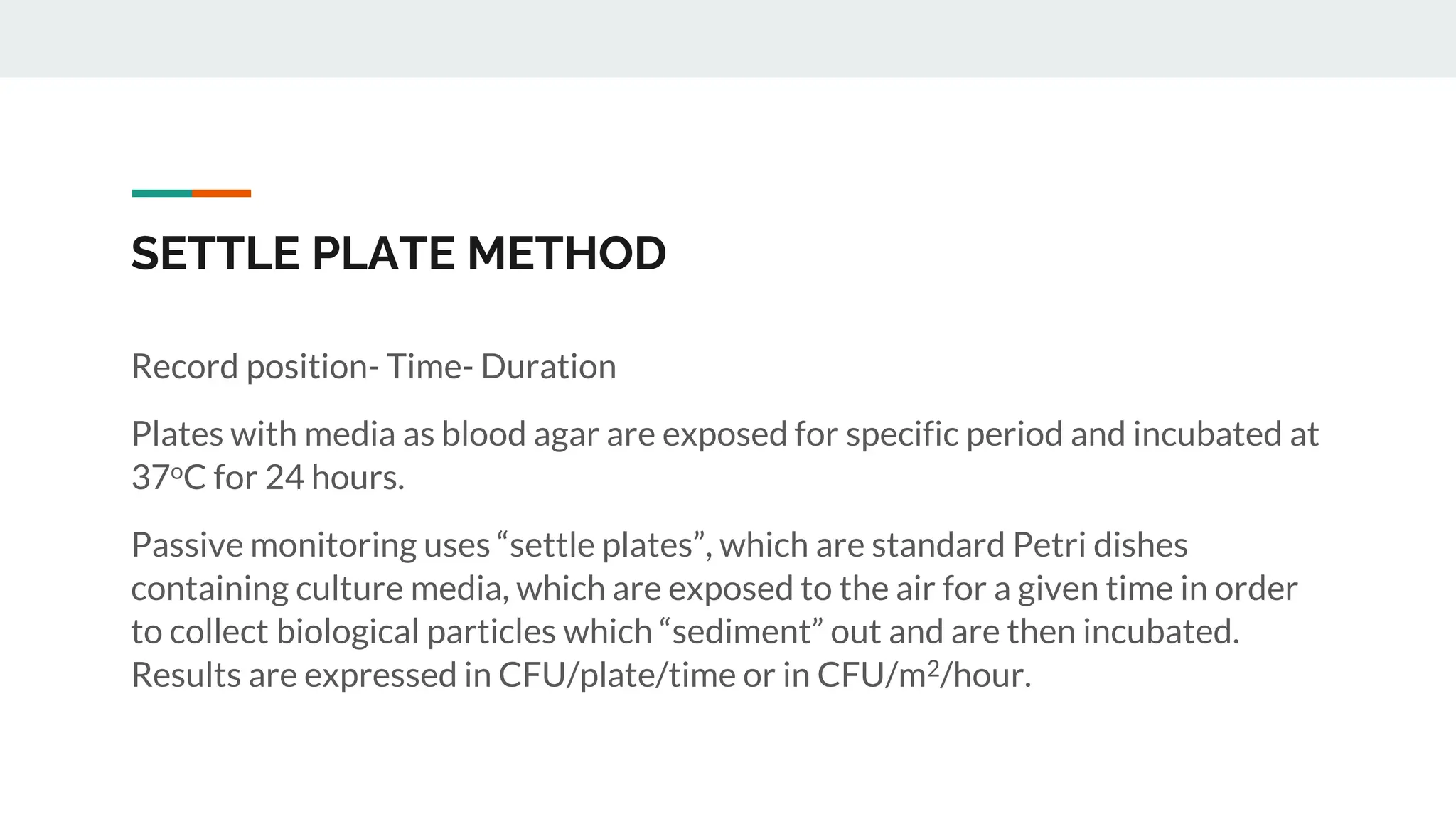
Passive monitoring uses “settle plates”, which are standard Petri dishes
containing culture media, which are exposed to the air for a given time in order
to collect biological particles which “sediment” out and are then incubated.
Results are expressed in CFU/plate/time or in CFU/m2/hour.
PROCEDURE-
❖ The staff should PPE.
❖ Place plates at table/stand height (at least 1 m high)- after
cleaning and fumigation of the OT of which sterility is to
be tested.
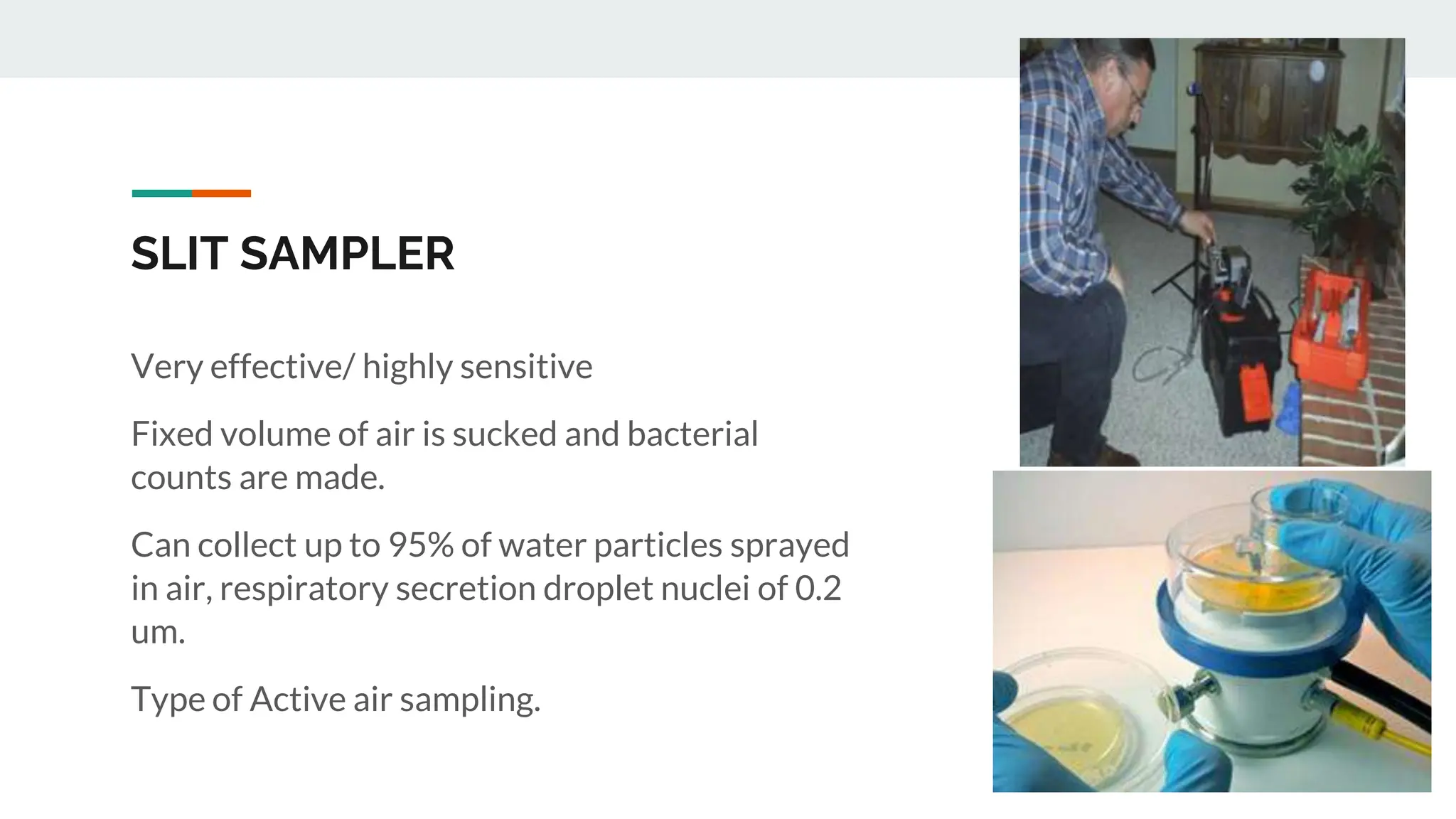
❖ Raise the lids of plates to expose the entire surface of the
medium.
❖ Take care to not put fingers on the plate.
❖ Leave plates exposed for 30 mins to 1 hour in all locations.
❖ Replace lids- transfer plates in protective bags, label them
and relocate to Microbiology department.
❖ Record in log book date and locations of sampling and also
results.
SLIT SAMPLER
Very effective/ highly sensitive
Fixed volume of air is sucked and bacterial
counts are made.
Can collect up to 95% of water particles sprayed
in air, respiratory secretion droplet nuclei of 0.2
um.
Type of Active air sampling.
The sampling equipment will determine the volume of air sampled.
Sampling volume needs to be more than 0.25 m3 (250 L) and optimally
around 1 m 3. (1000 L)
After sampling- remove test strips/ agar plate aseptically and label them to
send for processing.
Air sampler should be kept at the middle of the room of the theatre table at
the height of 1 m and to be secured on a trolley.
Switched on either by remote control or manually before leaving the room.
SURFACE AIR SYSTEM AIR SAMPLER
Pre-sterilized disposable, as well as autoclavable
AISI 316 stainless steel, heads available.
Can have two heads with two media types
simultaneously, such as tryptic soy agar (TSA) for
detection of bacteria & malt extract agar (MEA) for
detection of environmental yeasts, molds, & fungi.
SIGNIFICANT COUNT
Counts vary on-
❖ Number of personnel present in the given area.
❖ Behavior of persons- body movements, disturbance of
clothing.
❖ Nature of procedure, type of operation
❖ Varying ranges
❖ BUT only 1% are pathogenic e.g.- Staphylococcus aureus
❖ Recommended conventional operation theatre values
I. An empty theatre bio load should not exceed 35 CFU/m3.
II. During surgery bio load should not exceed 180 CFU/m3.
SURFACE SAMPLING
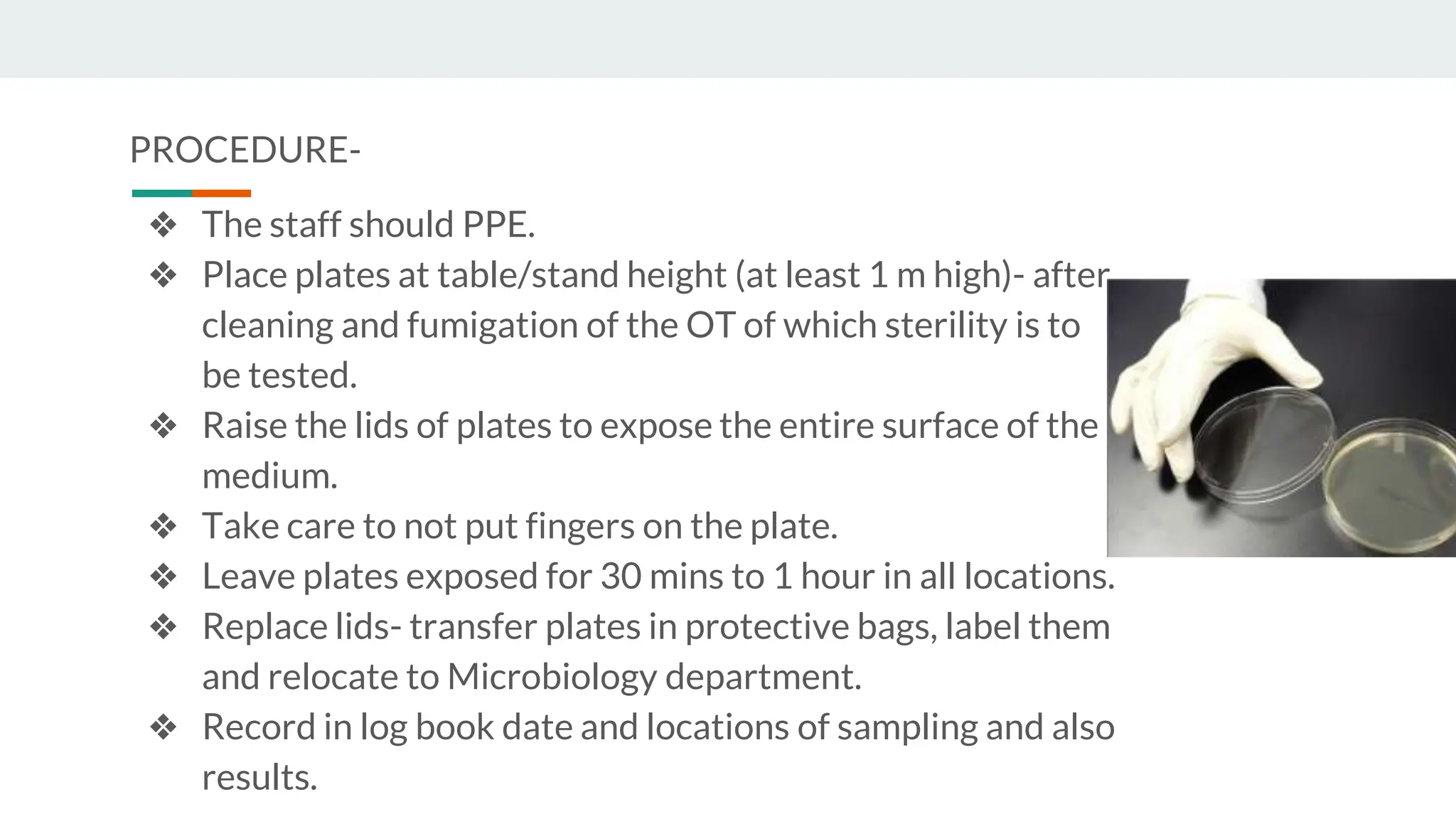
● Moistened sterile cotton swabs in nutrient broth/Normal saline- used to collect samples
from different sites like operation table, autoclaved instruments, drug trolley, walls, floor
and light.
● All samples properly labeled and immediately transported to microbiology laboratory.
● Swabs taken from different sites were inoculated on blood agar & MacConkey agar plates.
● Incubated at 37oC for 18-24 hrs under aerobic conditions.
● After incubation the isolates are identified by colony characteristics, gram stain and
standard biochemical tests.
● Anaerobic swabs- in RCMB ( only for structural changes in OT)
CONCLUSION
Microbial quality of air and surfaces in OT’s may be considered a mirror
image of hygienic conditions of hospital.
Presence of potential pathogens in OT’s, LR’s and SNCU’s can pose a great
risk to patients.
Surveillance of OT’s and other critical care facilities along with infection
control measures is helpful in controlling nosocomial infection.
THANK YOU

OPERATION THEATRE STERILITY TESTING.pptx

  • 1.
    OT STERILITY TESTING Dr.Nilanjana Mukherjee MD Microbiology Dr. V.M.G.M.C. Solapur BPMT OT NOTES
  • 2.
    METHODS AIR SURVEILLANCE- 1) SettlePlate method 2) Slit sampler method SURFACE SAMPLING- 1) Aerobic swabs 2) Anaerobic swabs
  • 3.
    AIR SURVEILLANCE Pre requisites- -The ventilation system should run continuously for 24 hours before sampling. - Single or multiple samples should be collected from each OT. - Doors should be closed prior and during sampling method. - Plates should be labelled with sample number, site within theatre, time and date of sample collection.
  • 4.
    SETTLE PLATE METHOD Recordposition- Time- Duration Plates with media as blood agar are exposed for specific period and incubated at 37oC for 24 hours. Passive monitoring uses “settle plates”, which are standard Petri dishes containing culture media, which are exposed to the air for a given time in order to collect biological particles which “sediment” out and are then incubated. Results are expressed in CFU/plate/time or in CFU/m2/hour.
  • 5.
    PROCEDURE- ❖ The staffshould PPE. ❖ Place plates at table/stand height (at least 1 m high)- after cleaning and fumigation of the OT of which sterility is to be tested. ❖ Raise the lids of plates to expose the entire surface of the medium. ❖ Take care to not put fingers on the plate. ❖ Leave plates exposed for 30 mins to 1 hour in all locations. ❖ Replace lids- transfer plates in protective bags, label them and relocate to Microbiology department. ❖ Record in log book date and locations of sampling and also results.
  • 6.
    SLIT SAMPLER Very effective/highly sensitive Fixed volume of air is sucked and bacterial counts are made. Can collect up to 95% of water particles sprayed in air, respiratory secretion droplet nuclei of 0.2 um. Type of Active air sampling.
  • 7.
    The sampling equipmentwill determine the volume of air sampled. Sampling volume needs to be more than 0.25 m3 (250 L) and optimally around 1 m 3. (1000 L) After sampling- remove test strips/ agar plate aseptically and label them to send for processing. Air sampler should be kept at the middle of the room of the theatre table at the height of 1 m and to be secured on a trolley. Switched on either by remote control or manually before leaving the room.
  • 8.
    SURFACE AIR SYSTEMAIR SAMPLER Pre-sterilized disposable, as well as autoclavable AISI 316 stainless steel, heads available. Can have two heads with two media types simultaneously, such as tryptic soy agar (TSA) for detection of bacteria & malt extract agar (MEA) for detection of environmental yeasts, molds, & fungi.
  • 9.
    SIGNIFICANT COUNT Counts varyon- ❖ Number of personnel present in the given area. ❖ Behavior of persons- body movements, disturbance of clothing. ❖ Nature of procedure, type of operation ❖ Varying ranges ❖ BUT only 1% are pathogenic e.g.- Staphylococcus aureus ❖ Recommended conventional operation theatre values I. An empty theatre bio load should not exceed 35 CFU/m3. II. During surgery bio load should not exceed 180 CFU/m3.
  • 10.
    SURFACE SAMPLING ● Moistenedsterile cotton swabs in nutrient broth/Normal saline- used to collect samples from different sites like operation table, autoclaved instruments, drug trolley, walls, floor and light. ● All samples properly labeled and immediately transported to microbiology laboratory. ● Swabs taken from different sites were inoculated on blood agar & MacConkey agar plates. ● Incubated at 37oC for 18-24 hrs under aerobic conditions. ● After incubation the isolates are identified by colony characteristics, gram stain and standard biochemical tests. ● Anaerobic swabs- in RCMB ( only for structural changes in OT)
  • 11.
    CONCLUSION Microbial quality ofair and surfaces in OT’s may be considered a mirror image of hygienic conditions of hospital. Presence of potential pathogens in OT’s, LR’s and SNCU’s can pose a great risk to patients. Surveillance of OT’s and other critical care facilities along with infection control measures is helpful in controlling nosocomial infection.
  • 12.