






Developing and Assessing
Self-regulated Learning
Dr. Carlo Magno
Professor of Educational Psychology
De La Salle University, Manila
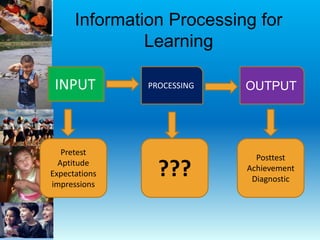
Information Processing for
Learning
INPUT OUTPUTPROCESSING
Pretest
Aptitude
Expectations
impressions
Posttest
Achievement
Diagnostic
???
The Case of JP
JP is a high school student who often
gets low grades. He doesn’t seem to
be bothered in failing quizzes. He
does not submit assignments,
projects, and other requirements
unless the teacher forces him to. He
doesn’t listen during class sessions,
do not participate in class, and do not
make drills and assignments. He
doesn’t believe that the school will
The Case of Sheena
Sheena listens every time the class is
discussing, she takes down notes,
and summarizes the things she
learned at the end of her classes.
She make sure that she reads the
necessary materials the teachers
assigns. She comes to school
prepared with complete assignments.
She is punctual in submitting her
projects. She recites and diligently
answers exercises and drills
conducted in class.
Analysis
What is the difference between JP
and Sheena?
Who would you want as a student?
Why?
How can you help JP?
Problems of students in
class:
Miss assignments
Inattentive during lectures
Volatile during class activities
Fails to recall instructions taught in
the classroom
Fails in exams
Submits poor work
Not submitting any work
at all!
Characteristics of Self-
regulated Learners (SRL)
Independent learners
Ability to control their learning
Focused in their studies
Plans and studies in advance to prepare
for tests, quizzes, exams etc.
Uses effective strategies to recall
instruction and information
Have superior motivation
Have adaptive learning methods
Views their future optimistically
Self-regulation
Defined by Zimmerman (2005) as
“self-generated thoughts, feelings,
and actions that are planned and
cyclically adapted to the attainment of
personal goals” (p. 14).
“a self-directive process by which
learners transform their mental
abilities into academic skills” (p. 65).
Components of SRL
(a) Setting specific proximal goals for
oneself
(b) Adopting powerful strategies for
attaining the goals
(c) Monitoring one's performance
selectively for signs of progress
(d) Restructuring one's physical and
social context to make it compatible with
one's goals
(e) Managing one's time use efficiently
(f) Self-evaluating one's methods
(g) Attributing causation to results
Outcomes of SRL (1)
Self-regulated learners turn out to
perform well in school related tasks
Learners who self-regulate have
increased self –efficacy or beliefs in
one’s ability to execute actions (see
Bandura & Schunk, 1981; Schunk,
1981; Schunk, 1983; 1984).
Self-regulated learners are more
motivated (see Fiske & Taylor, 1991;
Corno & Mandinach, 1983)
Outcomes of SRL (2)
Specifically, for the Filipino adolescent,
students’ who see the consequence of
their actions and those who structure
their environment for study showed to
be more mastery oriented (developing
competency and gaining understanding)
(see Magno & Lajom, 2008).
In a developmental perspective, all
components of self-regulation increased
from high school to college students
(Magno & Lajom, 2008).
Models of Self-regulation
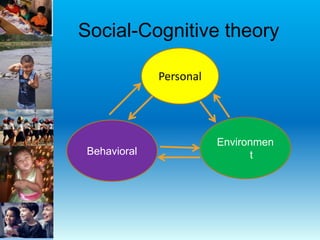
Social-cognitive theory (Bandura,
1986)
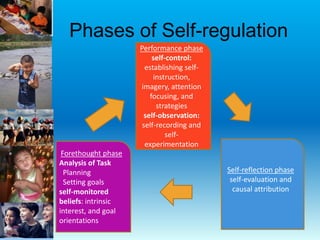
Phases of Self-regulation
(Zimmerman, 2002)
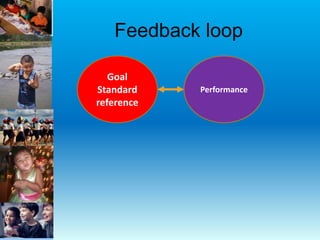
Self-regulation as a feedback loop
(Craver & Scheir, 2005)
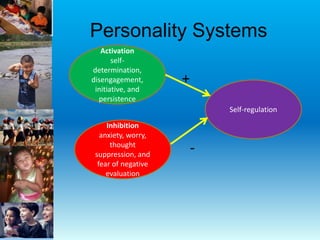
Personality systems perspective
Metacognition, motivation, and
strategy (Winne, 1995; 1997)
Social-Cognitive theory
Personal
Behavioral
Environmen
t
Phases of Self-regulation
Forethought phase
Analysis of Task
Planning
Setting goals
self-monitored
beliefs: intrinsic
interest, and goal
orientations
Performance phase
self-control:
establishing self-
instruction,
imagery, attention
focusing, and
strategies
self-observation:
self-recording and
self-
experimentation
Self-reflection phase
self-evaluation and
causal attribution
Feedback loop
Goal
Standard
reference
Performance
Personality Systems
Activation
self-
determination,
disengagement,
initiative, and
persistence
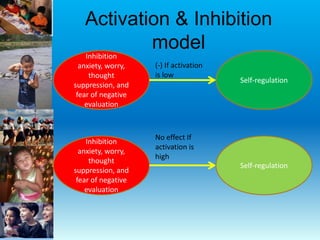
Inhibition
anxiety, worry,
thought
suppression, and
fear of negative
evaluation
Self-regulation
+
-
Activation & Inhibition
model
Inhibition
anxiety, worry,
thought
suppression, and
fear of negative
evaluation
Self-regulation
(-) If activation
is low
Inhibition
anxiety, worry,
thought
suppression, and
fear of negative
evaluation
Self-regulation
No effect If
activation is
high
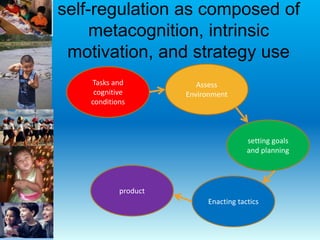
self-regulation as composed of
metacognition, intrinsic
motivation, and strategy use
Tasks and
cognitive
conditions
Assess
Environment
setting goals
and planning
Enacting tactics
product
How to train students to be
SR?
Self-regulated learning can be taught
to students
Why Assess Self-regulated
Learning in Schools?
Most schools base major decisions
and classroom interventions on
results of achievement, aptitude, and
diagnostic tests that are based on
ability of students.
Most assessment of learning is
focused as an outcome and not as a
process.
Most of the assessment is focused on
ability as a construct and not on
certain cognitive and strategic
processes of students thinking.
Protocols in Assessing SRL
Questionnaires
Structured interview
Teacher judgment
Think aloud techniques
Error detection tasks
Observation of performance
Questionnaires
Self-regulation questionnaires are composed
of a set of a sample items that are responded
numerically.
The items are classified under certain factors
of self-regulation.
A score is derived per factors and interpreted
whether it is above or below norms.
Examples:
Learning and Study Strategies Inventory (LASSI)
(Weinstein, 1987),
Motivated Strategies for Learning Questionnaire
(MSLQ) (Pintrich, Smith, Garcia, & McKeachie,
1991),
Metacognitive Strategies Inventory (MAI) (Scraw
& Dennison, 1994)
The Academic Self-regulated
Learning Scale (A-SRL-S)
seven subscales: Memory strategy,
goal-setting, self-evaluation, seeking
assistance, environmental structuring,
responsibility, and organizing.
confirmed in a measurement model with
good fit (RMR=.02, GFI=.94, CFI=.91)
Convergent validity was also
established where all factors increase
with each other
The items also showed adequate fit
using the one-parameter Rasch model
with acceptable item characteristic
curves (ICC’s).
A-SRL-S
Subscales M Varian
ce
Cronba
ch’s
Alpha
No.
of
item
s
CFA
Standardi
zed
Paramete
r
estimate
Person
Reliabi
lity
Item
Reliabi
lity
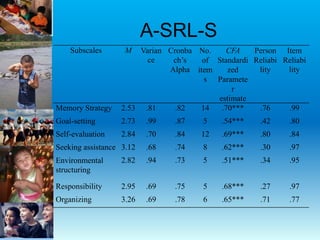
Memory Strategy 2.53 .81 .82 14 .70*** .76 .99
Goal-setting 2.73 .99 .87 5 .54*** .42 .80
Self-evaluation 2.84 .70 .84 12 .69*** .80 .84
Seeking assistance 3.12 .68 .74 8 .62*** .30 .97
Environmental
structuring
2.82 .94 .73 5 .51*** .34 .95
Responsibility 2.95 .69 .75 5 .68*** .27 .97
Organizing 3.26 .69 .78 6 .65*** .71 .77
Convergent Validity of the
Subscales of the A-SRL-S
(1) (2) (3) (4) (5) (6) (7)
(1)
Goal-setting ---
(2)
Memory Strategy 0.52*** ---
(3)
Self-evaluation 0.32***
0.55
*** ---
(4)
Seeking Assistance 0.27***
0.39
*** 0.49*** ---
(5)
Environmental
Structuring 0.25***
0.27
*** 0.35***
0.31
*** ---
(6)
Responsibility 0.28***
0.43
*** 0.48***
0.44
***
0.41
*** ---
(7)
Organizing 0.42***
0.43
*** 0.35***
0.41
***
0.38
***
0.51
*** ---
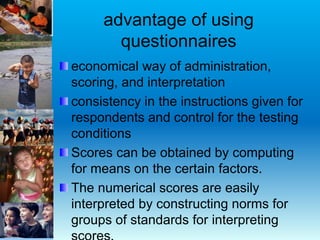
advantage of using
questionnaires
economical way of administration,
scoring, and interpretation
consistency in the instructions given for
respondents and control for the testing
conditions
Scores can be obtained by computing
for means on the certain factors.
The numerical scores are easily
interpreted by constructing norms for
groups of standards for interpreting
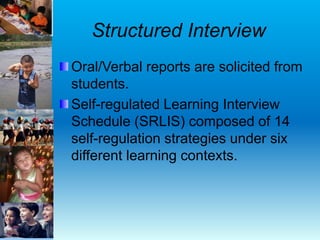
Structured Interview
Oral/Verbal reports are solicited from
students.
Self-regulated Learning Interview
Schedule (SRLIS) composed of 14
self-regulation strategies under six
different learning contexts.
Adapted SRLIS for Filipino
College Students
Self-regulation
Component
Prompt
Rehearsing and
memorizing
Assume your teacher is discussing with your class the history
of the Philippine revolution. Your teacher says that you will
be tested on the topic the next day. What method do you use
to help you learn and remember the information being
discussed?
Organizing and
transforming
Assume your teacher asked your class to write a short paper
on a topic on the history of the organization in school that
you belong to. Your score on this paper will affect your
course card grade. In such cases, what method in particular
will help you plan and write your paper?
Seeking information Teachers usually expect much accuracy with students’ math
home work. Many of these assignments must be completed
without the help of the teacher. What particular method do
you use when you don’t understand a math problem when
you’re already at home?
Self-evaluation When completing homework assignments such as science
reports or English grammar exercises, what method do you
use in particular for checking your work after it is finished?
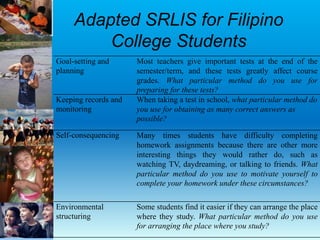
Adapted SRLIS for Filipino
College Students
Goal-setting and
planning
Most teachers give important tests at the end of the
semester/term, and these tests greatly affect course
grades. What particular method do you use for
preparing for these tests?
Keeping records and
monitoring
When taking a test in school, what particular method do
you use for obtaining as many correct answers as
possible?
Self-consequencing Many times students have difficulty completing
homework assignments because there are other more
interesting things they would rather do, such as
watching TV, daydreaming, or talking to friends. What
particular method do you use to motivate yourself to
complete your homework under these circumstances?
Environmental
structuring
Some students find it easier if they can arrange the place
where they study. What particular method do you use
for arranging the place where you study?
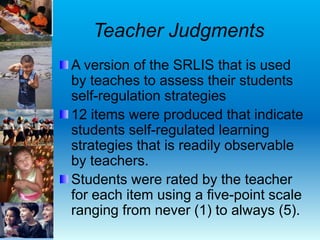
Teacher Judgments
A version of the SRLIS that is used
by teaches to assess their students
self-regulation strategies
12 items were produced that indicate
students self-regulated learning
strategies that is readily observable
by teachers.
Students were rated by the teacher
for each item using a five-point scale
ranging from never (1) to always (5).
Advantages
Teacher’s judgment about students’
self-regulation strategies can be very
accurate if they are trained to be
observant of students’ behavior.
Teachers can look at several
situations where self-regulation can
occur such as during drills, seat
works, group works, tests, recitations,
and even during class discussion.
Think aloud techniques
Students report their thoughts and
cognitive processes while performing a
task (Erricson, 2006)
1. Why do you think it is correct?
2. It is easy for you? Why?
3. What made it difficult?
4. Do you think you can solve it using
another technique?
5. How accurate are you with your
answer?
6. Is it easy to work with others or
better if alone?
Advantages
Think aloud does not limit students of
their response on a task.
The teacher can detect multiple signs
of self-regulation strategies the
students are engaging in. This can
help teachers by creating tasks that
would enrich students to develop
further their self-regulation skills.
Error Detection Tasks
Error detection tasks are created to
assess students’ ability to monitor their
performance and evaluate the material
exposed to.
The ability to detect errors is a means
that a student can exercise
metacognitive control because they
should have the ability to correct errors
after identifying them.
Error detection can be done by
providing an evaluation of errors
conducted.
Another technique is by underlining
specific spots where the error occurred.
Error Detection Tasks
The ability to detect errors is a sign
that students have mastered the
lesson and have developed
evaluation and monitoring skills.
Trace Methodologies
Traces are observable indicators
about cognition that students create
as they engage with a task (Winne,
1982).
Traces of student self-regulation can
be assessed by looking at their
underlines on texts, highlights on
particular information in a text, write
notes in the margin of reading
materials, and writes mnemonic
Trace Methodologies
Isolating information from the rest of
the material that they see as
important.
Cues for students to easily locate and
remember needed information.
Notes on the margin provide students
the needed cue to easily comprehend
their method of studying the material.
Some notes may also signal specific
strategies they use to remember
important points of the material.
Observation of performance
The teacher can create specific
classroom scenarios and activities that
tap self-regulation.
During these tasks the teacher notes
students’ behavior that may indicate
self-regulation.
Some students are asked how they
arrived with their answer, what
technique did they use to remember
information easily, what strategy was
used to understand the problem.
How do you make SRL work?
“Self-regulation needs effort, will,
choice, and desire in order to make it
effective and valuable.”

Assessing Self-regualtion

  • 1.
    Developing and Assessing Self-regulatedLearning Dr. Carlo Magno Professor of Educational Psychology De La Salle University, Manila
  • 2.
    Information Processing for Learning INPUTOUTPUTPROCESSING Pretest Aptitude Expectations impressions Posttest Achievement Diagnostic ???
  • 3.
    The Case ofJP JP is a high school student who often gets low grades. He doesn’t seem to be bothered in failing quizzes. He does not submit assignments, projects, and other requirements unless the teacher forces him to. He doesn’t listen during class sessions, do not participate in class, and do not make drills and assignments. He doesn’t believe that the school will
  • 4.
    The Case ofSheena Sheena listens every time the class is discussing, she takes down notes, and summarizes the things she learned at the end of her classes. She make sure that she reads the necessary materials the teachers assigns. She comes to school prepared with complete assignments. She is punctual in submitting her projects. She recites and diligently answers exercises and drills conducted in class.
  • 5.
    Analysis What is thedifference between JP and Sheena? Who would you want as a student? Why? How can you help JP?
  • 6.
    Problems of studentsin class: Miss assignments Inattentive during lectures Volatile during class activities Fails to recall instructions taught in the classroom Fails in exams Submits poor work Not submitting any work at all!
  • 7.
    Characteristics of Self- regulatedLearners (SRL) Independent learners Ability to control their learning Focused in their studies Plans and studies in advance to prepare for tests, quizzes, exams etc. Uses effective strategies to recall instruction and information Have superior motivation Have adaptive learning methods Views their future optimistically
  • 8.
    Self-regulation Defined by Zimmerman(2005) as “self-generated thoughts, feelings, and actions that are planned and cyclically adapted to the attainment of personal goals” (p. 14). “a self-directive process by which learners transform their mental abilities into academic skills” (p. 65).
  • 9.
    Components of SRL (a)Setting specific proximal goals for oneself (b) Adopting powerful strategies for attaining the goals (c) Monitoring one's performance selectively for signs of progress (d) Restructuring one's physical and social context to make it compatible with one's goals (e) Managing one's time use efficiently (f) Self-evaluating one's methods (g) Attributing causation to results
  • 10.
    Outcomes of SRL(1) Self-regulated learners turn out to perform well in school related tasks Learners who self-regulate have increased self –efficacy or beliefs in one’s ability to execute actions (see Bandura & Schunk, 1981; Schunk, 1981; Schunk, 1983; 1984). Self-regulated learners are more motivated (see Fiske & Taylor, 1991; Corno & Mandinach, 1983)
  • 11.
    Outcomes of SRL(2) Specifically, for the Filipino adolescent, students’ who see the consequence of their actions and those who structure their environment for study showed to be more mastery oriented (developing competency and gaining understanding) (see Magno & Lajom, 2008). In a developmental perspective, all components of self-regulation increased from high school to college students (Magno & Lajom, 2008).
  • 12.
    Models of Self-regulation Social-cognitivetheory (Bandura, 1986) Phases of Self-regulation (Zimmerman, 2002) Self-regulation as a feedback loop (Craver & Scheir, 2005) Personality systems perspective Metacognition, motivation, and strategy (Winne, 1995; 1997)
  • 13.
  • 14.
    Phases of Self-regulation Forethoughtphase Analysis of Task Planning Setting goals self-monitored beliefs: intrinsic interest, and goal orientations Performance phase self-control: establishing self- instruction, imagery, attention focusing, and strategies self-observation: self-recording and self- experimentation Self-reflection phase self-evaluation and causal attribution
  • 15.
  • 16.
    Personality Systems Activation self- determination, disengagement, initiative, and persistence Inhibition anxiety,worry, thought suppression, and fear of negative evaluation Self-regulation + -
  • 17.
    Activation & Inhibition model Inhibition anxiety,worry, thought suppression, and fear of negative evaluation Self-regulation (-) If activation is low Inhibition anxiety, worry, thought suppression, and fear of negative evaluation Self-regulation No effect If activation is high
  • 18.
    self-regulation as composedof metacognition, intrinsic motivation, and strategy use Tasks and cognitive conditions Assess Environment setting goals and planning Enacting tactics product
  • 19.
    How to trainstudents to be SR? Self-regulated learning can be taught to students
  • 20.
    Why Assess Self-regulated Learningin Schools? Most schools base major decisions and classroom interventions on results of achievement, aptitude, and diagnostic tests that are based on ability of students. Most assessment of learning is focused as an outcome and not as a process. Most of the assessment is focused on ability as a construct and not on certain cognitive and strategic processes of students thinking.
  • 21.
    Protocols in AssessingSRL Questionnaires Structured interview Teacher judgment Think aloud techniques Error detection tasks Observation of performance
  • 22.
    Questionnaires Self-regulation questionnaires arecomposed of a set of a sample items that are responded numerically. The items are classified under certain factors of self-regulation. A score is derived per factors and interpreted whether it is above or below norms. Examples: Learning and Study Strategies Inventory (LASSI) (Weinstein, 1987), Motivated Strategies for Learning Questionnaire (MSLQ) (Pintrich, Smith, Garcia, & McKeachie, 1991), Metacognitive Strategies Inventory (MAI) (Scraw & Dennison, 1994)
  • 23.
    The Academic Self-regulated LearningScale (A-SRL-S) seven subscales: Memory strategy, goal-setting, self-evaluation, seeking assistance, environmental structuring, responsibility, and organizing. confirmed in a measurement model with good fit (RMR=.02, GFI=.94, CFI=.91) Convergent validity was also established where all factors increase with each other The items also showed adequate fit using the one-parameter Rasch model with acceptable item characteristic curves (ICC’s).
  • 24.
    A-SRL-S Subscales M Varian ce Cronba ch’s Alpha No. of item s CFA Standardi zed Paramete r estimate Person Reliabi lity Item Reliabi lity MemoryStrategy 2.53 .81 .82 14 .70*** .76 .99 Goal-setting 2.73 .99 .87 5 .54*** .42 .80 Self-evaluation 2.84 .70 .84 12 .69*** .80 .84 Seeking assistance 3.12 .68 .74 8 .62*** .30 .97 Environmental structuring 2.82 .94 .73 5 .51*** .34 .95 Responsibility 2.95 .69 .75 5 .68*** .27 .97 Organizing 3.26 .69 .78 6 .65*** .71 .77
  • 25.
    Convergent Validity ofthe Subscales of the A-SRL-S (1) (2) (3) (4) (5) (6) (7) (1) Goal-setting --- (2) Memory Strategy 0.52*** --- (3) Self-evaluation 0.32*** 0.55 *** --- (4) Seeking Assistance 0.27*** 0.39 *** 0.49*** --- (5) Environmental Structuring 0.25*** 0.27 *** 0.35*** 0.31 *** --- (6) Responsibility 0.28*** 0.43 *** 0.48*** 0.44 *** 0.41 *** --- (7) Organizing 0.42*** 0.43 *** 0.35*** 0.41 *** 0.38 *** 0.51 *** ---
  • 26.
    advantage of using questionnaires economicalway of administration, scoring, and interpretation consistency in the instructions given for respondents and control for the testing conditions Scores can be obtained by computing for means on the certain factors. The numerical scores are easily interpreted by constructing norms for groups of standards for interpreting
  • 27.
    Structured Interview Oral/Verbal reportsare solicited from students. Self-regulated Learning Interview Schedule (SRLIS) composed of 14 self-regulation strategies under six different learning contexts.
  • 28.
    Adapted SRLIS forFilipino College Students Self-regulation Component Prompt Rehearsing and memorizing Assume your teacher is discussing with your class the history of the Philippine revolution. Your teacher says that you will be tested on the topic the next day. What method do you use to help you learn and remember the information being discussed? Organizing and transforming Assume your teacher asked your class to write a short paper on a topic on the history of the organization in school that you belong to. Your score on this paper will affect your course card grade. In such cases, what method in particular will help you plan and write your paper? Seeking information Teachers usually expect much accuracy with students’ math home work. Many of these assignments must be completed without the help of the teacher. What particular method do you use when you don’t understand a math problem when you’re already at home? Self-evaluation When completing homework assignments such as science reports or English grammar exercises, what method do you use in particular for checking your work after it is finished?
  • 29.
    Adapted SRLIS forFilipino College Students Goal-setting and planning Most teachers give important tests at the end of the semester/term, and these tests greatly affect course grades. What particular method do you use for preparing for these tests? Keeping records and monitoring When taking a test in school, what particular method do you use for obtaining as many correct answers as possible? Self-consequencing Many times students have difficulty completing homework assignments because there are other more interesting things they would rather do, such as watching TV, daydreaming, or talking to friends. What particular method do you use to motivate yourself to complete your homework under these circumstances? Environmental structuring Some students find it easier if they can arrange the place where they study. What particular method do you use for arranging the place where you study?
  • 30.
    Teacher Judgments A versionof the SRLIS that is used by teaches to assess their students self-regulation strategies 12 items were produced that indicate students self-regulated learning strategies that is readily observable by teachers. Students were rated by the teacher for each item using a five-point scale ranging from never (1) to always (5).
  • 31.
    Advantages Teacher’s judgment aboutstudents’ self-regulation strategies can be very accurate if they are trained to be observant of students’ behavior. Teachers can look at several situations where self-regulation can occur such as during drills, seat works, group works, tests, recitations, and even during class discussion.
  • 32.
    Think aloud techniques Studentsreport their thoughts and cognitive processes while performing a task (Erricson, 2006) 1. Why do you think it is correct? 2. It is easy for you? Why? 3. What made it difficult? 4. Do you think you can solve it using another technique? 5. How accurate are you with your answer? 6. Is it easy to work with others or better if alone?
  • 33.
    Advantages Think aloud doesnot limit students of their response on a task. The teacher can detect multiple signs of self-regulation strategies the students are engaging in. This can help teachers by creating tasks that would enrich students to develop further their self-regulation skills.
  • 34.
    Error Detection Tasks Errordetection tasks are created to assess students’ ability to monitor their performance and evaluate the material exposed to. The ability to detect errors is a means that a student can exercise metacognitive control because they should have the ability to correct errors after identifying them. Error detection can be done by providing an evaluation of errors conducted. Another technique is by underlining specific spots where the error occurred.
  • 35.
    Error Detection Tasks Theability to detect errors is a sign that students have mastered the lesson and have developed evaluation and monitoring skills.
  • 36.
    Trace Methodologies Traces areobservable indicators about cognition that students create as they engage with a task (Winne, 1982). Traces of student self-regulation can be assessed by looking at their underlines on texts, highlights on particular information in a text, write notes in the margin of reading materials, and writes mnemonic
  • 37.
    Trace Methodologies Isolating informationfrom the rest of the material that they see as important. Cues for students to easily locate and remember needed information. Notes on the margin provide students the needed cue to easily comprehend their method of studying the material. Some notes may also signal specific strategies they use to remember important points of the material.
  • 38.
    Observation of performance Theteacher can create specific classroom scenarios and activities that tap self-regulation. During these tasks the teacher notes students’ behavior that may indicate self-regulation. Some students are asked how they arrived with their answer, what technique did they use to remember information easily, what strategy was used to understand the problem.
  • 39.
    How do youmake SRL work? “Self-regulation needs effort, will, choice, and desire in order to make it effective and valuable.”