


(META)COGNITIVE PERSPECTIVE
SELF-REGULATED LEARNING
Jonna Malmberg
Learning and Educational Technology Research Unit
(LET)
WHO AM I?
• Post-Doc Researcher.
• Self-regulated learning (SRL) and socially shared
regulation of learning (SSRL)  (Meta)Cognitive
aspects
– How to identify challenges that require SRL?
– How is the students task understanding related to
the students stratgic learning in various task
types?
• Technology is used as a method to collect process
data of the students learning.
WHO ARE YOU?
• Introduce your self
• Explain shortly
- What is the purpose of this course
COURSE TASK
1. Collaborative group work: SRL (mind map)
2. During the presentation EXTEND your mind map about
what you have just learned
3. After – prepare to explain (5 min max) what you have
just learned about SRL
4. Example of ADDRESS research design – How to
support self-regulated learning in practise.
• How could you self-regulate your own learning?
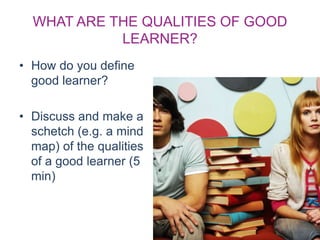
WHAT ARE THE QUALITIES OF GOOD
LEARNER?
• How do you define
good learner?
• Discuss and make a
schetch (e.g. a mind
map) of the qualities
of a good learner (5
min)
SELF-REGULATED LEARNER
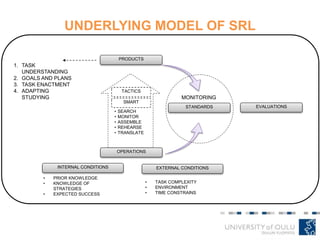
• Capable of taking charge of their own learning:
• Recognizes own strengths and weaknesses in
various learning situations.
– Knowledge of different strategies that can aid
meaningful learning
– Motivated to use these strategies in order to
reach learning goal
– Can use these strategies depending on the
learning situation.
Zimmermann, 2001; Winne & Perry,
2001
WHAT IS SELF-REGULATED
LEARNING?
• Active and proactive learning
• Process of learning to monitor, evaluate, and regulate (or
change) your own
– Learning and thinking (e.g. remember textbook)
– Motivation (e.g. feeling inspired or interested)
– Behaviour (e.g. getting organized, getting started)
• Lifelong process that you develop and refine over time
• CAN BE TEACHED AND LEARNED
WHAT IS SELF-REGULATED
LEARNING?
• Task understanding and goal setting
• Planning
• Enacting strategies
• Evaluating
• Cyclical process whereby students regulate their
efforts to optimize cognitive, motivational and
behavioural processes, guided by their learning
goals and the contextual features of the
environment (Pintrich, 2000; Zimmerman, 1998).
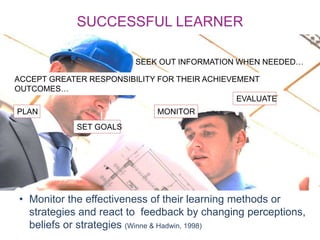
SUCCESSFUL LEARNER
• Monitor the effectiveness of their learning methods or
strategies and react to feedback by changing perceptions,
beliefs or strategies (Winne & Hadwin, 1998)
SEEK OUT INFORMATION WHEN NEEDED…
ACCEPT GREATER RESPONSIBILITY FOR THEIR ACHIEVEMENT
OUTCOMES…
PLAN
SET GOALS
MONITOR
EVALUATE
A BIT LIKE CONDUCTING
EXPERIMENTS ABOUT
YOUR LEARNING
• Identify a problem
• Set goals
• Make plans and set procedures
• Collect data about how things are going
• Compare findings to original goals
• Based on your findings you make
changes to the goals, plans or strategies
WHY IT IS IMPORTANT TO SELF-
REGULATE LEARNING?
• Improved learning outcomes!
Why?
Awareness of strengths and weaknesses
– What strategies I can use to bridge the caps between
ability and task demands?
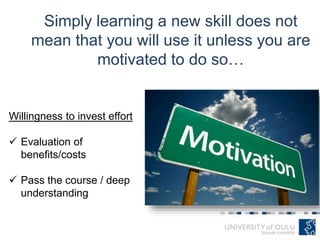
Simply learning a new skill does not
mean that you will use it unless you are
motivated to do so…
Willingness to invest effort
 Evaluation of
benefits/costs
 Pass the course / deep
understanding
How do Motivation and Cognition regulation
work in conjuction?
• In the context of collaborative learning succesful
regulation of motivation enables the learners to
proceed with the task (cognitive regulation)
(Malmberg, Järvelä, Järvenoja & Panadero, 2015).
• It is not clear theoretically how to combine
(metacognitive) and motivation/emotions in a
unified theory of SRL (e.g. Eliahy & Linnenbrink – Garcia, 2013)
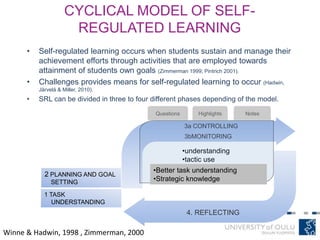
CYCLICAL MODEL OF SELF-
REGULATED LEARNING
• Self-regulated learning occurs when students sustain and manage their
achievement efforts through activities that are employed towards
attainment of students own goals (Zimmerman 1999; Pintrich 2001).
• Challenges provides means for self-regulated learning to occur (Hadwin,
Järvelä & Miller, 2010).
• SRL can be divided in three to four different phases depending of the model.
4. REFLECTING
•previous experiences
•previouse knolwedge
3a CONTROLLING
Highlights NotesQuestions
3bMONITORING
•understanding
•tactic use
•Better task understanding
•Strategic knowledge
1 TASK
UNDERSTANDING
2 PLANNING AND GOAL
SETTING
Winne & Hadwin, 1998 , Zimmerman, 2000
1. TASK UNDERSTANDING
•1st phase in self-regulating learning
•What is this task about?
•Drawing on past knowledge and
experiences
•Constructing your own representation or
“picture” of the task
When you know what you are supposed
to be doing, what it looks like, and what it
feels like to be on track
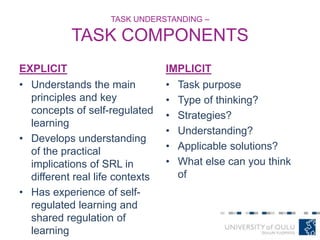
TASK UNDERSTANDING –
TASK COMPONENTS
EXPLICIT
• Understands the main
principles and key
concepts of self-regulated
learning
• Develops understanding
of the practical
implications of SRL in
different real life contexts
• Has experience of self-
regulated learning and
shared regulation of
learning
IMPLICIT
• Task purpose
• Type of thinking?
• Strategies?
• Understanding?
• Applicable solutions?
• What else can you think
of
WHAT MAKES THIS STUDENT
SUCCESSFUL WITH THIS TASK
ASSIGNMENT?
Read the Scenario 1
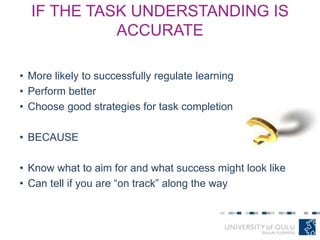
IF THE TASK UNDERSTANDING IS
ACCURATE
• More likely to successfully regulate learning
• Perform better
• Choose good strategies for task completion
• BECAUSE
• Know what to aim for and what success might look like
• Can tell if you are “on track” along the way
2. GOAL SETTING AND PLANNING
• Standards
• Something students use to judge progress
• Something students can use to judge performance
• Lead to strategy choices
• Reflections of task understanding
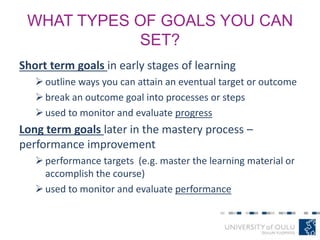
WHAT TYPES OF GOALS YOU CAN
SET?
Short term goals in early stages of learning
outline ways you can attain an eventual target or outcome
break an outcome goal into processes or steps
used to monitor and evaluate progress
Long term goals later in the mastery process –
performance improvement
performance targets (e.g. master the learning material or
accomplish the course)
used to monitor and evaluate performance
3. TASK ENACTMENT
MONITORING AND CONTROLLING
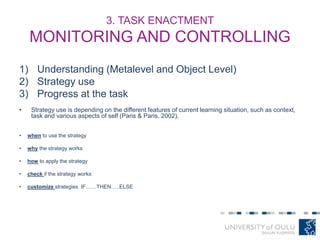
1) Understanding (Metalevel and Object Level)
2) Strategy use
3) Progress at the task
• Strategy use is depending on the different features of current learning situation, such as context,
task and various aspects of self (Paris & Paris, 2002).
• when to use the strategy
• why the strategy works
• how to apply the strategy
• check if the strategy works
• customize strategies IF……THEN…..ELSE
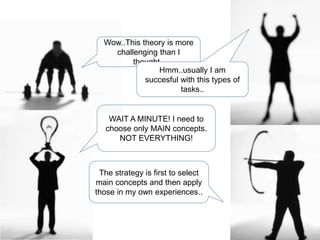
WAIT A MINUTE! I need to
choose only MAIN concepts.
NOT EVERYTHING!
Wow..This theory is more
challenging than I
thought..
Hmm..usually I am
succesful with this types of
tasks..
The strategy is first to select
main concepts and then apply
those in my own experiences..
6 serious challenges:
Motivational problems
1) Poor Task understanding
2) Vague Goals and Plans
3) Weak strategies (or strategy choices)
4) Lack of monitoring
5) Inaccurate self-evaluation
Hadwin, 2009; Järvelä & Järvenoja
2010
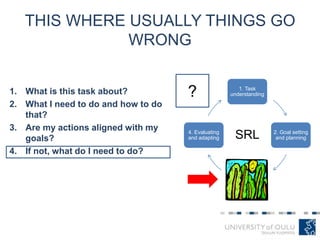
THIS WHERE USUALLY THINGS GO
WRONG
1. What is this task about?
2. What I need to do and how to do
that?
3. Are my actions aligned with my
goals?
4. If not, what do I need to do?
1. Task
understanding
2. Goal setting
and planning
3. Enacting
strategies
4. Evaluating
and adapting
?
SRL
IT IS NOT PRODUCTIVE
AND THEN YOU…
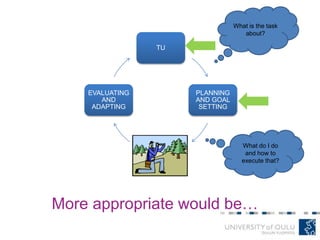
More appropriate would be…
TU
PLANNING
AND GOAL
SETTING
Toiminta
EVALUATING
AND
ADAPTING
What is the task
about?
What do I do
and how to
execute that?
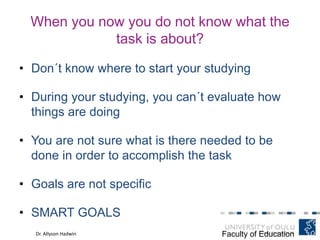
When you now you do not know what the
task is about?
Faculty of EducationDr. Allyson Hadwin
• Don´t know where to start your studying
• During your studying, you can´t evaluate how
things are doing
• You are not sure what is there needed to be
done in order to accomplish the task
• Goals are not specific
• SMART GOALS
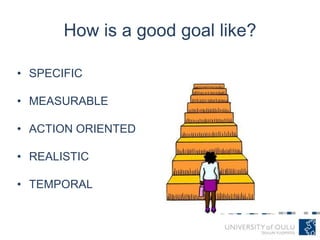
How is a good goal like?
• SPECIFIC
• MEASURABLE
• ACTION ORIENTED
• REALISTIC
• TEMPORAL
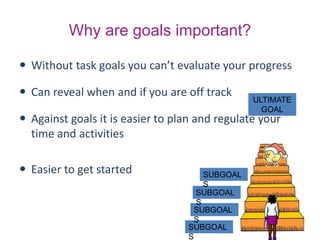
Why are goals important?
 Without task goals you can’t evaluate your progress
 Can reveal when and if you are off track
 Against goals it is easier to plan and regulate your
time and activities
 Easier to get started
SUBGOAL
S
ULTIMATE
GOAL
SUBGOAL
S
SUBGOAL
S
SUBGOAL
S
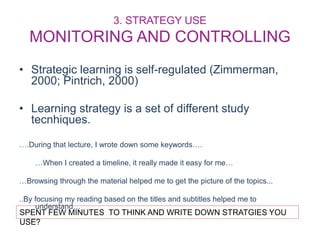
3. STRATEGY USE
MONITORING AND CONTROLLING
• Strategic learning is self-regulated (Zimmerman,
2000; Pintrich, 2000)
• Learning strategy is a set of different study
tecnhiques.
….During that lecture, I wrote down some keywords….
…When I created a timeline, it really made it easy for me…
…Browsing through the material helped me to get the picture of the topics...
..By focusing my reading based on the titles and subtitles helped me to
understand…
SPENT FEW MINUTES TO THINK AND WRITE DOWN STRATGIES YOU
USE?
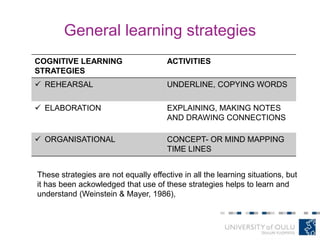
General learning strategies
COGNITIVE LEARNING
STRATEGIES
ACTIVITIES
 REHEARSAL UNDERLINE, COPYING WORDS
 ELABORATION EXPLAINING, MAKING NOTES
AND DRAWING CONNECTIONS
 ORGANISATIONAL CONCEPT- OR MIND MAPPING
TIME LINES
These strategies are not equally effective in all the learning situations, but
it has been ackowledged that use of these strategies helps to learn and
understand (Weinstein & Mayer, 1986),
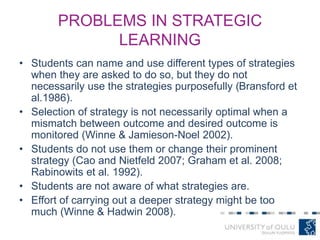
PROBLEMS IN STRATEGIC
LEARNING
• Students can name and use different types of strategies
when they are asked to do so, but they do not
necessarily use the strategies purposefully (Bransford et
al.1986).
• Selection of strategy is not necessarily optimal when a
mismatch between outcome and desired outcome is
monitored (Winne & Jamieson-Noel 2002).
• Students do not use them or change their prominent
strategy (Cao and Nietfeld 2007; Graham et al. 2008;
Rabinowits et al. 1992).
• Students are not aware of what strategies are.
• Effort of carrying out a deeper strategy might be too
much (Winne & Hadwin 2008).
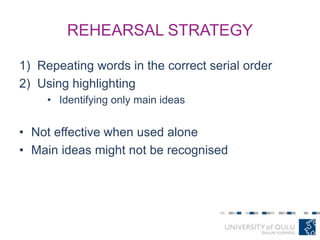
REHEARSAL STRATEGY
1) Repeating words in the correct serial order
2) Using highlighting
• Identifying only main ideas
• Not effective when used alone
• Main ideas might not be recognised
ORGANISATIONAL STRATEGY
• The purpose of organisational strategies is to
translate information into another form, such as
creating concept maps, diagrams or timelines
(Weinstein, & Mayer, 1986).
• The use of organisational strategies fosters
externalization of knowledge and enhances
selection of the most important concepts (Hilbert
& Renkl, 2007).
• What is already known and how the knowledge
structures change.
ELABORATION STRATEGY
• Paraphrasing or summarising, explaining ideas
by making notes to link to-be-learned
information to prior knowledge structures, asking
questions, compare/contrast.
• Additional ways on how to recall information.
• Requires thinking (to be learned information).
• Helps to connect what is already known.
WHAT PROBLEMS DID THE STUDENT
ENCOUNTER WITH THIS TASK
ASSIGNMENT?
Read the Scenario 2
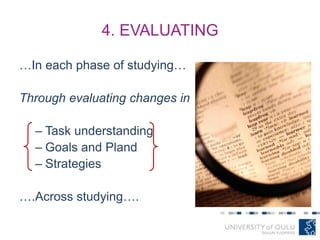
4. EVALUATING
…In each phase of studying…
Through evaluating changes in
– Task understanding
– Goals and Pland
– Strategies
….Across studying….
In order to self-regulate learning..
…Knowledge about different strategies
…Skill and will to cope with various learning
situations
…Degree of self-regulated learning varies
depending on the learning
situation…
..When experimenting with your
learning, you are
regulating….Volet & Järvelä, 2000; Hadwin, Järvelä & Miller,
EXTERNAL CONDITIONSINTERNAL CONDITIONS
• TASK COMPLEXITY
• ENVIRONMENT
• TIME CONSTRAINS
• PRIOR KNOWLEDGE
• KNOWLEDGE OF
STRATEGIES
• EXPECTED SUCCESS
OPERATIONS
SMART
TACTICS
PRODUCTS
STANDARDS EVALUATIONS
• SEARCH
• MONITOR
• ASSEMBLE
• REHEARSE
• TRANSLATE
1. TASK
UNDERSTANDING
2. GOALS AND PLANS
3. TASK ENACTMENT
4. ADAPTING
STUDYING MONITORING
UNDERLYING MODEL OF SRL
HAS SOMETHING CHANGED?
• Present your group IDEAS
• How is the ”good learner like” in
the light of models of self-
regulated learning?
• In other words, what you have just
heard
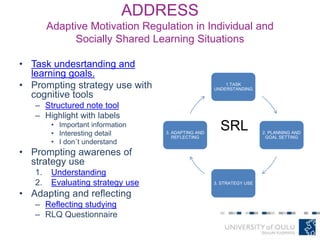
ADDRESS
Adaptive Motivation Regulation in Individual and
Socially Shared Learning Situations
• Task undesrtanding and
learning goals.
• Prompting strategy use with
cognitive tools
– Structured note tool
– Highlight with labels
• Important information
• Interesting detail
• I don´t understand
• Prompting awarenes of
strategy use
1. Understanding
2. Evaluating strategy use
• Adapting and reflecting
– Reflecting studying
– RLQ Questionnaire
1.TASK
UNDERSTANDING
2. PLANNING AND
GOAL SETTING
3. STRATEGY USE
3. ADAPTING AND
REFLECTING
SRL
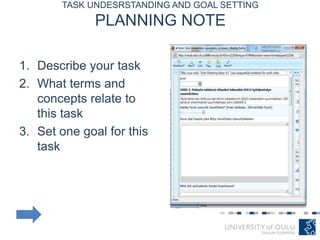
TASK UNDESRSTANDING AND GOAL SETTING
PLANNING NOTE
1. Describe your task
2. What terms and
concepts relate to
this task
3. Set one goal for this
task
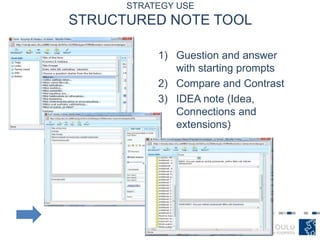
STRATEGY USE
STRUCTURED NOTE TOOL
1) Guestion and answer
with starting prompts
2) Compare and Contrast
3) IDEA note (Idea,
Connections and
extensions)
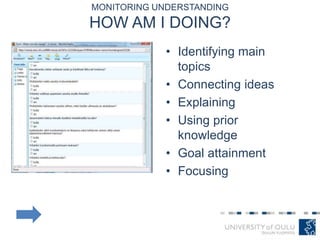
MONITORING UNDERSTANDING
HOW AM I DOING?
• Identifying main
topics
• Connecting ideas
• Explaining
• Using prior
knowledge
• Goal attainment
• Focusing
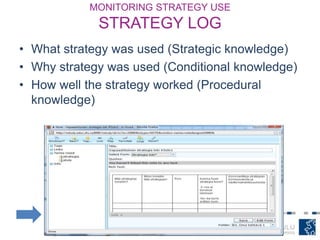
MONITORING STRATEGY USE
STRATEGY LOG
• What strategy was used (Strategic knowledge)
• Why strategy was used (Conditional knowledge)
• How well the strategy worked (Procedural
knowledge)

Srl renoved2015

  • 1.
    (META)COGNITIVE PERSPECTIVE SELF-REGULATED LEARNING JonnaMalmberg Learning and Educational Technology Research Unit (LET)
  • 2.
    WHO AM I? •Post-Doc Researcher. • Self-regulated learning (SRL) and socially shared regulation of learning (SSRL)  (Meta)Cognitive aspects – How to identify challenges that require SRL? – How is the students task understanding related to the students stratgic learning in various task types? • Technology is used as a method to collect process data of the students learning.
  • 3.
    WHO ARE YOU? •Introduce your self • Explain shortly - What is the purpose of this course
  • 4.
    COURSE TASK 1. Collaborativegroup work: SRL (mind map) 2. During the presentation EXTEND your mind map about what you have just learned 3. After – prepare to explain (5 min max) what you have just learned about SRL 4. Example of ADDRESS research design – How to support self-regulated learning in practise. • How could you self-regulate your own learning?
  • 5.
    WHAT ARE THEQUALITIES OF GOOD LEARNER? • How do you define good learner? • Discuss and make a schetch (e.g. a mind map) of the qualities of a good learner (5 min)
  • 6.
    SELF-REGULATED LEARNER • Capableof taking charge of their own learning: • Recognizes own strengths and weaknesses in various learning situations. – Knowledge of different strategies that can aid meaningful learning – Motivated to use these strategies in order to reach learning goal – Can use these strategies depending on the learning situation. Zimmermann, 2001; Winne & Perry, 2001
  • 7.
    WHAT IS SELF-REGULATED LEARNING? •Active and proactive learning • Process of learning to monitor, evaluate, and regulate (or change) your own – Learning and thinking (e.g. remember textbook) – Motivation (e.g. feeling inspired or interested) – Behaviour (e.g. getting organized, getting started) • Lifelong process that you develop and refine over time • CAN BE TEACHED AND LEARNED
  • 8.
    WHAT IS SELF-REGULATED LEARNING? •Task understanding and goal setting • Planning • Enacting strategies • Evaluating • Cyclical process whereby students regulate their efforts to optimize cognitive, motivational and behavioural processes, guided by their learning goals and the contextual features of the environment (Pintrich, 2000; Zimmerman, 1998).
  • 9.
    SUCCESSFUL LEARNER • Monitorthe effectiveness of their learning methods or strategies and react to feedback by changing perceptions, beliefs or strategies (Winne & Hadwin, 1998) SEEK OUT INFORMATION WHEN NEEDED… ACCEPT GREATER RESPONSIBILITY FOR THEIR ACHIEVEMENT OUTCOMES… PLAN SET GOALS MONITOR EVALUATE
  • 10.
    A BIT LIKECONDUCTING EXPERIMENTS ABOUT YOUR LEARNING • Identify a problem • Set goals • Make plans and set procedures • Collect data about how things are going • Compare findings to original goals • Based on your findings you make changes to the goals, plans or strategies
  • 11.
    WHY IT ISIMPORTANT TO SELF- REGULATE LEARNING? • Improved learning outcomes! Why? Awareness of strengths and weaknesses – What strategies I can use to bridge the caps between ability and task demands?
  • 12.
    Simply learning anew skill does not mean that you will use it unless you are motivated to do so… Willingness to invest effort  Evaluation of benefits/costs  Pass the course / deep understanding
  • 13.
    How do Motivationand Cognition regulation work in conjuction? • In the context of collaborative learning succesful regulation of motivation enables the learners to proceed with the task (cognitive regulation) (Malmberg, Järvelä, Järvenoja & Panadero, 2015). • It is not clear theoretically how to combine (metacognitive) and motivation/emotions in a unified theory of SRL (e.g. Eliahy & Linnenbrink – Garcia, 2013)
  • 14.
    CYCLICAL MODEL OFSELF- REGULATED LEARNING • Self-regulated learning occurs when students sustain and manage their achievement efforts through activities that are employed towards attainment of students own goals (Zimmerman 1999; Pintrich 2001). • Challenges provides means for self-regulated learning to occur (Hadwin, Järvelä & Miller, 2010). • SRL can be divided in three to four different phases depending of the model. 4. REFLECTING •previous experiences •previouse knolwedge 3a CONTROLLING Highlights NotesQuestions 3bMONITORING •understanding •tactic use •Better task understanding •Strategic knowledge 1 TASK UNDERSTANDING 2 PLANNING AND GOAL SETTING Winne & Hadwin, 1998 , Zimmerman, 2000
  • 15.
    1. TASK UNDERSTANDING •1stphase in self-regulating learning •What is this task about? •Drawing on past knowledge and experiences •Constructing your own representation or “picture” of the task When you know what you are supposed to be doing, what it looks like, and what it feels like to be on track
  • 16.
    TASK UNDERSTANDING – TASKCOMPONENTS EXPLICIT • Understands the main principles and key concepts of self-regulated learning • Develops understanding of the practical implications of SRL in different real life contexts • Has experience of self- regulated learning and shared regulation of learning IMPLICIT • Task purpose • Type of thinking? • Strategies? • Understanding? • Applicable solutions? • What else can you think of
  • 17.
    WHAT MAKES THISSTUDENT SUCCESSFUL WITH THIS TASK ASSIGNMENT? Read the Scenario 1
  • 18.
    IF THE TASKUNDERSTANDING IS ACCURATE • More likely to successfully regulate learning • Perform better • Choose good strategies for task completion • BECAUSE • Know what to aim for and what success might look like • Can tell if you are “on track” along the way
  • 19.
    2. GOAL SETTINGAND PLANNING • Standards • Something students use to judge progress • Something students can use to judge performance • Lead to strategy choices • Reflections of task understanding
  • 20.
    WHAT TYPES OFGOALS YOU CAN SET? Short term goals in early stages of learning outline ways you can attain an eventual target or outcome break an outcome goal into processes or steps used to monitor and evaluate progress Long term goals later in the mastery process – performance improvement performance targets (e.g. master the learning material or accomplish the course) used to monitor and evaluate performance
  • 21.
    3. TASK ENACTMENT MONITORINGAND CONTROLLING 1) Understanding (Metalevel and Object Level) 2) Strategy use 3) Progress at the task • Strategy use is depending on the different features of current learning situation, such as context, task and various aspects of self (Paris & Paris, 2002). • when to use the strategy • why the strategy works • how to apply the strategy • check if the strategy works • customize strategies IF……THEN…..ELSE
  • 22.
    WAIT A MINUTE!I need to choose only MAIN concepts. NOT EVERYTHING! Wow..This theory is more challenging than I thought.. Hmm..usually I am succesful with this types of tasks.. The strategy is first to select main concepts and then apply those in my own experiences..
  • 23.
    6 serious challenges: Motivationalproblems 1) Poor Task understanding 2) Vague Goals and Plans 3) Weak strategies (or strategy choices) 4) Lack of monitoring 5) Inaccurate self-evaluation Hadwin, 2009; Järvelä & Järvenoja 2010
  • 24.
    THIS WHERE USUALLYTHINGS GO WRONG 1. What is this task about? 2. What I need to do and how to do that? 3. Are my actions aligned with my goals? 4. If not, what do I need to do? 1. Task understanding 2. Goal setting and planning 3. Enacting strategies 4. Evaluating and adapting ? SRL
  • 25.
    IT IS NOTPRODUCTIVE AND THEN YOU…
  • 26.
    More appropriate wouldbe… TU PLANNING AND GOAL SETTING Toiminta EVALUATING AND ADAPTING What is the task about? What do I do and how to execute that?
  • 27.
    When you nowyou do not know what the task is about? Faculty of EducationDr. Allyson Hadwin • Don´t know where to start your studying • During your studying, you can´t evaluate how things are doing • You are not sure what is there needed to be done in order to accomplish the task • Goals are not specific • SMART GOALS
  • 28.
    How is agood goal like? • SPECIFIC • MEASURABLE • ACTION ORIENTED • REALISTIC • TEMPORAL
  • 29.
    Why are goalsimportant?  Without task goals you can’t evaluate your progress  Can reveal when and if you are off track  Against goals it is easier to plan and regulate your time and activities  Easier to get started SUBGOAL S ULTIMATE GOAL SUBGOAL S SUBGOAL S SUBGOAL S
  • 30.
    3. STRATEGY USE MONITORINGAND CONTROLLING • Strategic learning is self-regulated (Zimmerman, 2000; Pintrich, 2000) • Learning strategy is a set of different study tecnhiques. ….During that lecture, I wrote down some keywords…. …When I created a timeline, it really made it easy for me… …Browsing through the material helped me to get the picture of the topics... ..By focusing my reading based on the titles and subtitles helped me to understand… SPENT FEW MINUTES TO THINK AND WRITE DOWN STRATGIES YOU USE?
  • 31.
    General learning strategies COGNITIVELEARNING STRATEGIES ACTIVITIES  REHEARSAL UNDERLINE, COPYING WORDS  ELABORATION EXPLAINING, MAKING NOTES AND DRAWING CONNECTIONS  ORGANISATIONAL CONCEPT- OR MIND MAPPING TIME LINES These strategies are not equally effective in all the learning situations, but it has been ackowledged that use of these strategies helps to learn and understand (Weinstein & Mayer, 1986),
  • 32.
    PROBLEMS IN STRATEGIC LEARNING •Students can name and use different types of strategies when they are asked to do so, but they do not necessarily use the strategies purposefully (Bransford et al.1986). • Selection of strategy is not necessarily optimal when a mismatch between outcome and desired outcome is monitored (Winne & Jamieson-Noel 2002). • Students do not use them or change their prominent strategy (Cao and Nietfeld 2007; Graham et al. 2008; Rabinowits et al. 1992). • Students are not aware of what strategies are. • Effort of carrying out a deeper strategy might be too much (Winne & Hadwin 2008).
  • 33.
    REHEARSAL STRATEGY 1) Repeatingwords in the correct serial order 2) Using highlighting • Identifying only main ideas • Not effective when used alone • Main ideas might not be recognised
  • 34.
    ORGANISATIONAL STRATEGY • Thepurpose of organisational strategies is to translate information into another form, such as creating concept maps, diagrams or timelines (Weinstein, & Mayer, 1986). • The use of organisational strategies fosters externalization of knowledge and enhances selection of the most important concepts (Hilbert & Renkl, 2007). • What is already known and how the knowledge structures change.
  • 35.
    ELABORATION STRATEGY • Paraphrasingor summarising, explaining ideas by making notes to link to-be-learned information to prior knowledge structures, asking questions, compare/contrast. • Additional ways on how to recall information. • Requires thinking (to be learned information). • Helps to connect what is already known.
  • 36.
    WHAT PROBLEMS DIDTHE STUDENT ENCOUNTER WITH THIS TASK ASSIGNMENT? Read the Scenario 2
  • 37.
    4. EVALUATING …In eachphase of studying… Through evaluating changes in – Task understanding – Goals and Pland – Strategies ….Across studying….
  • 38.
    In order toself-regulate learning.. …Knowledge about different strategies …Skill and will to cope with various learning situations …Degree of self-regulated learning varies depending on the learning situation… ..When experimenting with your learning, you are regulating….Volet & Järvelä, 2000; Hadwin, Järvelä & Miller,
  • 39.
    EXTERNAL CONDITIONSINTERNAL CONDITIONS •TASK COMPLEXITY • ENVIRONMENT • TIME CONSTRAINS • PRIOR KNOWLEDGE • KNOWLEDGE OF STRATEGIES • EXPECTED SUCCESS OPERATIONS SMART TACTICS PRODUCTS STANDARDS EVALUATIONS • SEARCH • MONITOR • ASSEMBLE • REHEARSE • TRANSLATE 1. TASK UNDERSTANDING 2. GOALS AND PLANS 3. TASK ENACTMENT 4. ADAPTING STUDYING MONITORING UNDERLYING MODEL OF SRL
  • 40.
    HAS SOMETHING CHANGED? •Present your group IDEAS • How is the ”good learner like” in the light of models of self- regulated learning? • In other words, what you have just heard
  • 41.
    ADDRESS Adaptive Motivation Regulationin Individual and Socially Shared Learning Situations • Task undesrtanding and learning goals. • Prompting strategy use with cognitive tools – Structured note tool – Highlight with labels • Important information • Interesting detail • I don´t understand • Prompting awarenes of strategy use 1. Understanding 2. Evaluating strategy use • Adapting and reflecting – Reflecting studying – RLQ Questionnaire 1.TASK UNDERSTANDING 2. PLANNING AND GOAL SETTING 3. STRATEGY USE 3. ADAPTING AND REFLECTING SRL
  • 42.
    TASK UNDESRSTANDING ANDGOAL SETTING PLANNING NOTE 1. Describe your task 2. What terms and concepts relate to this task 3. Set one goal for this task
  • 43.
    STRATEGY USE STRUCTURED NOTETOOL 1) Guestion and answer with starting prompts 2) Compare and Contrast 3) IDEA note (Idea, Connections and extensions)
  • 44.
    MONITORING UNDERSTANDING HOW AMI DOING? • Identifying main topics • Connecting ideas • Explaining • Using prior knowledge • Goal attainment • Focusing
  • 45.
    MONITORING STRATEGY USE STRATEGYLOG • What strategy was used (Strategic knowledge) • Why strategy was used (Conditional knowledge) • How well the strategy worked (Procedural knowledge)

Editor's Notes

  • #15 Yet, not all the learning is self-regulated. Rather, challenges, wheather they are cognitive, motivational or behavioral provides means for self-regulated learning. Theoretically, SRL can be divided in four different phases. Before the actual studying phase, the students evaluate what is the task about. This is evaluation is based on the students preveious experiences about the same types of tasks. At the second phase, the students set a goal for their learning based on their evaluation about the task and plan their learning in line with their task spesific learning goals. During the actual studying phase, the students control their learning by using different types of study tactics. Yet, at the same time the students monitor their understanding and wheather the tactic they are currently using is appropriate for their learning. And – this is actually the phase which constitutes strategy use during learning. Finally, after the studying the students reflect their current learning. According to this reflection, the students might have a better understanding about different types of tasks and also better knowledge about strategies for future learning.
  • #24 What is the task I am I supposed to do now and why? Why am I about to do this and how? What methods
  • #40 9. Winne and Hadwins model differentiates from other models so, that it differentiates task understanding from goals setting and planning phase. Also, each five phases stages are embedded in the same general cognitive architecture. Conditions influence the whole learning process, especially to the operations and standards. Operations are involved in memory storage and retrieval. searching memory, monitoring new information’s fit with previously learned information, assembling new links to knowledge, rehearsing knowledge to commit it to memory, and translat ing knowledge in one form, such as verbal, to another, such as pictorial. However, in phase three, Task enactment these operations are the most visible in terms of tactics and strategies learners utilize to solve a learning task. In each learning stage, these operations create internal or external products. These products include task definitions in Phase 1, goals and plans in Phase 2, and attempts at learning in Phase 3. These products are then compared with standards through the monitoring process, and the fit between product and standards (internal, self self-selected goal that determines whether any particular phase’s product is sufficient so that the next phase can begin. Lastly, evaluations might occur during a learning cycle of after the learning task. For example, when the evaluation indicates a mismatch between a phase product and standard. Winne and Hadwin suggest that students can enact control functions that can alter current and previous phase products. Accordingly, these regulatiry activities are situated for spesific tasks, but also adaptive for past learning experiences. That is, they affevte to conditions, namely internal conditions such as prior domain knowledge, strategies and expected success.
  • #42 In address research project, funded by finish academy we have applied self-regulated learning theory in practise in each phase of studying. First, task understanding and goal setting was supported with