RASHMI CHAUHAN ASSISTANT PROFESSOR CHANDIGARH COLLEGE OF EDUCATION, LANDRAN, MOHALI PUNJAB.  ACTION RESEARCH
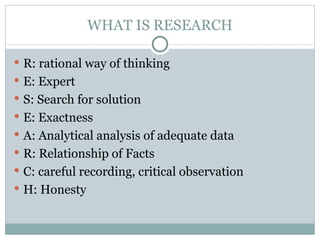
WHAT IS RESEARCH R: rational way of thinking E: Expert S: Search for solution E: Exactness A: Analytical analysis of adequate data R: Relationship of Facts C: careful recording, critical observation H: Honesty
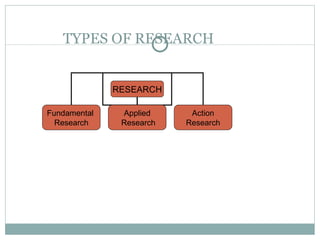
TYPES OF RESEARCH RESEARCH Fundamental  Research Applied Research Action Research
Research Fundamental Research This helps in developing theories by discovering broad generalization and principles. APPLIED RESEARCH Applied  research utilizes those principles to know  the problem with best possible manner
Definition of Action Research C.V.Good:  “ Action research is a research used by teachers, supervisors and administrators to improve the quality of their decision and action” John Best & Kahn:  “Action research is focused on the immediate application  and not on the development of theory. It has placed its emphasis on a real problem in a local setting. Its finding are to be evaluated in terms of local applicability, not in terms of universal validity ” Sara Blackwell :  “ Action Research is the research concerned with school problems carried out by school personnel’s to improve school practices”
Field of Action Research Study the needs of the children. Study the interest of the children. Problems of discipline. Social problems. Problems of learning. Improvement of the curriculum. Problems of teachers. Problems of students attendance
Steps of Action Research Identification of the Problem Defining and delimiting the problem Analyzing the causes relevant to the problem Formation of Action hypothesis Developing a suitable Research design for Action hypothesis Evaluation of result of action hypothesis
Identification of the Problem Sources of Problems Problems related to teaching Problems pertaining to examination Problems pertaining to co-curricular activities Problems related to administration and organisation of institution
Defining and delimiting the problem Only those words are to be used meaning of which is clear and precise Area of the problem should be determined Problem should neither be too wide nor be too limited
Analyzing the causes relevant to the problem Logical relation Verifiable Specific Authentic Control
Formation of Action hypothesis Characteristics of action hypothesis Verifiable Effective Clear words Purpose Logical Economical
Sources of action hypotheses Experience Insight Creative imagination Discussion Sensitivity Analysis of the cause of the problem New Researches
Developing a suitable research design Main aspects of design Description of Activites Method Required Means Required Time
Evaluation of the Results or Conclusions  Methods of Evaluation Observation Collection of opinions Questionnaire Interview Check list Tests Statistical Methods
Proposal of An Action Research Name of the Teacher  :  Name of the Institute  :  Class    : 9th.   Area of the Problem  : Students not doing Home-   work in Maths Pin-Pointed problem : To create a habit in these pupils, of doing Home-work in Maths who shows carelessness and fail to do it in time.
Contd.. 6. Probable causes: Individual differences Lack in intelligence Domestic environment Weak eye-sight Impaired hearing Non-understanding of questions given in home-work No-checking of home-work No punishment to defaulters
7. Action Hypothesis:  If the teacher checks the home-task in Mathematics carefully, and punishes the defaulters, the pupil will start doing home work carefully and timely.
8.Preparation of Suitable Action Plan Month, Week, Date Activiites to be started Method Expected Tools Nov. I Week To know about the interests, aptitudes.  Self –effort and cooperation of companions  Personal Interview Nov. I Week To decide  how many copies can be checked  Self-thinking Study Nov II Week To decide how much home task should be given to the pupils daily Conversation with all the teachers who teach the class Nov II Week To understand the content regarding home task Self- thinking Text books of Maths Nov III Week To get back the copies from the students in the definite  time  Self- effort Answer copies in Maths Nov III Week To punish those who do the home work carelessly or those who fail to do the home work Self- effort and cooperation of the associates Answer books in Maths. Nov IV Week To know the progress of the students  Self efforts Answer books in Maths
9. Evaluation of the Results of Action Research:  Before conducting research 48 out of 60 or 80% did not complete the home work After the research only 12 or 20% pupil did home work in time and carefully

Action research

  • 1.
    RASHMI CHAUHAN ASSISTANTPROFESSOR CHANDIGARH COLLEGE OF EDUCATION, LANDRAN, MOHALI PUNJAB. ACTION RESEARCH
  • 2.
    WHAT IS RESEARCHR: rational way of thinking E: Expert S: Search for solution E: Exactness A: Analytical analysis of adequate data R: Relationship of Facts C: careful recording, critical observation H: Honesty
  • 3.
    TYPES OF RESEARCHRESEARCH Fundamental Research Applied Research Action Research
  • 4.
    Research Fundamental ResearchThis helps in developing theories by discovering broad generalization and principles. APPLIED RESEARCH Applied research utilizes those principles to know the problem with best possible manner
  • 5.
    Definition of ActionResearch C.V.Good: “ Action research is a research used by teachers, supervisors and administrators to improve the quality of their decision and action” John Best & Kahn: “Action research is focused on the immediate application and not on the development of theory. It has placed its emphasis on a real problem in a local setting. Its finding are to be evaluated in terms of local applicability, not in terms of universal validity ” Sara Blackwell : “ Action Research is the research concerned with school problems carried out by school personnel’s to improve school practices”
  • 6.
    Field of ActionResearch Study the needs of the children. Study the interest of the children. Problems of discipline. Social problems. Problems of learning. Improvement of the curriculum. Problems of teachers. Problems of students attendance
  • 7.
    Steps of ActionResearch Identification of the Problem Defining and delimiting the problem Analyzing the causes relevant to the problem Formation of Action hypothesis Developing a suitable Research design for Action hypothesis Evaluation of result of action hypothesis
  • 8.
    Identification of theProblem Sources of Problems Problems related to teaching Problems pertaining to examination Problems pertaining to co-curricular activities Problems related to administration and organisation of institution
  • 9.
    Defining and delimitingthe problem Only those words are to be used meaning of which is clear and precise Area of the problem should be determined Problem should neither be too wide nor be too limited
  • 10.
    Analyzing the causesrelevant to the problem Logical relation Verifiable Specific Authentic Control
  • 11.
    Formation of Actionhypothesis Characteristics of action hypothesis Verifiable Effective Clear words Purpose Logical Economical
  • 12.
    Sources of actionhypotheses Experience Insight Creative imagination Discussion Sensitivity Analysis of the cause of the problem New Researches
  • 13.
    Developing a suitableresearch design Main aspects of design Description of Activites Method Required Means Required Time
  • 14.
    Evaluation of theResults or Conclusions Methods of Evaluation Observation Collection of opinions Questionnaire Interview Check list Tests Statistical Methods
  • 15.
    Proposal of AnAction Research Name of the Teacher : Name of the Institute : Class : 9th. Area of the Problem : Students not doing Home- work in Maths Pin-Pointed problem : To create a habit in these pupils, of doing Home-work in Maths who shows carelessness and fail to do it in time.
  • 16.
    Contd.. 6. Probablecauses: Individual differences Lack in intelligence Domestic environment Weak eye-sight Impaired hearing Non-understanding of questions given in home-work No-checking of home-work No punishment to defaulters
  • 17.
    7. Action Hypothesis: If the teacher checks the home-task in Mathematics carefully, and punishes the defaulters, the pupil will start doing home work carefully and timely.
  • 18.
    8.Preparation of SuitableAction Plan Month, Week, Date Activiites to be started Method Expected Tools Nov. I Week To know about the interests, aptitudes. Self –effort and cooperation of companions Personal Interview Nov. I Week To decide how many copies can be checked Self-thinking Study Nov II Week To decide how much home task should be given to the pupils daily Conversation with all the teachers who teach the class Nov II Week To understand the content regarding home task Self- thinking Text books of Maths Nov III Week To get back the copies from the students in the definite time Self- effort Answer copies in Maths Nov III Week To punish those who do the home work carelessly or those who fail to do the home work Self- effort and cooperation of the associates Answer books in Maths. Nov IV Week To know the progress of the students Self efforts Answer books in Maths
  • 19.
    9. Evaluation ofthe Results of Action Research: Before conducting research 48 out of 60 or 80% did not complete the home work After the research only 12 or 20% pupil did home work in time and carefully