Week 8 EVALUATING LEARNER ACHIEVEMENT
By the end of this class, LTLE385 students should be able to Define evaluation in general and learner evaluation in particular. Express the role of evaluation in the instructional design process. List the different types of learner evaluation. Describe the process of learner evaluation. Develop appropriate test items.  OBJECTIVES
http://www.polleverywhere.com / Listen to instruction. Read the question. Have your mobiles ready. Get started to text your answers to 148820  PRE-TEST
Make three groups. Put the pieces together and the winning team will get to have a prize. ICEBREAKER
What is the purpose of evaluation after all? A QUESTION FOR YOU
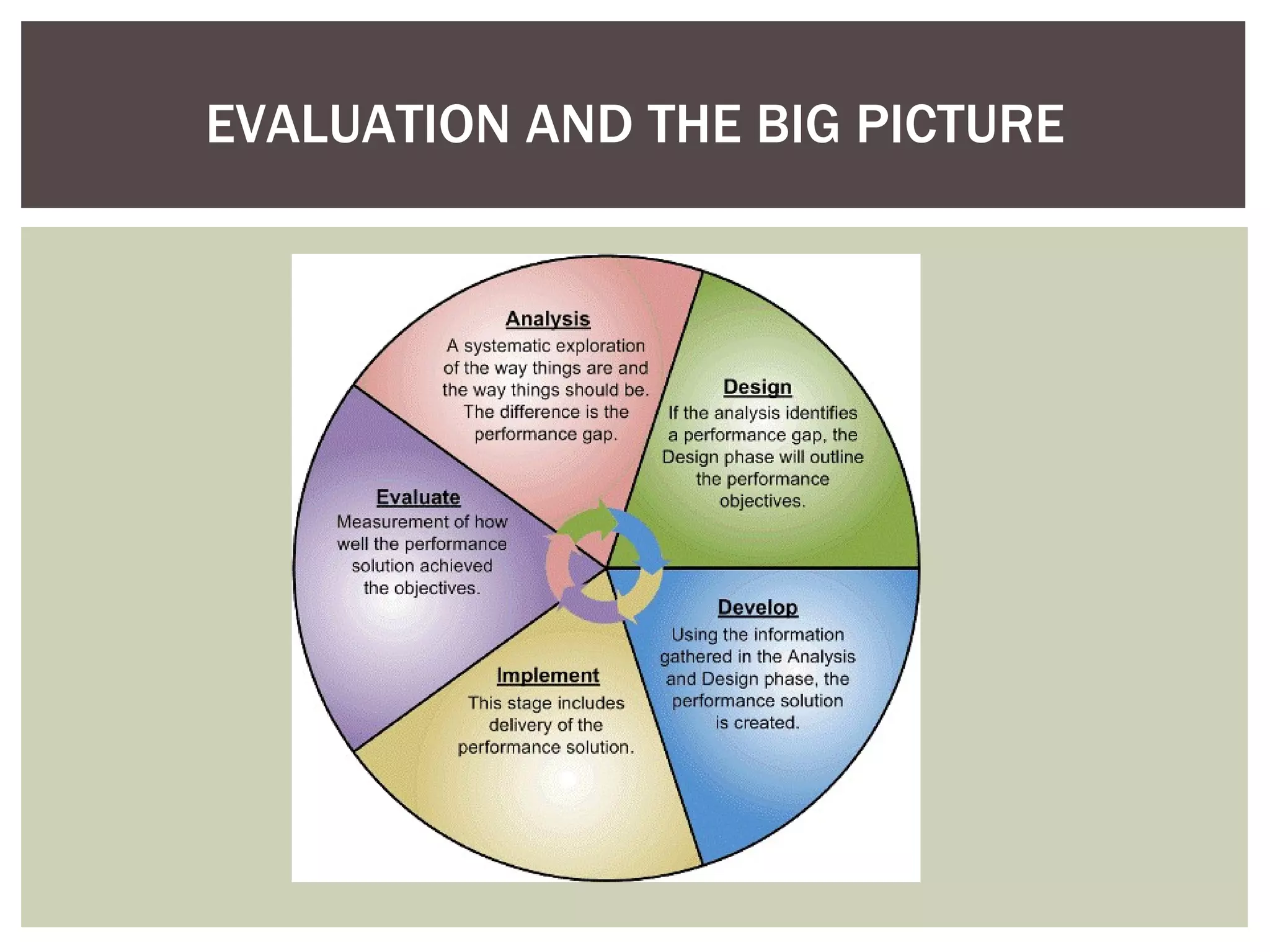
EVALUATION AND THE BIG PICTURE
Evaluation: The process for determining the success level of an individual or product based on data and then making decisions based on this success level.  Assessment: The procedures or techniques used to obtain data about learner or product. Measurement: The data collected, which is typically expressed quantitatively.  EVALUATION, ASSESSMENT, AND MEASUREMENT
Determine the level of performance or achievement that an individual has attained as a result of instruction. Begins by examining the instructional goal and objectives. Decide on the desired change in learner  knowledge, skill, or attitude. Determine the criteria for judging the success. Develop appropriate assessment activities.  LEARNER EVALUATION
Pre-Instruction Gather data about learner current abilities Make adjustments to instruction based on learner knowledge and ability During Instruction Observation Quick-Write or Random-Call  Post-Instruction Summative Evaluation LEARNER EVALUATION TIMING
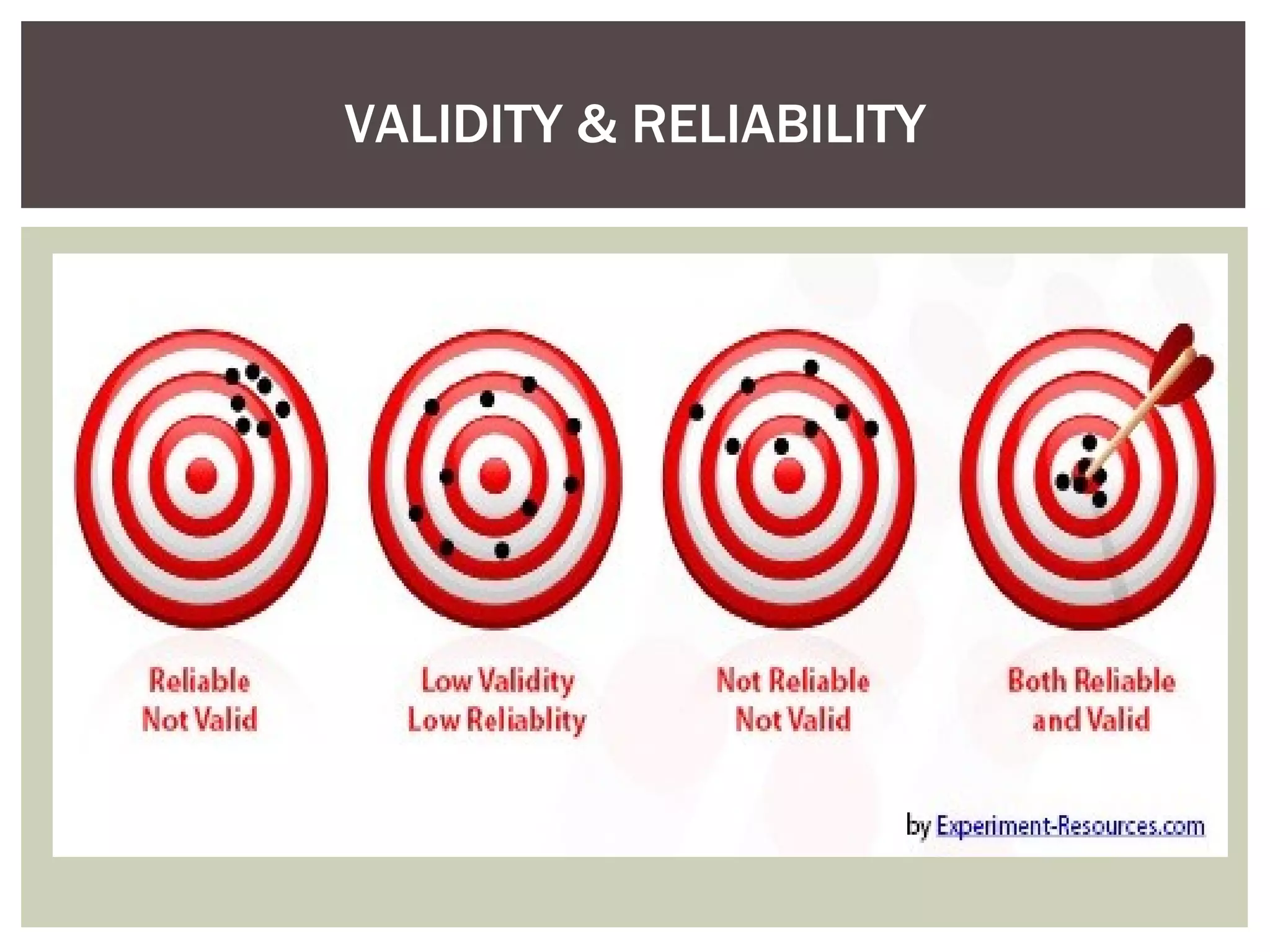
Validity: A learner evaluation is considered valid when it helps determine whether the intended outcome were met by the learner  Face validity Content validity Reliability The extent to which a learner evaluation will provide similar results when conducted on multiple occasions. Criterion-Referenced Norm-Referenced DEVELOPING A LEARNER EVALUATION
VALIDITY & RELIABILITY
Developing and implementing knowledge tests guidelines (p. 143) Objective tests True/False Items Multiple Choice Items Matching Items Constructed-response tests Short-Answer Items Essay Items DEVELOPING KNOWLEDGE ASSESSMENT TESTS (PAPER-AND PENCIL TESTS)
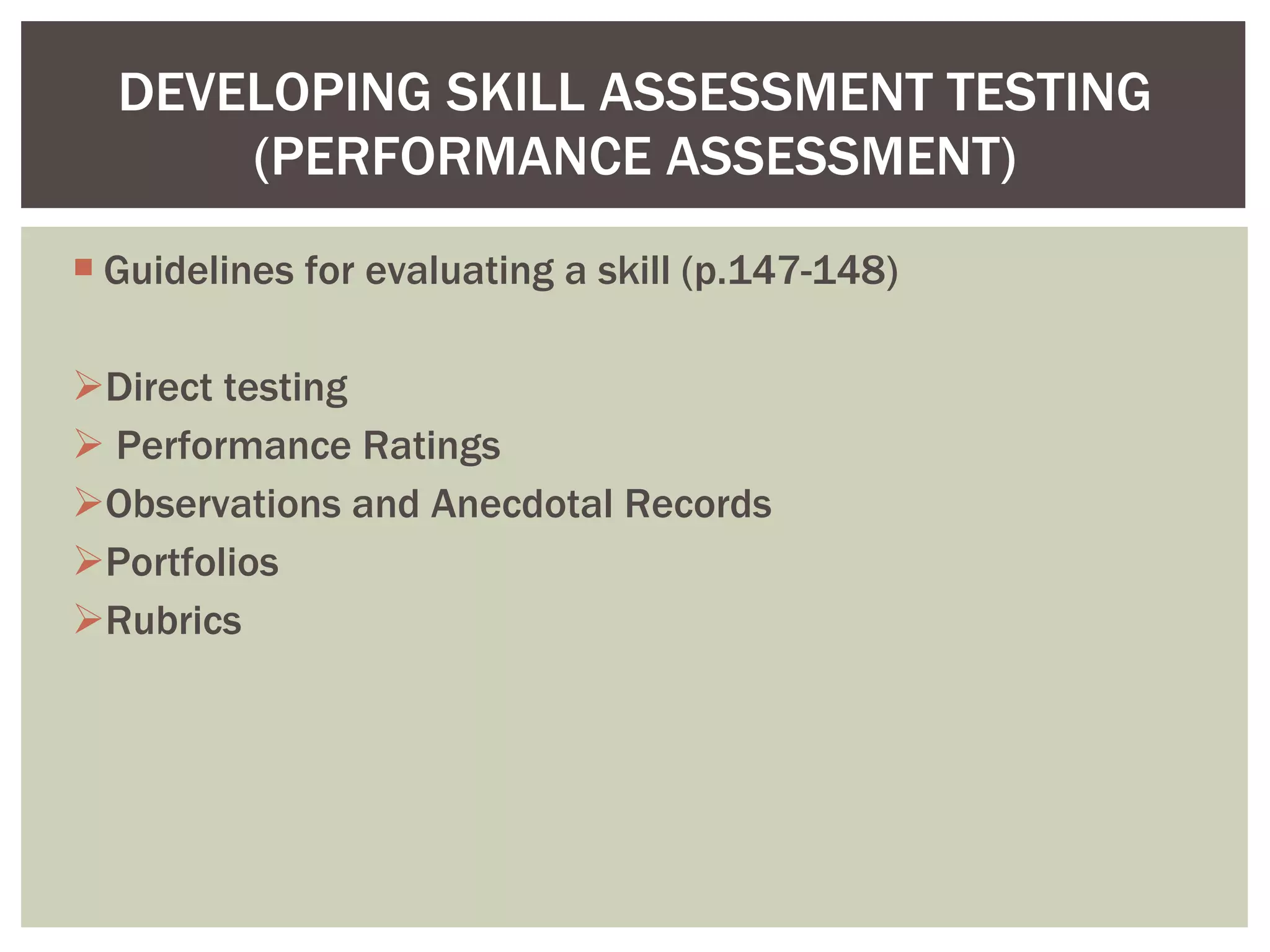
Guidelines for evaluating a skill (p.147-148) Direct testing Performance Ratings Observations and Anecdotal Records Portfolios Rubrics DEVELOPING SKILL ASSESSMENT TESTING (PERFORMANCE ASSESSMENT)
The most difficult outcome to determine because it examines learner’s behavior Observation and Anecdotal Records Surveys and Questionnaires Self-Reporting Inventories Interviews  ASSESSMENT TECHNIQUES TO DETERMINE A CHANGE IN ATTITUDE
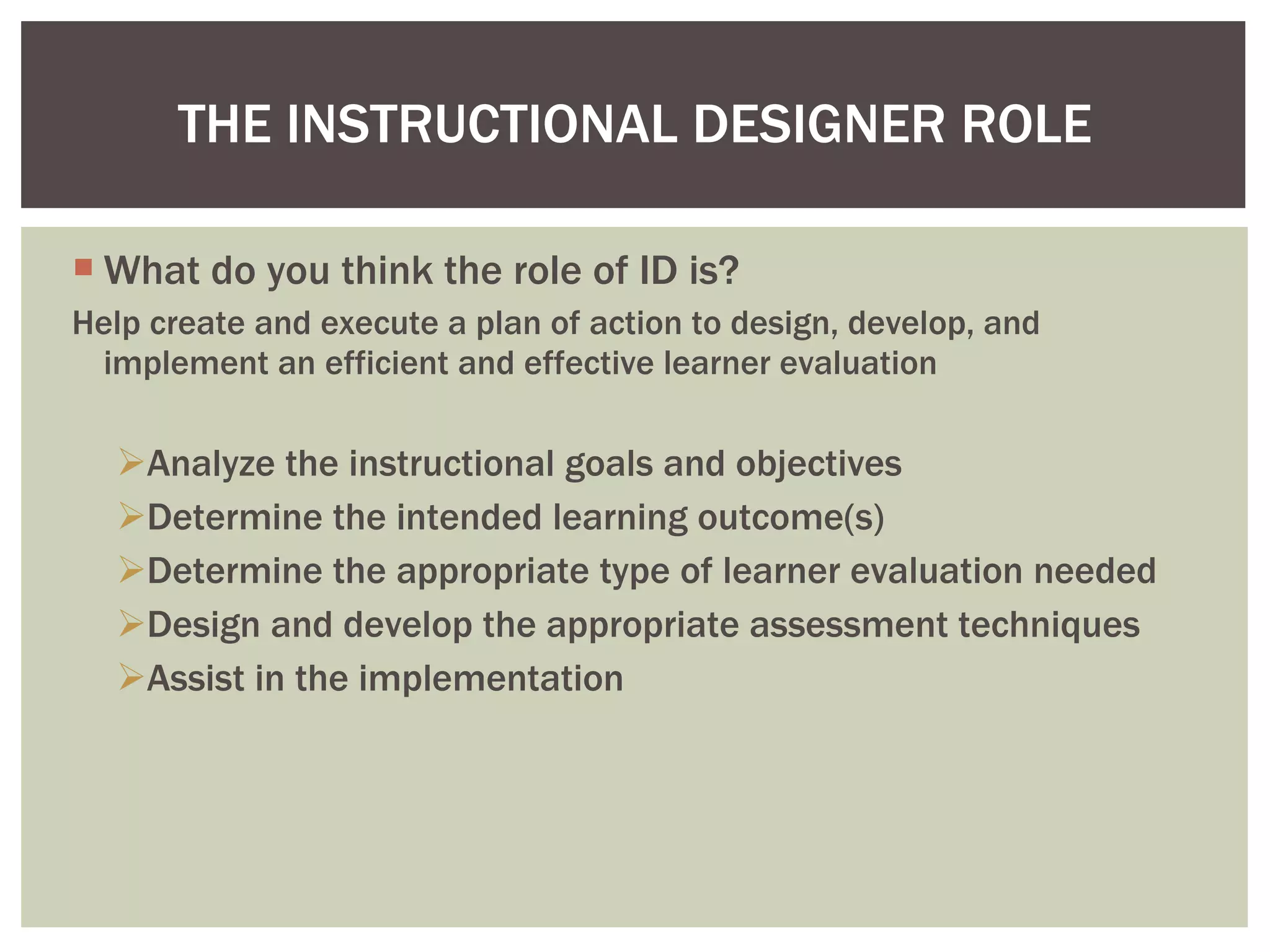
What do you think the role of ID is? Help create and execute a plan of action to design, develop, and implement an efficient and effective learner evaluation  Analyze the instructional goals and objectives Determine the intended learning outcome(s) Determine the appropriate type of learner evaluation needed Design and develop the appropriate assessment techniques Assist in the implementation  THE INSTRUCTIONAL DESIGNER ROLE
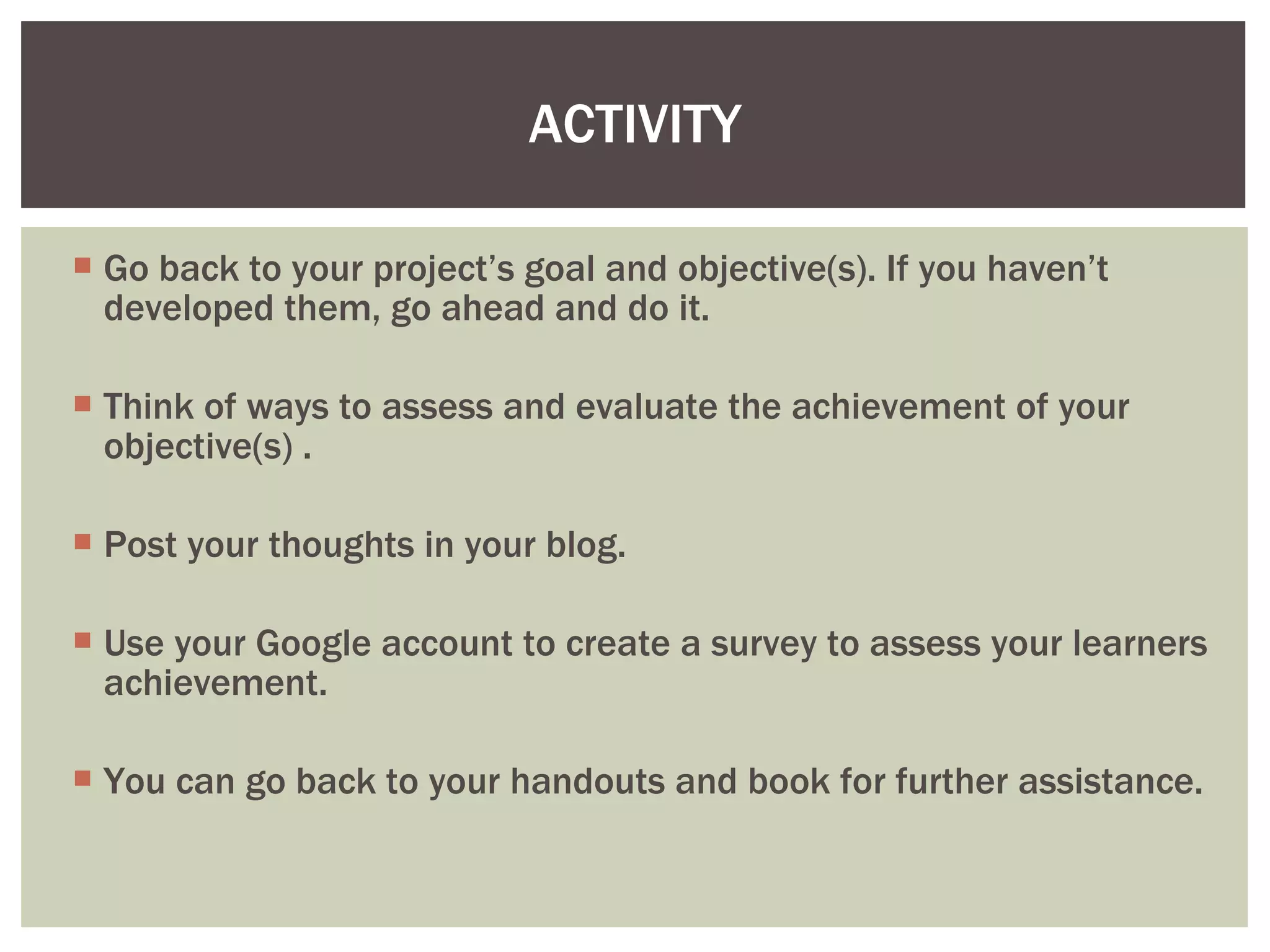
Go back to your project’s goal and objective(s). If you haven’t developed them, go ahead and do it. Think of ways to assess and evaluate the achievement of your objective(s) . Post your thoughts in your blog. Use your Google account to create a survey to assess your learners achievement. You can go back to your handouts and book for further assistance.  ACTIVITY
HANDOUTS
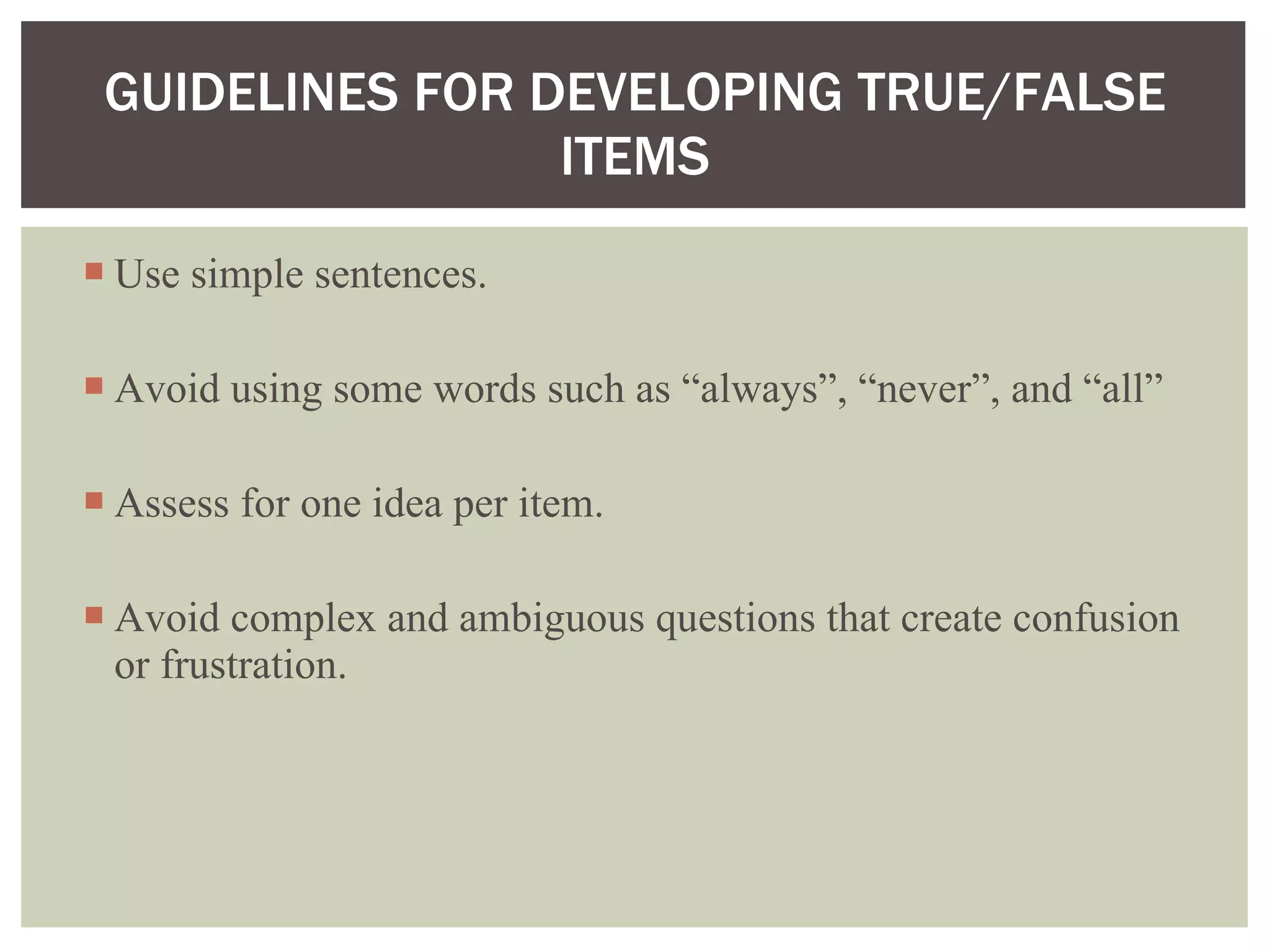
Use simple sentences. Avoid using some words such as “always”, “never”, and “all”  Assess for one idea per item. Avoid complex and ambiguous questions that create confusion or frustration. GUIDELINES FOR DEVELOPING TRUE/FALSE ITEMS
GUIDELINES FOR DEVELOPING CHOICE ITEMS Write a clear descriptive stem. Keep the choices short and clear (stick to four alternatives) Avoid the use of negatives in the stem. Have only one correct answer. Write the distractors to be plausible yet clearly wrong . Avoid using “All of the above” or “Non of the above”
List more options than the premise list. Use homogenous list. Place longer phrases in the left column. Restrict the number of matches to 10 or fewer. GUIDELINES FOR DEVELOPING MATCHING ITEMS
Statement should not be directly quoted from the text. Answer blanks should be in the same place on the page. The questions should measure accomplishment of objectives appropriately. There should be only one blank in an item. GUIDELINES FOR DEVELOPING SHORT-ANSWER ITEMS
Be unobtrusive because people behave differently in the presence of others.  Be objective in your language. It should be clear, accurate, and formal. Be scientific in your observations. they should be accurate, thorough and complete.  should include nothing but your observations. Include an observation form.  GUIDELINES FOR CONDUCTING OBSERVATION
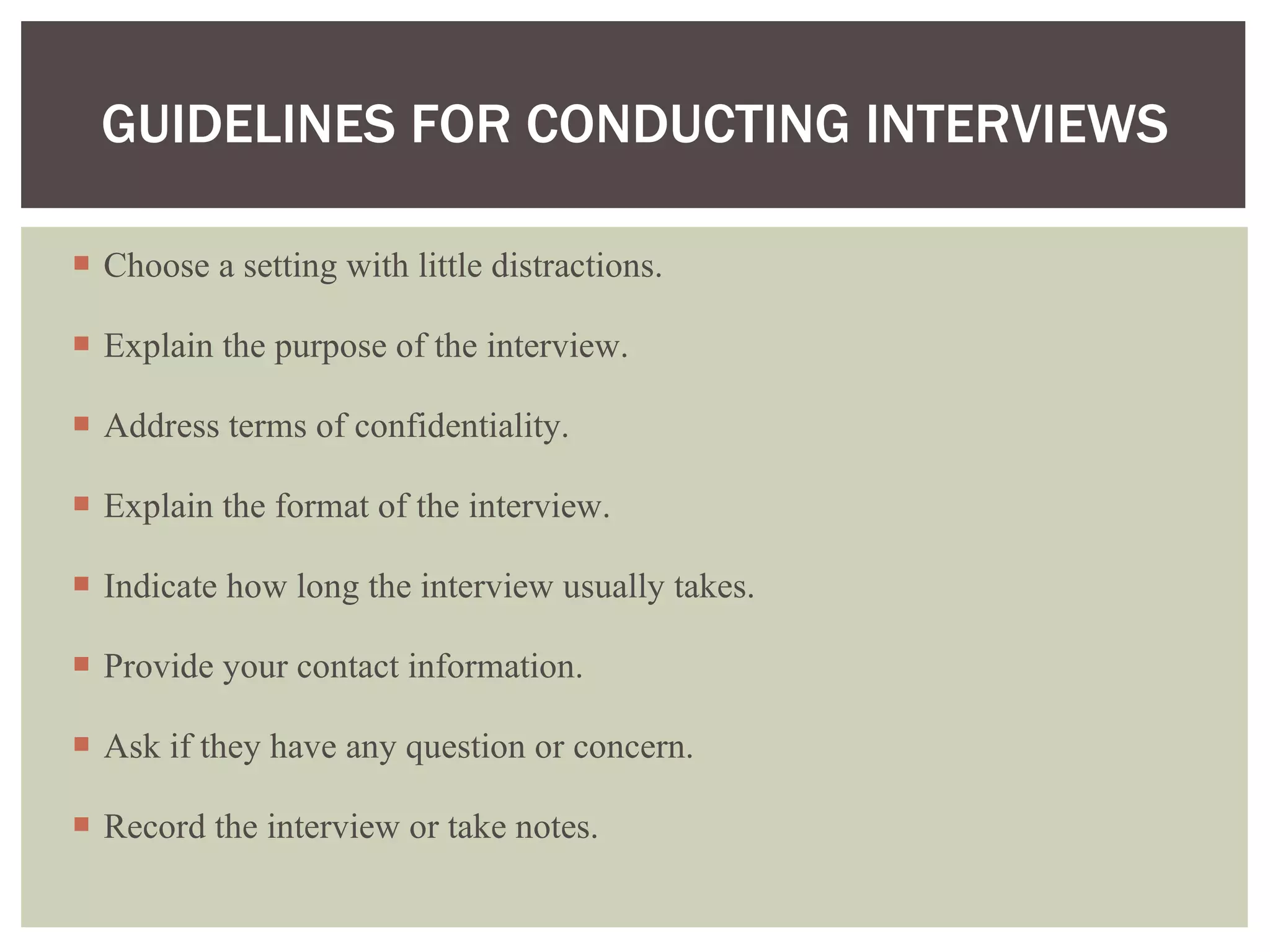
Choose a setting with little distractions. Explain the purpose of the interview. Address terms of confidentiality. Explain the format of the interview.  Indicate how long the interview usually takes. Provide your contact information. Ask if they have any question or concern. Record the interview or take notes.  GUIDELINES FOR CONDUCTING INTERVIEWS
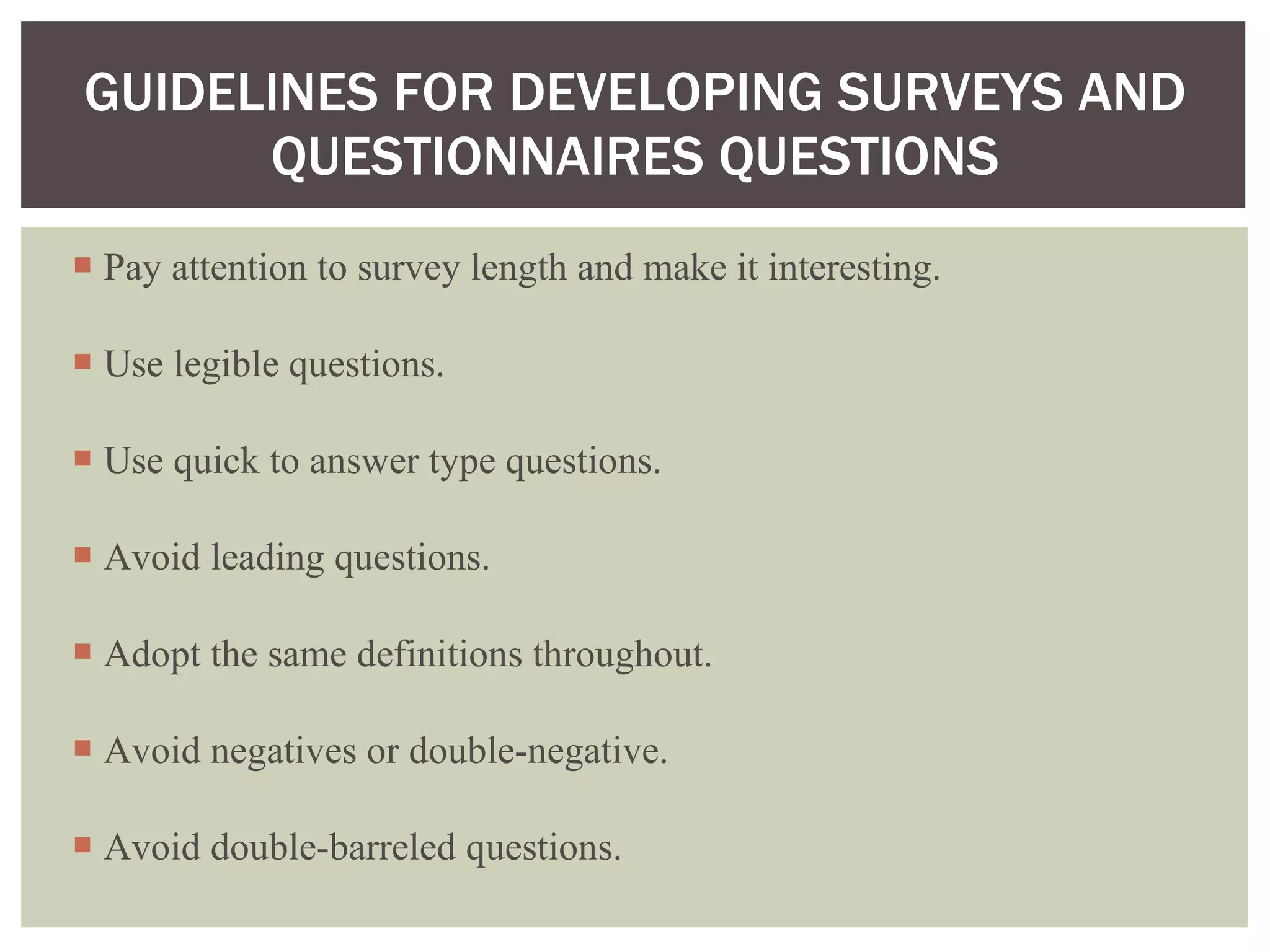
Pay attention to survey length and make it interesting. Use legible questions. Use quick to answer type questions. Avoid leading questions. Adopt the same definitions throughout. Avoid negatives or double-negative. Avoid double-barreled questions.  GUIDELINES FOR DEVELOPING SURVEYS AND QUESTIONNAIRES QUESTIONS

Evaluating Learners Achievement

  • 1.
    Week 8 EVALUATINGLEARNER ACHIEVEMENT
  • 2.
    By the endof this class, LTLE385 students should be able to Define evaluation in general and learner evaluation in particular. Express the role of evaluation in the instructional design process. List the different types of learner evaluation. Describe the process of learner evaluation. Develop appropriate test items. OBJECTIVES
  • 3.
    http://www.polleverywhere.com / Listento instruction. Read the question. Have your mobiles ready. Get started to text your answers to 148820 PRE-TEST
  • 4.
    Make three groups.Put the pieces together and the winning team will get to have a prize. ICEBREAKER
  • 5.
    What is thepurpose of evaluation after all? A QUESTION FOR YOU
  • 6.
    EVALUATION AND THEBIG PICTURE
  • 7.
    Evaluation: The processfor determining the success level of an individual or product based on data and then making decisions based on this success level. Assessment: The procedures or techniques used to obtain data about learner or product. Measurement: The data collected, which is typically expressed quantitatively. EVALUATION, ASSESSMENT, AND MEASUREMENT
  • 8.
    Determine the levelof performance or achievement that an individual has attained as a result of instruction. Begins by examining the instructional goal and objectives. Decide on the desired change in learner knowledge, skill, or attitude. Determine the criteria for judging the success. Develop appropriate assessment activities. LEARNER EVALUATION
  • 9.
    Pre-Instruction Gather dataabout learner current abilities Make adjustments to instruction based on learner knowledge and ability During Instruction Observation Quick-Write or Random-Call Post-Instruction Summative Evaluation LEARNER EVALUATION TIMING
  • 10.
    Validity: A learnerevaluation is considered valid when it helps determine whether the intended outcome were met by the learner Face validity Content validity Reliability The extent to which a learner evaluation will provide similar results when conducted on multiple occasions. Criterion-Referenced Norm-Referenced DEVELOPING A LEARNER EVALUATION
  • 11.
  • 12.
    Developing and implementingknowledge tests guidelines (p. 143) Objective tests True/False Items Multiple Choice Items Matching Items Constructed-response tests Short-Answer Items Essay Items DEVELOPING KNOWLEDGE ASSESSMENT TESTS (PAPER-AND PENCIL TESTS)
  • 13.
    Guidelines for evaluatinga skill (p.147-148) Direct testing Performance Ratings Observations and Anecdotal Records Portfolios Rubrics DEVELOPING SKILL ASSESSMENT TESTING (PERFORMANCE ASSESSMENT)
  • 14.
    The most difficultoutcome to determine because it examines learner’s behavior Observation and Anecdotal Records Surveys and Questionnaires Self-Reporting Inventories Interviews ASSESSMENT TECHNIQUES TO DETERMINE A CHANGE IN ATTITUDE
  • 15.
    What do youthink the role of ID is? Help create and execute a plan of action to design, develop, and implement an efficient and effective learner evaluation Analyze the instructional goals and objectives Determine the intended learning outcome(s) Determine the appropriate type of learner evaluation needed Design and develop the appropriate assessment techniques Assist in the implementation THE INSTRUCTIONAL DESIGNER ROLE
  • 16.
    Go back toyour project’s goal and objective(s). If you haven’t developed them, go ahead and do it. Think of ways to assess and evaluate the achievement of your objective(s) . Post your thoughts in your blog. Use your Google account to create a survey to assess your learners achievement. You can go back to your handouts and book for further assistance. ACTIVITY
  • 17.
  • 18.
    Use simple sentences.Avoid using some words such as “always”, “never”, and “all” Assess for one idea per item. Avoid complex and ambiguous questions that create confusion or frustration. GUIDELINES FOR DEVELOPING TRUE/FALSE ITEMS
  • 19.
    GUIDELINES FOR DEVELOPINGCHOICE ITEMS Write a clear descriptive stem. Keep the choices short and clear (stick to four alternatives) Avoid the use of negatives in the stem. Have only one correct answer. Write the distractors to be plausible yet clearly wrong . Avoid using “All of the above” or “Non of the above”
  • 20.
    List more optionsthan the premise list. Use homogenous list. Place longer phrases in the left column. Restrict the number of matches to 10 or fewer. GUIDELINES FOR DEVELOPING MATCHING ITEMS
  • 21.
    Statement should notbe directly quoted from the text. Answer blanks should be in the same place on the page. The questions should measure accomplishment of objectives appropriately. There should be only one blank in an item. GUIDELINES FOR DEVELOPING SHORT-ANSWER ITEMS
  • 22.
    Be unobtrusive becausepeople behave differently in the presence of others. Be objective in your language. It should be clear, accurate, and formal. Be scientific in your observations. they should be accurate, thorough and complete. should include nothing but your observations. Include an observation form. GUIDELINES FOR CONDUCTING OBSERVATION
  • 23.
    Choose a settingwith little distractions. Explain the purpose of the interview. Address terms of confidentiality. Explain the format of the interview. Indicate how long the interview usually takes. Provide your contact information. Ask if they have any question or concern. Record the interview or take notes. GUIDELINES FOR CONDUCTING INTERVIEWS
  • 24.
    Pay attention tosurvey length and make it interesting. Use legible questions. Use quick to answer type questions. Avoid leading questions. Adopt the same definitions throughout. Avoid negatives or double-negative. Avoid double-barreled questions. GUIDELINES FOR DEVELOPING SURVEYS AND QUESTIONNAIRES QUESTIONS

Editor's Notes

  • #5 Tie it to how the pieces fit together Explain the how evaluation should be justified to take part