Assessing Knowledge, Process,
Understanding, and
Product/Performance
Dr. Carlo Magno
Further Correspondence:
crlmgn@yahoo.com
1
Answer the following questions:
• What is assessment for you?
• When do you conduct assessment?
• What do you use to assess academic
skills of students?
2
Advance Organizer
• Assessment competencies
• The need for Standards
• KPUP
3
Assessment Competencies for Teachers
• Constructed by the AFT, NCME, NEA:
• Teachers should be skilled in:
1. choosing assessment methods appropriate for
instructional decisions.
2. Administering, scoring, and interpreting the results
of both externally produced and teacher produced
assessment methods.
3. Using assessment results when making decisions
about individual students, planning teaching, and
developing curriculum and school improvement.
American Federation of Teachers, National Council on Measurement and Evaluation, and
National Education Association in the United States of America.
Assessment Competencies for Teachers
4. Developing valid pupil grading procedures
that use pupil assessment.
5. Communicating assessment results to
students, parents, other lay audiences, and
other educators.
6. Recognizing unethical, illegal, and otherwise
inappropriate assessment methods and uses
of assessment information.
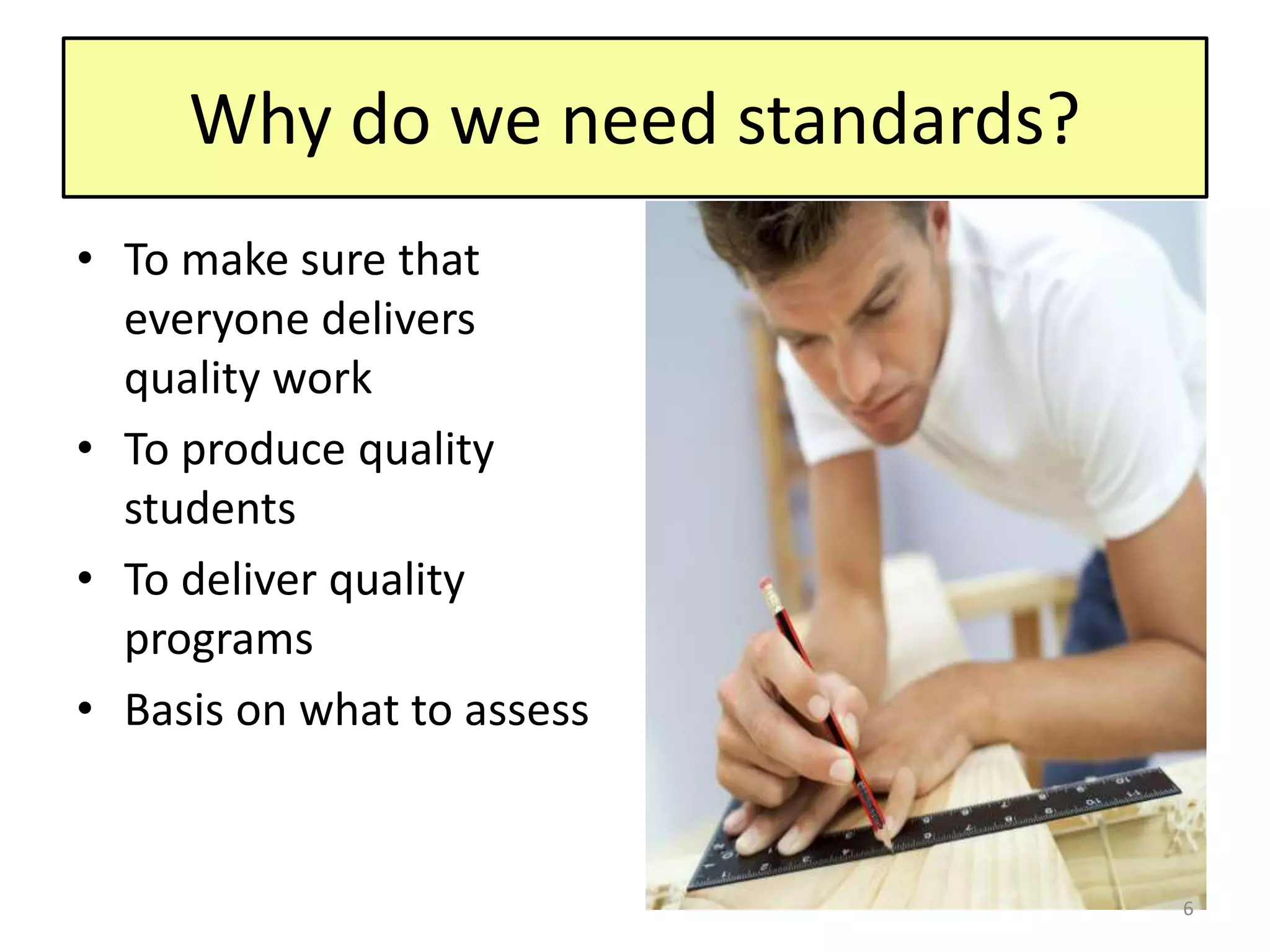
Why do we need standards?
• To make sure that
everyone delivers
quality work
• To produce quality
students
• To deliver quality
programs
• Basis on what to assess
6
Mathematics Standards for Junior HS
• Algebra
– explore the concepts involving a quadratic
function and its graph and solve problems
involving quadratic functions and equations.
– solve equations involving rational expressions
– explore relationships of quantities that involve
variation and solve problems involving direct,
indirect and joint variation
7
Mathematics Standards for Junior HS
– simplify expressions with rational exponents and
solve problems involving them.
– perform fundamental operations on expressions
involving radicals and solve problems involving
expressions and equations with radicals.
8
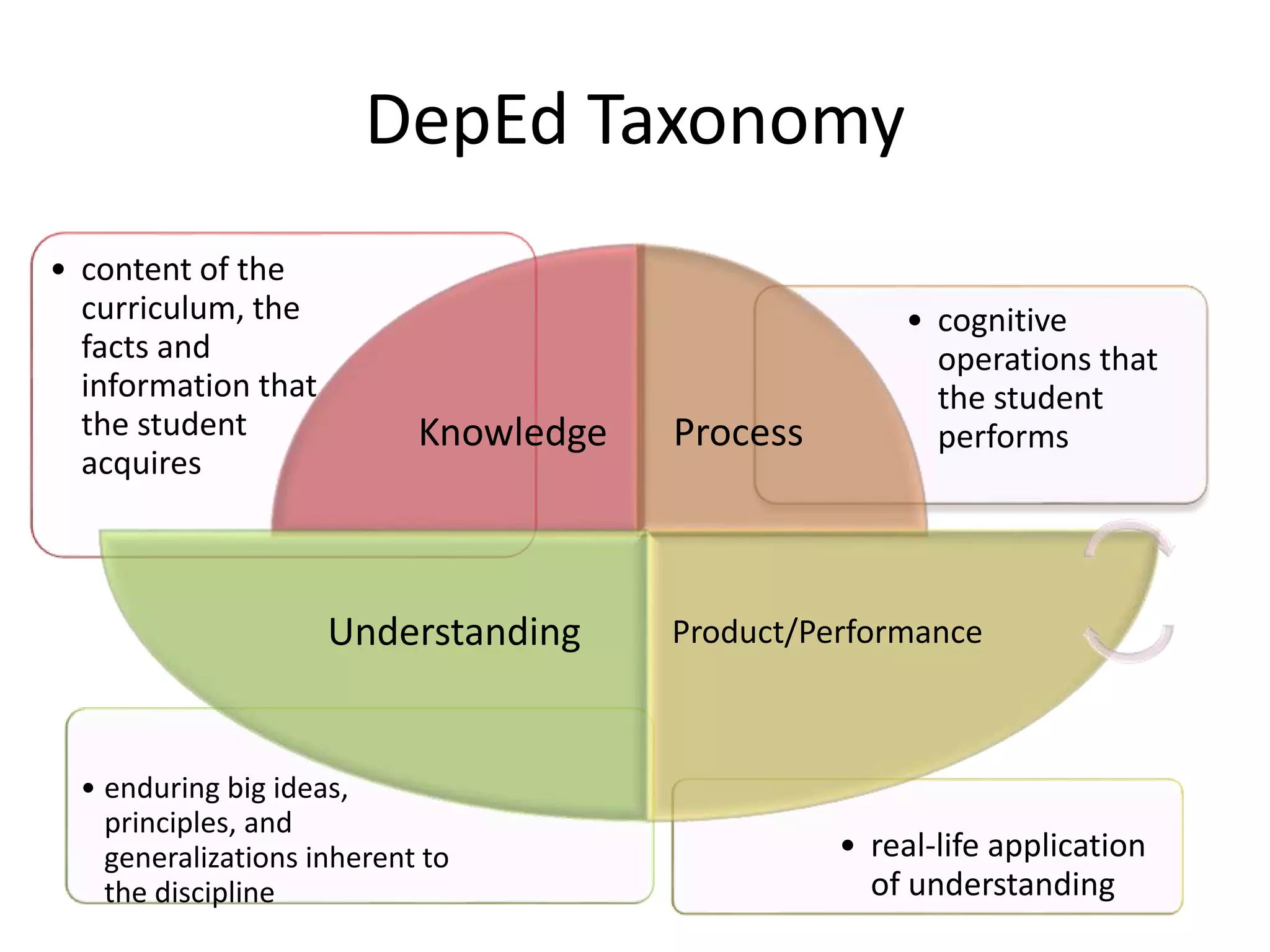
DepEd Taxonomy
• real-life application
of understanding
• enduring big ideas,
principles, and
generalizations inherent to
the discipline
• cognitive
operations that
the student
performs
• content of the
curriculum, the
facts and
information that
the student
acquires
Knowledge Process
Product/PerformanceUnderstanding
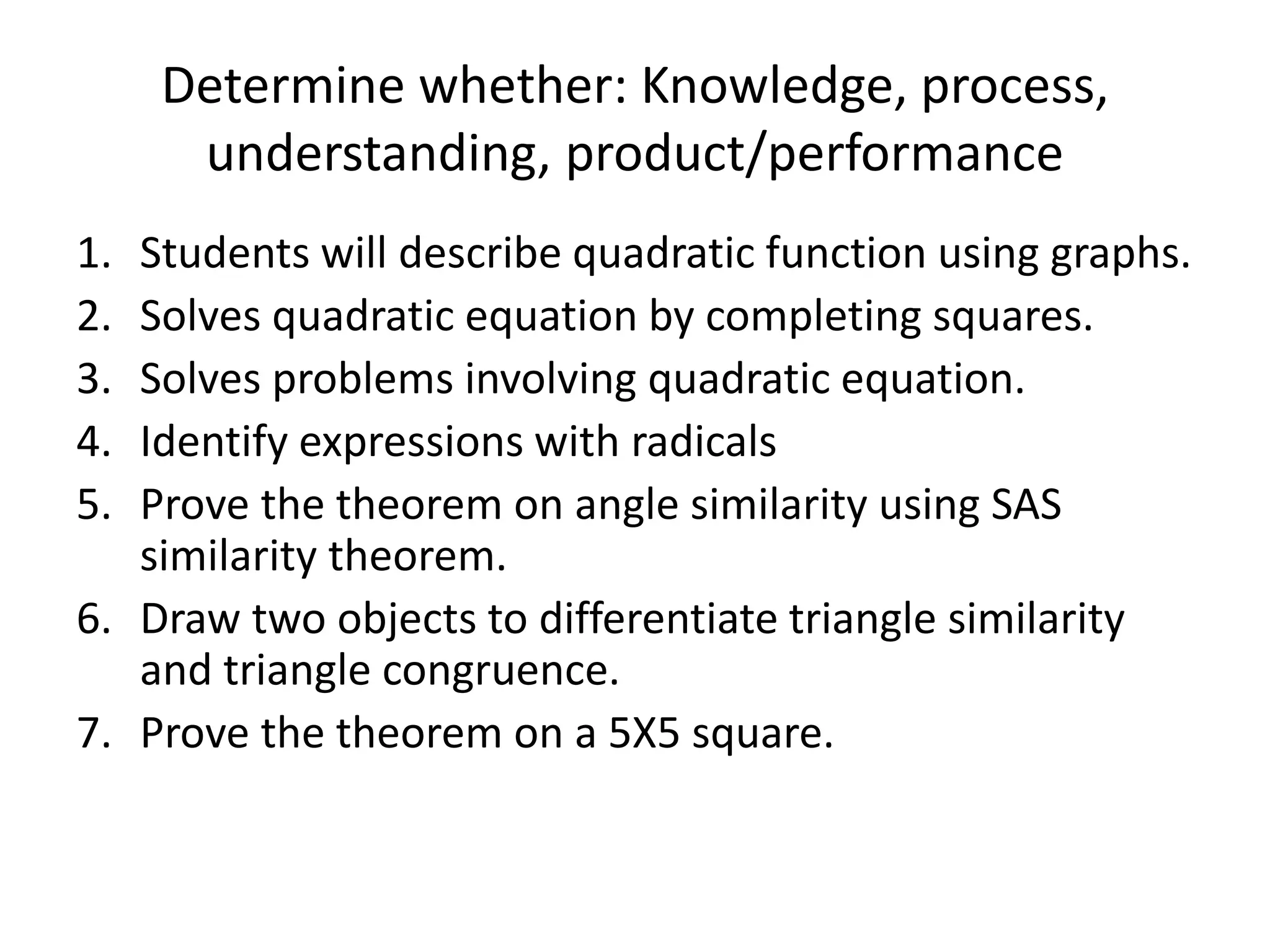
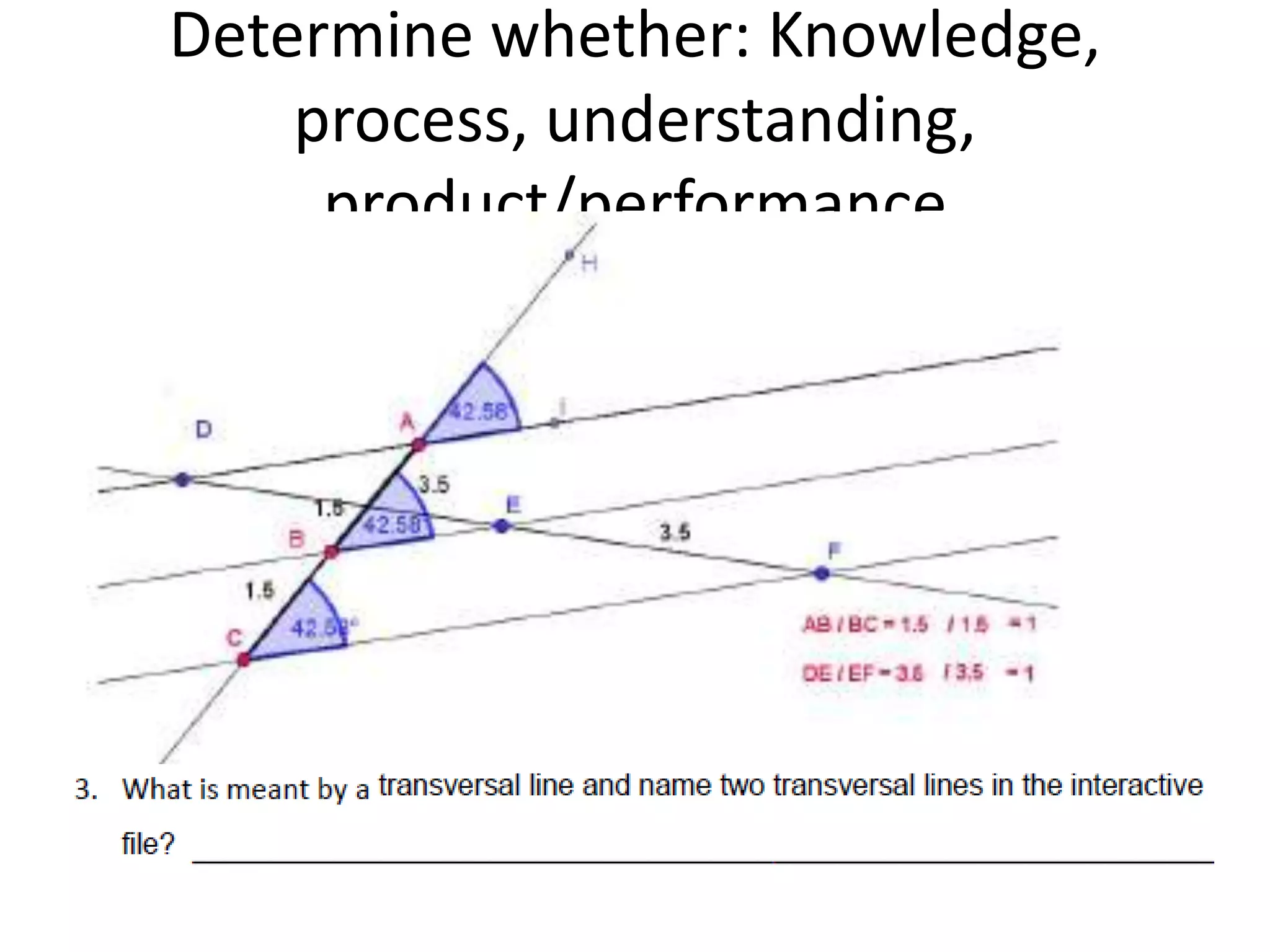
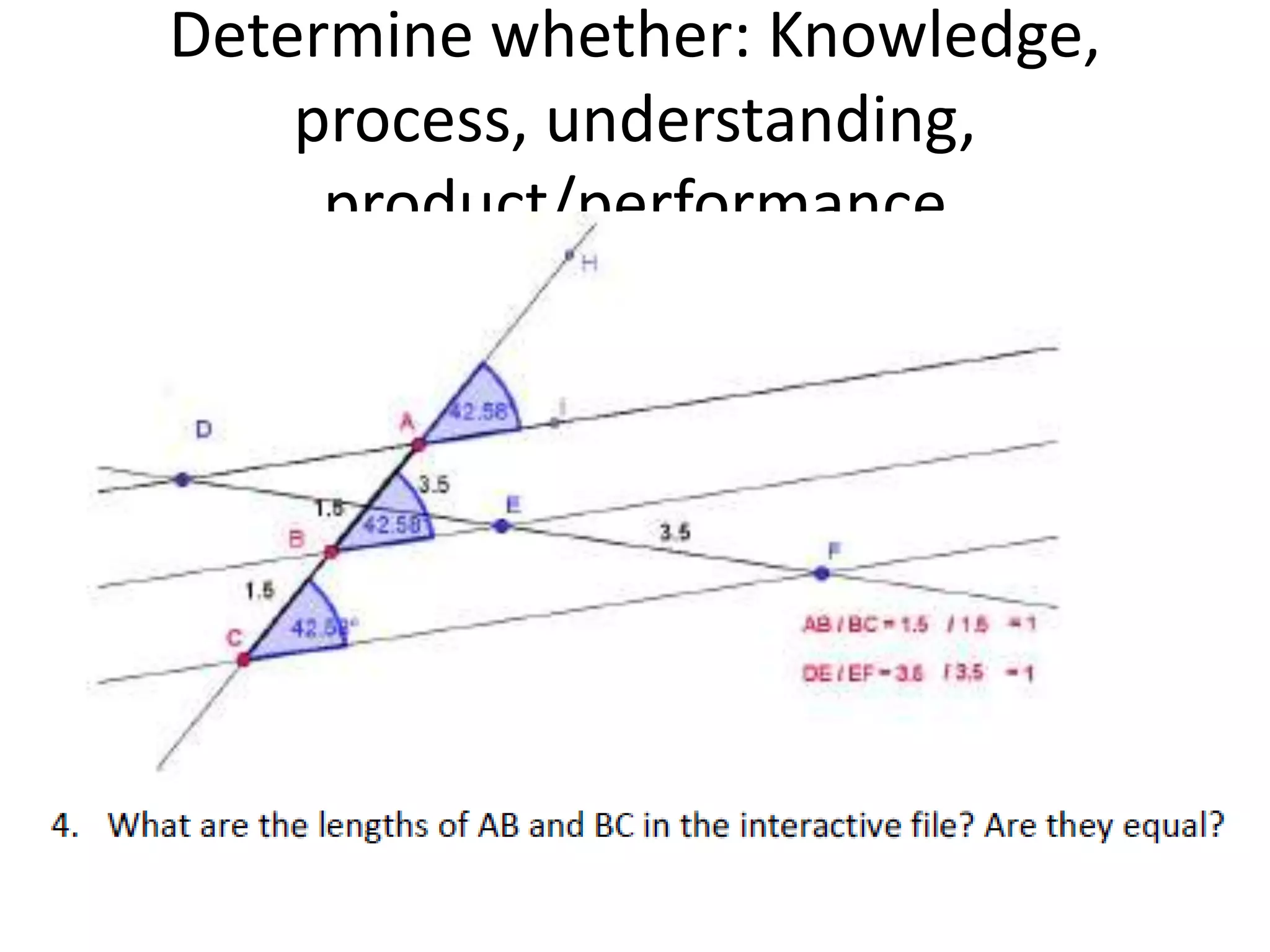
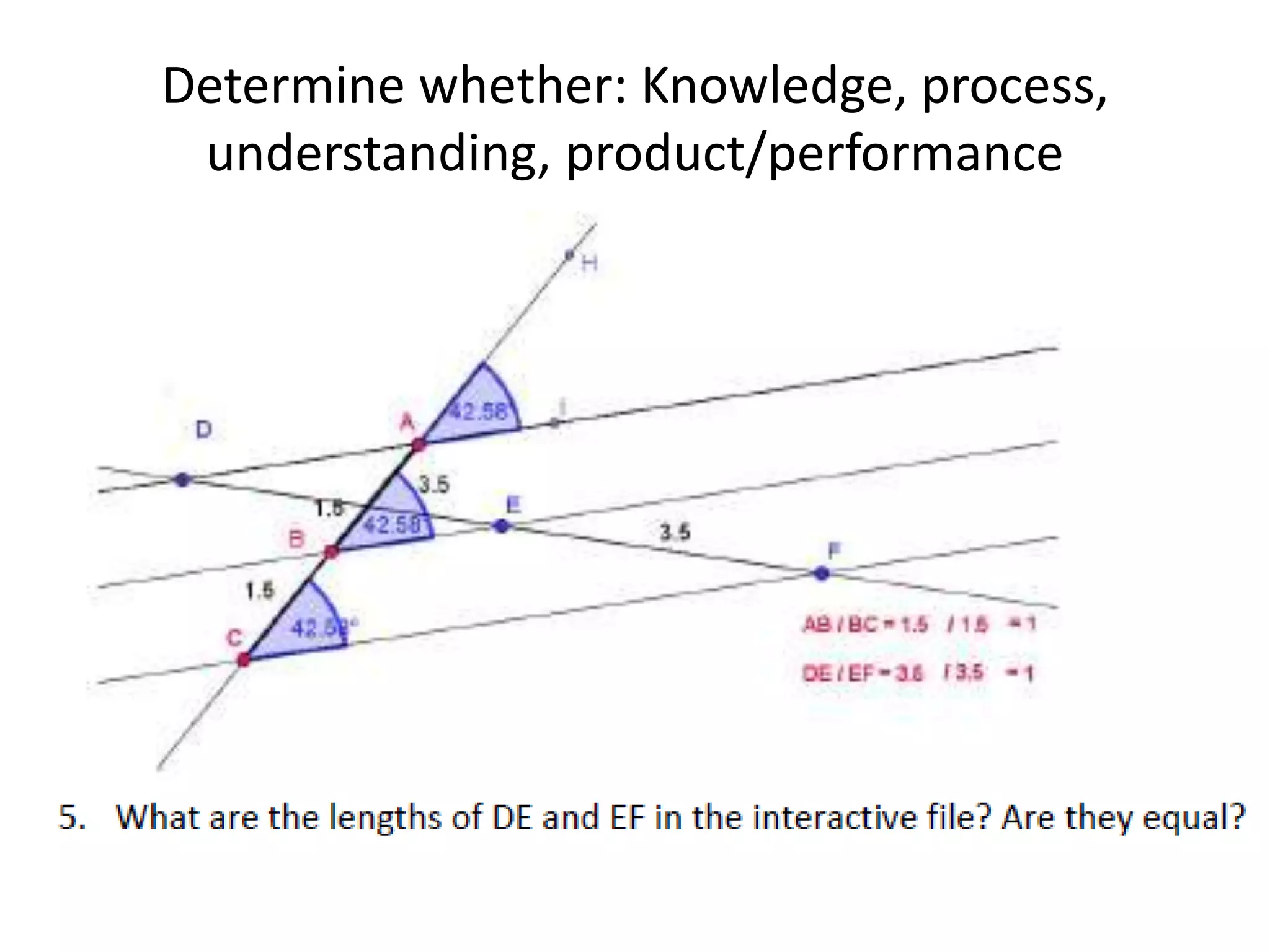
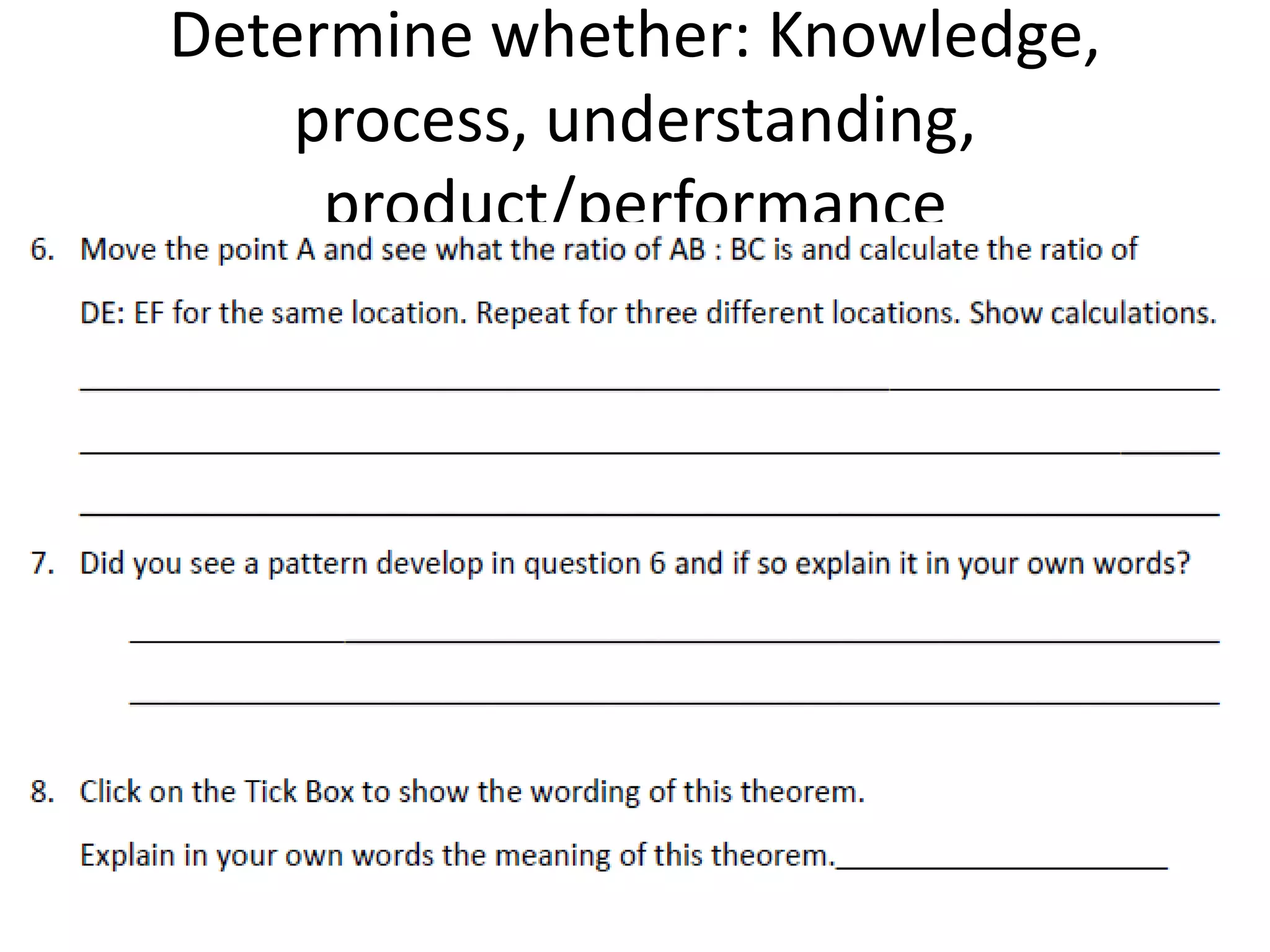
Determine whether: Knowledge, process,
understanding, product/performance
1. Students will describe quadratic function using graphs.
2. Solves quadratic equation by completing squares.
3. Solves problems involving quadratic equation.
4. Identify expressions with radicals
5. Prove the theorem on angle similarity using SAS
similarity theorem.
6. Draw two objects to differentiate triangle similarity
and triangle congruence.
7. Prove the theorem on a 5X5 square.
7. Determine the trigonometric ratio of special
triangles
8. Creates a graph of an arithmetic sequence.
9. Give examples of polynomial functions
10.Draw a circle and illustrate 5 different chords.
Determine whether: Knowledge,
process, understanding,
product/performance
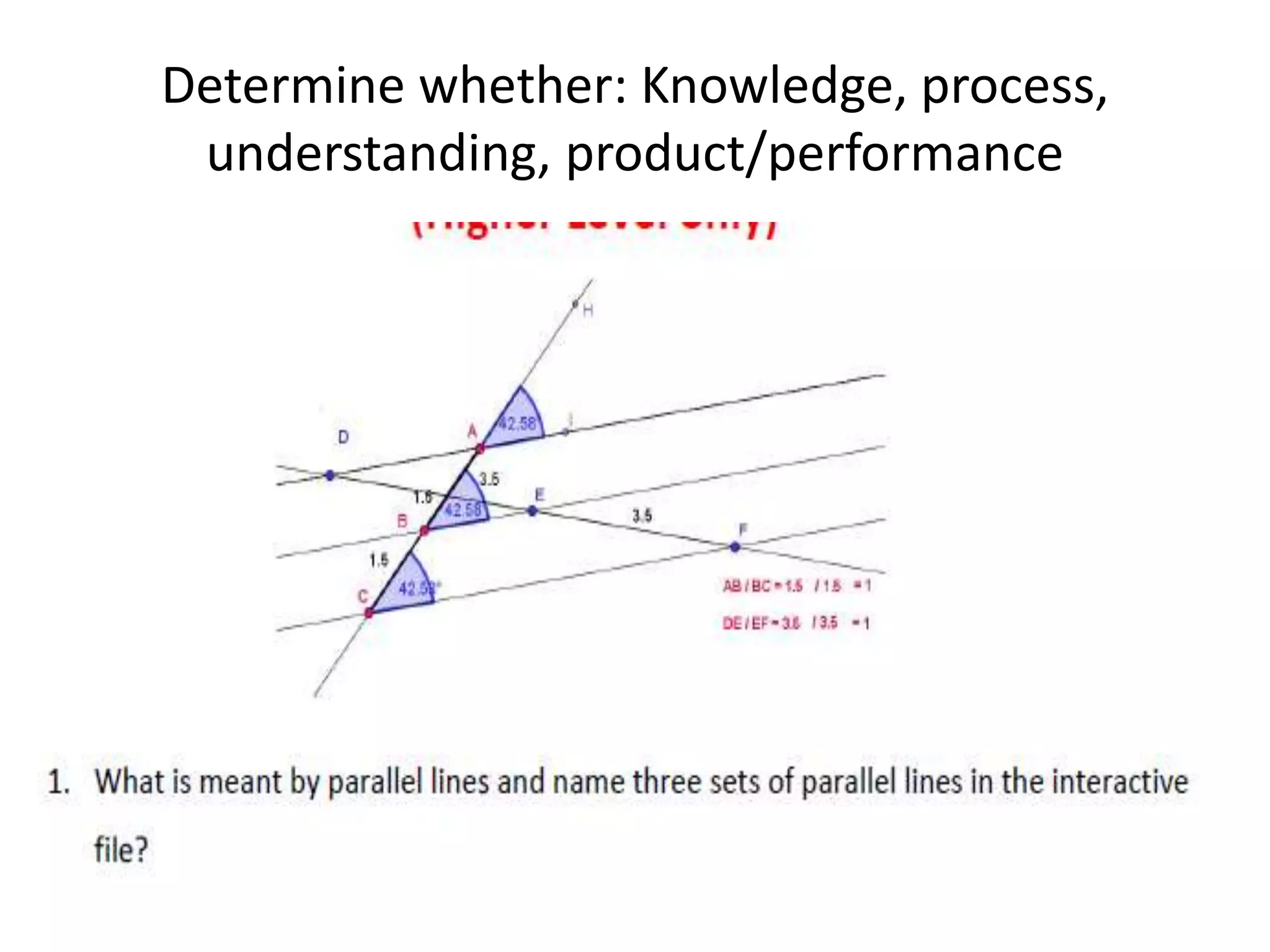
Determine whether: Knowledge, process,
understanding, product/performance
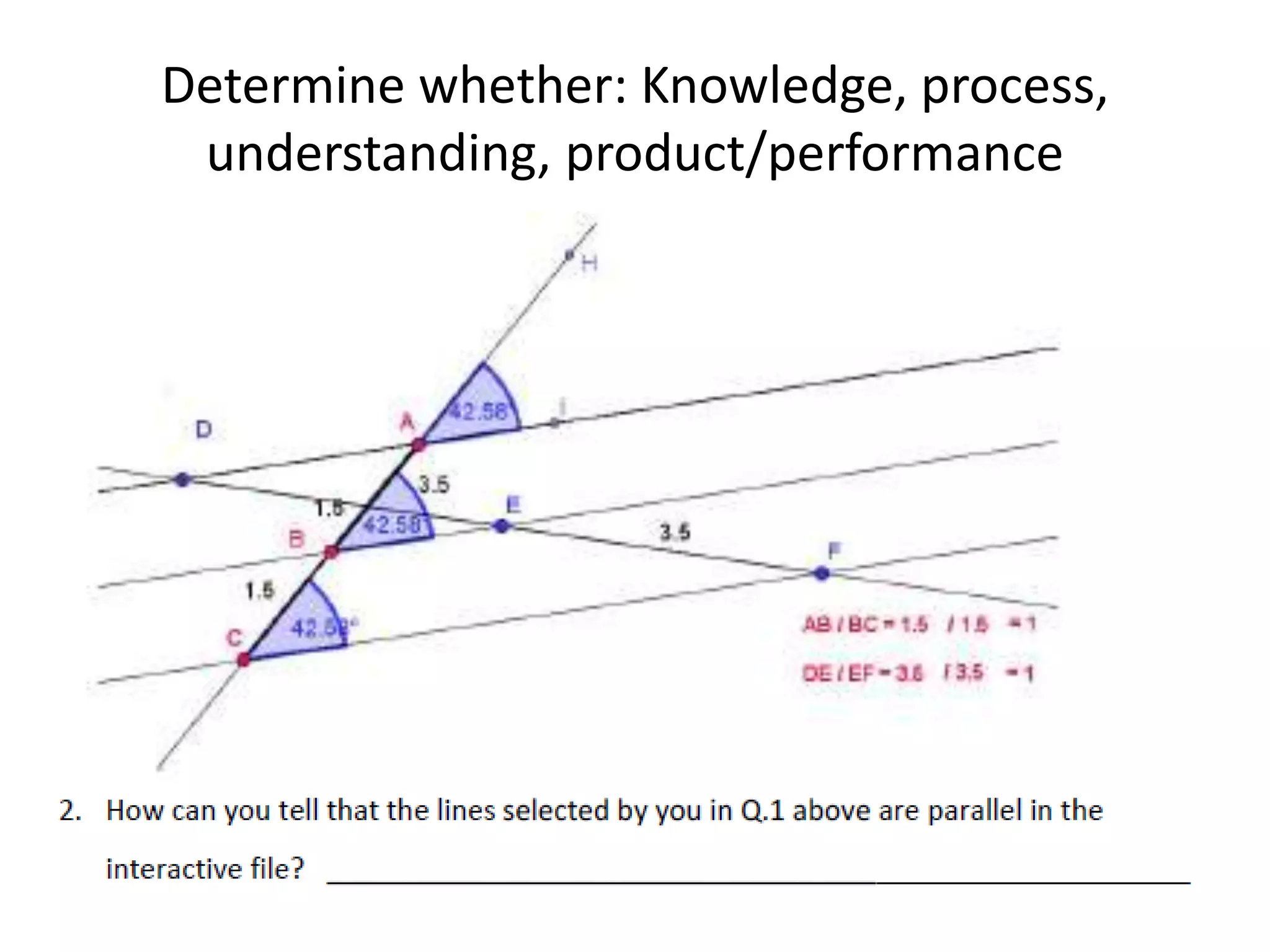
Determine whether: Knowledge, process,
understanding, product/performance
Determine whether: Knowledge,
process, understanding,
product/performance
Determine whether: Knowledge,
process, understanding,
product/performance
Determine whether: Knowledge, process,
understanding, product/performance
Determine whether: Knowledge,
process, understanding,
product/performance
Knowledge
• Define
• Describe
• Identify
• Label
• Enumerate
• Match
• Outline
• select
• State
• Name
• reproduce
18
Six Facets of Understanding
Explain - provide thorough and justifiable accounts of
phenomena, facts, and data
Interpret — tell meaningful stories, offer apt translations,
provide a revealing historical or personal dimension to ideas
and events; make subjects personal or accessible through
images, anecdotes, analogies, and models
Apply — effectively use and adapt what they know in diverse
contexts
Have perspective — see and hear points of view through
critical eyes and ears; see the big picture
Empathize — find value in what others might find odd, alien,
or implausible; perceive sensitively on the basis of prior
indirect experience
Have self-knowledge — perceive the personal style,
prejudices, projections, and habits of mind that both shape
and impede our own understanding; they are aware of what
they do not understand and why understanding is so hard
Explain
Which of the following statements of the relationship
between market price and normal price is true?
a. Over a short period of time, market price varies directly
with changes in normal price.
b. Over a long period of time, market price tends to equal
normal price.
c. Market price is usually lower than normal price.
d. Over a long period of time, market price determines
normal price.
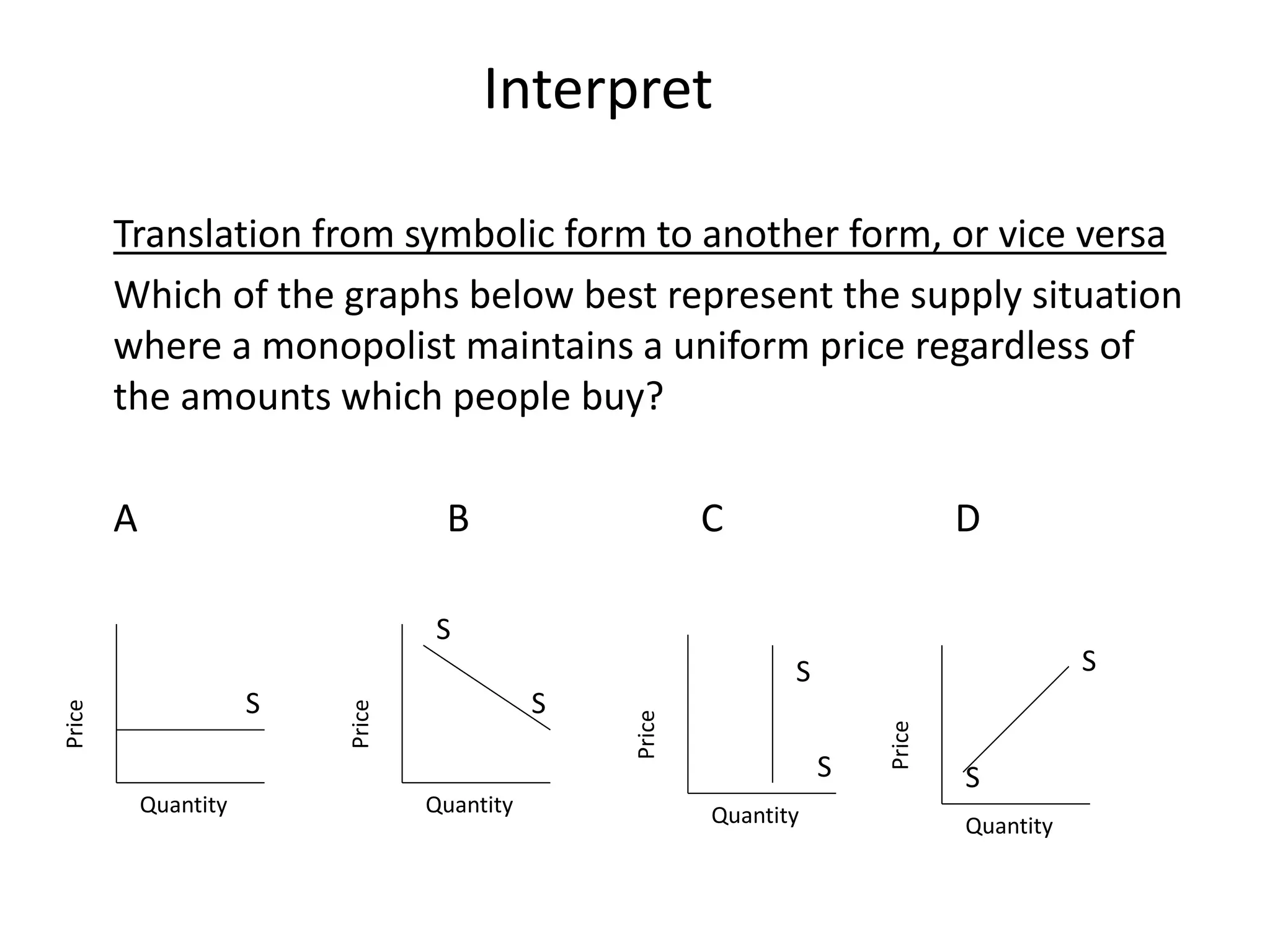
Translation from symbolic form to another form, or vice versa
Which of the graphs below best represent the supply situation
where a monopolist maintains a uniform price regardless of
the amounts which people buy?
A B C D
S
Price
Quantity
S
Price
Quantity
S
S
Price
Quantity
S S
Price
Quantity
S
Interpret
Apply
In the following items (4-8) you are to judge the effects of a particular policy on the
distribution of income. In each case assume that there are no other changes in
policy that would counteract the effect of the policy described in the item. Mark
the item:
A. If the policy described would tend to reduce the existing degree of inequality in
the distribution of income,
B. If the policy described would tend to increase the existing degree of inequality
in the distribution of income, or
C. If the policy described would have no effect, or an indeterminate effect, on the
distribution of income.
__ 4. Increasingly progressive income taxes.
__ 5. Confiscation of rent on unimproved
__ 6. Introduction of a national sales tax
__ 7. Increasing the personal exemptions from income taxes
__ 8. Distributing a subsidy to sharecroppers on southern farms
Have perspective
After reading the passage answer the following questions…
1. Where was Carol walking?
a. park
b. beach
c. mall
d. city hall
2. How did she feel on this walk?
a. envied
b. sad
c. relaxed
d. happy
Have perspective
3. Carol envied the people around her because they
_____________________.
a. were sad and lonely
b. love the city life
c. were laughing and joking
d. don’t like the city
Empathize
• Your new maid from the mountain destroyed
your very expensive Narra door and she used
it as firewood and cooked rice in your newly
landscaped garden. How should you react?
• A…
• B…
• C…
• D…
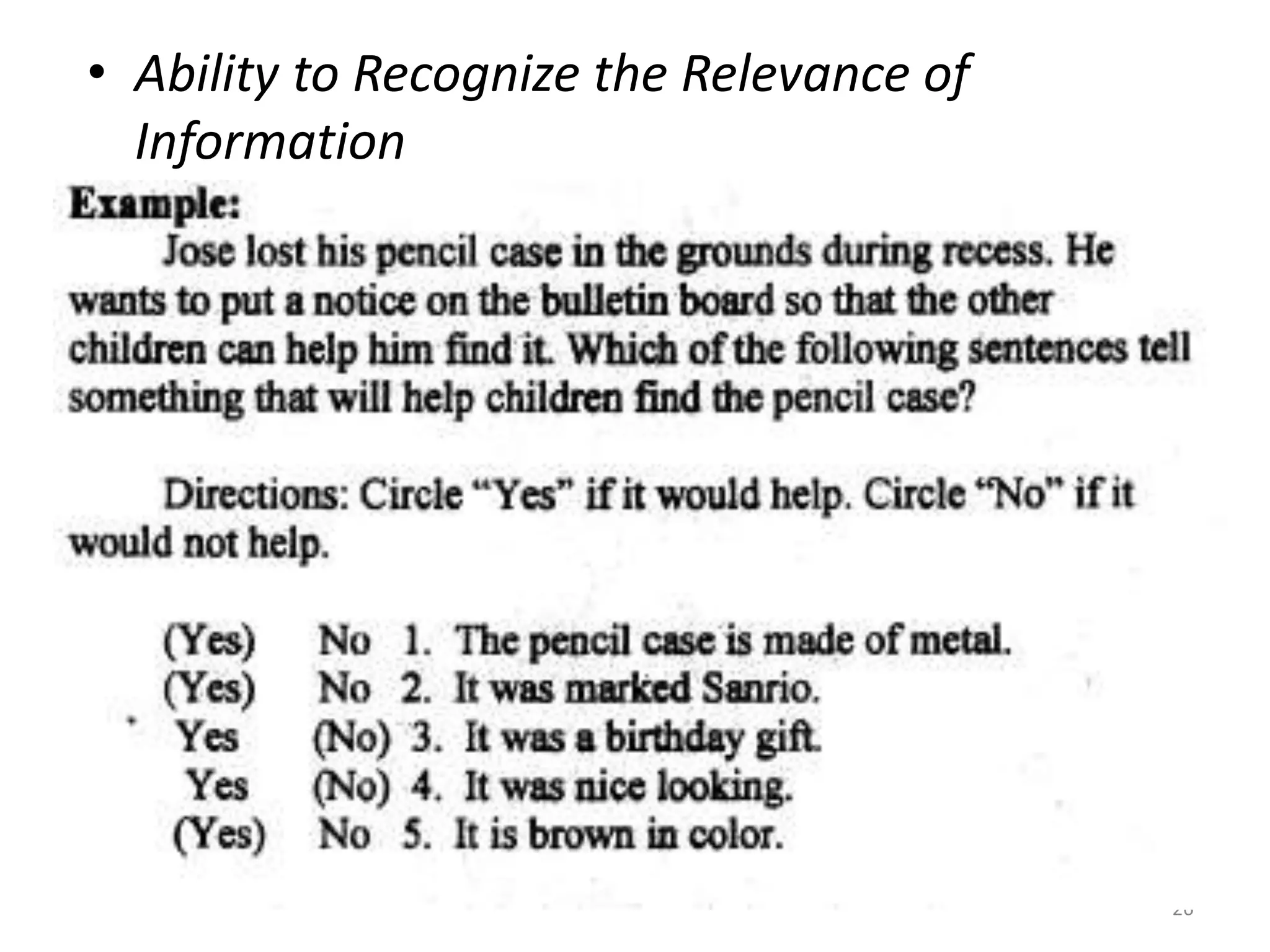
• Ability to Recognize the Relevance of
Information
26
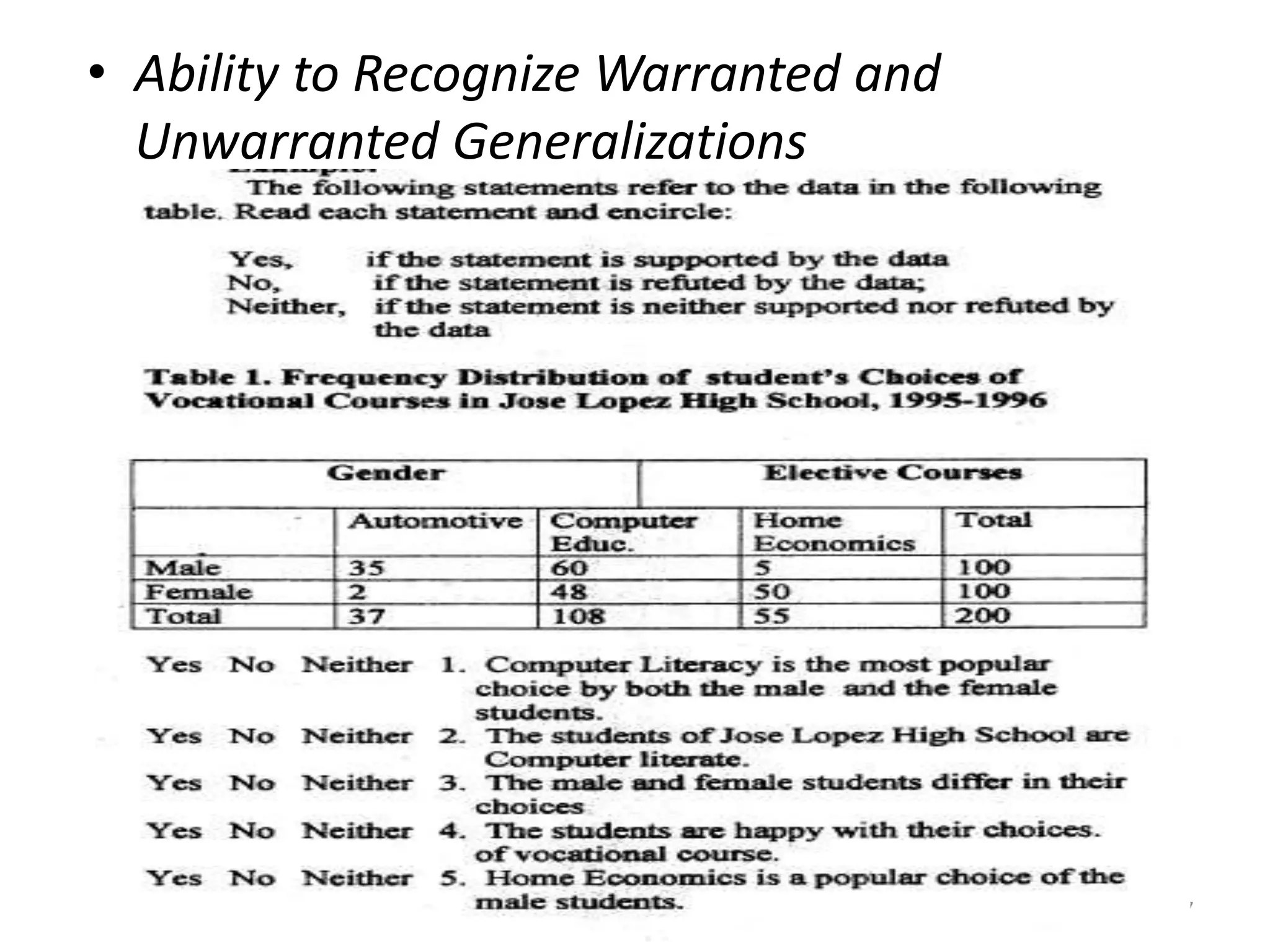
• Ability to Recognize Warranted and
Unwarranted Generalizations
27
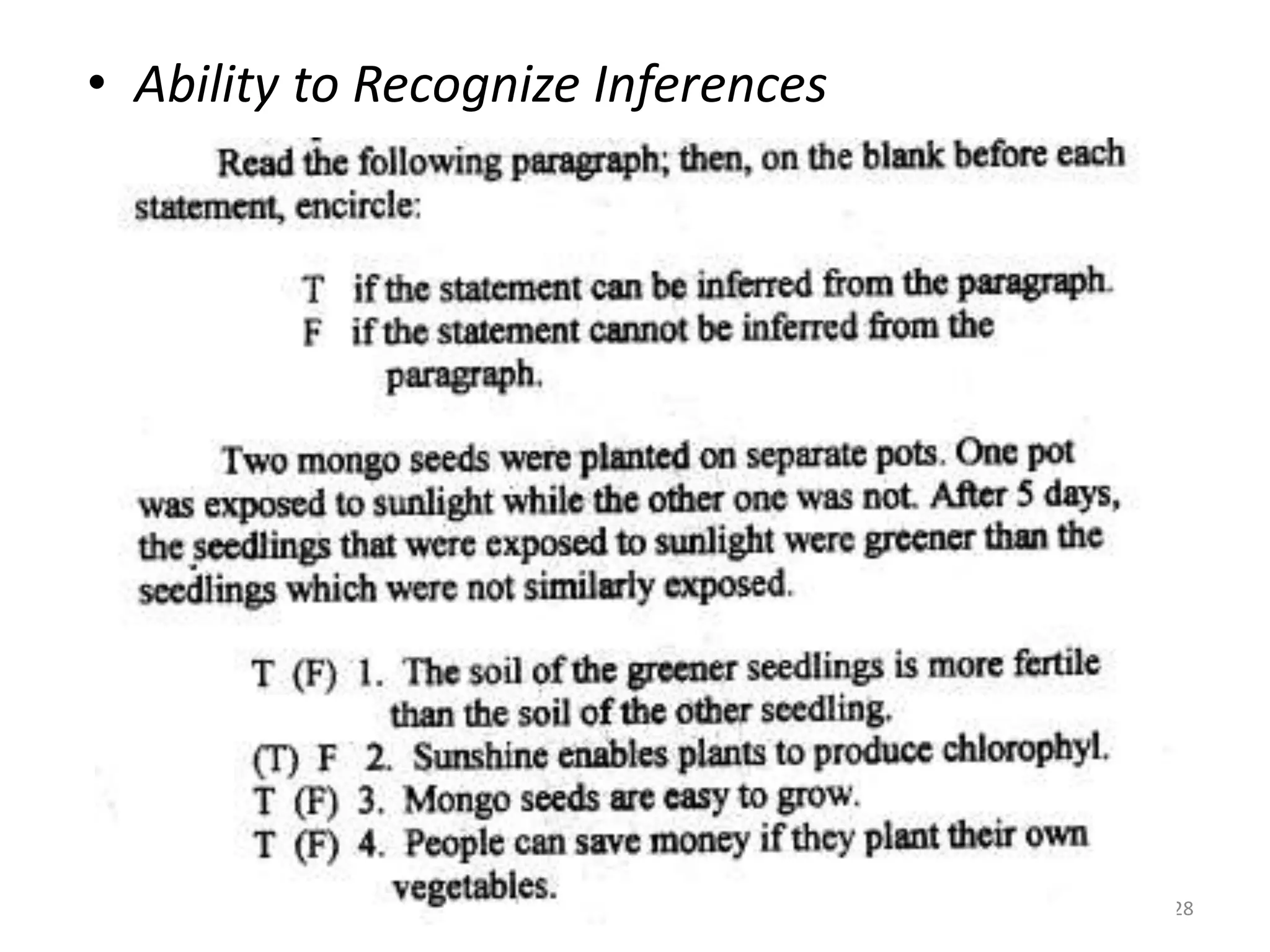
• Ability to Recognize Inferences
28
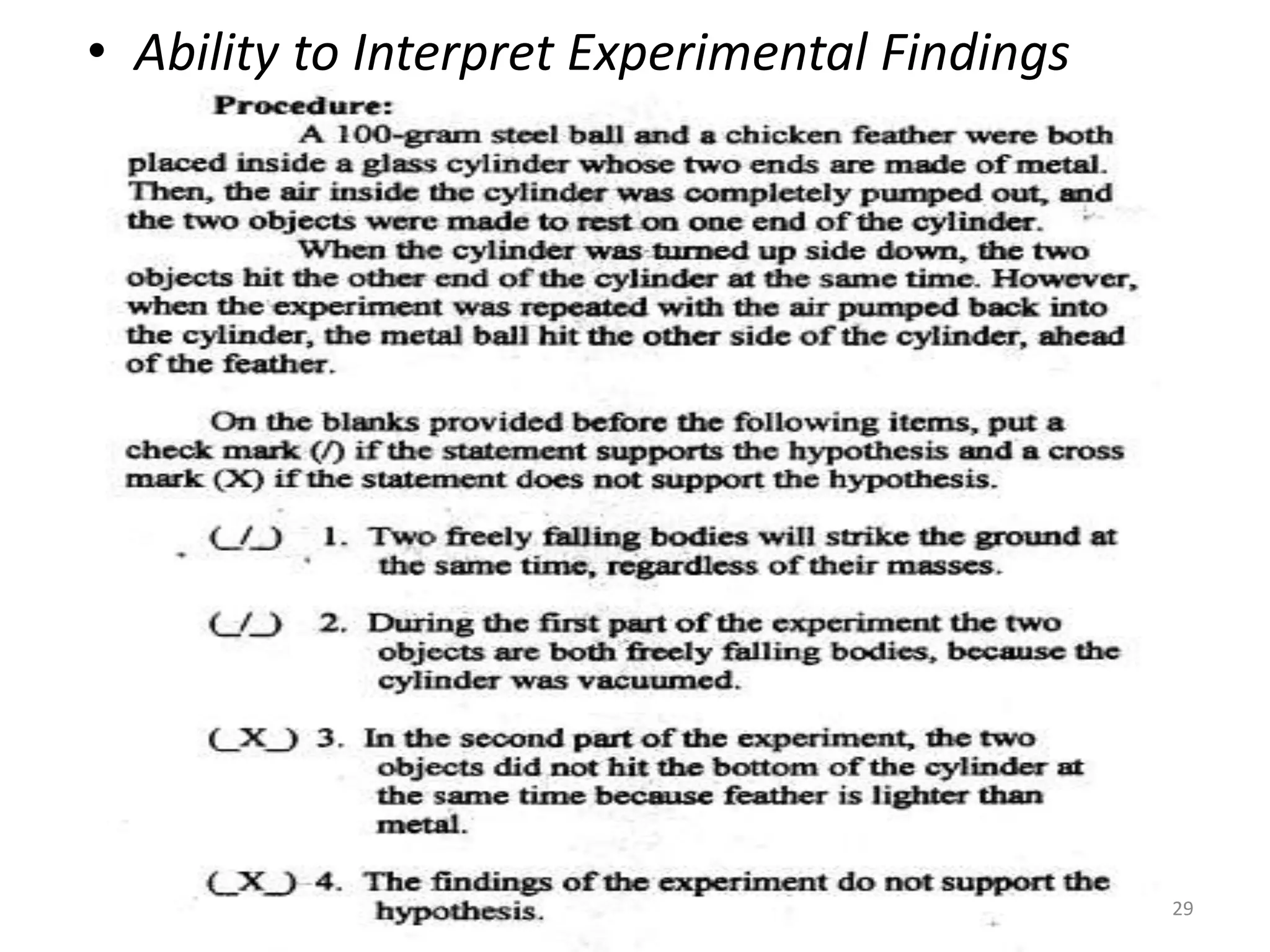
• Ability to Interpret Experimental Findings
29
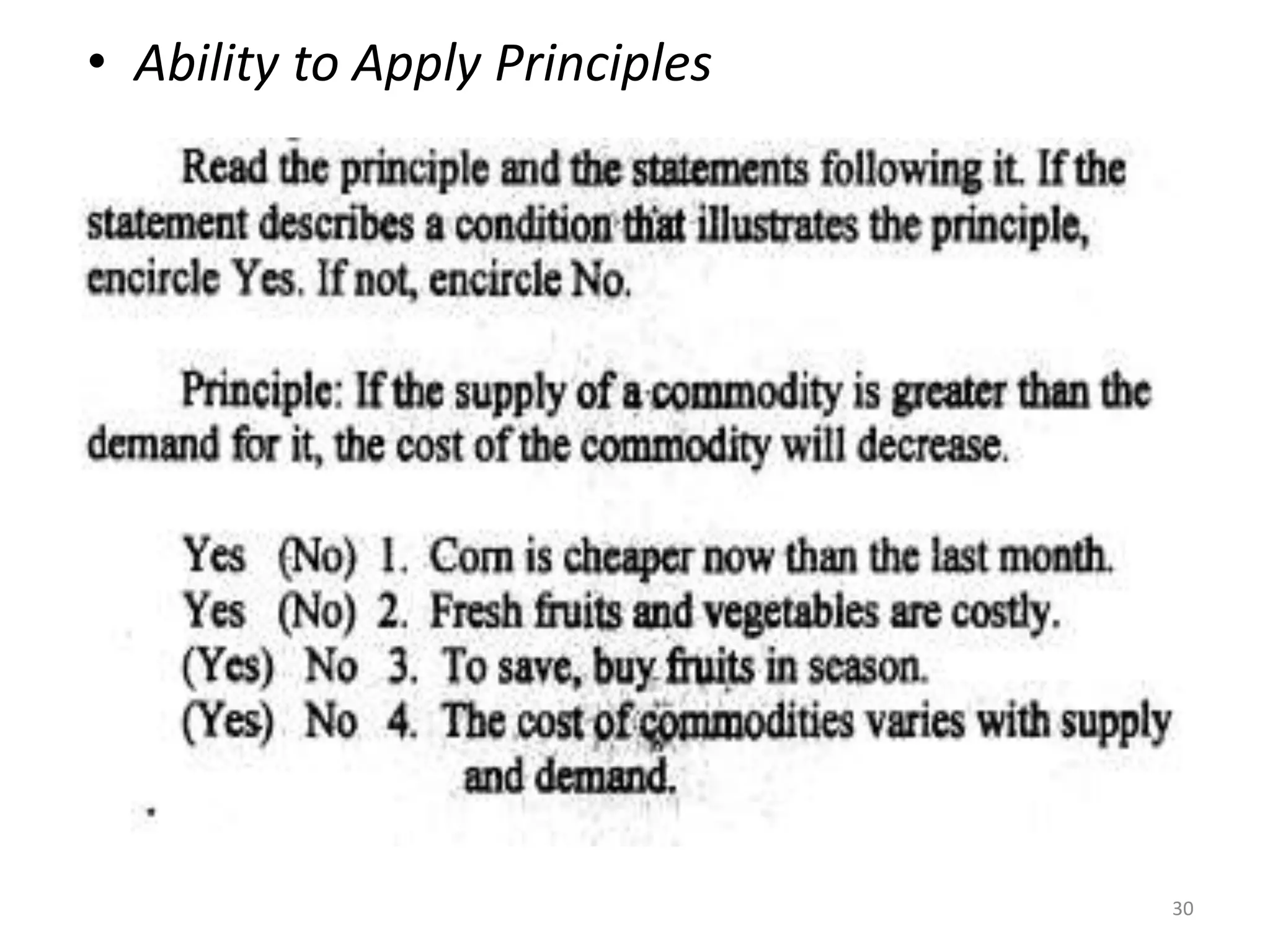
• Ability to Apply Principles
30
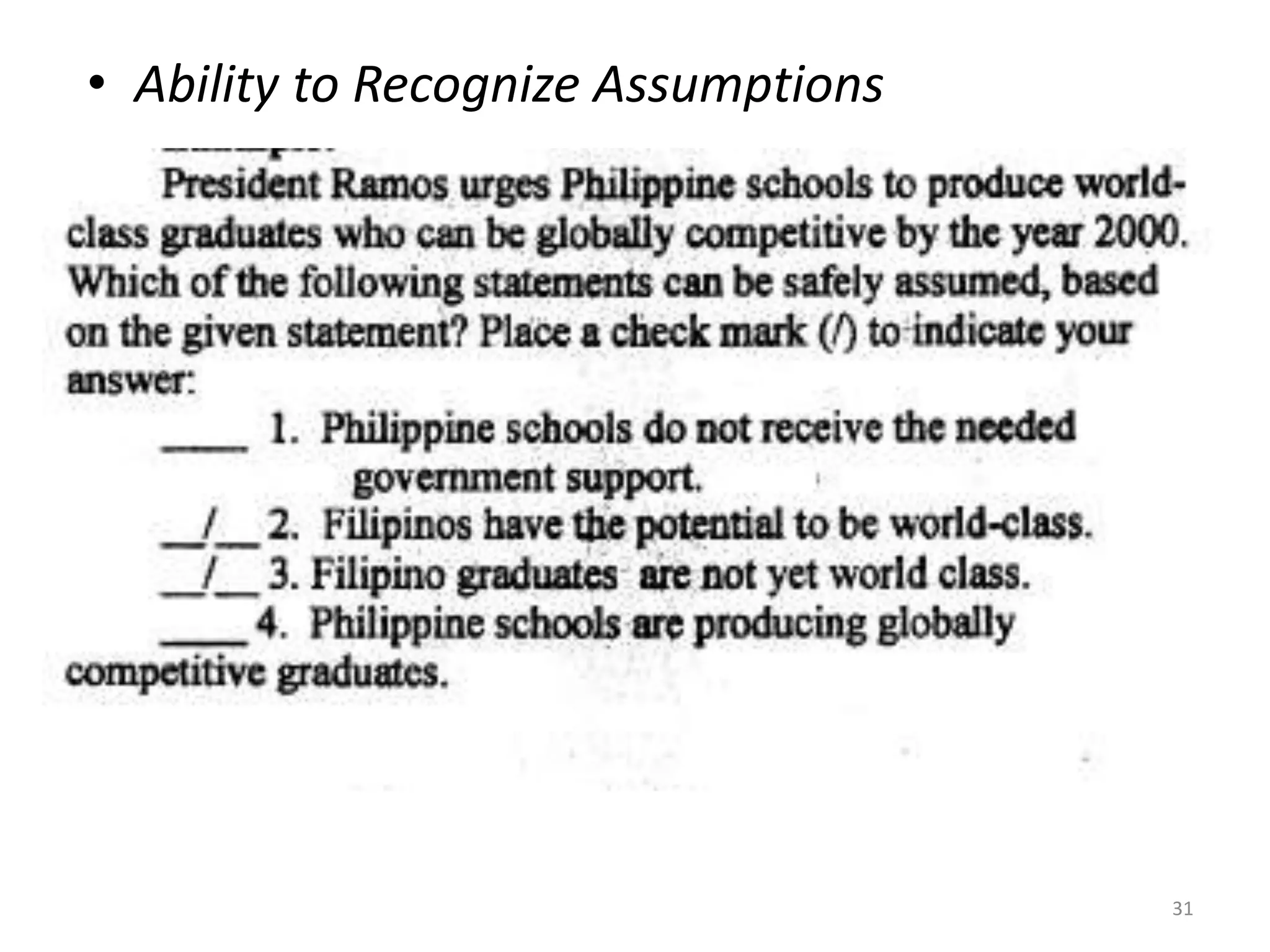
• Ability to Recognize Assumptions
31
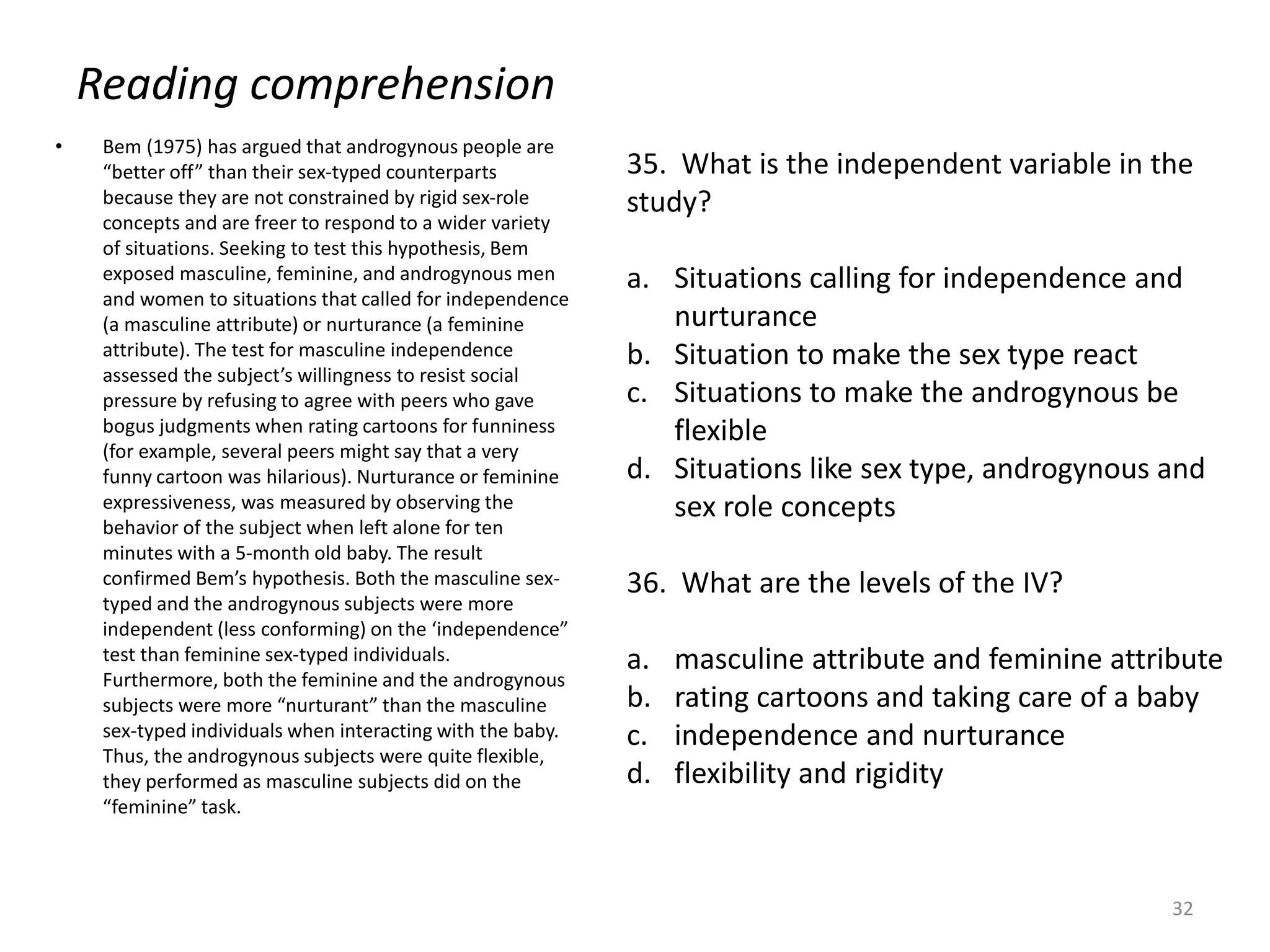
Reading comprehension
• Bem (1975) has argued that androgynous people are
“better off” than their sex-typed counterparts
because they are not constrained by rigid sex-role
concepts and are freer to respond to a wider variety
of situations. Seeking to test this hypothesis, Bem
exposed masculine, feminine, and androgynous men
and women to situations that called for independence
(a masculine attribute) or nurturance (a feminine
attribute). The test for masculine independence
assessed the subject’s willingness to resist social
pressure by refusing to agree with peers who gave
bogus judgments when rating cartoons for funniness
(for example, several peers might say that a very
funny cartoon was hilarious). Nurturance or feminine
expressiveness, was measured by observing the
behavior of the subject when left alone for ten
minutes with a 5-month old baby. The result
confirmed Bem’s hypothesis. Both the masculine sex-
typed and the androgynous subjects were more
independent (less conforming) on the ‘independence”
test than feminine sex-typed individuals.
Furthermore, both the feminine and the androgynous
subjects were more “nurturant” than the masculine
sex-typed individuals when interacting with the baby.
Thus, the androgynous subjects were quite flexible,
they performed as masculine subjects did on the
“feminine” task.
32
35. What is the independent variable in the
study?
a. Situations calling for independence and
nurturance
b. Situation to make the sex type react
c. Situations to make the androgynous be
flexible
d. Situations like sex type, androgynous and
sex role concepts
36. What are the levels of the IV?
a. masculine attribute and feminine attribute
b. rating cartoons and taking care of a baby
c. independence and nurturance
d. flexibility and rigidity
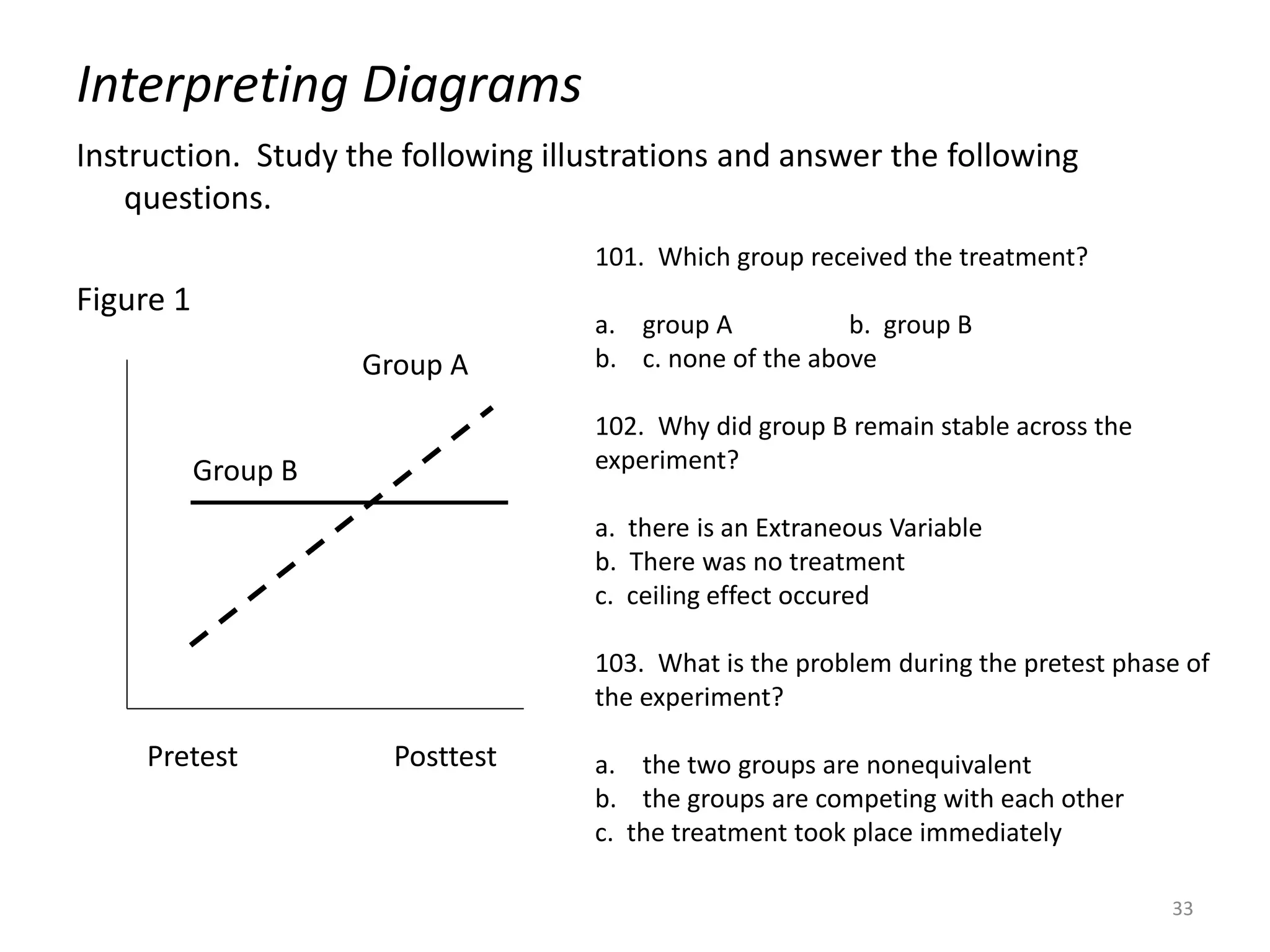
Interpreting Diagrams
Instruction. Study the following illustrations and answer the following
questions.
Figure 1
33
Pretest Posttest
101. Which group received the treatment?
a. group A b. group B
b. c. none of the above
102. Why did group B remain stable across the
experiment?
a. there is an Extraneous Variable
b. There was no treatment
c. ceiling effect occured
103. What is the problem during the pretest phase of
the experiment?
a. the two groups are nonequivalent
b. the groups are competing with each other
c. the treatment took place immediately
Group B
Group A
Process
• Cognitive operations
• Cognitive and Metacognitive skills
• Self-regulation
• Learning strategies
34
Two components of Metacognition
• Knowledge of cognition is the reflective aspect of
metacognition. It is the individuals’ awareness of their
own knowledge, learning preferences, styles, strengths,
and limitations, as well as their awareness of how to use
this knowledge that can determine how well they can
perform different tasks (de Carvalho, Magno, Lajom,
Bunagan, & Regodon, 2005).
• Regulation of cognition on the other hand is the control
aspect of learning. It is the procedural aspect of
knowledge that allows effective linking of actions needed
to complete a given task (Carvalho & Yuzawa, 2001).
Components of Metacogniton
Knowledge of Cognition
• (1) Declarative knowledge – knowledge
about one’s skills, intellectual resources,
and abilities as a learner.
• (2) Procedural knowledge – knowledge
about how to implement learning
procedures (strategies)
• (3) Conditional knowledge – knowledge
about when and why to use learning
procedures.
Examples of knowledge of cognition in
Mathematical Investigation
• Declarative Knowledge
– Knowing what is needed to be solved
– Understanding ones intellectual strengths and
weaknesses in solving math problems
• Procedural knowledge
– Awareness of what strategies to use when solving
math problems
– Have a specific purpose of each strategy to use
• Conditional knowledge
– Solve better if the case is relevant
– Use different learning strategies depending
on the type of problem
Components of Metacogniton
Regulation of cognition
1) Planning – planning, goal setting, and allocating
resources prior to learning.
(2) Information Management Strategies – skills and
strategy sequences used on- line to process
information more effectively (organizing,
elaborating, summarizing, selective focusing).
(3) Monitoring – Assessing one’s learning or strategy
use.
(4) Debugging Strategies – strategies used to correct
comprehension and performance errors
(5) Evaluation of learning – analysis of performance
and strategy effectiveness after learning episodes.
Examples of regulation of cognition
• Planning
• Pacing oneself when solving in order to have enough time
• Thinking about what really needs to be solved before beginning
a task
• Information Management Strategies
• Focusing attention to important information
• Slowing down when important information is encountered
• Monitoring
• Considering alternatives to a problem before solving
• Pause regularly to check for comprehension
• Debugging Strategies
• Ask help form others when one doesn’t understand
• Stop and go over of it is not clear
• Evaluation of learning
• Recheck after solving
• Find easier ways to do things
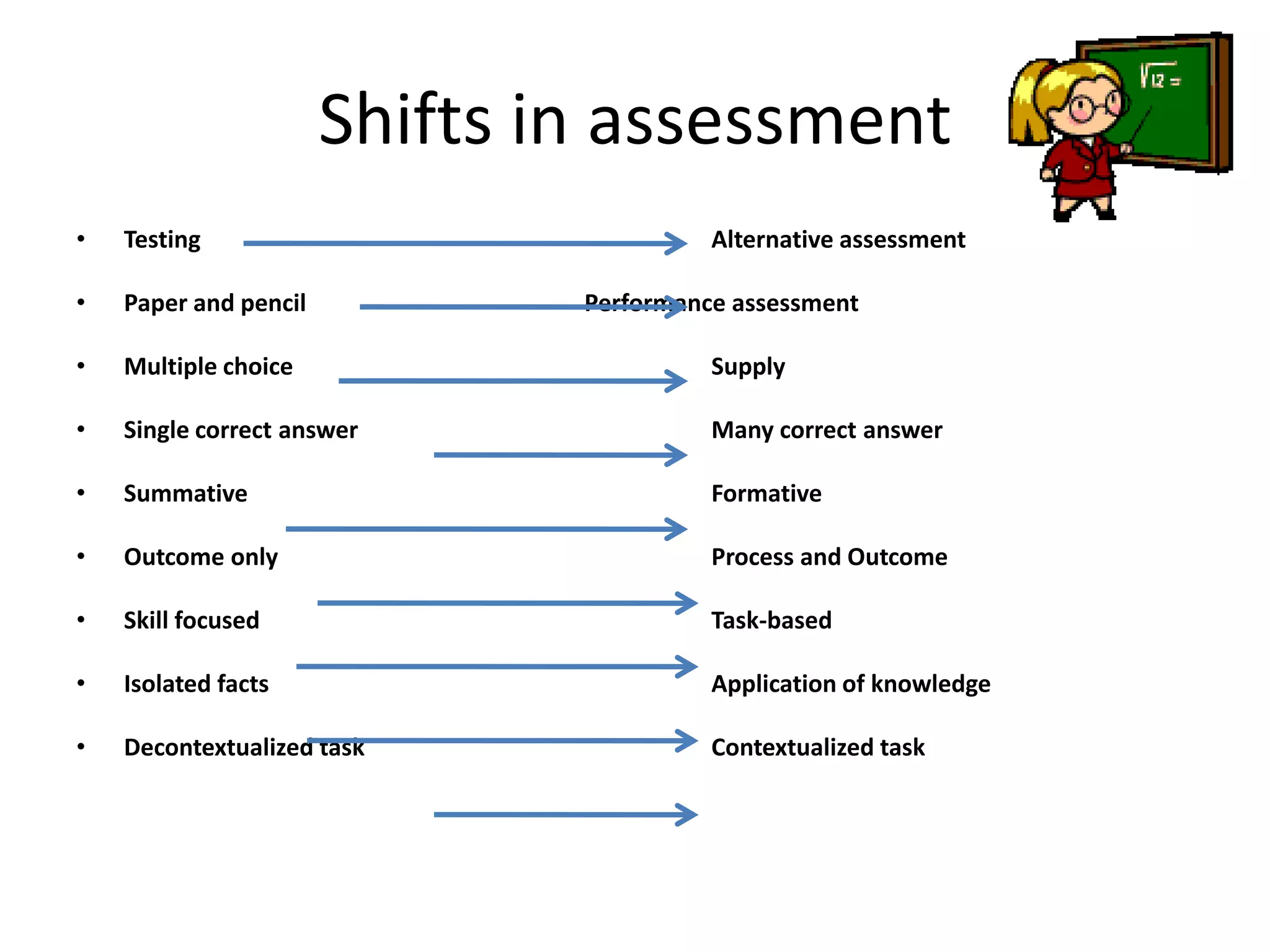
Shifts in assessment
• Testing Alternative assessment
• Paper and pencil Performance assessment
• Multiple choice Supply
• Single correct answer Many correct answer
• Summative Formative
• Outcome only Process and Outcome
• Skill focused Task-based
• Isolated facts Application of knowledge
• Decontextualized task Contextualized task
Alternative forms of assessment
• Performance based assessment
• Authentic assessment
• Portfolio assessment
Terms
• Authentic
assessment
• Direct assessment
• Alternative
assessment
• Performance testing
• Performance
assessment
• Changes are taking
place in assessment
Method
• Assessment should measure what is really
important in the curriculum.
• Assessment should look more like
instructional activities than like tests.
• Educational assessment should approximate
the learning tasks of interest, so that, when
students practice for the assessment, some
useful learning takes place.
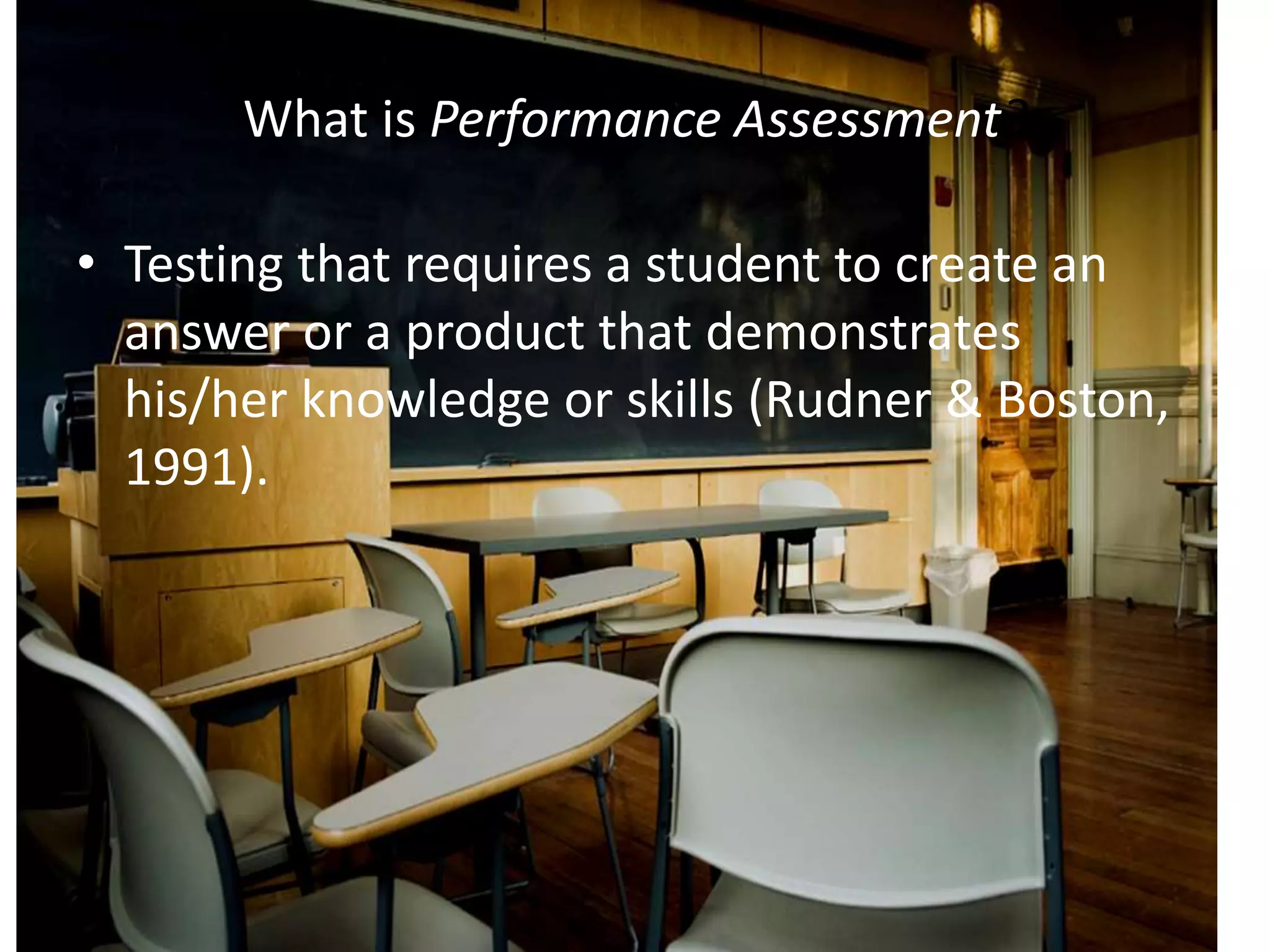
What is Performance Assessment?
• Testing that requires a student to create an
answer or a product that demonstrates
his/her knowledge or skills (Rudner & Boston,
1991).
Features of performance assessment
• Intended to assess what it is that students know and can do
with the emphasis on doing.
• Have a high degree of realism about them.
• Involve: (a) activities for which there is no correct answer, (b)
assessing groups rather than individuals, (c) testing that would
continue over an extended period of time, (d) self-evaluation
of performances.
• Likely use open-ended tasks aimed at assessing higher level
cognitive skills.
Push on performance assessment
• Bring testing methods more in line with
instruction.
• Assessment should approximate closely what
it is students should know and be able to do.
Emphasis of performance assessment
• Should assess higher level cognitive skills
rather than narrow and lower level discreet
skills.
• Direct measures of skills of interest.
Characteristics of performance-based
assessment
• Students perform, create, construct, produce, or do something.
• Deep understanding and/or reasoning skills are needed and
assessed.
• Involves sustained work, often days and weeks.
• Calls on students to explain, justify, and defend.
• Performance is directly observable.
• Involves engaging in ideas of importance and substance.
• Relies on trained assessor’s judgments for scoring
• Multiple criteria and standards are prespecified and public
• There is no single correct answer.
• If authentic, the performance is grounded in real world contexts
and constraints.
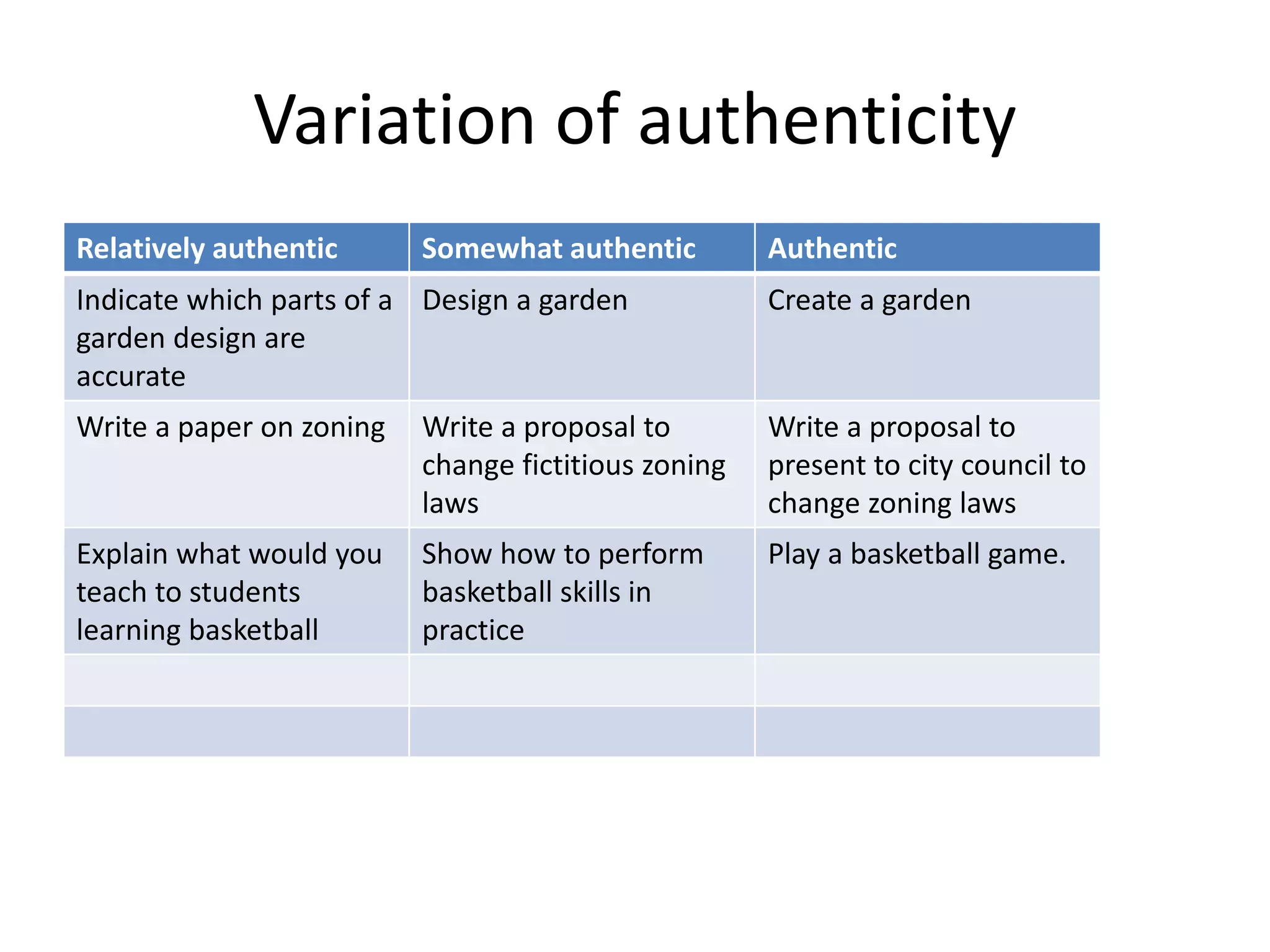
Variation of authenticity
Relatively authentic Somewhat authentic Authentic
Indicate which parts of a
garden design are
accurate
Design a garden Create a garden
Write a paper on zoning Write a proposal to
change fictitious zoning
laws
Write a proposal to
present to city council to
change zoning laws
Explain what would you
teach to students
learning basketball
Show how to perform
basketball skills in
practice
Play a basketball game.
Constructing Performance Based tasks
1. Identify the performance task in which students
will be engaged
2. Develop descriptions of the task and the context
in which the performance is to be conducted.
3. Write the specific question, prompt, or problem
that the student will receive.
• Structure: Individual or group?
• Content: Specific or integrated?
• Complexity: Restricted or extended?
Complexity of task
• Restricted-type task
– Narrowly defined and require brief responses
– Task is structured and specific
– Ex:
• Construct a bar graph from data provided
• Demonstrate a shorter conversation in French about what is on a
menu
• Read an article from the newspaper and answer questions
• Flip a coin ten times. Predict what the next ten flips of the coin will
be, and explain why.
• Listen to the evening news on television and explain if you believe
the stories are biased.
• Construct a circle, square, and triangle from provided materials
that have the same circumference.
• Extended-type task
– Complex, elaborate, and time-consuming.
– Often include collaborative work with small group of
students.
– Requires the use of a variety of information
– Examples:
• Design a playhouse and estimate cost of materials and labor
• Plan a trip to another country: Include the budget and itinerary,
and justify why you want to visit certain places
• Conduct a historical reenactment (e. g. impeachment trial of
ERAP)
• Diagnose and repair a car problem
• Design an advertising campaign for a new or existing product
Identifying Performance Task
Description
• Prepare a task description
• Listing of specifications to ensure that essential if
criteria are met
• Includes the ff.:
– Content and skill targets to be assessed
– Description of student activities
• Group or individual
• Help allowed
– Resources needed
– Teacher role
– Administrative process
– Scoring procedures
Performance-based Task Question
Prompt
• Task prompts and questions will be based on
the task descriptions.
• Clearly identifies the outcomes, outlines what
the students are encourage dot do, explains
criteria for judgment.
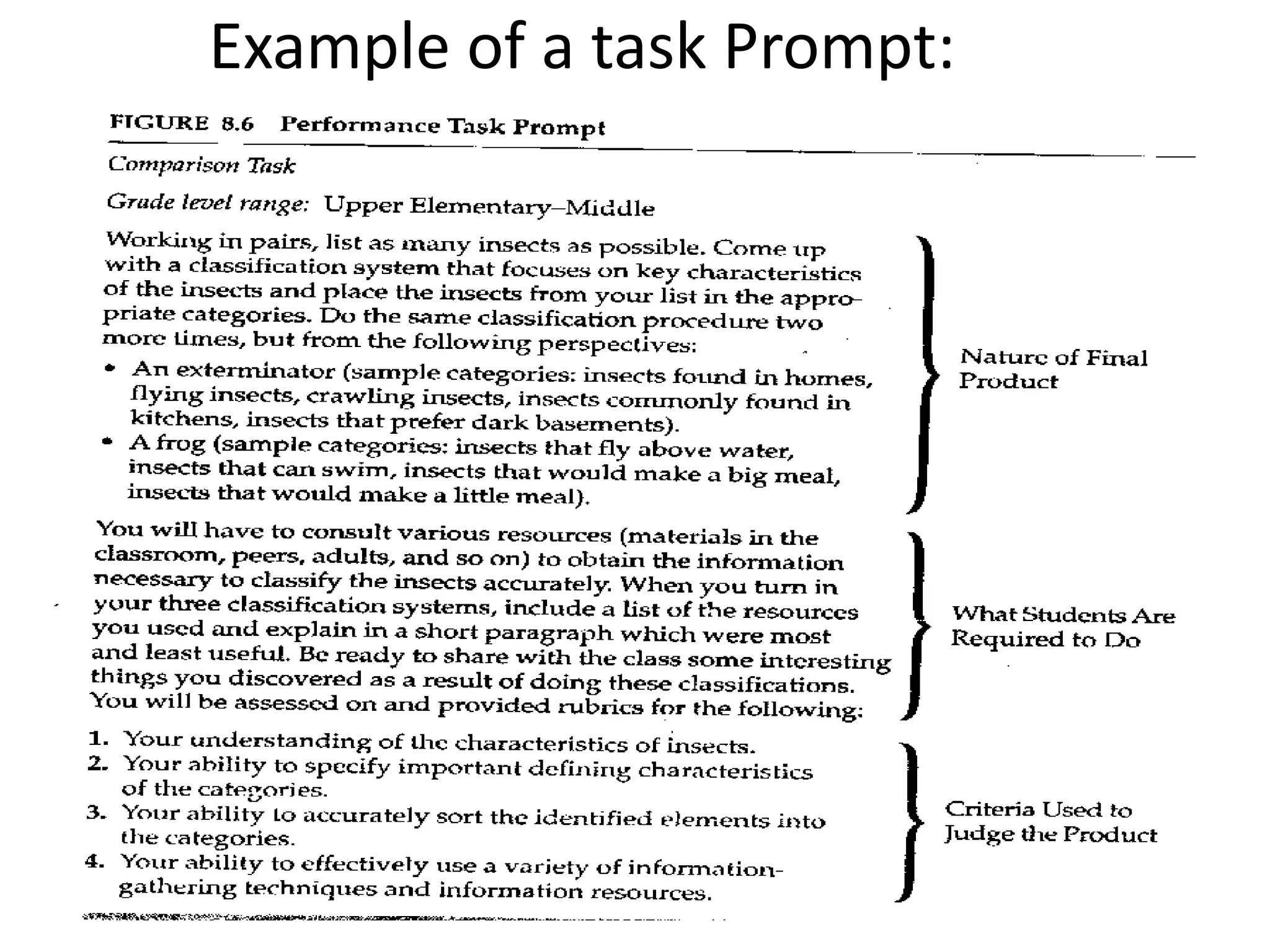
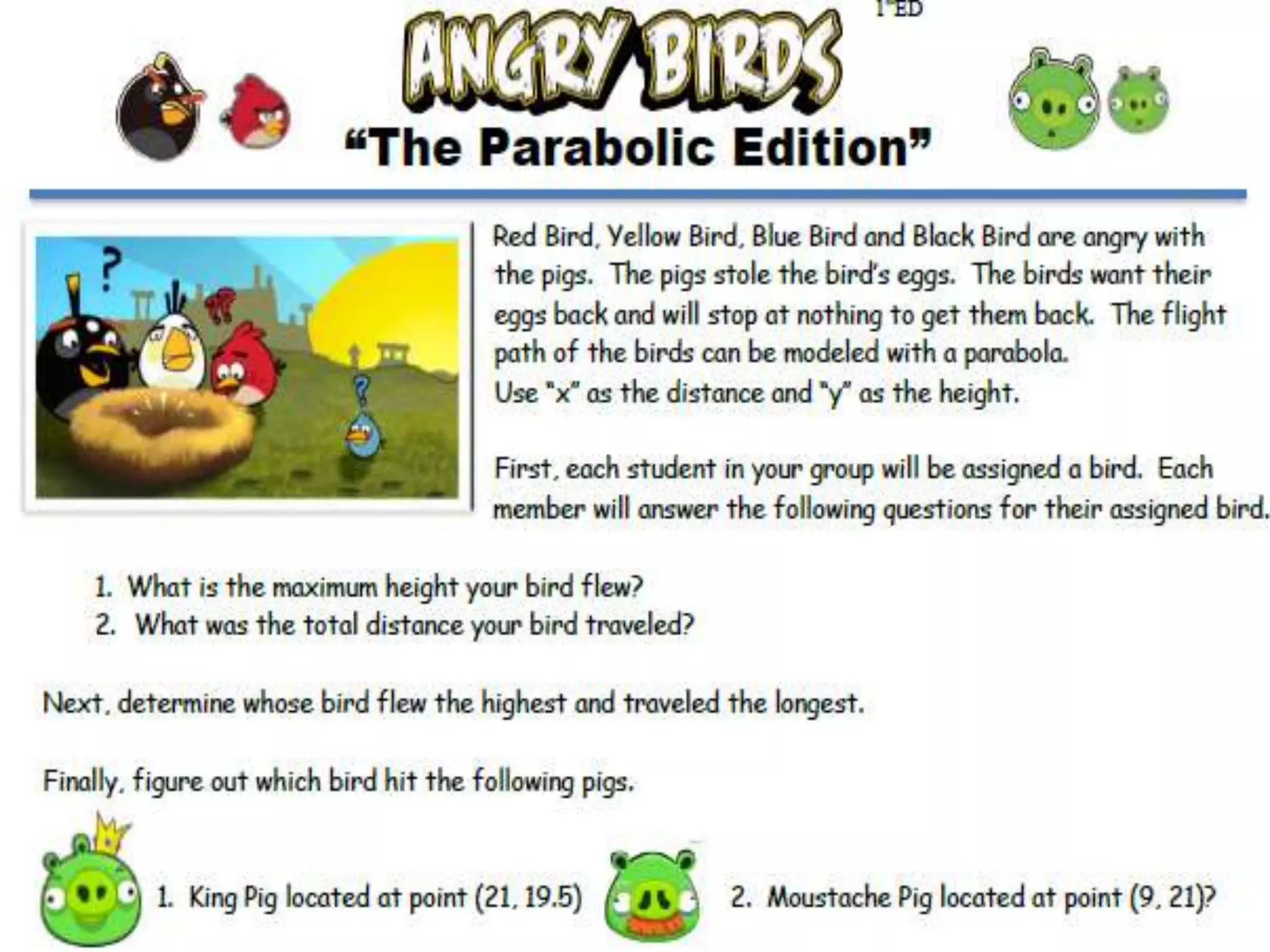
Example of a task Prompt:
Performance Criteria
• What you look for in student responses to
evaluate their progress toward meeting the
learning target.
• Dimensions of traits in performance that are used
to illustrate understanding, reasoning, and
proficiency.
• Start with identifying the most important
dimensions of the performance
• What distinguishes an adequate to an inadequate
demonstration of the target?
Example of Criteria
• Learning target:
– Students will be able to write a persuasive paper to
encourage the reader to accept a specific course of
action or point of view.
• Criteria:
– Appropriateness of language for the audience
– Plausibility and relevance of supporting arguments.
– Level of detail presented
– Evidence of creative, innovative thinking
– Clarity of expression
– Organization of ideas
Rating Scales
• Indicate the degree to which a particular
dimension is present.
• Three kinds: Numerical, qualitative, combined
qualitative/quantitative
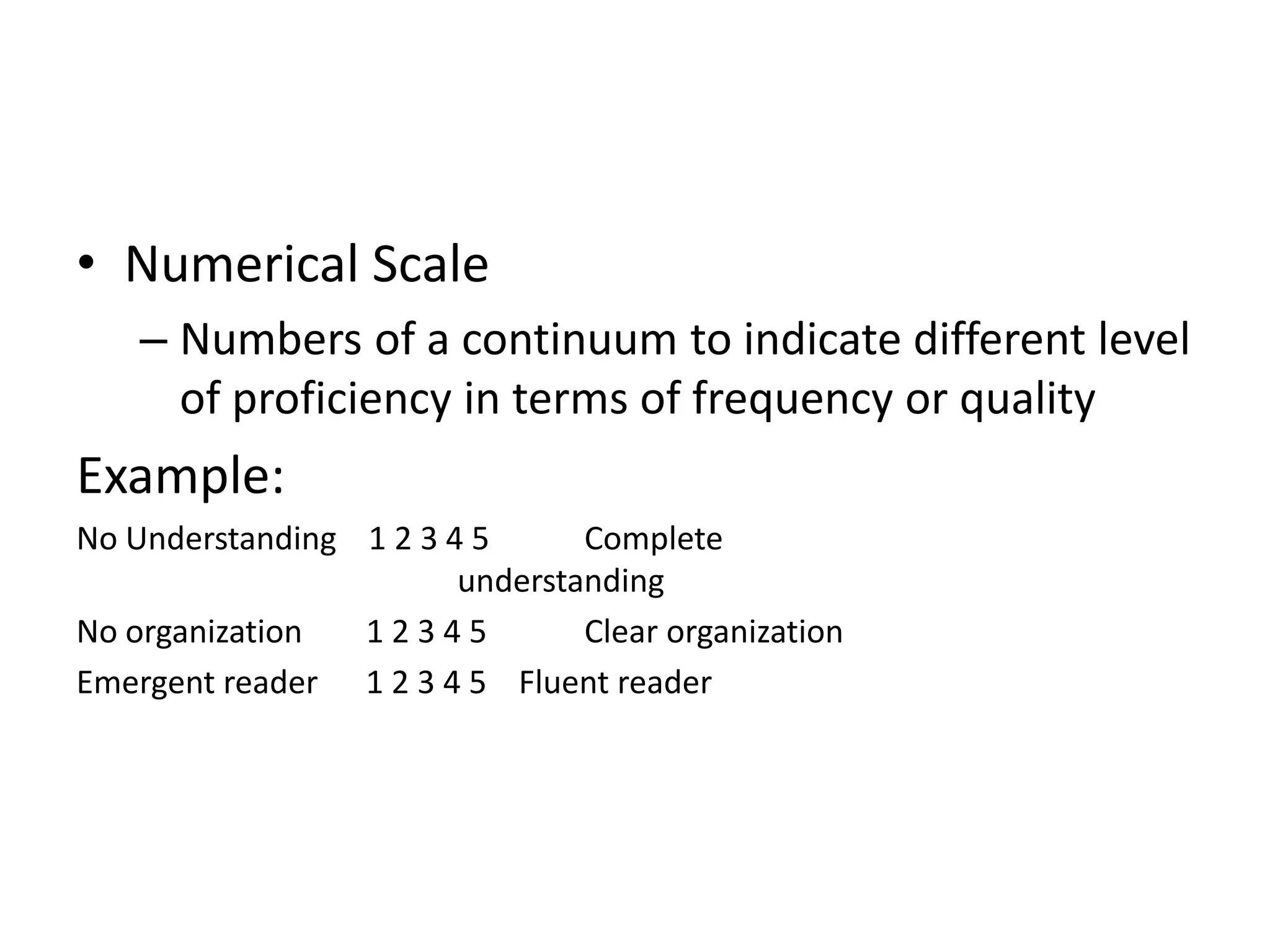
• Numerical Scale
– Numbers of a continuum to indicate different level
of proficiency in terms of frequency or quality
Example:
No Understanding 1 2 3 4 5 Complete
understanding
No organization 1 2 3 4 5 Clear organization
Emergent reader 1 2 3 4 5 Fluent reader
• Qualitative scale
– Uses verbal descriptions to indicate student
performance.
– Provides a way to check the whether each
dimension was evidenced.
• Type A: Indicate different gradations of the dimension
• Type B: Checklist
• Example of Type A:
– Minimal, partial, complete
– Never, seldom, occasionally, frequently, always
– Consistent, sporadically, rarely
– None, some, complete
– Novice, intermediate, advance, superior
– Inadequate, needs improvement, good excellent
– Excellent, proficient, needs improvement
– Absent, developing, adequate, fully developed
– Limited, partial, thorough
– Emerging, developing, achieving
– Not there yet, shows growth, proficient
– Excellent, good, fair, poor
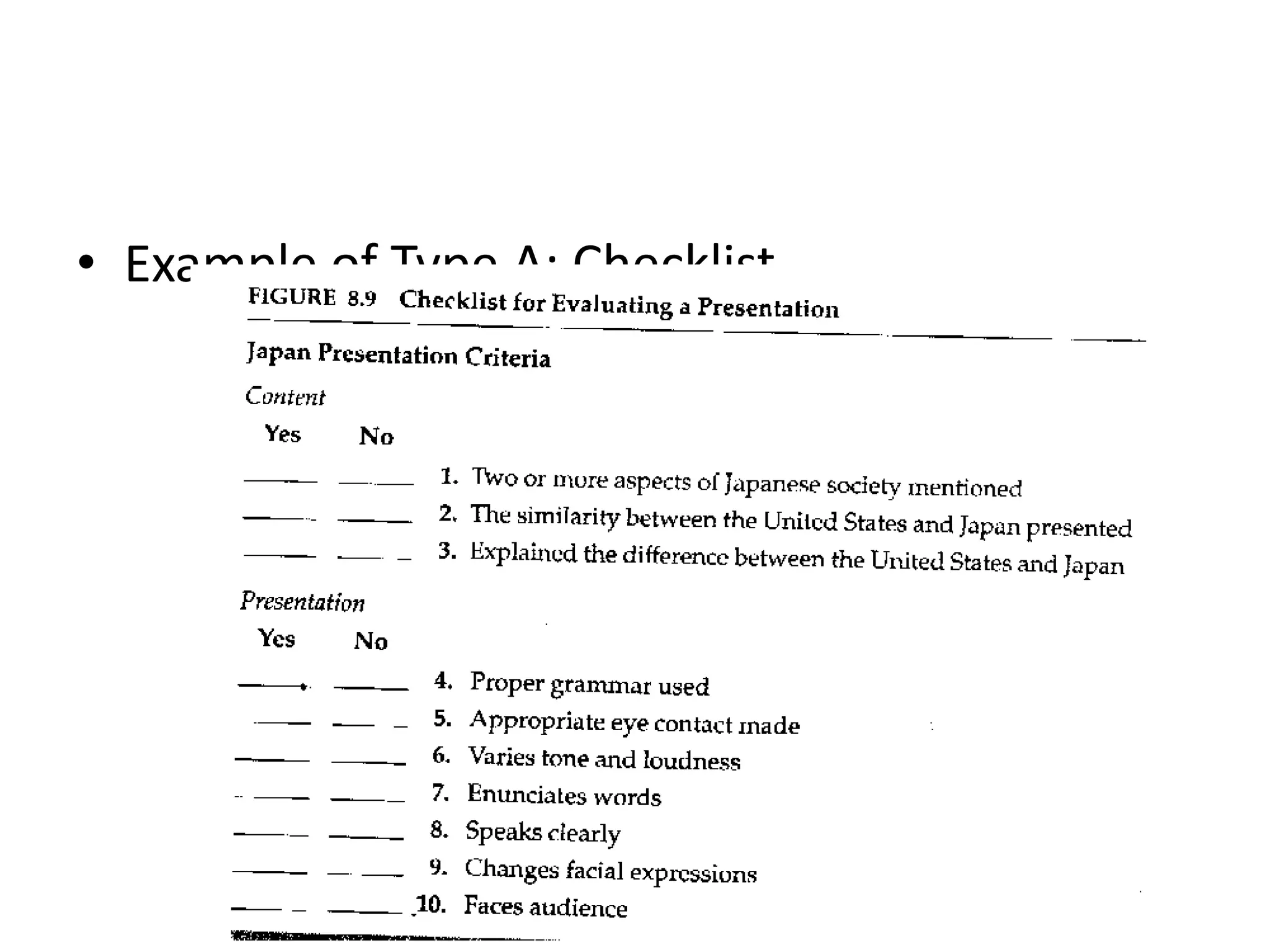
• Example of Type A: Checklist
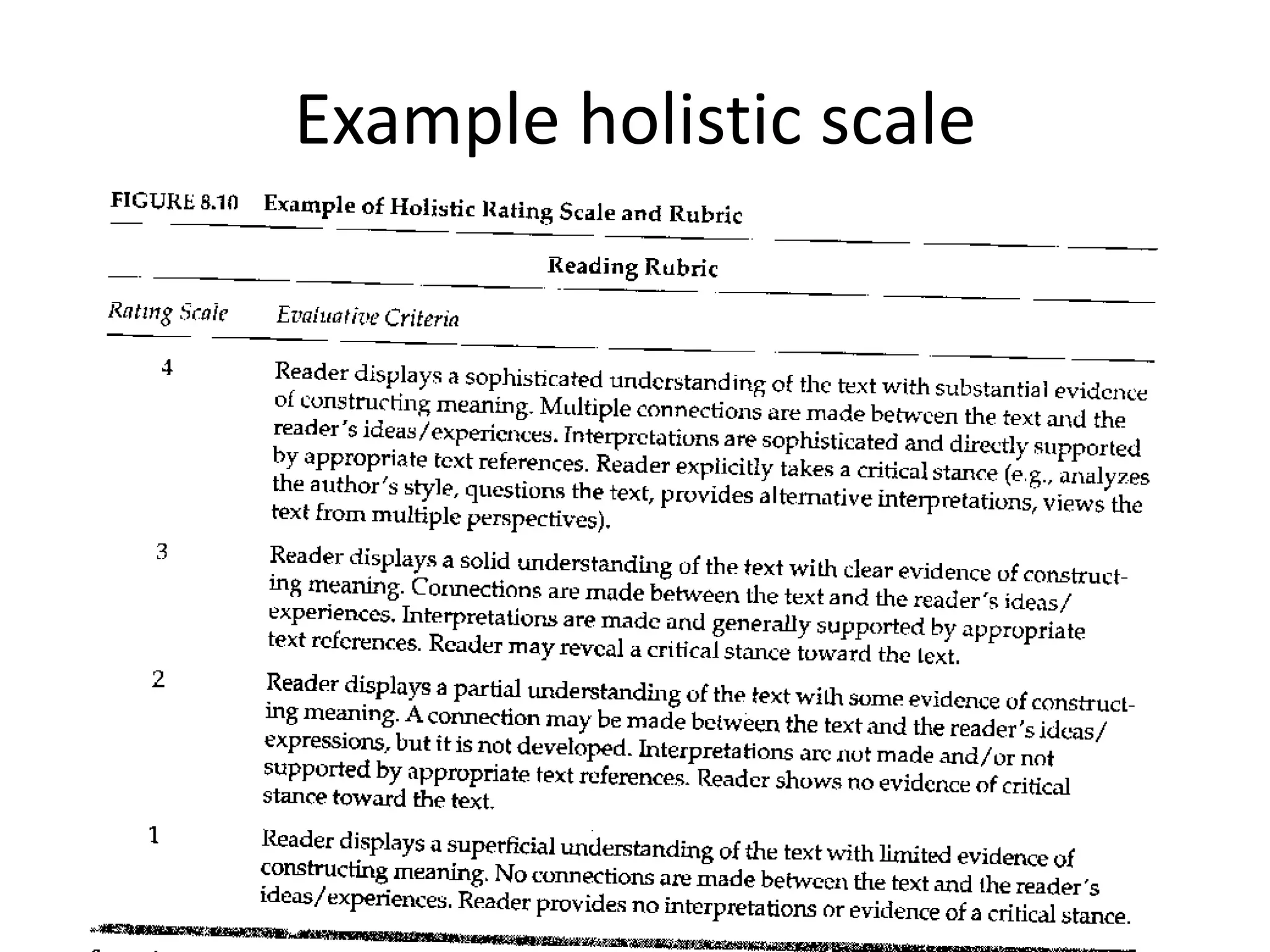
• Holistic scale
– The category of the scale contains several criteria, yielding
a single score that gives an overall impression or rating
Example
level 4: Sophisticated understanding of text indicated
with constructed meaning
level 3: Solid understanding of text indicated with some
constructed meaning
level 2: Partial understanding of text indicated with
tenuous constructed meaning
level 1: superficial understanding of text with little or
no constructed meaning
Example holistic scale
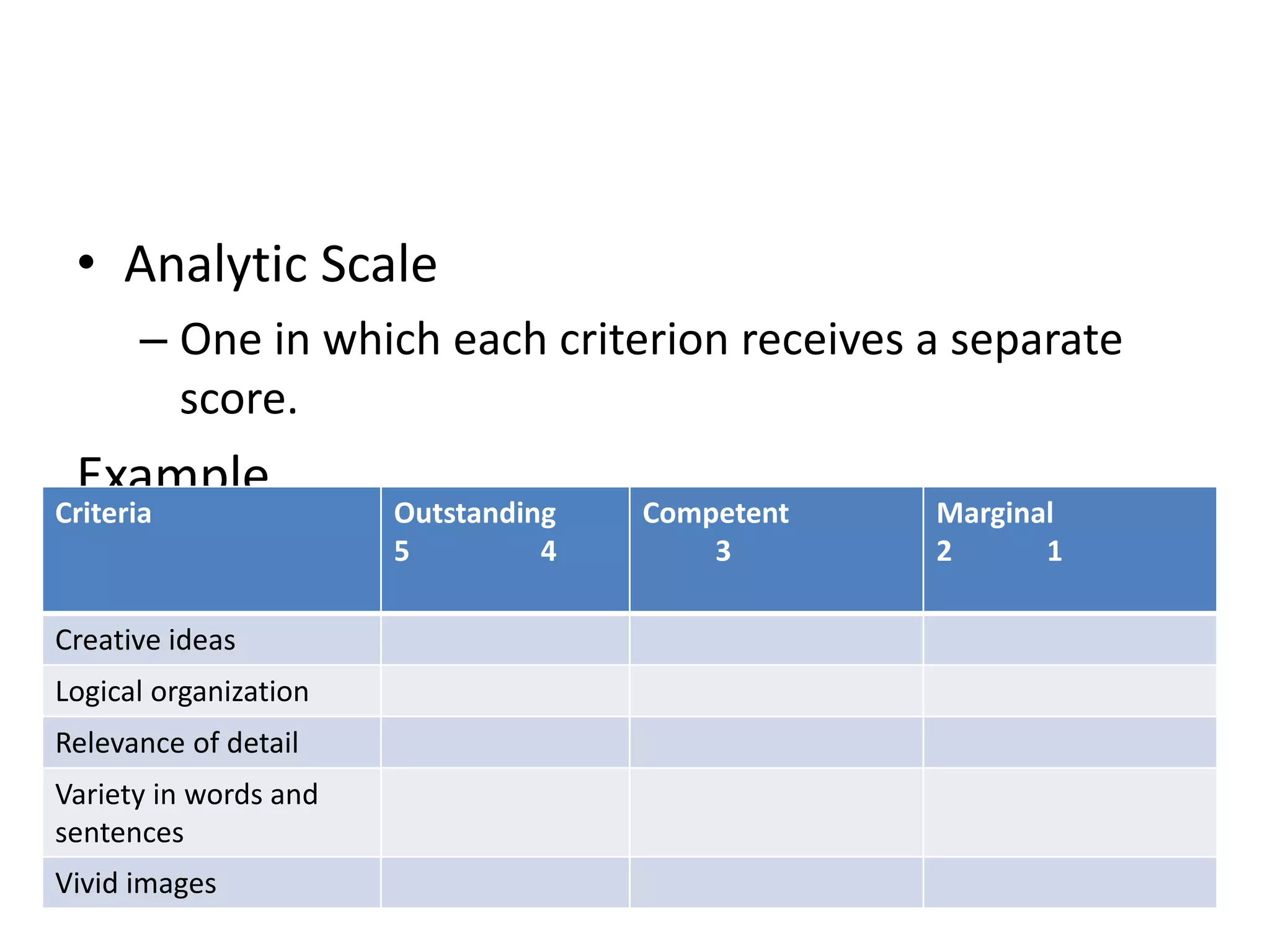
• Analytic Scale
– One in which each criterion receives a separate
score.
Example
Criteria Outstanding
5 4
Competent
3
Marginal
2 1
Creative ideas
Logical organization
Relevance of detail
Variety in words and
sentences
Vivid images
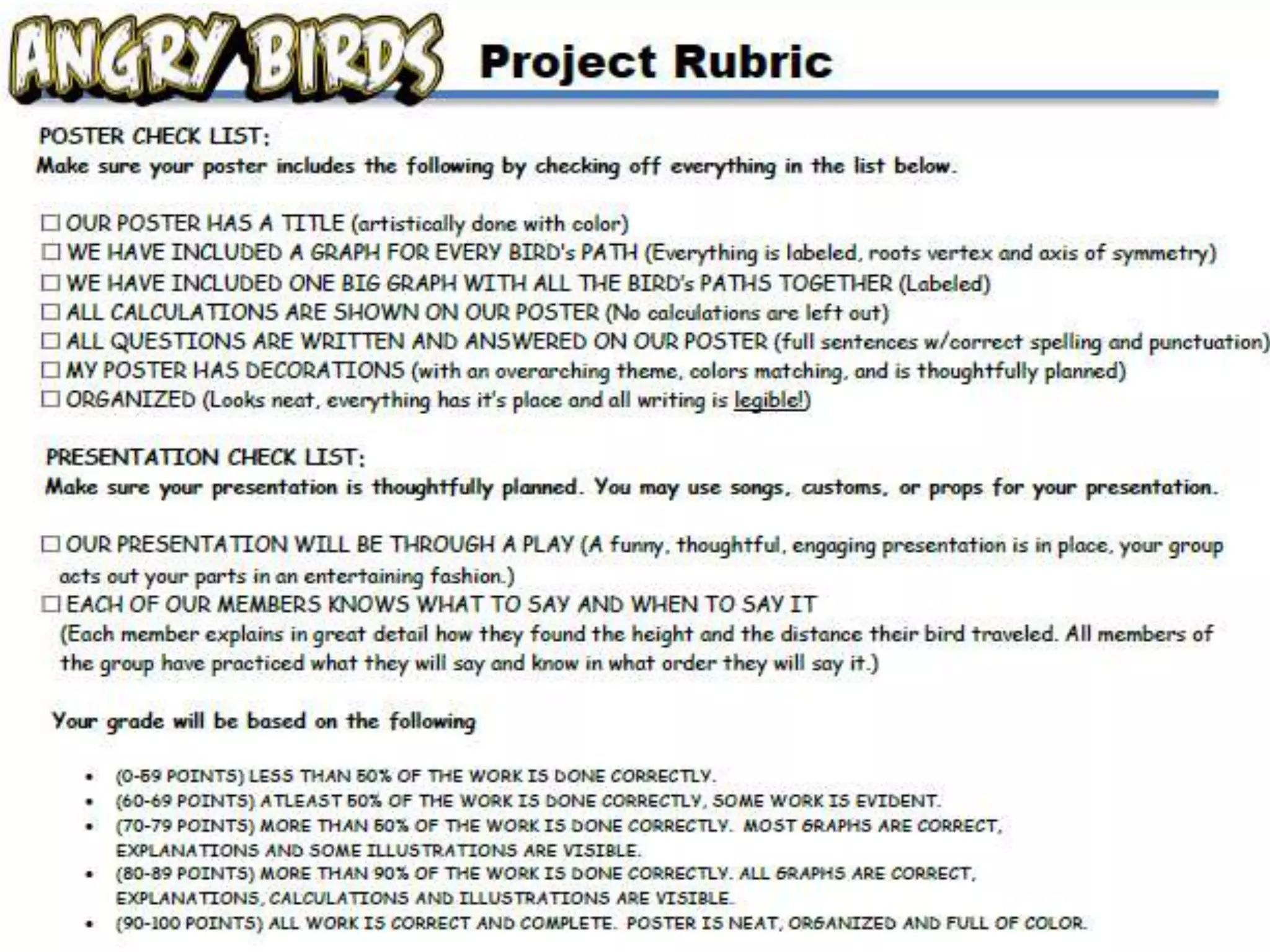
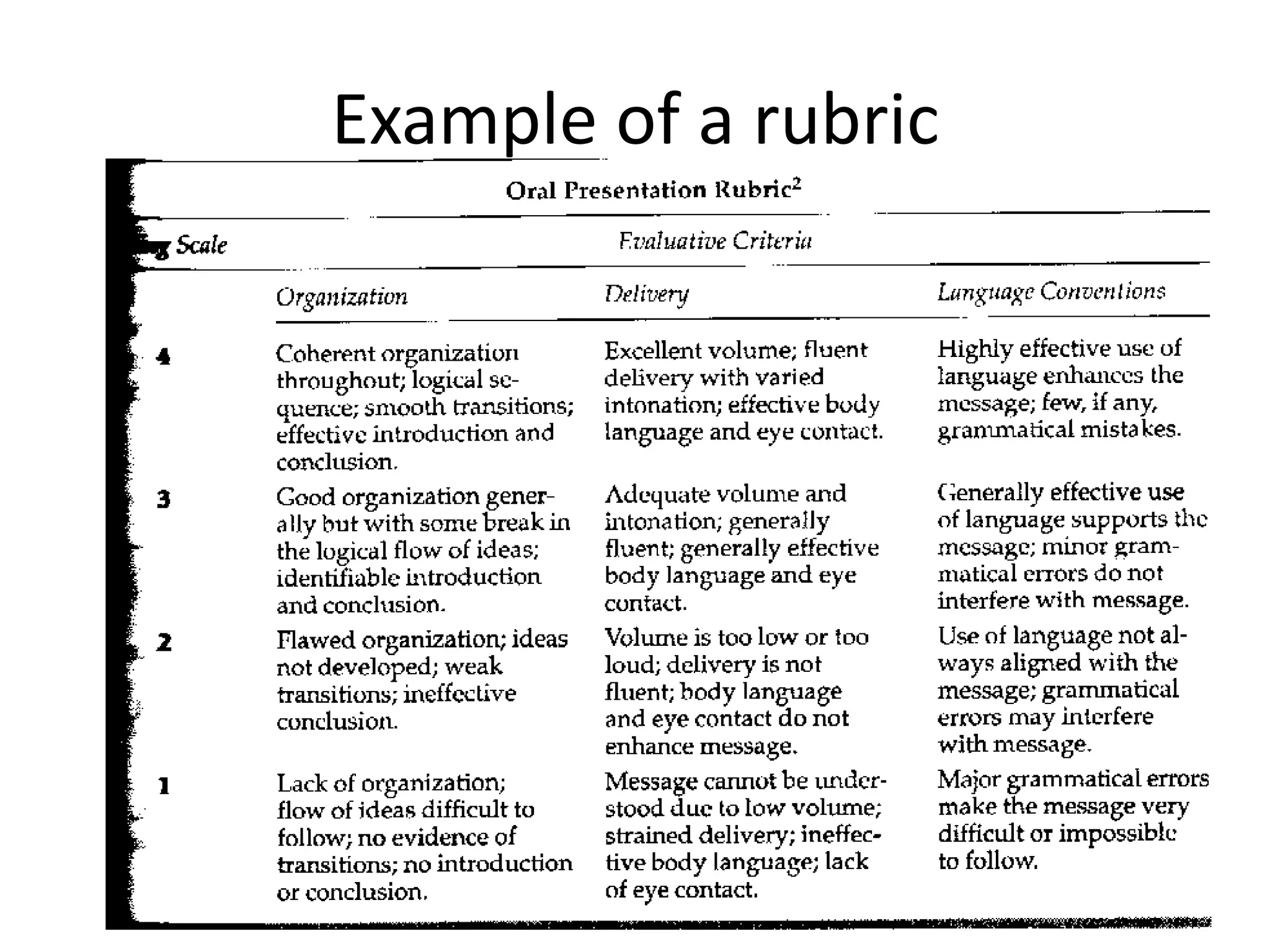
Rubrics
• When scoring criteria are combined with a
rating scale, a complete scoring guideline is
produced or rubric.
• A scoring guide that uses criteria to differentiate
between levels of student proficiency.
Example of a rubric
Guidelines in creating a rubric
1. Be sure the criteria focus on important aspects of the
performance
2. Match the type of rating with the purpose of the
assessment
3. The descriptions of the criteria should be directly
observable
4. The criteria should be written so that students,
parents, and others understand them.
5. The characteristics and traits used in the scale should
be clearly and specifically defined.
6. Take appropriate steps to minimize scoring frame
Workshop
• Create a performance based task.
• Indicate the following:
– Nature of the final product
– What students are suppose to do
– Criteria for the marking

Assessment Knowledge, Process, Understanding, Process/Product

  • 1.
    Assessing Knowledge, Process, Understanding,and Product/Performance Dr. Carlo Magno Further Correspondence: crlmgn@yahoo.com 1
  • 2.
    Answer the followingquestions: • What is assessment for you? • When do you conduct assessment? • What do you use to assess academic skills of students? 2
  • 3.
    Advance Organizer • Assessmentcompetencies • The need for Standards • KPUP 3
  • 4.
    Assessment Competencies forTeachers • Constructed by the AFT, NCME, NEA: • Teachers should be skilled in: 1. choosing assessment methods appropriate for instructional decisions. 2. Administering, scoring, and interpreting the results of both externally produced and teacher produced assessment methods. 3. Using assessment results when making decisions about individual students, planning teaching, and developing curriculum and school improvement. American Federation of Teachers, National Council on Measurement and Evaluation, and National Education Association in the United States of America.
  • 5.
    Assessment Competencies forTeachers 4. Developing valid pupil grading procedures that use pupil assessment. 5. Communicating assessment results to students, parents, other lay audiences, and other educators. 6. Recognizing unethical, illegal, and otherwise inappropriate assessment methods and uses of assessment information.
  • 6.
    Why do weneed standards? • To make sure that everyone delivers quality work • To produce quality students • To deliver quality programs • Basis on what to assess 6
  • 7.
    Mathematics Standards forJunior HS • Algebra – explore the concepts involving a quadratic function and its graph and solve problems involving quadratic functions and equations. – solve equations involving rational expressions – explore relationships of quantities that involve variation and solve problems involving direct, indirect and joint variation 7
  • 8.
    Mathematics Standards forJunior HS – simplify expressions with rational exponents and solve problems involving them. – perform fundamental operations on expressions involving radicals and solve problems involving expressions and equations with radicals. 8
  • 9.
    DepEd Taxonomy • real-lifeapplication of understanding • enduring big ideas, principles, and generalizations inherent to the discipline • cognitive operations that the student performs • content of the curriculum, the facts and information that the student acquires Knowledge Process Product/PerformanceUnderstanding
  • 10.
    Determine whether: Knowledge,process, understanding, product/performance 1. Students will describe quadratic function using graphs. 2. Solves quadratic equation by completing squares. 3. Solves problems involving quadratic equation. 4. Identify expressions with radicals 5. Prove the theorem on angle similarity using SAS similarity theorem. 6. Draw two objects to differentiate triangle similarity and triangle congruence. 7. Prove the theorem on a 5X5 square.
  • 11.
    7. Determine thetrigonometric ratio of special triangles 8. Creates a graph of an arithmetic sequence. 9. Give examples of polynomial functions 10.Draw a circle and illustrate 5 different chords. Determine whether: Knowledge, process, understanding, product/performance
  • 12.
    Determine whether: Knowledge,process, understanding, product/performance
  • 13.
    Determine whether: Knowledge,process, understanding, product/performance
  • 14.
    Determine whether: Knowledge, process,understanding, product/performance
  • 15.
    Determine whether: Knowledge, process,understanding, product/performance
  • 16.
    Determine whether: Knowledge,process, understanding, product/performance
  • 17.
    Determine whether: Knowledge, process,understanding, product/performance
  • 18.
    Knowledge • Define • Describe •Identify • Label • Enumerate • Match • Outline • select • State • Name • reproduce 18
  • 19.
    Six Facets ofUnderstanding Explain - provide thorough and justifiable accounts of phenomena, facts, and data Interpret — tell meaningful stories, offer apt translations, provide a revealing historical or personal dimension to ideas and events; make subjects personal or accessible through images, anecdotes, analogies, and models Apply — effectively use and adapt what they know in diverse contexts Have perspective — see and hear points of view through critical eyes and ears; see the big picture Empathize — find value in what others might find odd, alien, or implausible; perceive sensitively on the basis of prior indirect experience Have self-knowledge — perceive the personal style, prejudices, projections, and habits of mind that both shape and impede our own understanding; they are aware of what they do not understand and why understanding is so hard
  • 20.
    Explain Which of thefollowing statements of the relationship between market price and normal price is true? a. Over a short period of time, market price varies directly with changes in normal price. b. Over a long period of time, market price tends to equal normal price. c. Market price is usually lower than normal price. d. Over a long period of time, market price determines normal price.
  • 21.
    Translation from symbolicform to another form, or vice versa Which of the graphs below best represent the supply situation where a monopolist maintains a uniform price regardless of the amounts which people buy? A B C D S Price Quantity S Price Quantity S S Price Quantity S S Price Quantity S Interpret
  • 22.
    Apply In the followingitems (4-8) you are to judge the effects of a particular policy on the distribution of income. In each case assume that there are no other changes in policy that would counteract the effect of the policy described in the item. Mark the item: A. If the policy described would tend to reduce the existing degree of inequality in the distribution of income, B. If the policy described would tend to increase the existing degree of inequality in the distribution of income, or C. If the policy described would have no effect, or an indeterminate effect, on the distribution of income. __ 4. Increasingly progressive income taxes. __ 5. Confiscation of rent on unimproved __ 6. Introduction of a national sales tax __ 7. Increasing the personal exemptions from income taxes __ 8. Distributing a subsidy to sharecroppers on southern farms
  • 23.
    Have perspective After readingthe passage answer the following questions… 1. Where was Carol walking? a. park b. beach c. mall d. city hall 2. How did she feel on this walk? a. envied b. sad c. relaxed d. happy
  • 24.
    Have perspective 3. Carolenvied the people around her because they _____________________. a. were sad and lonely b. love the city life c. were laughing and joking d. don’t like the city
  • 25.
    Empathize • Your newmaid from the mountain destroyed your very expensive Narra door and she used it as firewood and cooked rice in your newly landscaped garden. How should you react? • A… • B… • C… • D…
  • 26.
    • Ability toRecognize the Relevance of Information 26
  • 27.
    • Ability toRecognize Warranted and Unwarranted Generalizations 27
  • 28.
    • Ability toRecognize Inferences 28
  • 29.
    • Ability toInterpret Experimental Findings 29
  • 30.
    • Ability toApply Principles 30
  • 31.
    • Ability toRecognize Assumptions 31
  • 32.
    Reading comprehension • Bem(1975) has argued that androgynous people are “better off” than their sex-typed counterparts because they are not constrained by rigid sex-role concepts and are freer to respond to a wider variety of situations. Seeking to test this hypothesis, Bem exposed masculine, feminine, and androgynous men and women to situations that called for independence (a masculine attribute) or nurturance (a feminine attribute). The test for masculine independence assessed the subject’s willingness to resist social pressure by refusing to agree with peers who gave bogus judgments when rating cartoons for funniness (for example, several peers might say that a very funny cartoon was hilarious). Nurturance or feminine expressiveness, was measured by observing the behavior of the subject when left alone for ten minutes with a 5-month old baby. The result confirmed Bem’s hypothesis. Both the masculine sex- typed and the androgynous subjects were more independent (less conforming) on the ‘independence” test than feminine sex-typed individuals. Furthermore, both the feminine and the androgynous subjects were more “nurturant” than the masculine sex-typed individuals when interacting with the baby. Thus, the androgynous subjects were quite flexible, they performed as masculine subjects did on the “feminine” task. 32 35. What is the independent variable in the study? a. Situations calling for independence and nurturance b. Situation to make the sex type react c. Situations to make the androgynous be flexible d. Situations like sex type, androgynous and sex role concepts 36. What are the levels of the IV? a. masculine attribute and feminine attribute b. rating cartoons and taking care of a baby c. independence and nurturance d. flexibility and rigidity
  • 33.
    Interpreting Diagrams Instruction. Studythe following illustrations and answer the following questions. Figure 1 33 Pretest Posttest 101. Which group received the treatment? a. group A b. group B b. c. none of the above 102. Why did group B remain stable across the experiment? a. there is an Extraneous Variable b. There was no treatment c. ceiling effect occured 103. What is the problem during the pretest phase of the experiment? a. the two groups are nonequivalent b. the groups are competing with each other c. the treatment took place immediately Group B Group A
  • 34.
    Process • Cognitive operations •Cognitive and Metacognitive skills • Self-regulation • Learning strategies 34
  • 35.
    Two components ofMetacognition • Knowledge of cognition is the reflective aspect of metacognition. It is the individuals’ awareness of their own knowledge, learning preferences, styles, strengths, and limitations, as well as their awareness of how to use this knowledge that can determine how well they can perform different tasks (de Carvalho, Magno, Lajom, Bunagan, & Regodon, 2005). • Regulation of cognition on the other hand is the control aspect of learning. It is the procedural aspect of knowledge that allows effective linking of actions needed to complete a given task (Carvalho & Yuzawa, 2001).
  • 36.
    Components of Metacogniton Knowledgeof Cognition • (1) Declarative knowledge – knowledge about one’s skills, intellectual resources, and abilities as a learner. • (2) Procedural knowledge – knowledge about how to implement learning procedures (strategies) • (3) Conditional knowledge – knowledge about when and why to use learning procedures.
  • 37.
    Examples of knowledgeof cognition in Mathematical Investigation • Declarative Knowledge – Knowing what is needed to be solved – Understanding ones intellectual strengths and weaknesses in solving math problems • Procedural knowledge – Awareness of what strategies to use when solving math problems – Have a specific purpose of each strategy to use • Conditional knowledge – Solve better if the case is relevant – Use different learning strategies depending on the type of problem
  • 38.
    Components of Metacogniton Regulationof cognition 1) Planning – planning, goal setting, and allocating resources prior to learning. (2) Information Management Strategies – skills and strategy sequences used on- line to process information more effectively (organizing, elaborating, summarizing, selective focusing). (3) Monitoring – Assessing one’s learning or strategy use. (4) Debugging Strategies – strategies used to correct comprehension and performance errors (5) Evaluation of learning – analysis of performance and strategy effectiveness after learning episodes.
  • 39.
    Examples of regulationof cognition • Planning • Pacing oneself when solving in order to have enough time • Thinking about what really needs to be solved before beginning a task • Information Management Strategies • Focusing attention to important information • Slowing down when important information is encountered • Monitoring • Considering alternatives to a problem before solving • Pause regularly to check for comprehension • Debugging Strategies • Ask help form others when one doesn’t understand • Stop and go over of it is not clear • Evaluation of learning • Recheck after solving • Find easier ways to do things
  • 40.
    Shifts in assessment •Testing Alternative assessment • Paper and pencil Performance assessment • Multiple choice Supply • Single correct answer Many correct answer • Summative Formative • Outcome only Process and Outcome • Skill focused Task-based • Isolated facts Application of knowledge • Decontextualized task Contextualized task
  • 41.
    Alternative forms ofassessment • Performance based assessment • Authentic assessment • Portfolio assessment
  • 42.
    Terms • Authentic assessment • Directassessment • Alternative assessment • Performance testing • Performance assessment • Changes are taking place in assessment
  • 43.
    Method • Assessment shouldmeasure what is really important in the curriculum. • Assessment should look more like instructional activities than like tests. • Educational assessment should approximate the learning tasks of interest, so that, when students practice for the assessment, some useful learning takes place.
  • 44.
    What is PerformanceAssessment? • Testing that requires a student to create an answer or a product that demonstrates his/her knowledge or skills (Rudner & Boston, 1991).
  • 45.
    Features of performanceassessment • Intended to assess what it is that students know and can do with the emphasis on doing. • Have a high degree of realism about them. • Involve: (a) activities for which there is no correct answer, (b) assessing groups rather than individuals, (c) testing that would continue over an extended period of time, (d) self-evaluation of performances. • Likely use open-ended tasks aimed at assessing higher level cognitive skills.
  • 48.
    Push on performanceassessment • Bring testing methods more in line with instruction. • Assessment should approximate closely what it is students should know and be able to do.
  • 49.
    Emphasis of performanceassessment • Should assess higher level cognitive skills rather than narrow and lower level discreet skills. • Direct measures of skills of interest.
  • 50.
    Characteristics of performance-based assessment •Students perform, create, construct, produce, or do something. • Deep understanding and/or reasoning skills are needed and assessed. • Involves sustained work, often days and weeks. • Calls on students to explain, justify, and defend. • Performance is directly observable. • Involves engaging in ideas of importance and substance. • Relies on trained assessor’s judgments for scoring • Multiple criteria and standards are prespecified and public • There is no single correct answer. • If authentic, the performance is grounded in real world contexts and constraints.
  • 51.
    Variation of authenticity Relativelyauthentic Somewhat authentic Authentic Indicate which parts of a garden design are accurate Design a garden Create a garden Write a paper on zoning Write a proposal to change fictitious zoning laws Write a proposal to present to city council to change zoning laws Explain what would you teach to students learning basketball Show how to perform basketball skills in practice Play a basketball game.
  • 52.
    Constructing Performance Basedtasks 1. Identify the performance task in which students will be engaged 2. Develop descriptions of the task and the context in which the performance is to be conducted. 3. Write the specific question, prompt, or problem that the student will receive. • Structure: Individual or group? • Content: Specific or integrated? • Complexity: Restricted or extended?
  • 53.
    Complexity of task •Restricted-type task – Narrowly defined and require brief responses – Task is structured and specific – Ex: • Construct a bar graph from data provided • Demonstrate a shorter conversation in French about what is on a menu • Read an article from the newspaper and answer questions • Flip a coin ten times. Predict what the next ten flips of the coin will be, and explain why. • Listen to the evening news on television and explain if you believe the stories are biased. • Construct a circle, square, and triangle from provided materials that have the same circumference.
  • 54.
    • Extended-type task –Complex, elaborate, and time-consuming. – Often include collaborative work with small group of students. – Requires the use of a variety of information – Examples: • Design a playhouse and estimate cost of materials and labor • Plan a trip to another country: Include the budget and itinerary, and justify why you want to visit certain places • Conduct a historical reenactment (e. g. impeachment trial of ERAP) • Diagnose and repair a car problem • Design an advertising campaign for a new or existing product
  • 55.
    Identifying Performance Task Description •Prepare a task description • Listing of specifications to ensure that essential if criteria are met • Includes the ff.: – Content and skill targets to be assessed – Description of student activities • Group or individual • Help allowed – Resources needed – Teacher role – Administrative process – Scoring procedures
  • 56.
    Performance-based Task Question Prompt •Task prompts and questions will be based on the task descriptions. • Clearly identifies the outcomes, outlines what the students are encourage dot do, explains criteria for judgment.
  • 57.
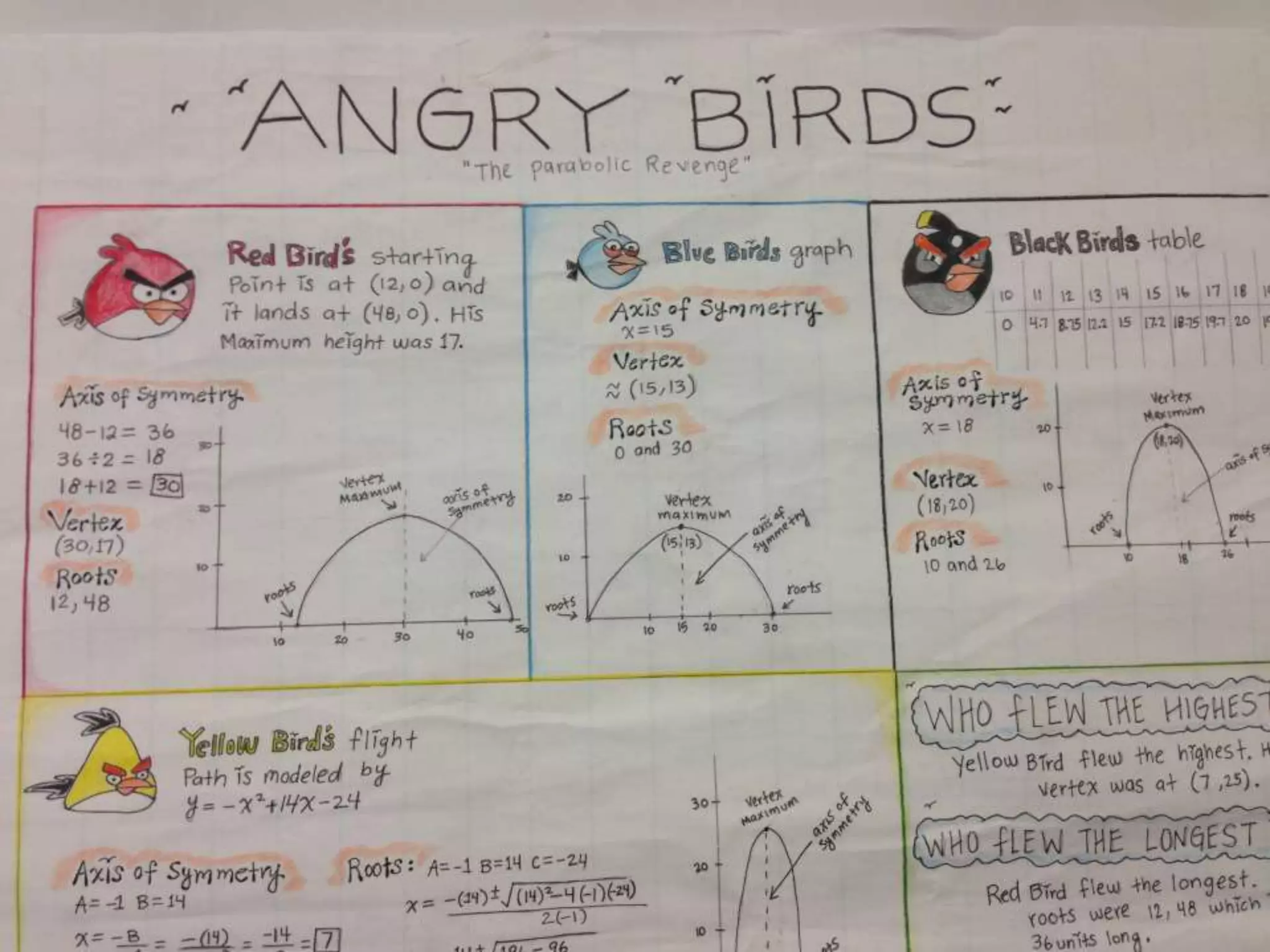
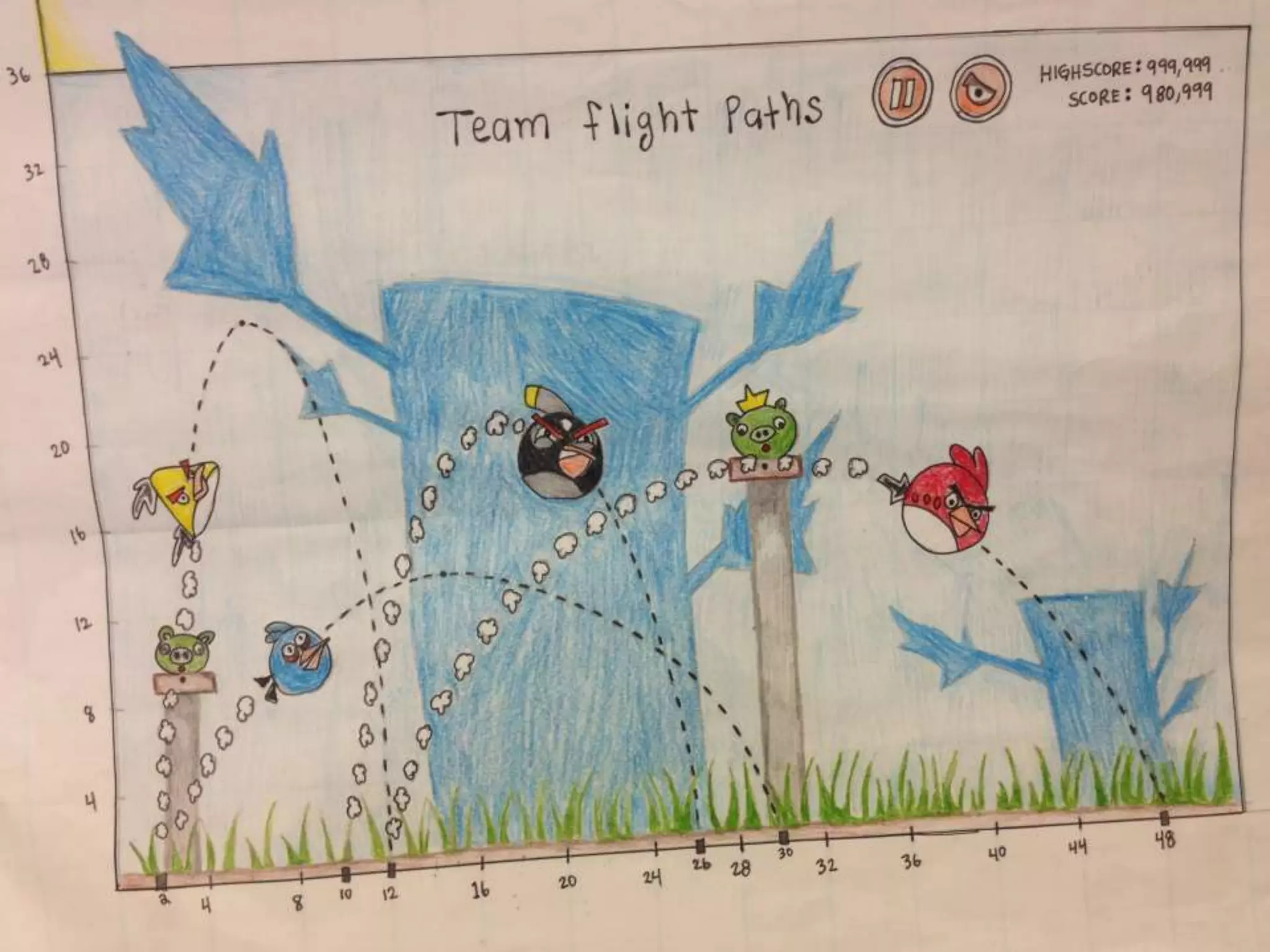
    Example of atask Prompt:
  • 64.
    Performance Criteria • Whatyou look for in student responses to evaluate their progress toward meeting the learning target. • Dimensions of traits in performance that are used to illustrate understanding, reasoning, and proficiency. • Start with identifying the most important dimensions of the performance • What distinguishes an adequate to an inadequate demonstration of the target?
  • 65.
    Example of Criteria •Learning target: – Students will be able to write a persuasive paper to encourage the reader to accept a specific course of action or point of view. • Criteria: – Appropriateness of language for the audience – Plausibility and relevance of supporting arguments. – Level of detail presented – Evidence of creative, innovative thinking – Clarity of expression – Organization of ideas
  • 66.
    Rating Scales • Indicatethe degree to which a particular dimension is present. • Three kinds: Numerical, qualitative, combined qualitative/quantitative
  • 67.
    • Numerical Scale –Numbers of a continuum to indicate different level of proficiency in terms of frequency or quality Example: No Understanding 1 2 3 4 5 Complete understanding No organization 1 2 3 4 5 Clear organization Emergent reader 1 2 3 4 5 Fluent reader
  • 68.
    • Qualitative scale –Uses verbal descriptions to indicate student performance. – Provides a way to check the whether each dimension was evidenced. • Type A: Indicate different gradations of the dimension • Type B: Checklist
  • 69.
    • Example ofType A: – Minimal, partial, complete – Never, seldom, occasionally, frequently, always – Consistent, sporadically, rarely – None, some, complete – Novice, intermediate, advance, superior – Inadequate, needs improvement, good excellent – Excellent, proficient, needs improvement – Absent, developing, adequate, fully developed – Limited, partial, thorough – Emerging, developing, achieving – Not there yet, shows growth, proficient – Excellent, good, fair, poor
  • 70.
    • Example ofType A: Checklist
  • 71.
    • Holistic scale –The category of the scale contains several criteria, yielding a single score that gives an overall impression or rating Example level 4: Sophisticated understanding of text indicated with constructed meaning level 3: Solid understanding of text indicated with some constructed meaning level 2: Partial understanding of text indicated with tenuous constructed meaning level 1: superficial understanding of text with little or no constructed meaning
  • 72.
  • 73.
    • Analytic Scale –One in which each criterion receives a separate score. Example Criteria Outstanding 5 4 Competent 3 Marginal 2 1 Creative ideas Logical organization Relevance of detail Variety in words and sentences Vivid images
  • 74.
    Rubrics • When scoringcriteria are combined with a rating scale, a complete scoring guideline is produced or rubric. • A scoring guide that uses criteria to differentiate between levels of student proficiency.
  • 75.
  • 76.
    Guidelines in creatinga rubric 1. Be sure the criteria focus on important aspects of the performance 2. Match the type of rating with the purpose of the assessment 3. The descriptions of the criteria should be directly observable 4. The criteria should be written so that students, parents, and others understand them. 5. The characteristics and traits used in the scale should be clearly and specifically defined. 6. Take appropriate steps to minimize scoring frame
  • 77.
    Workshop • Create aperformance based task. • Indicate the following: – Nature of the final product – What students are suppose to do – Criteria for the marking