REPRESENTING DATA USING PICTOGRAM
AND LINE GRAPH-INTERPRETATION OF
PICTOGRAM AND LINE GRAPH
PRESENTED BY
MEKHA DEVI M
PICTOGRAM
• A pictograph uses picture symbols to convey the meaning
of statistical information.
• This is a very common diagram used by the governments
and advertisers.
• Appropriate pictures are drawn with sizes proportional to
the magnitude of observations.
• That is in pictogram, the magnitude of certain things is
shown by their pictures.
• These diagrams are not abstract like the line graphs or bar
diagrams.
INTERPRETATION OF PICTOGRAM
Example -1
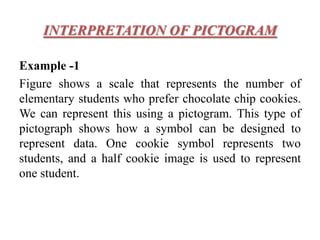
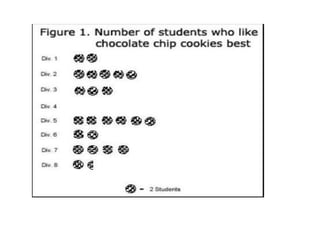
Figure shows a scale that represents the number of
elementary students who prefer chocolate chip cookies.
We can represent this using a pictogram. This type of
pictograph shows how a symbol can be designed to
represent data. One cookie symbol represents two
students, and a half cookie image is used to represent
one student.
Example-2
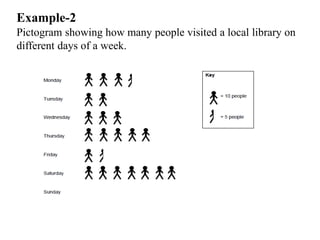
Pictogram showing how many people visited a local library on
different days of a week.
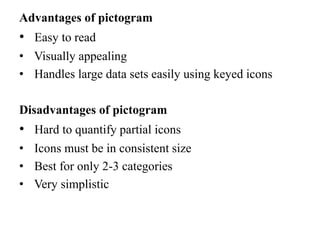
Advantages of pictogram
• Easy to read
• Visually appealing
• Handles large data sets easily using keyed icons
Disadvantages of pictogram
• Hard to quantify partial icons
• Icons must be in consistent size
• Best for only 2-3 categories
• Very simplistic
LINE GRAPH/TIME SERIES GRAPH
When we observe the values of a variable at different
points of time, the series so formed is known as time
series. The technique of graphic presentation is
extremely helpful in analyzing change at different
points of time. On the X-axis we generally take the time
and the Y-axis the value of the variable and join the
various points by straight lines. The graph so formed is
known as the line graph. Such graphs are most widely
used in practice. They are simple to understand, easiest
to make and most adaptable to many uses.
Interpretation of line graph
1. Graphs of one variable
When only one variable is to be represented, take time
on the X-axis and the value of variable on the Y-axis
then plot various points and join them by straightlines.
The fluctuations of this line shows the variations in the
variable and the distances of the plotting from the base
line of the graph indicates the magnitude.
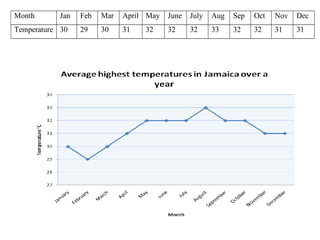
Example:- Line graph shows the temperatures of
Jamaica over the year
Month Jan Feb Mar April May June July Aug Sep Oct Nov Dec
Temperature 30 29 30 31 32 32 32 33 32 32 31 31
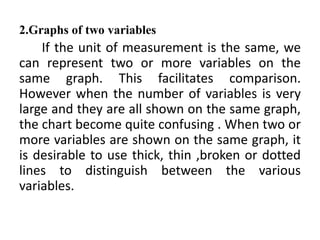
2.Graphs of two variables
If the unit of measurement is the same, we
can represent two or more variables on the
same graph. This facilitates comparison.
However when the number of variables is very
large and they are all shown on the same graph,
the chart become quite confusing . When two or
more variables are shown on the same graph, it
is desirable to use thick, thin ,broken or dotted
lines to distinguish between the various
variables.
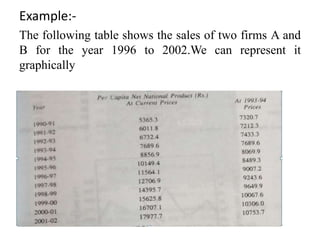
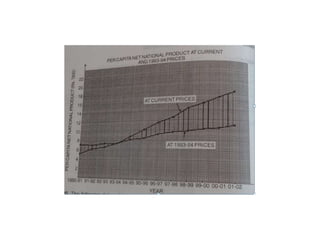
Example:-
The following table shows the sales of two firms A and
B for the year 1996 to 2002.We can represent it
graphically
Advantages of line graph
1. Can compare multiple contious data sets easily.
2. Interim data can be inferred from graph line.
Disadvantages
1. Use only with continuous data.
THANK YOU

Assesment in education

  • 1.
    REPRESENTING DATA USINGPICTOGRAM AND LINE GRAPH-INTERPRETATION OF PICTOGRAM AND LINE GRAPH PRESENTED BY MEKHA DEVI M
  • 2.
    PICTOGRAM • A pictographuses picture symbols to convey the meaning of statistical information. • This is a very common diagram used by the governments and advertisers. • Appropriate pictures are drawn with sizes proportional to the magnitude of observations. • That is in pictogram, the magnitude of certain things is shown by their pictures. • These diagrams are not abstract like the line graphs or bar diagrams.
  • 3.
    INTERPRETATION OF PICTOGRAM Example-1 Figure shows a scale that represents the number of elementary students who prefer chocolate chip cookies. We can represent this using a pictogram. This type of pictograph shows how a symbol can be designed to represent data. One cookie symbol represents two students, and a half cookie image is used to represent one student.
  • 5.
    Example-2 Pictogram showing howmany people visited a local library on different days of a week.
  • 6.
    Advantages of pictogram •Easy to read • Visually appealing • Handles large data sets easily using keyed icons Disadvantages of pictogram • Hard to quantify partial icons • Icons must be in consistent size • Best for only 2-3 categories • Very simplistic
  • 7.
    LINE GRAPH/TIME SERIESGRAPH When we observe the values of a variable at different points of time, the series so formed is known as time series. The technique of graphic presentation is extremely helpful in analyzing change at different points of time. On the X-axis we generally take the time and the Y-axis the value of the variable and join the various points by straight lines. The graph so formed is known as the line graph. Such graphs are most widely used in practice. They are simple to understand, easiest to make and most adaptable to many uses.
  • 8.
    Interpretation of linegraph 1. Graphs of one variable When only one variable is to be represented, take time on the X-axis and the value of variable on the Y-axis then plot various points and join them by straightlines. The fluctuations of this line shows the variations in the variable and the distances of the plotting from the base line of the graph indicates the magnitude. Example:- Line graph shows the temperatures of Jamaica over the year
  • 9.
    Month Jan FebMar April May June July Aug Sep Oct Nov Dec Temperature 30 29 30 31 32 32 32 33 32 32 31 31
  • 10.
    2.Graphs of twovariables If the unit of measurement is the same, we can represent two or more variables on the same graph. This facilitates comparison. However when the number of variables is very large and they are all shown on the same graph, the chart become quite confusing . When two or more variables are shown on the same graph, it is desirable to use thick, thin ,broken or dotted lines to distinguish between the various variables.
  • 11.
    Example:- The following tableshows the sales of two firms A and B for the year 1996 to 2002.We can represent it graphically
  • 13.
    Advantages of linegraph 1. Can compare multiple contious data sets easily. 2. Interim data can be inferred from graph line. Disadvantages 1. Use only with continuous data.
  • 14.