Assembly Language
Contents
• What is Assembly Language?
• Assembler and Assembling Technique
• Mnemonics
• Why Assembly?
• Limitations
2
What is Assembly Language?
• An assembly language is a low-level programming language
• Used for a computer, or other programmable device.
• Assembly language is converted into executable machine code by a utility
program, that is referred as an assembler.
3
Assembler and Assembling Technique
• The programmer normally translates each assembly language instruction into its
equivalent hexadecimal code. Then the hexadecimal code is entered into memory.
This is called “Hand Assembly” technique
• The other possibility is a program called an “Assembler”, which does the
translation automatically.
4
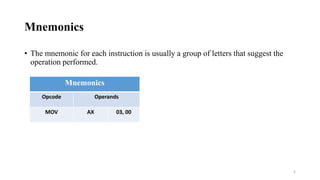
Mnemonics
• The mnemonic for each instruction is usually a group of letters that suggest the
operation performed.
Mnemonics
Opcode Operands
MOV AX 03, 00
5
Why Assembly Language?
• Provides knowledge of interface of programs with OS, processor and BIOS.
• How processor accesses and executes instruction.
• How instructions accesses and process data
• It requires less memory and execution time
• It allows hardware-specific complex jobs in an easier way.
6
Limitations
• Not portable. It has a lack of portability of program between different computer
architectures.
• The syntax is difficult to remember.
• Hard to read, maintain and debug.
• It takes a lot of time and effort to write the code for the same.
7
8
Thank You

Assembly language

  • 1.
  • 2.
    Contents • What isAssembly Language? • Assembler and Assembling Technique • Mnemonics • Why Assembly? • Limitations 2
  • 3.
    What is AssemblyLanguage? • An assembly language is a low-level programming language • Used for a computer, or other programmable device. • Assembly language is converted into executable machine code by a utility program, that is referred as an assembler. 3
  • 4.
    Assembler and AssemblingTechnique • The programmer normally translates each assembly language instruction into its equivalent hexadecimal code. Then the hexadecimal code is entered into memory. This is called “Hand Assembly” technique • The other possibility is a program called an “Assembler”, which does the translation automatically. 4
  • 5.
    Mnemonics • The mnemonicfor each instruction is usually a group of letters that suggest the operation performed. Mnemonics Opcode Operands MOV AX 03, 00 5
  • 6.
    Why Assembly Language? •Provides knowledge of interface of programs with OS, processor and BIOS. • How processor accesses and executes instruction. • How instructions accesses and process data • It requires less memory and execution time • It allows hardware-specific complex jobs in an easier way. 6
  • 7.
    Limitations • Not portable.It has a lack of portability of program between different computer architectures. • The syntax is difficult to remember. • Hard to read, maintain and debug. • It takes a lot of time and effort to write the code for the same. 7
  • 8.