Understanding
Assembly
Language
Syntax, Advantages, and
Comparison with
Machine Language
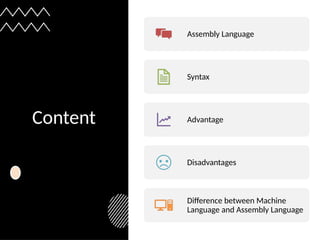
Content
Assembly Language
Syntax
Advantage
Disadvantages
Difference between Machine
Language and Assembly Language
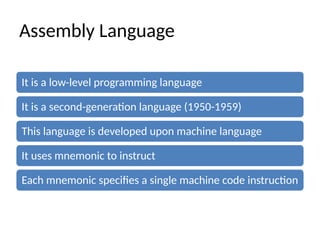
Assembly Language
It is a low-level programming language
It is a second-generation language (1950-1959)
This language is developed upon machine language
It uses mnemonic to instruct
Each mnemonic specifies a single machine code instruction
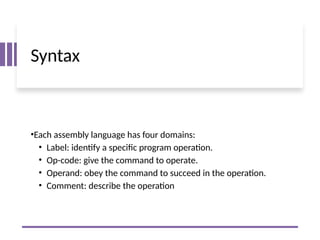
Syntax
•Each assembly language has four domains:
• Label: identify a specific program operation.
• Op-code: give the command to operate.
• Operand: obey the command to succeed in the operation.
• Comment: describe the operation
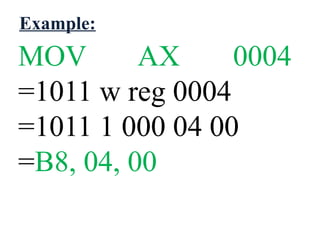
Example:
MOV AX 0004
=1011 w reg 0004
=1011 1 000 04 00
=B8, 04, 00
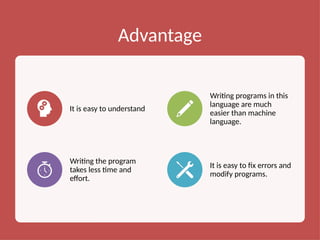
Advantage
It is easy to understand
Writing programs in this
language are much
easier than machine
language.
Writing the program
takes less time and
effort.
It is easy to fix errors and
modify programs.
Disadvantages
It is a machine-
dependent language.
The programmer has to
know about the machine
while designing the
program.
A translator program
called Assembler is
required.
It use more complex
method than high-level
languages.
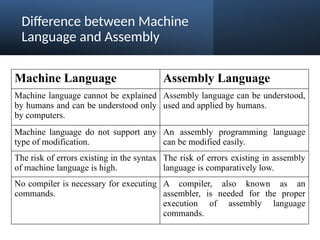
Difference between Machine
Language and Assembly
Machine Language Assembly Language
Machine language cannot be explained
by humans and can be understood only
by computers.
Assembly language can be understood,
used and applied by humans.
Machine language do not support any
type of modification.
An assembly programming language
can be modified easily.
The risk of errors existing in the syntax
of machine language is high.
The risk of errors existing in assembly
language is comparatively low.
No compiler is necessary for executing
commands.
A compiler, also known as an
assembler, is needed for the proper
execution of assembly language
commands.
Thanks

Understanding Assembly Language Syntax, Advantages, and Comparison with Machine Language.pptx

  • 1.
  • 2.
  • 3.
    Assembly Language It isa low-level programming language It is a second-generation language (1950-1959) This language is developed upon machine language It uses mnemonic to instruct Each mnemonic specifies a single machine code instruction
  • 4.
    Syntax •Each assembly languagehas four domains: • Label: identify a specific program operation. • Op-code: give the command to operate. • Operand: obey the command to succeed in the operation. • Comment: describe the operation
  • 5.
    Example: MOV AX 0004 =1011w reg 0004 =1011 1 000 04 00 =B8, 04, 00
  • 6.
    Advantage It is easyto understand Writing programs in this language are much easier than machine language. Writing the program takes less time and effort. It is easy to fix errors and modify programs.
  • 7.
    Disadvantages It is amachine- dependent language. The programmer has to know about the machine while designing the program. A translator program called Assembler is required. It use more complex method than high-level languages.
  • 8.
    Difference between Machine Languageand Assembly Machine Language Assembly Language Machine language cannot be explained by humans and can be understood only by computers. Assembly language can be understood, used and applied by humans. Machine language do not support any type of modification. An assembly programming language can be modified easily. The risk of errors existing in the syntax of machine language is high. The risk of errors existing in assembly language is comparatively low. No compiler is necessary for executing commands. A compiler, also known as an assembler, is needed for the proper execution of assembly language commands.
  • 9.