Diyala University
College of Engineering
Department of Communications
By AULA MAAD
RIYAM ABD_AL GABAAR
NABAA BADEEA
AHMAD ABBAS
THIRD STAGE
FOR Professor
Hussein Shakoor
2014_2_24
Assembly Language
contens
Assembly Language
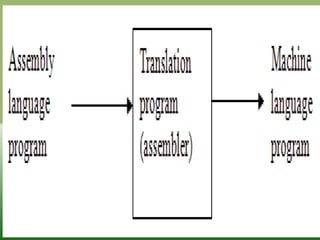
the relationship between assembly
language and machine language
Application of Assembly Language
opcode and operand
Mnemonics
The ASCII-code
Assembly Languages
One step up from machine language
Originally a more user-friendly way to program
Now mostly a compiler target
Model of Computer computation: stored
ther is some types of assmbly languages CISC:
Complex Instruction-Set RISC: Reduced InstructionSet Computer
DSP: Digital Signal Processor
VLIW: Very Long Instruction Word
The relationship between assembly language
and machine language
Assembly language is a convenience mechanism over •
the machine language. With assembly language you
use mnemonic sequences instead of numeric
operation codes and can use symbolic labels instead
of manually calculating offsets. It also protects you
from really dumb errors - like typing a malformed
processor instruction.
Otherwise the assemply language is the equivalent of •
the machine language. Sometimes you will have an old
assembler that will not support mnemonics for some
instructions of the newer processors - then you can still
insert operation codes directly into the program.
Application of Assembly Language
1. Assembly Language is used when speed and
reliability are the overriding factor like small
footprint real-time operating systems.
2. By using assembly language, programmers can
maximize on speed to a level. It is easy to write than
machine code programs.
3. It allows the programmer access to registers or
instructions that are not usually provided by a Highlevel language.
Application of Assembly Language
4. The main Application of Assembly Language
is for direct hardware manipulation i.e. device
drivers.
5. Assembly language also directly correlates
which machine instructions; the only way to
get closer to the machine is to write in binary
or hex code
opcode and operand
opcode (operational code) is machine code, it tells
the processor to perform particular action your
instruction converts to opcode before the execution.
operand: it is a memory location or a variable or any
general purpose register. it stores data. and u can
perform operations on it .
Mnemonics
mnemonics are nothing but the symbols
used to indicate a particular meaning in
assembly language. They are used to
make programming easier for
programmers
The ASCII-code
The “American Standard Code for
Information Interchange“ ASCII was
suggested in 1968
This standardisation made now
information exchange possible
between different computer
systems.
The ASCII-code
It has the word length 7 and codes decimal
digits, the characters of the latin alphabet as
well as special character. From the 128
possible binary words are 32 pseudo-words
and/or control characters.
A&a&r&n
A&a&r&n

A&a&r&n

  • 1.
    Diyala University College ofEngineering Department of Communications By AULA MAAD RIYAM ABD_AL GABAAR NABAA BADEEA AHMAD ABBAS THIRD STAGE FOR Professor Hussein Shakoor 2014_2_24
  • 2.
  • 3.
    contens Assembly Language the relationshipbetween assembly language and machine language Application of Assembly Language opcode and operand Mnemonics The ASCII-code
  • 4.
    Assembly Languages One stepup from machine language Originally a more user-friendly way to program Now mostly a compiler target Model of Computer computation: stored ther is some types of assmbly languages CISC: Complex Instruction-Set RISC: Reduced InstructionSet Computer DSP: Digital Signal Processor VLIW: Very Long Instruction Word
  • 6.
    The relationship betweenassembly language and machine language Assembly language is a convenience mechanism over • the machine language. With assembly language you use mnemonic sequences instead of numeric operation codes and can use symbolic labels instead of manually calculating offsets. It also protects you from really dumb errors - like typing a malformed processor instruction. Otherwise the assemply language is the equivalent of • the machine language. Sometimes you will have an old assembler that will not support mnemonics for some instructions of the newer processors - then you can still insert operation codes directly into the program.
  • 7.
    Application of AssemblyLanguage 1. Assembly Language is used when speed and reliability are the overriding factor like small footprint real-time operating systems. 2. By using assembly language, programmers can maximize on speed to a level. It is easy to write than machine code programs. 3. It allows the programmer access to registers or instructions that are not usually provided by a Highlevel language.
  • 8.
    Application of AssemblyLanguage 4. The main Application of Assembly Language is for direct hardware manipulation i.e. device drivers. 5. Assembly language also directly correlates which machine instructions; the only way to get closer to the machine is to write in binary or hex code
  • 9.
    opcode and operand opcode(operational code) is machine code, it tells the processor to perform particular action your instruction converts to opcode before the execution. operand: it is a memory location or a variable or any general purpose register. it stores data. and u can perform operations on it .
  • 11.
    Mnemonics mnemonics are nothingbut the symbols used to indicate a particular meaning in assembly language. They are used to make programming easier for programmers
  • 12.
    The ASCII-code The “AmericanStandard Code for Information Interchange“ ASCII was suggested in 1968 This standardisation made now information exchange possible between different computer systems.
  • 13.
    The ASCII-code It hasthe word length 7 and codes decimal digits, the characters of the latin alphabet as well as special character. From the 128 possible binary words are 32 pseudo-words and/or control characters.