J. Bense Tony
Anna University
        Chennai
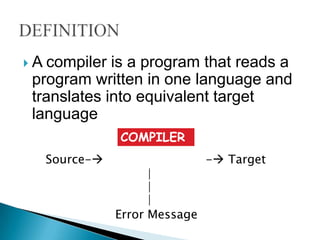
Acompiler is a program that reads a
program written in one language and
translates into equivalent target
language
                COMPILER
     Source-                   - Target
                      |
                      |
                      |
                Error Message
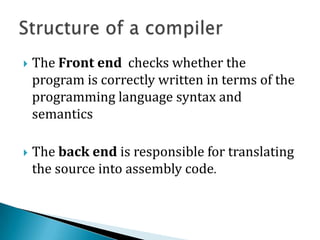
   The Front end checks whether the
    program is correctly written in terms of the
    programming language syntax and
    semantics

   The back end is responsible for translating
    the source into assembly code.
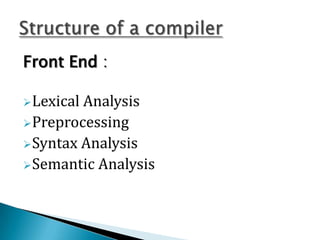
Front End :

LexicalAnalysis
Preprocessing
Syntax Analysis
Semantic Analysis
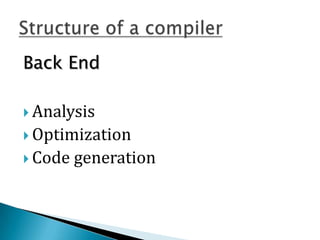
Back End

 Analysis
 Optimization
 Code   generation
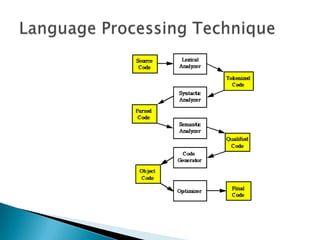
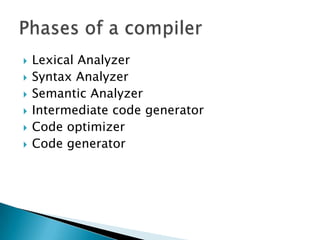
   Lexical Analyzer
   Syntax Analyzer
   Semantic Analyzer
   Intermediate code generator
   Code optimizer
   Code generator
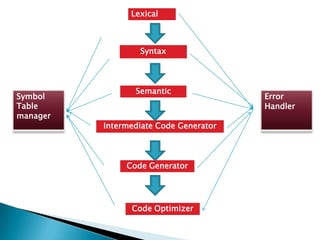
Lexical


                  Syntax


                 Semantic
Symbol                                  Error
Table                                   Handler
manager
          Intermediate Code Generator


               Code Generator


                Code Optimizer
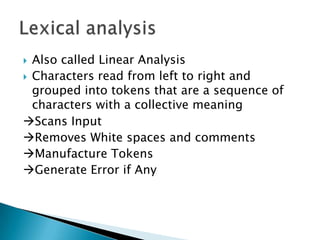
 Also called Linear Analysis
 Characters read from left to right and
  grouped into tokens that are a sequence of
  characters with a collective meaning
Scans Input
Removes White spaces and comments
Manufacture Tokens
Generate Error if Any
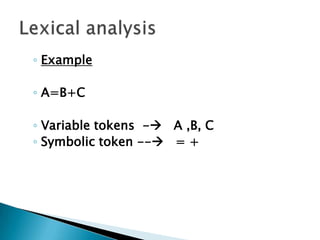
◦ Example

◦ A=B+C

◦ Variable tokens - A ,B, C
◦ Symbolic token -- = +
   Also called as Hierarchial Analysis
   A syntax tree[also called as parse tree] is generated
    where
    ◦ Operators  Interior nodes
    ◦ Operands  Children of node for operators.

                          =

                  A               +           Interior

                              B       C       Children
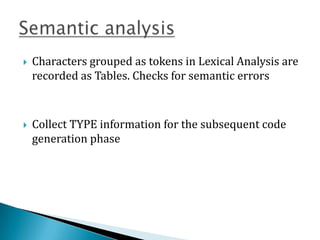
   Characters grouped as tokens in Lexical Analysis are
    recorded as Tables. Checks for semantic errors


   Collect TYPE information for the subsequent code
    generation phase
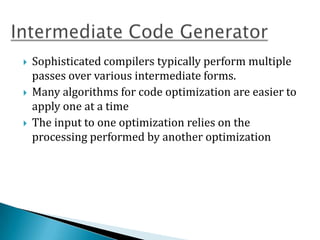
   Sophisticated compilers typically perform multiple
    passes over various intermediate forms.
   Many algorithms for code optimization are easier to
    apply one at a time
   The input to one optimization relies on the
    processing performed by another optimization
 Input : Concrete Syntax Tree[Parse Tree] or
           Abstract Syntax Tree
 The tree is converted into a linear sequence
  of instructions, usually in an intermediate
  language such as three address code.
 This is an Early stage of Code generation
Concrete Parse tree
             Abstract syntax tree


Converted into a linear sequence of instructions


       Results in 3AC [ 3 Address Code]
   This phase attempts to improve the intermediate
    code inorder to increase the running time

   Reduce the complexity of the code generated

   Leading to a faster execution of the program

   Increased Performance
   Platform Dependant/ Platform Independent
   Optimization can be automated by compilers or
    performed by programmers
   Usually, the most powerful optimization is to find
    a superior algorithm.
   Include activities like
    ◦ Optimization of LOOPS
    ◦ Optimization of Bottlenecks
 Succeeding step of Intermediate code
  optimizer
 Consists of re-locatable machine
  code/assembly code
 Intermediate instructions are converted
  into a a sequence of machine instructions
 One   pass compilers

 Multi   pass compilers

 Load    and go compilers

 Optimizing   compilers
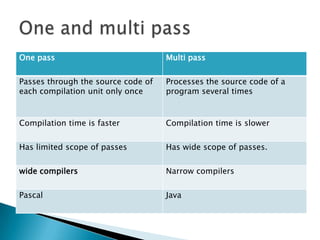
One pass                            Multi pass

Passes through the source code of   Processes the source code of a
each compilation unit only once     program several times


Compilation time is faster          Compilation time is slower


Has limited scope of passes         Has wide scope of passes.


wide compilers                      Narrow compilers


Pascal                              Java
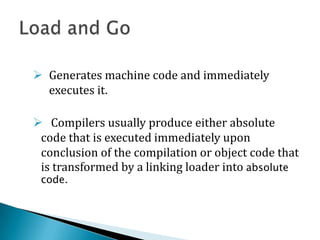
 Generates machine code and immediately
  executes it.

 Compilers usually produce either absolute
 code that is executed immediately upon
 conclusion of the compilation or object code that
 is transformed by a linking loader into absolute
 code.
   Loop optimization
   Data flow
   Code generation
   Functional language
   Interprocedural optimizations
   SSA [Static Single Assignment] based
    optimizations
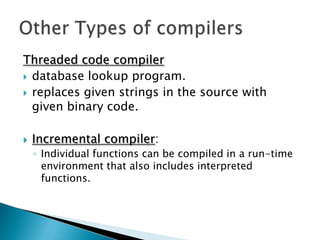
Threaded code compiler
 database lookup program.
 replaces given strings in the source with
  given binary code.

   Incremental compiler:
    ◦ Individual functions can be compiled in a run-time
      environment that also includes interpreted
      functions.
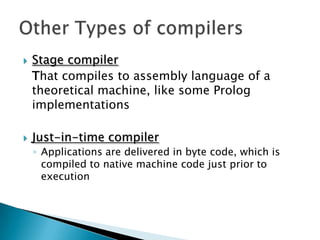
   Stage compiler
    That compiles to assembly language of a
    theoretical machine, like some Prolog
    implementations

   Just-in-time compiler
    ◦ Applications are delivered in byte code, which is
      compiled to native machine code just prior to
      execution
   A Retargetable compiler
    ◦ object code is frequently of lesser quality than that
      produced by a compiler developed specifically for a
      processor.
    ◦ Retargetable compilers are often also cross
      compilers
   A parallelizing compiler
    ◦ converts a serial input program into a form suitable
      for efficient execution on a parallel computer
      architecture.
 The compiler highlights all the possible
  errors which are obstacle in the
  program to provide a good meaning.
 Logical errors could be found only at
  Run time of the program.
   Array bound missing
   Array size too large
   Bad file name
   Call of on function
   Declaration missing
   Compound statement missing
   Illegal Accessions
   Not abstract
   Not accessible
   Not initialized
   Not found in “import”
   Scope related errors
   Cannot be inherited
   Overloading
   Overriding errors
   Program is free from lexical errors
   Program is free from syntax errors
   Program is free from semantic errors
   Even a complex program could be compiled in a
    small interval of time
   In programs related to database accessing,
    many risks are reduced.
THANK


YOU

Compilers

  • 1.
    J. Bense Tony AnnaUniversity Chennai
  • 2.
    Acompiler is aprogram that reads a program written in one language and translates into equivalent target language COMPILER Source- - Target | | | Error Message
  • 4.
    The Front end checks whether the program is correctly written in terms of the programming language syntax and semantics  The back end is responsible for translating the source into assembly code.
  • 5.
  • 6.
    Back End  Analysis Optimization  Code generation
  • 7.
    Lexical Analyzer  Syntax Analyzer  Semantic Analyzer  Intermediate code generator  Code optimizer  Code generator
  • 8.
    Lexical Syntax Semantic Symbol Error Table Handler manager Intermediate Code Generator Code Generator Code Optimizer
  • 9.
     Also calledLinear Analysis  Characters read from left to right and grouped into tokens that are a sequence of characters with a collective meaning Scans Input Removes White spaces and comments Manufacture Tokens Generate Error if Any
  • 10.
    ◦ Example ◦ A=B+C ◦Variable tokens - A ,B, C ◦ Symbolic token -- = +
  • 11.
    Also called as Hierarchial Analysis  A syntax tree[also called as parse tree] is generated where ◦ Operators  Interior nodes ◦ Operands  Children of node for operators. = A + Interior B C Children
  • 12.
    Characters grouped as tokens in Lexical Analysis are recorded as Tables. Checks for semantic errors  Collect TYPE information for the subsequent code generation phase
  • 13.
    Sophisticated compilers typically perform multiple passes over various intermediate forms.  Many algorithms for code optimization are easier to apply one at a time  The input to one optimization relies on the processing performed by another optimization
  • 14.
     Input :Concrete Syntax Tree[Parse Tree] or Abstract Syntax Tree  The tree is converted into a linear sequence of instructions, usually in an intermediate language such as three address code.  This is an Early stage of Code generation
  • 15.
    Concrete Parse tree Abstract syntax tree Converted into a linear sequence of instructions Results in 3AC [ 3 Address Code]
  • 16.
    This phase attempts to improve the intermediate code inorder to increase the running time  Reduce the complexity of the code generated  Leading to a faster execution of the program  Increased Performance
  • 17.
    Platform Dependant/ Platform Independent  Optimization can be automated by compilers or performed by programmers  Usually, the most powerful optimization is to find a superior algorithm.  Include activities like ◦ Optimization of LOOPS ◦ Optimization of Bottlenecks
  • 18.
     Succeeding stepof Intermediate code optimizer  Consists of re-locatable machine code/assembly code  Intermediate instructions are converted into a a sequence of machine instructions
  • 19.
     One pass compilers  Multi pass compilers  Load and go compilers  Optimizing compilers
  • 20.
    One pass Multi pass Passes through the source code of Processes the source code of a each compilation unit only once program several times Compilation time is faster Compilation time is slower Has limited scope of passes Has wide scope of passes. wide compilers Narrow compilers Pascal Java
  • 21.
     Generates machinecode and immediately executes it.  Compilers usually produce either absolute code that is executed immediately upon conclusion of the compilation or object code that is transformed by a linking loader into absolute code.
  • 22.
    Loop optimization  Data flow  Code generation  Functional language  Interprocedural optimizations  SSA [Static Single Assignment] based optimizations
  • 23.
    Threaded code compiler database lookup program.  replaces given strings in the source with given binary code.  Incremental compiler: ◦ Individual functions can be compiled in a run-time environment that also includes interpreted functions.
  • 24.
    Stage compiler That compiles to assembly language of a theoretical machine, like some Prolog implementations  Just-in-time compiler ◦ Applications are delivered in byte code, which is compiled to native machine code just prior to execution
  • 25.
    A Retargetable compiler ◦ object code is frequently of lesser quality than that produced by a compiler developed specifically for a processor. ◦ Retargetable compilers are often also cross compilers  A parallelizing compiler ◦ converts a serial input program into a form suitable for efficient execution on a parallel computer architecture.
  • 26.
     The compilerhighlights all the possible errors which are obstacle in the program to provide a good meaning.  Logical errors could be found only at Run time of the program.
  • 27.
    Array bound missing  Array size too large  Bad file name  Call of on function  Declaration missing  Compound statement missing  Illegal Accessions
  • 28.
    Not abstract  Not accessible  Not initialized  Not found in “import”  Scope related errors  Cannot be inherited  Overloading  Overriding errors
  • 29.
    Program is free from lexical errors  Program is free from syntax errors  Program is free from semantic errors  Even a complex program could be compiled in a small interval of time  In programs related to database accessing, many risks are reduced.
  • 30.