Micro-programmed Control
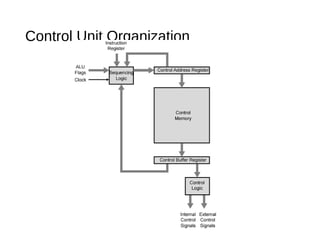
Control Unit Organization
Micro-programmed Control
• Use sequences of instructions (see earlier notes) to control complex
operations
• Called micro-programming or firmware
Implementation (1)
• All the control unit does is generate a set of control signals
• Each control signal is on or off
• Represent each control signal by a bit
• Have a control word for each micro-operation
• Have a sequence of control words for each machine code instruction
• Add an address to specify the next micro-instruction, depending on
conditions
Implementation (2)
• Today’s large microprocessor
• Many instructions and associated register-level hardware
• Many control points to be manipulated
• This results in control memory that
• Contains a large number of words
• co-responding to the number of instructions to be executed
• Has a wide word width
• Due to the large number of control points to be manipulated
Micro-program Word Length
• Based on 3 factors
• Maximum number of simultaneous micro-operations supported
• The way control information is represented or encoded
• The way in which the next micro-instruction address is specified
Micro-instruction Types
• Each micro-instruction specifies single (or few) micro-operations to
be performed
• (vertical micro-programming)
• Each micro-instruction specifies many different micro-operations to
be performed in parallel
• (horizontal micro-programming)
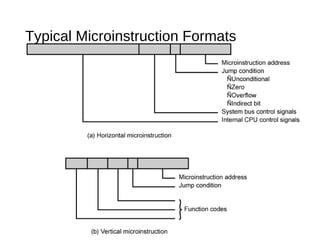
Vertical Micro-programming
• Width is narrow
• n control signals encoded into log2 n bits
• Limited ability to express parallelism
• Considerable encoding of control information requires external
memory word decoder to identify the exact control line being
manipulated
Horizontal Micro-programming
• Wide memory word
• High degree of parallel operations possible
• Little encoding of control information
Typical Microinstruction Formats
Compromise
• Divide control signals into disjoint groups
• Implement each group as separate field in memory word
• Supports reasonable levels of parallelism without too much
complexity
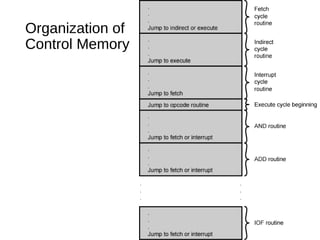
Organization of
Control Memory
Control Unit
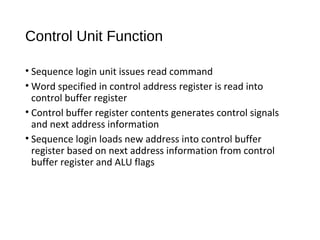
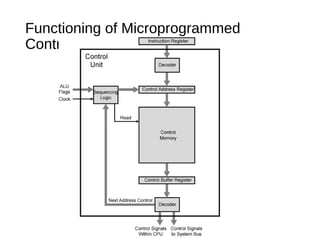
Control Unit Function
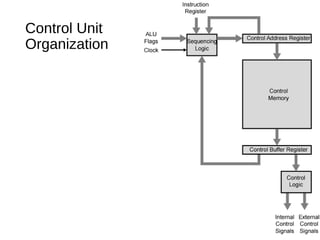
• Sequence login unit issues read command
• Word specified in control address register is read into
control buffer register
• Control buffer register contents generates control signals
and next address information
• Sequence login loads new address into control buffer
register based on next address information from control
buffer register and ALU flags
Next Address Decision
• Depending on ALU flags and control buffer register
• Get next instruction
• Add 1 to control address register
• Jump to new routine based on jump microinstruction
• Load address field of control buffer register into control address register
• Jump to machine instruction routine
• Load control address register based on opcode in IR
Functioning of Microprogrammed
Control Unit
Wilkes Control
• 1951
• Matrix partially filled with diodes
• During cycle, one row activated
• Generates signals where diode present
• First part of row generates control
• Second generates address for next cycle
Wilkes's Microprogrammed Control Unit
Advantages and Disadvantages of
Microprogramming
• Simplifies design of control unit
• Cheaper
• Less error-prone
• Slower
Tasks Done By Microprogrammed
Control Unit
• Microinstruction sequencing
• Microinstruction execution
• Must consider both together
Design Considerations
• Size of microinstructions
• Address generation time
• Determined by instruction register
• Once per cycle, after instruction is fetched
• Next sequential address
• Common in most designed
• Branches
• Both conditional and unconditional
Sequencing Techniques
• Based on current microinstruction, condition flags, contents of IR,
control memory address must be generated
• Based on format of address information
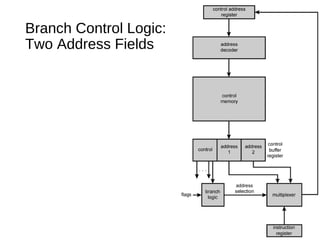
• Two address fields
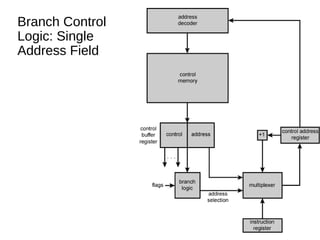
• Single address field
• Variable format
Branch Control Logic:
Two Address Fields
Branch Control
Logic: Single
Address Field
Branch Control
Logic: Variable
Format
Address Generation
Explicit Implicit
Two-field Mapping
Unconditional Branch Addition
Conditional branch Residual control
Execution
• The cycle is the basic event
• Each cycle is made up of two events
• Fetch
• Determined by generation of microinstruction address
• Execute
Execute
• Effect is to generate control signals
• Some control points internal to processor
• Rest go to external control bus or other interface
Control Unit
Organization
A Taxonomy of Microinstructions
• Vertical/horizontal
• Packed/unpacked
• Hard/soft microprogramming
• Direct/indirect encoding
Improvements over Wilkes
• Wilkes had each bit directly produced a control signal or directly
produced one bit of next address
• More complex address sequencing schemes,
• using fewer microinstruction bits, are possible
• Require more complex sequencing logic module
• Control word bits can be saved by encoding and subsequently
decoding control information
How to Encode
• K different internal and external control signals
• Wilkes’s:
• K bits dedicated
• 2K control signals during any instruction cycle
• Not all used
• Two sources cannot be gated to same destination
• Register cannot be source and destination
• Only one pattern presented to ALU at a time
• Only one pattern presented to external control bus at a time
• Require Q < 2K which can be encoded with log2Q < K bits
• Not done
• As difficult to program as pure decoded (Wilkes) scheme
• Requires complex slow control logic module
• Compromises
• More bits than necessary used
• Some combinations that are physically allowable are not possible to encode
Specific Encoding Techniques
• Microinstruction organized as set of fields
• Each field contains code
• Activates one or more control signals
• Organize format into independent fields
• Field depicts set of actions (pattern of control signals)
• Actions from different fields can occur simultaneously
• Alternative actions that can be specified by a field are mutually
exclusive
• Only one action specified for field could occur at a time
Microinstruction Encoding
Direct Encoding
Microinstruction Encoding
Indirect Encoding

Micro programmed control

  • 1.
  • 2.
  • 3.
    Micro-programmed Control • Usesequences of instructions (see earlier notes) to control complex operations • Called micro-programming or firmware
  • 4.
    Implementation (1) • Allthe control unit does is generate a set of control signals • Each control signal is on or off • Represent each control signal by a bit • Have a control word for each micro-operation • Have a sequence of control words for each machine code instruction • Add an address to specify the next micro-instruction, depending on conditions
  • 5.
    Implementation (2) • Today’slarge microprocessor • Many instructions and associated register-level hardware • Many control points to be manipulated • This results in control memory that • Contains a large number of words • co-responding to the number of instructions to be executed • Has a wide word width • Due to the large number of control points to be manipulated
  • 6.
    Micro-program Word Length •Based on 3 factors • Maximum number of simultaneous micro-operations supported • The way control information is represented or encoded • The way in which the next micro-instruction address is specified
  • 7.
    Micro-instruction Types • Eachmicro-instruction specifies single (or few) micro-operations to be performed • (vertical micro-programming) • Each micro-instruction specifies many different micro-operations to be performed in parallel • (horizontal micro-programming)
  • 8.
    Vertical Micro-programming • Widthis narrow • n control signals encoded into log2 n bits • Limited ability to express parallelism • Considerable encoding of control information requires external memory word decoder to identify the exact control line being manipulated
  • 9.
    Horizontal Micro-programming • Widememory word • High degree of parallel operations possible • Little encoding of control information
  • 10.
  • 11.
    Compromise • Divide controlsignals into disjoint groups • Implement each group as separate field in memory word • Supports reasonable levels of parallelism without too much complexity
  • 12.
  • 13.
  • 14.
    Control Unit Function •Sequence login unit issues read command • Word specified in control address register is read into control buffer register • Control buffer register contents generates control signals and next address information • Sequence login loads new address into control buffer register based on next address information from control buffer register and ALU flags
  • 15.
    Next Address Decision •Depending on ALU flags and control buffer register • Get next instruction • Add 1 to control address register • Jump to new routine based on jump microinstruction • Load address field of control buffer register into control address register • Jump to machine instruction routine • Load control address register based on opcode in IR
  • 16.
  • 17.
    Wilkes Control • 1951 •Matrix partially filled with diodes • During cycle, one row activated • Generates signals where diode present • First part of row generates control • Second generates address for next cycle
  • 18.
  • 19.
    Advantages and Disadvantagesof Microprogramming • Simplifies design of control unit • Cheaper • Less error-prone • Slower
  • 20.
    Tasks Done ByMicroprogrammed Control Unit • Microinstruction sequencing • Microinstruction execution • Must consider both together
  • 21.
    Design Considerations • Sizeof microinstructions • Address generation time • Determined by instruction register • Once per cycle, after instruction is fetched • Next sequential address • Common in most designed • Branches • Both conditional and unconditional
  • 22.
    Sequencing Techniques • Basedon current microinstruction, condition flags, contents of IR, control memory address must be generated • Based on format of address information • Two address fields • Single address field • Variable format
  • 23.
  • 24.
  • 25.
  • 26.
    Address Generation Explicit Implicit Two-fieldMapping Unconditional Branch Addition Conditional branch Residual control
  • 27.
    Execution • The cycleis the basic event • Each cycle is made up of two events • Fetch • Determined by generation of microinstruction address • Execute
  • 28.
    Execute • Effect isto generate control signals • Some control points internal to processor • Rest go to external control bus or other interface
  • 29.
  • 30.
    A Taxonomy ofMicroinstructions • Vertical/horizontal • Packed/unpacked • Hard/soft microprogramming • Direct/indirect encoding
  • 31.
    Improvements over Wilkes •Wilkes had each bit directly produced a control signal or directly produced one bit of next address • More complex address sequencing schemes, • using fewer microinstruction bits, are possible • Require more complex sequencing logic module • Control word bits can be saved by encoding and subsequently decoding control information
  • 32.
    How to Encode •K different internal and external control signals • Wilkes’s: • K bits dedicated • 2K control signals during any instruction cycle • Not all used • Two sources cannot be gated to same destination • Register cannot be source and destination • Only one pattern presented to ALU at a time • Only one pattern presented to external control bus at a time • Require Q < 2K which can be encoded with log2Q < K bits • Not done • As difficult to program as pure decoded (Wilkes) scheme • Requires complex slow control logic module • Compromises • More bits than necessary used • Some combinations that are physically allowable are not possible to encode
  • 33.
    Specific Encoding Techniques •Microinstruction organized as set of fields • Each field contains code • Activates one or more control signals • Organize format into independent fields • Field depicts set of actions (pattern of control signals) • Actions from different fields can occur simultaneously • Alternative actions that can be specified by a field are mutually exclusive • Only one action specified for field could occur at a time
  • 34.
  • 35.