


G. H. Patel College of
Engineering & Technology
Subject : System Programming (2150708)
Topic : Macro Processor
Batch : 1D16
Prepared by:
Khyati Valera (160110116059)
Rutvi Vasani (160110116060)
Bhavik Vashi (160110116061)
Submitted to: Prof. Vinita Shah
What is macro?
▶ A macro is a unit of specification for program generation through
expansion.
▶ A macro consists of a name , a set of formal parameters and
body of code.
▶ The use of a macro name with a set of actual parameters is
replaced by some code generated from its body. This is called
macro expansion.
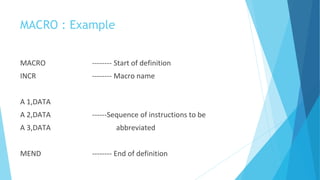
MACRO : Example
MACRO -------- Start of definition
INCR -------- Macro name
A 1,DATA
A 2,DATA ------Sequence of instructions to be
A 3,DATA abbreviated
MEND -------- End of definition
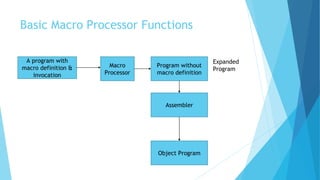
Basic Macro Processor Functions
A program with
macro definition &
invocation
Macro
Processor
Program without
macro definition
Expanded
Program
Assembler
Object Program
NESTED MACRO CALLS
▶ A model statement in a macro may constitute a call on another
macro. Such calls are known as nested macro calls.
▶ Macro containing the nested call is the outer macro and
Macro called is inner macro.
▶ They follow LIFO rule.
▶ Thus, in structure of nested macro calls, expansion of latest
macro call (i.e. inner macro) is completed first.
NESTED MACRO CALLS : Example
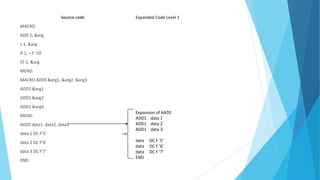
Source code
MACRO
ADD 1, &arg
L 1, &arg
A 1, = F ‘10’
ST 1, &arg
MEND
MACRO ADDS &arg1, &arg2, &arg3
ADD1 &arg1
ADD1 &arg2
ADD1 &arg3
MEND
ADDS data1, data2, data3
data 1 DC F‘5’
data 2 DC F‘6’
data 3 DC F‘7’
END
Expanded Code Level 1
Expansion of AADS
ADD1 data 1
ADD1 data 2
ADD1 data 3
data DC F ‘5’
data DC F ‘6’
data DC F ‘7’
END
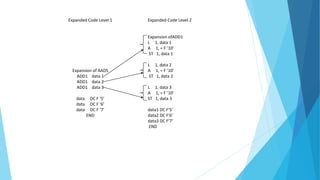
Expanded Code Level 2
Expansion ofADD1
L 1, data 1
A 1, = F ’10’
ST 1, data 1
L 1, data 2
A 1, = F ’10’
ST 1, data 2
L 1, data 3
A 1, = F ’10’
ST 1, data 3
data1 DC F‘5’
data2 DC F‘6’
data3 DC F‘7’
END
Expanded Code Level 1
Expansion of AADS
ADD1 data 1
ADD1 data 2
ADD1 data 3
data DC F ‘5’
data DC F ‘6’
data DC F ‘7’
END
ADVANCED MACRO FACILITIES
▶ Advanced macro facilities are aimed to supporting semantic expansion.
▶ Used for:
▶ performing conditional expansion of model statements and
in writing expansion time loops.
▶ These facilities can be grouped into following.
▶ 1. Facilities for alteration of flow of control during expansion.
▶ 2. Expansion time variables.
▶ 3. Attributes of parameters.
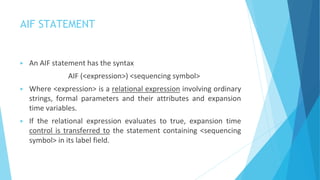
AIF STATEMENT
▶ An AIF statement has the syntax
AIF (<expression>) <sequencing symbol>
▶ Where <expression> is a relational expression involving ordinary
strings, formal parameters and their attributes and expansion
time variables.
▶ If the relational expression evaluates to true, expansion time
control is transferred to the statement containing <sequencing
symbol> in its label field.
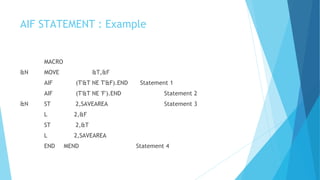
AIF STATEMENT : Example
MACRO
&N MOVE &T,&F
AIF (T'&T NE T'&F).END Statement 1
AIF (T'&T NE 'F').END Statement 2
&N ST 2,SAVEAREA Statement 3
L 2,&F
ST 2,&T
L 2,SAVEAREA
END MEND Statement 4
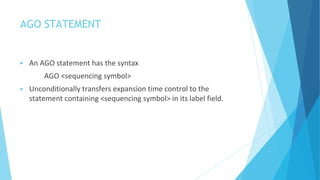
AGO STATEMENT
▶ An AGO statement has the syntax
AGO <sequencing symbol>
▶ Unconditionally transfers expansion time control to the
statement containing <sequencing symbol> in its label field.
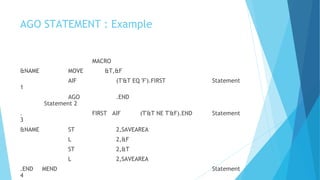
AGO STATEMENT : Example
MACRO
&NAME MOVE &T,&F
AIF (T'&T EQ 'F').FIRST Statement
1
AGO .END
Statement 2
. FIRST AIF (T'&T NE T'&F).END Statement
3
&NAME ST 2,SAVEAREA
L 2,&F
ST 2,&T
L 2,SAVEAREA
.END MEND Statement
4
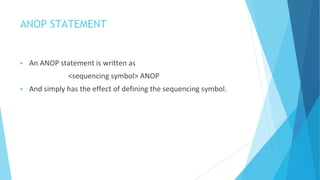
ANOP STATEMENT
▶ An ANOP statement is written as
<sequencing symbol> ANOP
▶ And simply has the effect of defining the sequencing symbol.
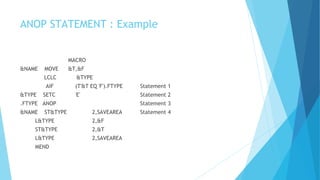
ANOP STATEMENT : Example
MACRO
&NAME MOVE &T,&F
LCLC &TYPE
AIF (T'&T EQ 'F').FTYPE Statement 1
&TYPE SETC 'E' Statement 2
.FTYPE ANOP Statement 3
&NAME ST&TYPE 2,SAVEAREA Statement 4
L&TYPE 2,&F
ST&TYPE 2,&T
L&TYPE 2,SAVEAREA
MEND
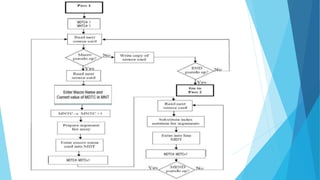
Algorithm : Pass 1
▶ Pass1 of macro processor makes a line-by-line scan over its input.
▶ Set MDTC = 1 as well as MNTC = 1.
▶ Read next line from input program.
▶ If it is a MACRO pseudo-op, the entire macro definition except this
(MACRO) line is stored in MDT.
▶ The name is entered into Macro Name Table along with a pointer to
the first location of MDT entry of the definition.
▶ When the END pseudo-op is encountered all the macro-definations
have been processed, so control is transferred to pass2
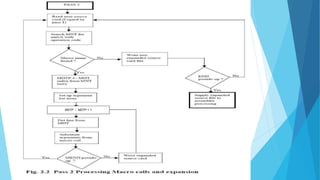
Algorithm : Pass 2
▶ This algorithm reads one line of input program at a time.
▶ for each Line it checks if op-code of that line matches any of the MNT entry.
▶ When match is found (i.e. when call is pointer called MDTF to corresponding
macro definition stored in MDT.
▶ The initial value of MDTP is obtained from MDT index field of MNT entry.
▶ The macro expander prepares the ALA consisting of a table of dummy
argument indices & corresponding arguments to the call.
▶ Reading proceeds from the MDT, as each successive line is read, The values
form the argument list one substituted for dummy arguments indices in the
macro defn.
▶ Reading MEND line in MDT terminates expansion of macro & scanning
continues from the input file.
▶ When END pseudo-op encountered , the expanded source program is given
to the assembler
MACRO PROCESSOR
MACRO PROCESSOR

MACRO PROCESSOR

  • 1.
    G. H. PatelCollege of Engineering & Technology Subject : System Programming (2150708) Topic : Macro Processor Batch : 1D16 Prepared by: Khyati Valera (160110116059) Rutvi Vasani (160110116060) Bhavik Vashi (160110116061) Submitted to: Prof. Vinita Shah
  • 2.
    What is macro? ▶A macro is a unit of specification for program generation through expansion. ▶ A macro consists of a name , a set of formal parameters and body of code. ▶ The use of a macro name with a set of actual parameters is replaced by some code generated from its body. This is called macro expansion.
  • 3.
    MACRO : Example MACRO-------- Start of definition INCR -------- Macro name A 1,DATA A 2,DATA ------Sequence of instructions to be A 3,DATA abbreviated MEND -------- End of definition
  • 4.
    Basic Macro ProcessorFunctions A program with macro definition & invocation Macro Processor Program without macro definition Expanded Program Assembler Object Program
  • 5.
    NESTED MACRO CALLS ▶A model statement in a macro may constitute a call on another macro. Such calls are known as nested macro calls. ▶ Macro containing the nested call is the outer macro and Macro called is inner macro. ▶ They follow LIFO rule. ▶ Thus, in structure of nested macro calls, expansion of latest macro call (i.e. inner macro) is completed first.
  • 6.
  • 7.
    Source code MACRO ADD 1,&arg L 1, &arg A 1, = F ‘10’ ST 1, &arg MEND MACRO ADDS &arg1, &arg2, &arg3 ADD1 &arg1 ADD1 &arg2 ADD1 &arg3 MEND ADDS data1, data2, data3 data 1 DC F‘5’ data 2 DC F‘6’ data 3 DC F‘7’ END Expanded Code Level 1 Expansion of AADS ADD1 data 1 ADD1 data 2 ADD1 data 3 data DC F ‘5’ data DC F ‘6’ data DC F ‘7’ END
  • 8.
    Expanded Code Level2 Expansion ofADD1 L 1, data 1 A 1, = F ’10’ ST 1, data 1 L 1, data 2 A 1, = F ’10’ ST 1, data 2 L 1, data 3 A 1, = F ’10’ ST 1, data 3 data1 DC F‘5’ data2 DC F‘6’ data3 DC F‘7’ END Expanded Code Level 1 Expansion of AADS ADD1 data 1 ADD1 data 2 ADD1 data 3 data DC F ‘5’ data DC F ‘6’ data DC F ‘7’ END
  • 9.
    ADVANCED MACRO FACILITIES ▶Advanced macro facilities are aimed to supporting semantic expansion. ▶ Used for: ▶ performing conditional expansion of model statements and in writing expansion time loops. ▶ These facilities can be grouped into following. ▶ 1. Facilities for alteration of flow of control during expansion. ▶ 2. Expansion time variables. ▶ 3. Attributes of parameters.
  • 10.
    AIF STATEMENT ▶ AnAIF statement has the syntax AIF (<expression>) <sequencing symbol> ▶ Where <expression> is a relational expression involving ordinary strings, formal parameters and their attributes and expansion time variables. ▶ If the relational expression evaluates to true, expansion time control is transferred to the statement containing <sequencing symbol> in its label field.
  • 11.
    AIF STATEMENT :Example MACRO &N MOVE &T,&F AIF (T'&T NE T'&F).END Statement 1 AIF (T'&T NE 'F').END Statement 2 &N ST 2,SAVEAREA Statement 3 L 2,&F ST 2,&T L 2,SAVEAREA END MEND Statement 4
  • 12.
    AGO STATEMENT ▶ AnAGO statement has the syntax AGO <sequencing symbol> ▶ Unconditionally transfers expansion time control to the statement containing <sequencing symbol> in its label field.
  • 13.
    AGO STATEMENT :Example MACRO &NAME MOVE &T,&F AIF (T'&T EQ 'F').FIRST Statement 1 AGO .END Statement 2 . FIRST AIF (T'&T NE T'&F).END Statement 3 &NAME ST 2,SAVEAREA L 2,&F ST 2,&T L 2,SAVEAREA .END MEND Statement 4
  • 14.
    ANOP STATEMENT ▶ AnANOP statement is written as <sequencing symbol> ANOP ▶ And simply has the effect of defining the sequencing symbol.
  • 15.
    ANOP STATEMENT :Example MACRO &NAME MOVE &T,&F LCLC &TYPE AIF (T'&T EQ 'F').FTYPE Statement 1 &TYPE SETC 'E' Statement 2 .FTYPE ANOP Statement 3 &NAME ST&TYPE 2,SAVEAREA Statement 4 L&TYPE 2,&F ST&TYPE 2,&T L&TYPE 2,SAVEAREA MEND
  • 16.
    Algorithm : Pass1 ▶ Pass1 of macro processor makes a line-by-line scan over its input. ▶ Set MDTC = 1 as well as MNTC = 1. ▶ Read next line from input program. ▶ If it is a MACRO pseudo-op, the entire macro definition except this (MACRO) line is stored in MDT. ▶ The name is entered into Macro Name Table along with a pointer to the first location of MDT entry of the definition. ▶ When the END pseudo-op is encountered all the macro-definations have been processed, so control is transferred to pass2
  • 18.
    Algorithm : Pass2 ▶ This algorithm reads one line of input program at a time. ▶ for each Line it checks if op-code of that line matches any of the MNT entry. ▶ When match is found (i.e. when call is pointer called MDTF to corresponding macro definition stored in MDT. ▶ The initial value of MDTP is obtained from MDT index field of MNT entry. ▶ The macro expander prepares the ALA consisting of a table of dummy argument indices & corresponding arguments to the call. ▶ Reading proceeds from the MDT, as each successive line is read, The values form the argument list one substituted for dummy arguments indices in the macro defn. ▶ Reading MEND line in MDT terminates expansion of macro & scanning continues from the input file. ▶ When END pseudo-op encountered , the expanded source program is given to the assembler