Assembly Language
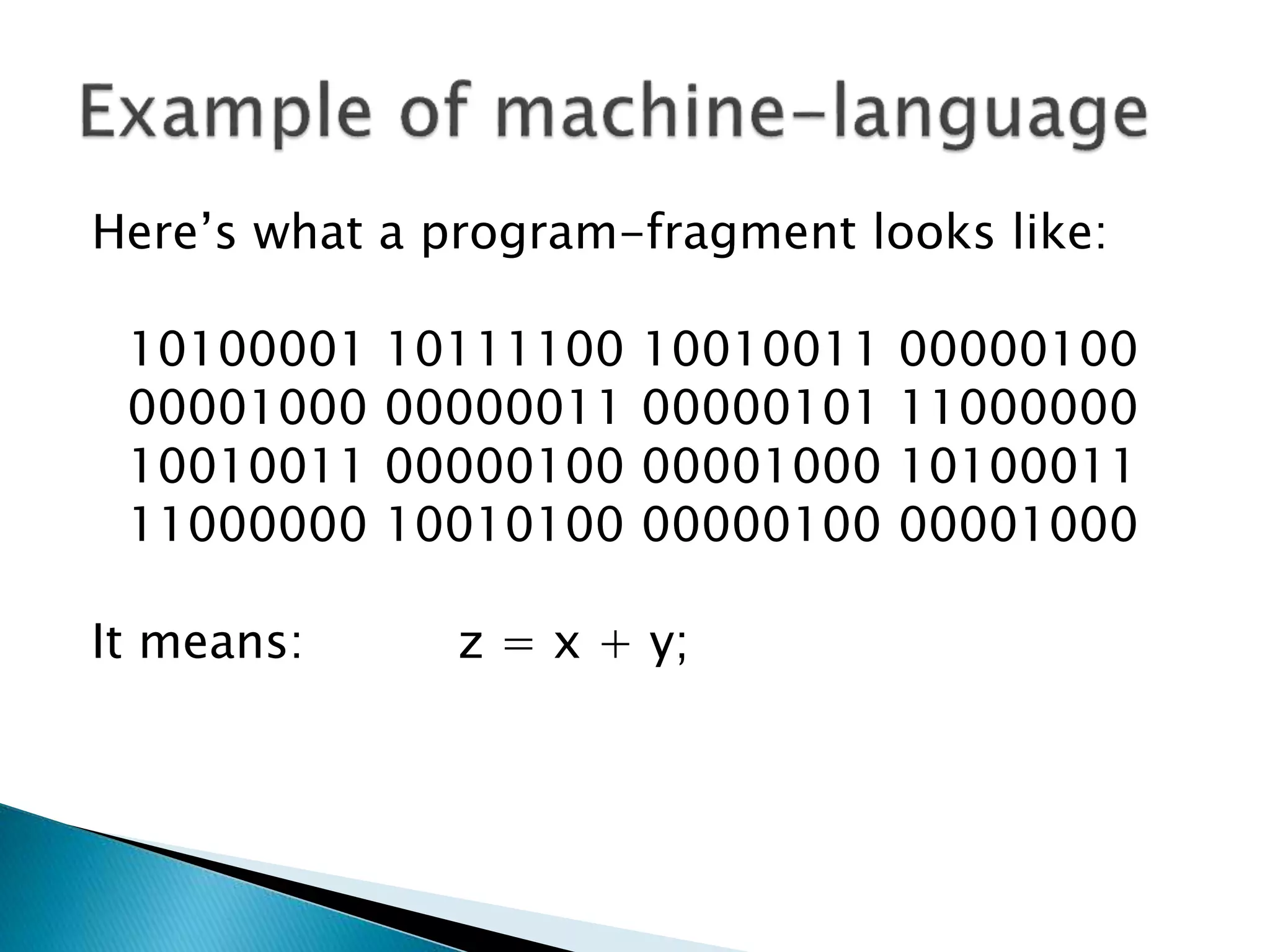
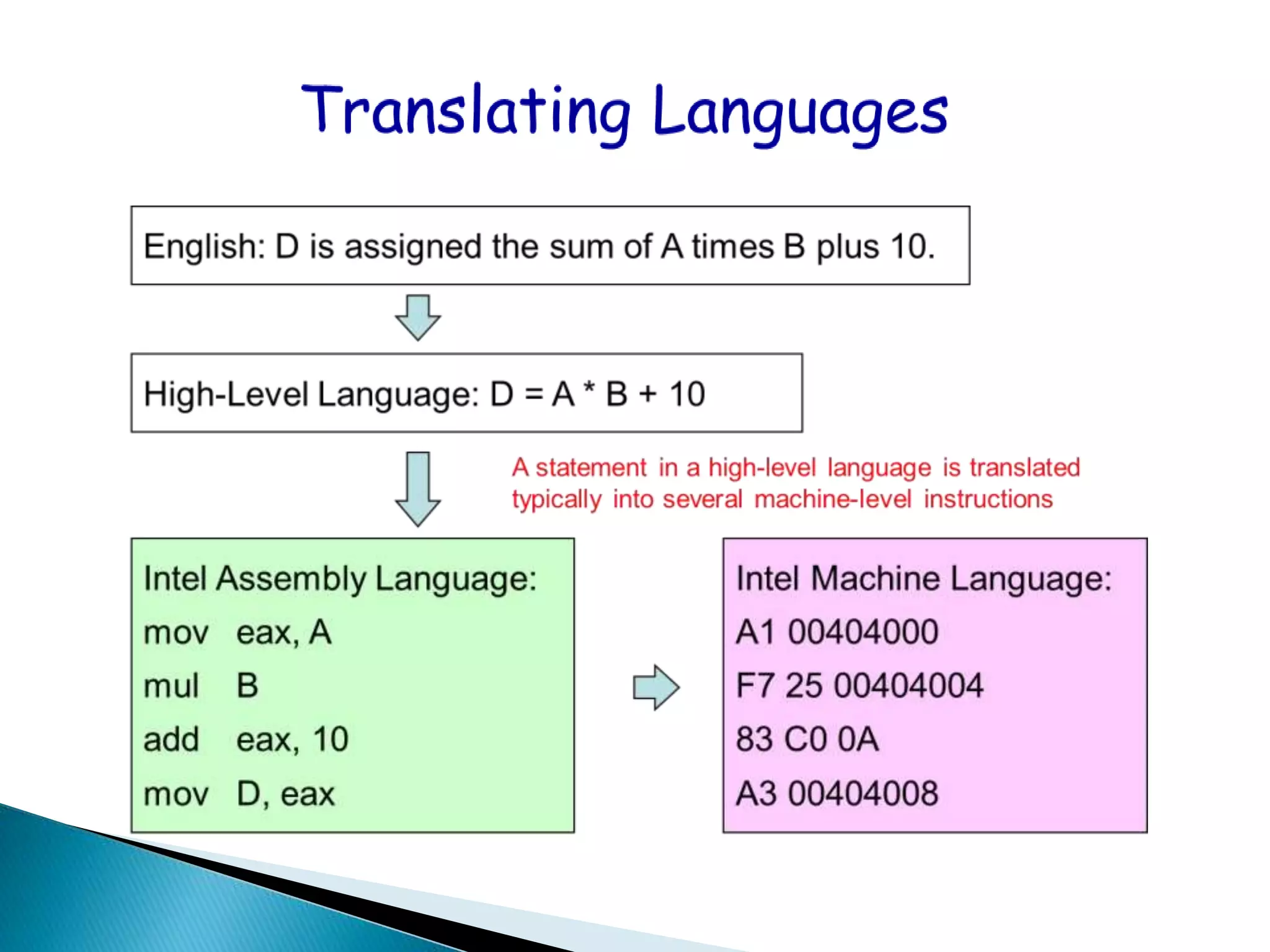
Here’s what a program-fragment looks like:
10100001 10111100 10010011 00000100
00001000 00000011 00000101 11000000
10010011 00000100 00001000 10100011
11000000 10010100 00000100 00001000
It means: z = x + y;
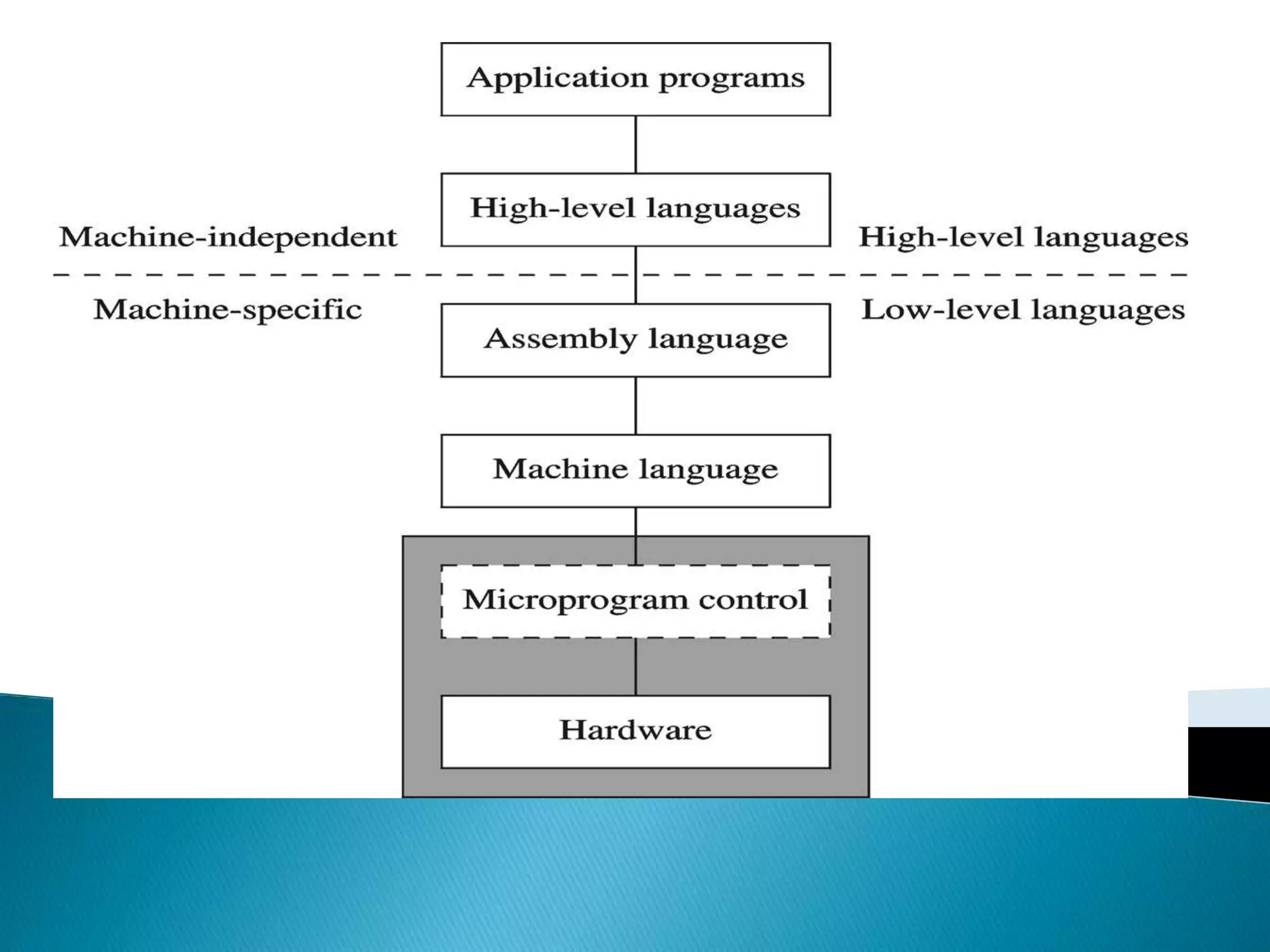
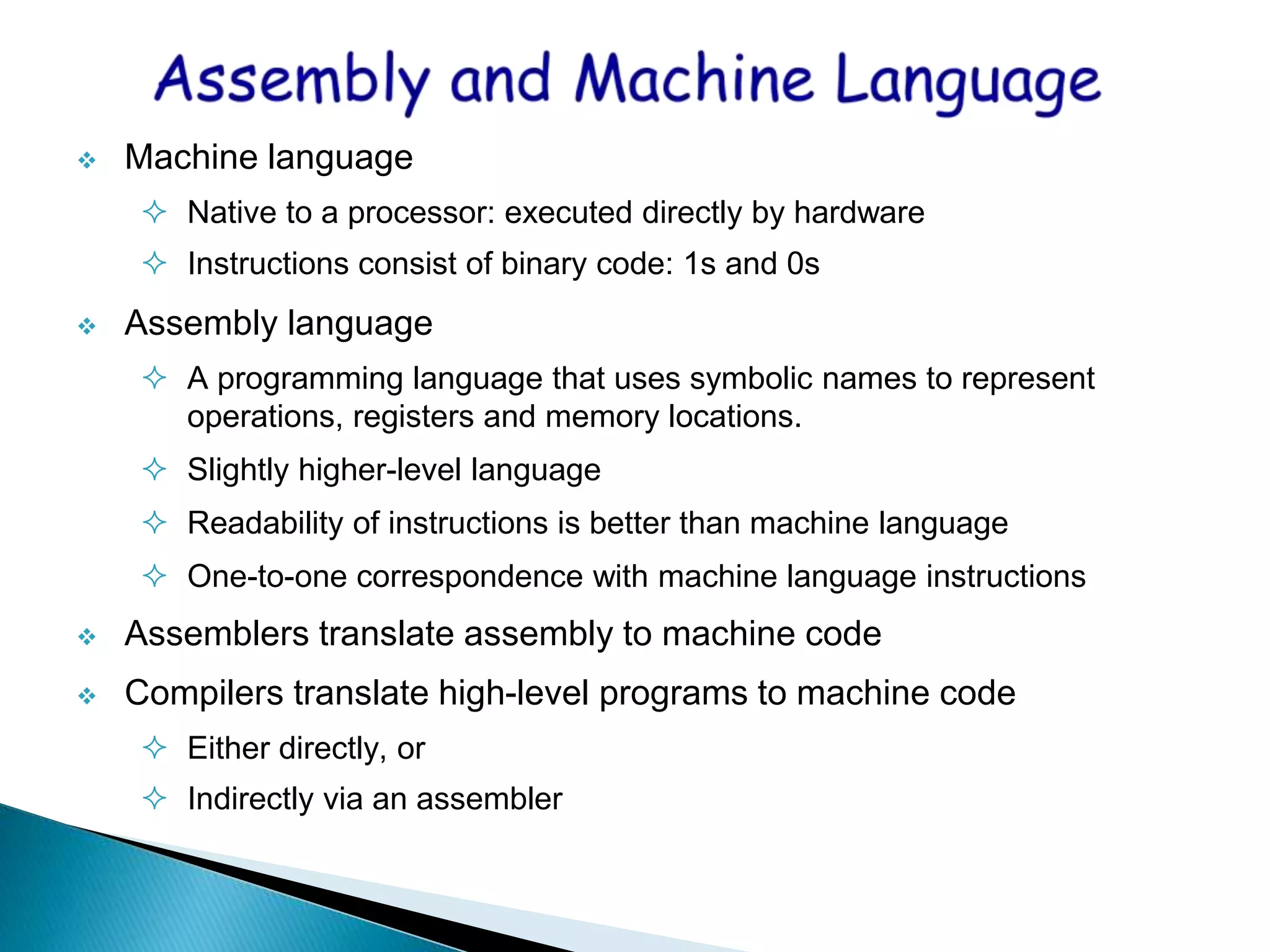
 Machine language
 Native to a processor: executed directly by hardware
 Instructions consist of binary code: 1s and 0s
 Assembly language
 A programming language that uses symbolic names to represent
operations, registers and memory locations.
 Slightly higher-level language
 Readability of instructions is better than machine language
 One-to-one correspondence with machine language instructions
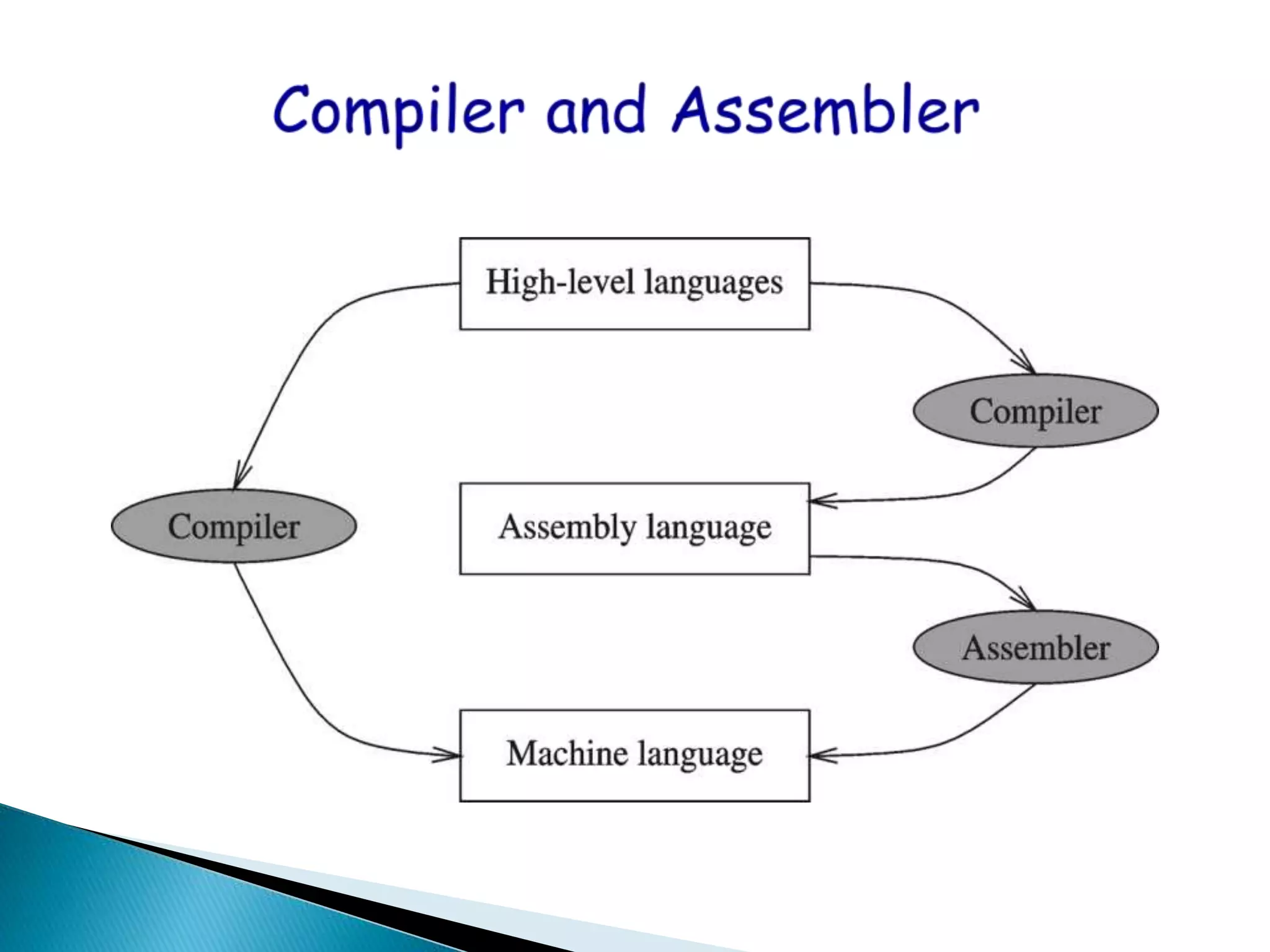
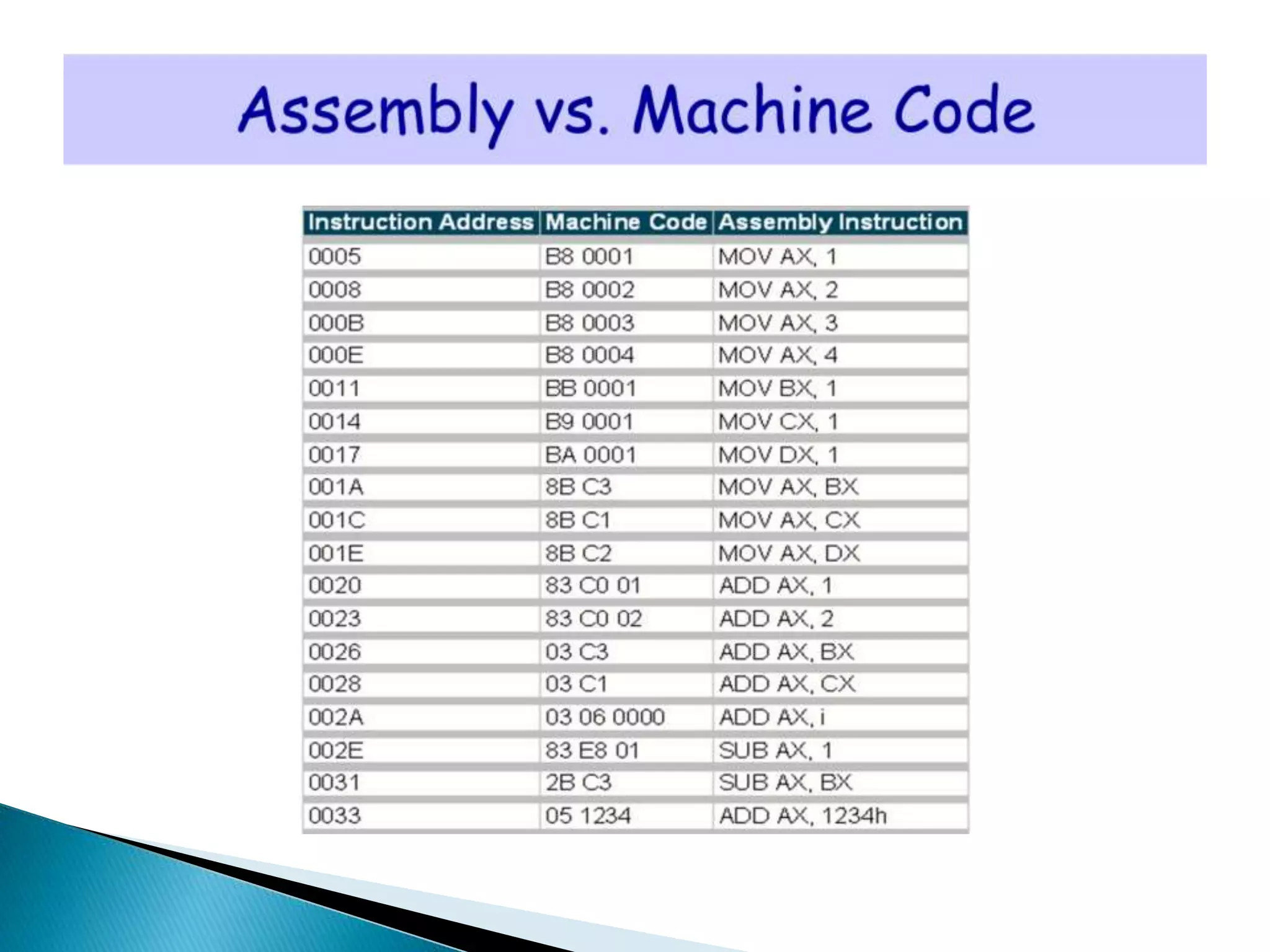
 Assemblers translate assembly to machine code
 Compilers translate high-level programs to machine code
 Either directly, or
 Indirectly via an assembler
 Software tools are needed for editing, assembling, linking,
and debugging assembly language programs
 An assembler is a program that converts source-code
programs written in assembly language into object files in
machine language
 Popular assemblers have emerged over the years for the
Intel family of processors. These include …
 TASM (Turbo Assembler from Borland)
 NASM (Netwide Assembler for both Windows and Linux), and
 GNU assembler distributed by the free software foundation
 In assembly language, mnemonics are used
to specify an opcode that represents a
complete and operational machine language
instruction. This is later translated by the
assembler to generate the object code. For
example, the mnemonic MOV is used in
assembly language for copying and moving
data between registers and memory
locations.
 Each command of a program is called an instruction (it
instructs the computer what to do).
 Computers only deal with binary data, hence the
instructions must be in binary format (0s and 1s) .
 The set of all instructions (in binary form) makes up the
computer's machine language. This is also referred to as
the instruction set.
 Machine language instructions usually are made up of
several fields. Each field specifies different information
for the computer. The major two fields are:
 Opcode field which stands for operation code and it
specifies the particular operation that is to be performed.
 Each operation has its unique opcode.
 Operands fields which specify where to get the source
and destination operands for the operation specified by
the opcode.
 The source/destination of operands can be a constant, the
memory or one of the general-purpose registers.
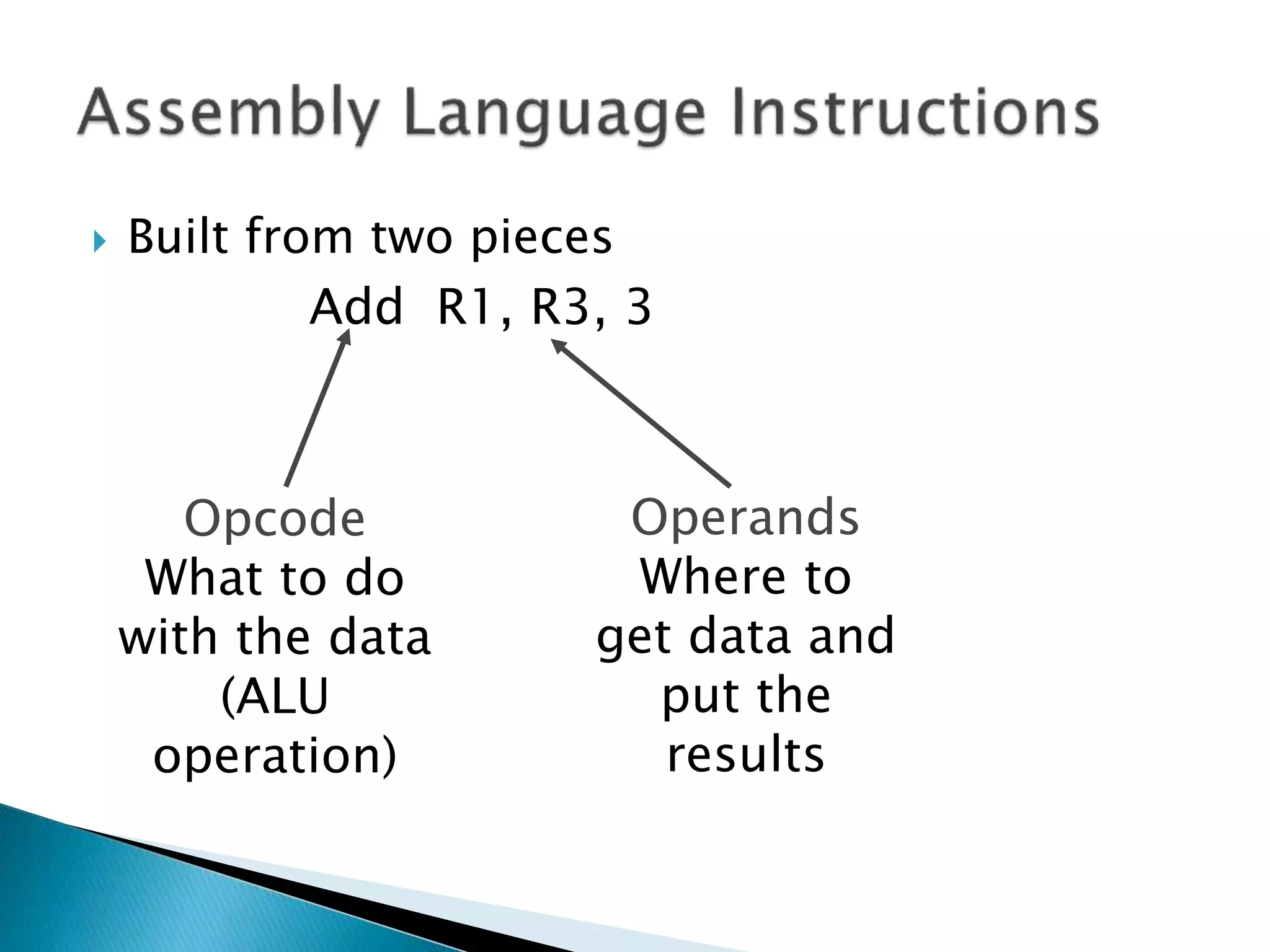
 Built from two pieces
Add R1, R3, 3
Opcode
What to do
with the data
(ALU
operation)
Operands
Where to
get data and
put the
results
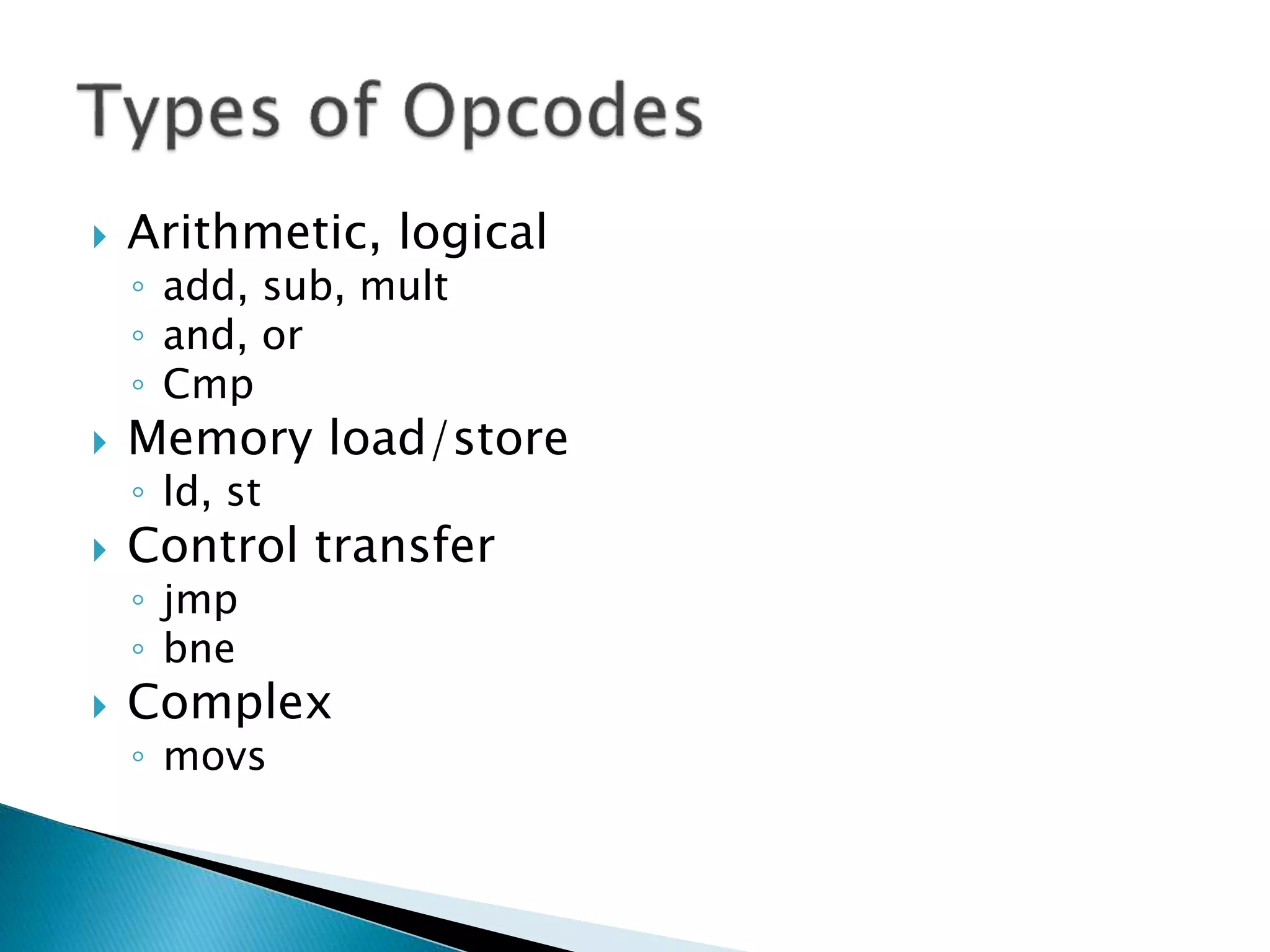
 Arithmetic, logical
◦ add, sub, mult
◦ and, or
◦ Cmp
 Memory load/store
◦ ld, st
 Control transfer
◦ jmp
◦ bne
 Complex
◦ movs
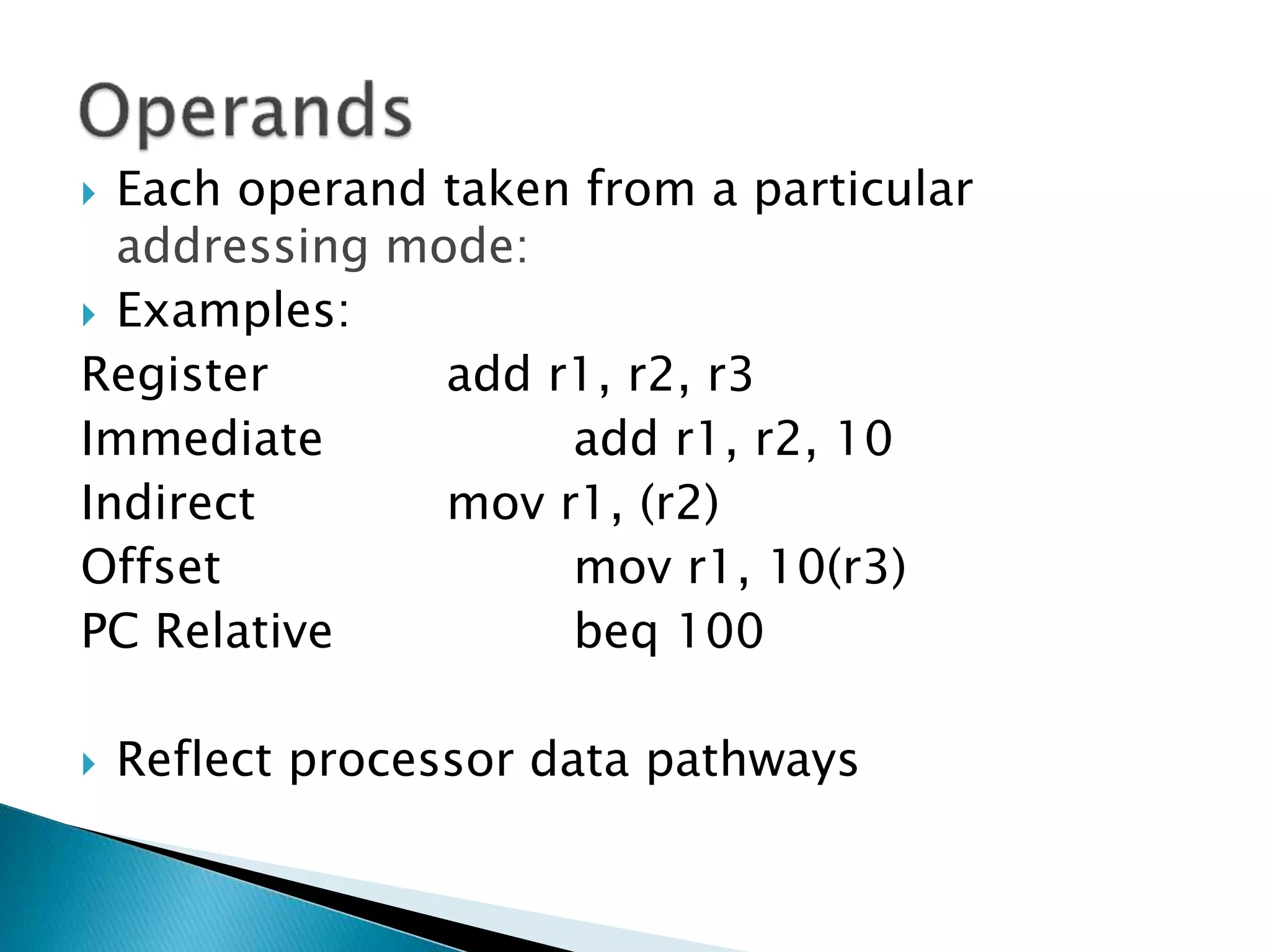
 Each operand taken from a particular
addressing mode:
 Examples:
Register add r1, r2, r3
Immediate add r1, r2, 10
Indirect mov r1, (r2)
Offset mov r1, 10(r3)
PC Relative beq 100
 Reflect processor data pathways
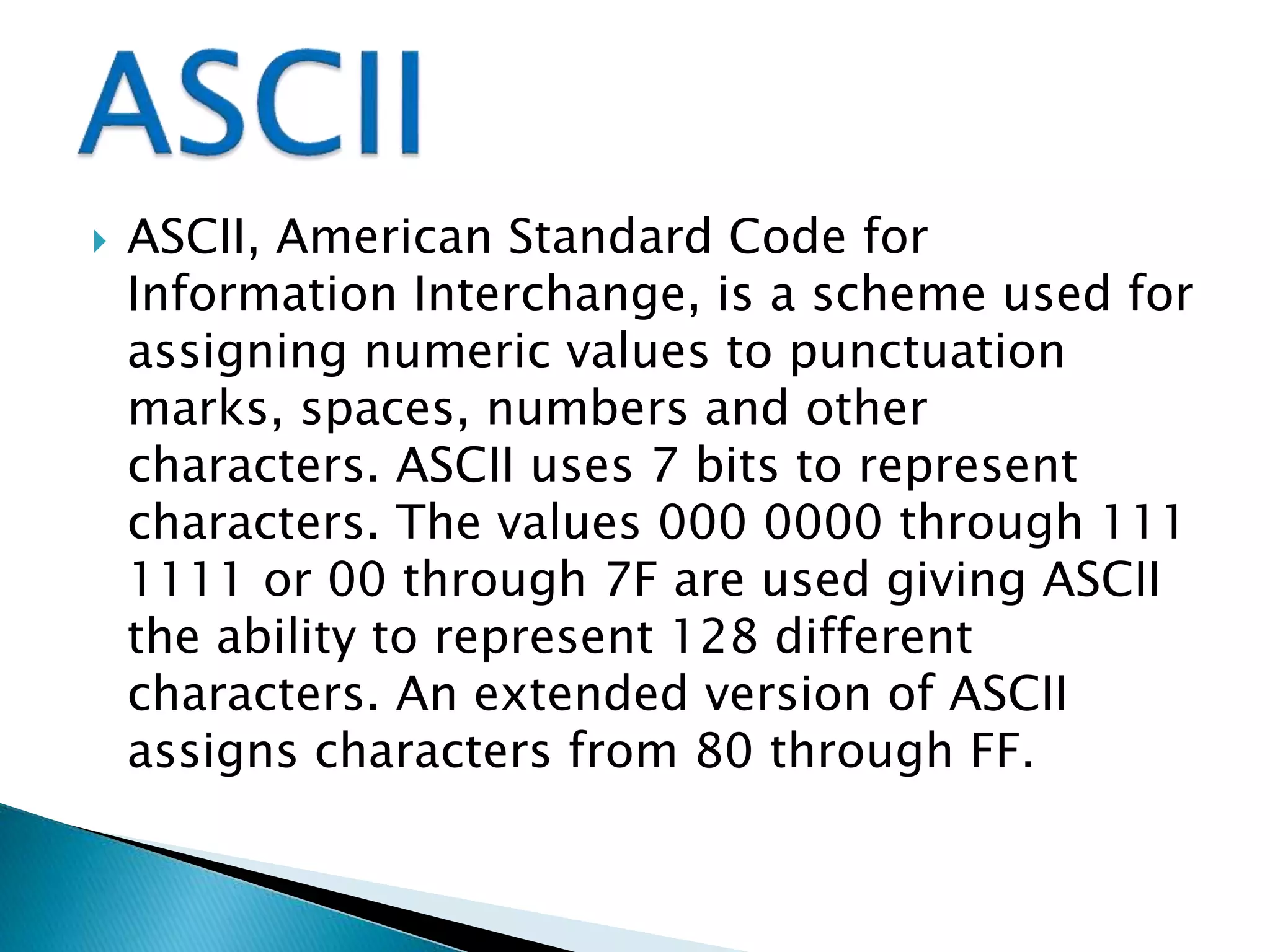
 ASCII, American Standard Code for
Information Interchange, is a scheme used for
assigning numeric values to punctuation
marks, spaces, numbers and other
characters. ASCII uses 7 bits to represent
characters. The values 000 0000 through 111
1111 or 00 through 7F are used giving ASCII
the ability to represent 128 different
characters. An extended version of ASCII
assigns characters from 80 through FF.
 Accessibility to system hardware
 Assembly Language is useful for implementing system software
 Also useful for small embedded system applications
 Space and Time efficiency
 Understanding sources of program inefficiency
 Tuning program performance
 Writing compact code
 Writing assembly programs gives the computer designer the needed
deep understanding of the instruction set and how to design one
 To be able to write compilers for HLLs, we need to be expert with
the machine language. Assembly programming provides this
experience
1. Shows how program interfaces with the processor,
operating system, and BIOS.
2. Shows how data is represented and stored in
memory and on external devices.
3. Clarifies how processor accesses and executes
instructions and how instructions access and
process data.
4. Clarifies how a program accesses external devices.
 1. Assembly Language is used when speed and
reliability are the overriding factor like small
footprint real-time operating systems.
2. By using assembly language, programmers can
maximize on speed to a level. It is easy to write
than machine code programs.
3. It allows the programmer access to registers or
instructions that are not usually provided by a
High-level language.
4. The main Application of Assembly Language is
for direct hardware manipulation i.e. device
drivers.
5. Assembly language also directly correlates
which machine instructions; the only way to get
closer to the machine is to write in binary or hex
code.
microprocesser-140306112352-phpapp01.pdf

microprocesser-140306112352-phpapp01.pdf

  • 1.
  • 3.
    Here’s what aprogram-fragment looks like: 10100001 10111100 10010011 00000100 00001000 00000011 00000101 11000000 10010011 00000100 00001000 10100011 11000000 10010100 00000100 00001000 It means: z = x + y;
  • 4.
     Machine language Native to a processor: executed directly by hardware  Instructions consist of binary code: 1s and 0s  Assembly language  A programming language that uses symbolic names to represent operations, registers and memory locations.  Slightly higher-level language  Readability of instructions is better than machine language  One-to-one correspondence with machine language instructions  Assemblers translate assembly to machine code  Compilers translate high-level programs to machine code  Either directly, or  Indirectly via an assembler
  • 6.
     Software toolsare needed for editing, assembling, linking, and debugging assembly language programs  An assembler is a program that converts source-code programs written in assembly language into object files in machine language  Popular assemblers have emerged over the years for the Intel family of processors. These include …  TASM (Turbo Assembler from Borland)  NASM (Netwide Assembler for both Windows and Linux), and  GNU assembler distributed by the free software foundation
  • 7.
     In assemblylanguage, mnemonics are used to specify an opcode that represents a complete and operational machine language instruction. This is later translated by the assembler to generate the object code. For example, the mnemonic MOV is used in assembly language for copying and moving data between registers and memory locations.
  • 8.
     Each commandof a program is called an instruction (it instructs the computer what to do).  Computers only deal with binary data, hence the instructions must be in binary format (0s and 1s) .  The set of all instructions (in binary form) makes up the computer's machine language. This is also referred to as the instruction set.
  • 9.
     Machine languageinstructions usually are made up of several fields. Each field specifies different information for the computer. The major two fields are:  Opcode field which stands for operation code and it specifies the particular operation that is to be performed.  Each operation has its unique opcode.  Operands fields which specify where to get the source and destination operands for the operation specified by the opcode.  The source/destination of operands can be a constant, the memory or one of the general-purpose registers.
  • 10.
     Built fromtwo pieces Add R1, R3, 3 Opcode What to do with the data (ALU operation) Operands Where to get data and put the results
  • 11.
     Arithmetic, logical ◦add, sub, mult ◦ and, or ◦ Cmp  Memory load/store ◦ ld, st  Control transfer ◦ jmp ◦ bne  Complex ◦ movs
  • 12.
     Each operandtaken from a particular addressing mode:  Examples: Register add r1, r2, r3 Immediate add r1, r2, 10 Indirect mov r1, (r2) Offset mov r1, 10(r3) PC Relative beq 100  Reflect processor data pathways
  • 15.
     ASCII, AmericanStandard Code for Information Interchange, is a scheme used for assigning numeric values to punctuation marks, spaces, numbers and other characters. ASCII uses 7 bits to represent characters. The values 000 0000 through 111 1111 or 00 through 7F are used giving ASCII the ability to represent 128 different characters. An extended version of ASCII assigns characters from 80 through FF.
  • 16.
     Accessibility tosystem hardware  Assembly Language is useful for implementing system software  Also useful for small embedded system applications  Space and Time efficiency  Understanding sources of program inefficiency  Tuning program performance  Writing compact code  Writing assembly programs gives the computer designer the needed deep understanding of the instruction set and how to design one  To be able to write compilers for HLLs, we need to be expert with the machine language. Assembly programming provides this experience
  • 17.
    1. Shows howprogram interfaces with the processor, operating system, and BIOS. 2. Shows how data is represented and stored in memory and on external devices. 3. Clarifies how processor accesses and executes instructions and how instructions access and process data. 4. Clarifies how a program accesses external devices.
  • 18.
     1. AssemblyLanguage is used when speed and reliability are the overriding factor like small footprint real-time operating systems. 2. By using assembly language, programmers can maximize on speed to a level. It is easy to write than machine code programs. 3. It allows the programmer access to registers or instructions that are not usually provided by a High-level language. 4. The main Application of Assembly Language is for direct hardware manipulation i.e. device drivers. 5. Assembly language also directly correlates which machine instructions; the only way to get closer to the machine is to write in binary or hex code.