Dr. Bikal Lamichhane
1st year Resident
NAMS
Ascending and Descending Spinal Tracts
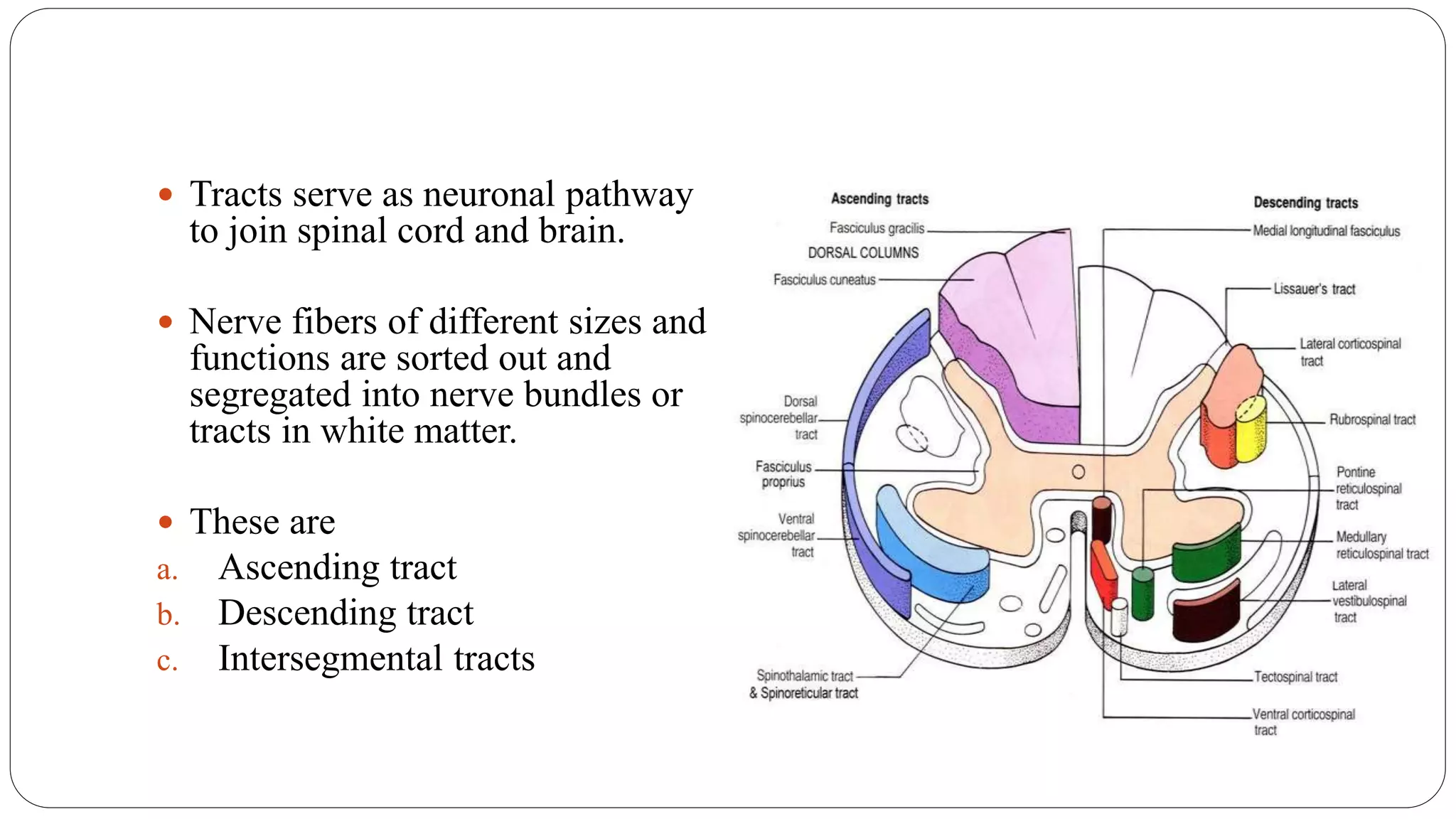
 Tracts serve as neuronal pathway
to join spinal cord and brain.
 Nerve fibers of different sizes and
functions are sorted out and
segregated into nerve bundles or
tracts in white matter.
 These are
a. Ascending tract
b. Descending tract
c. Intersegmental tracts
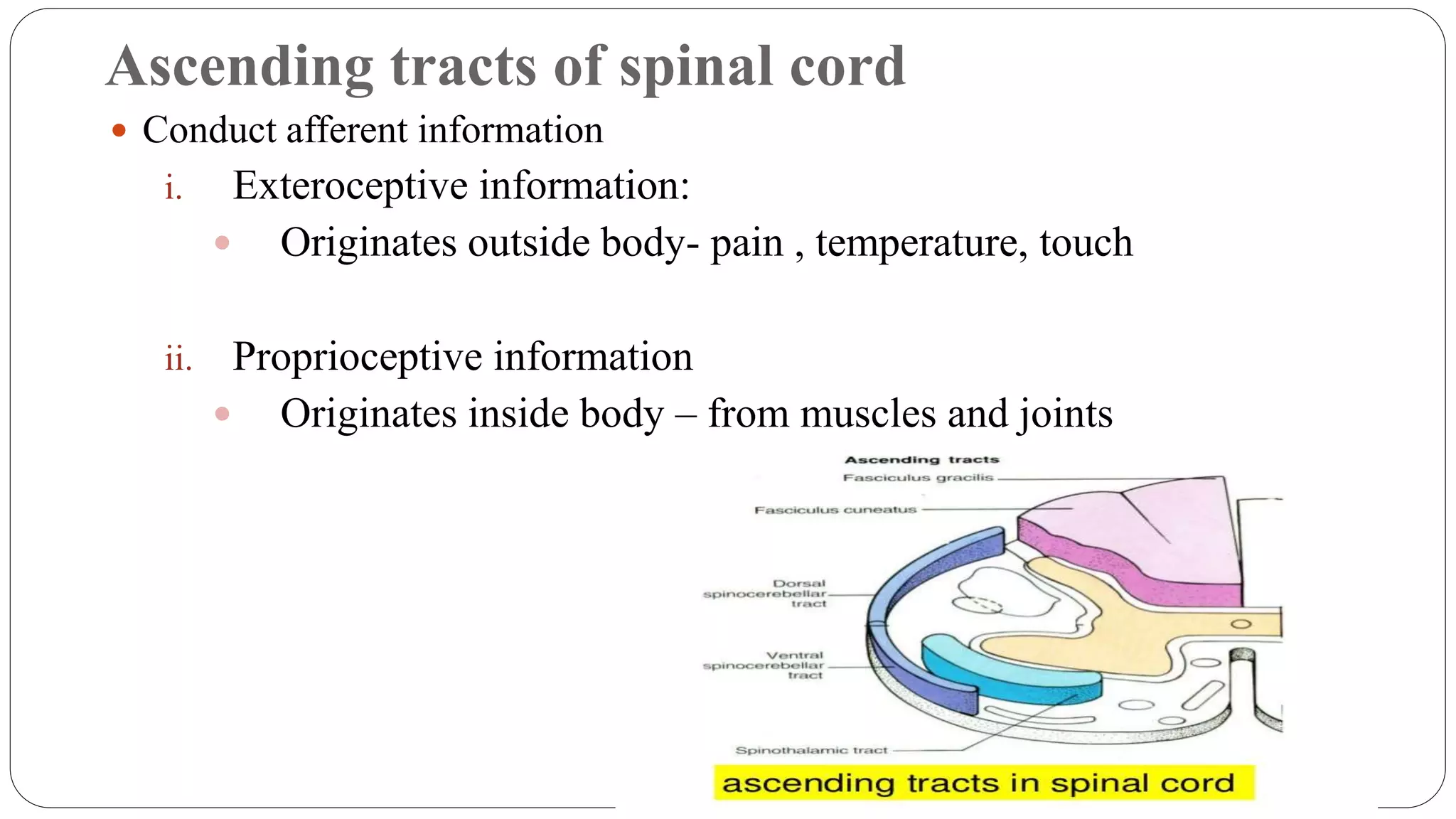
Ascending tracts of spinal cord
 Conduct afferent information
i. Exteroceptive information:
 Originates outside body- pain , temperature, touch
ii. Proprioceptive information
 Originates inside body – from muscles and joints
First-order neuron
 Has its cell body in the posterior root ganglion of the
spinal nerve
 Peripheral process connects with a sensory receptor
ending
 Central process enters spinal cord through posterior
root to synapse on second-order neuron.
Second-order neuron
 Gives rise to an axon that decussates (crosses to
opposite side) & ascends to higher level of CNS where
it synapses with third-order neuron.
Third-order neuron
 Usually in thalamus & gives rise to a projection fiber
that passes to a sensory region of cerebral cortex
Lateral Spinothalamic tract
 Pain & temperature impulses travel to spinal cord in fast-conducting delta A-type fibers &
slow-conducting C-type fibers.
 Axons entering spinal cord from posterior root ganglion proceed to tip of posterior gray
column & divide into ascending & descending branches, travel for a distance of one or two
segments of spinal cord & form posterolateral tract of Lissauer.
 Terminate by synapsing with cells in posterior gray column.
 Axons of second-order neurons cross to opposite side in anterior gray & white commissures
within one spinal segment of the cord, ascending in contralateral white column.
As the tract ascends through spinal cord, new fibers are added to
anteromedial aspect of tract.
 In upper cervical segments of the cord, sacral fibers are lateral
and cervical segments are medial.
 Fibers carrying pain are situated slightly anterior to those
conducting temperature.
As the lateral spinothalamic tract ascends through medulla
oblongata, accompanied by anterior spinothalamic tract &
spinotectal tract: spinal lemniscus.
 It further ascends through posterior part of pons, midbrain &
tract end by synapsing with third-order neuron in ventral
posterolateral nucleus of thalamus.
 Further it course through posterior limb of internal capsule &
corona radiata to reach somesthetic area in postcentral gyrus
of cerebral cortex.
 Contralateral half of body is represented as
inverted, with the hand and mouth situated
inferiorly
 leg situated superiorly
 foot and anogenital region on medial surface
of hemisphere.
 Sensory Homonculus.
 Then transmitted to other regions of
cerebral cortex to be used by motor areas
and parietal association area.
 Role of cerebral cortex is interpreting
quality of sensory information at level of
consciousness.
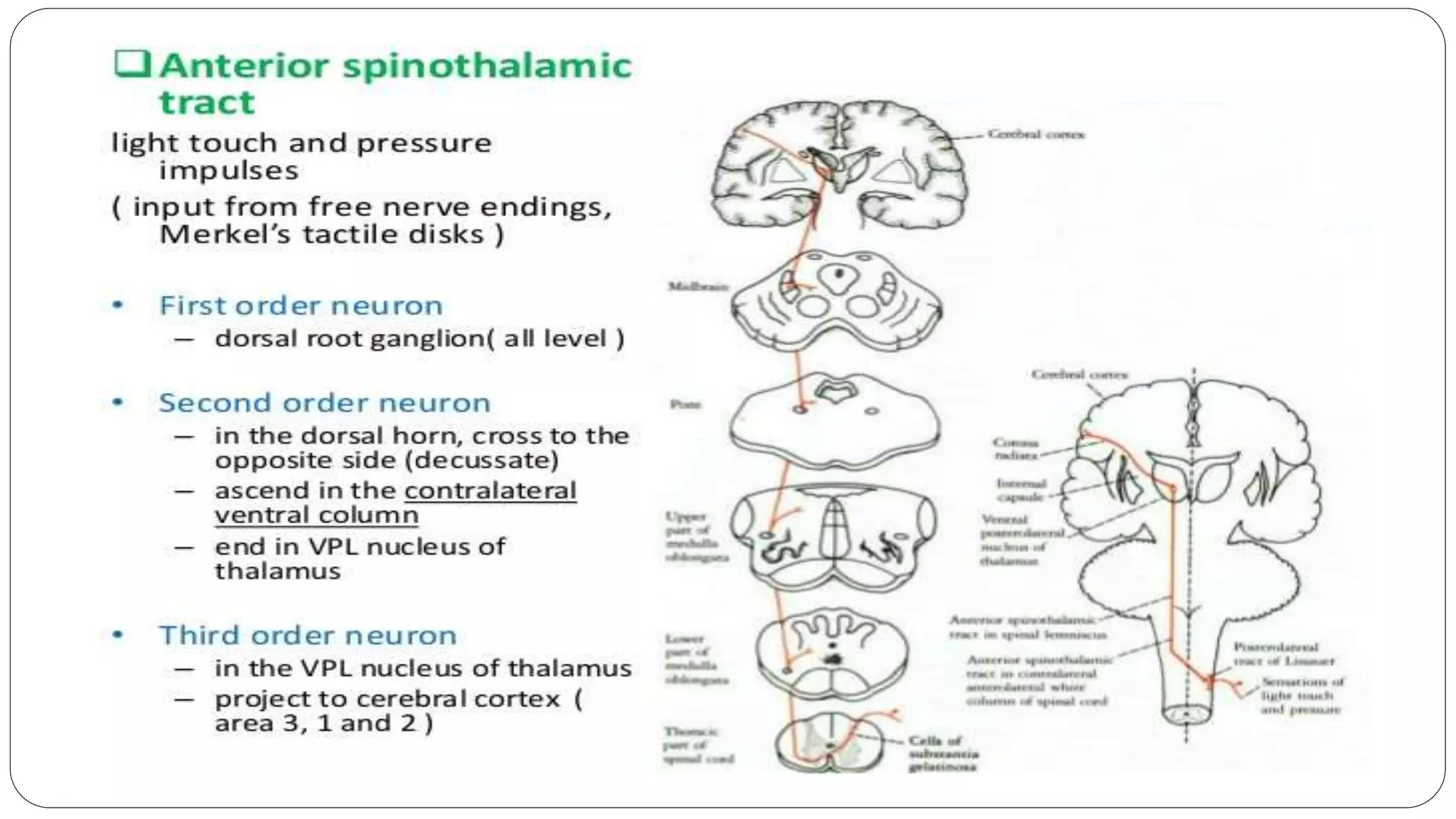
Anterior spinothalamic tract
 The axons enter spinal cord from posterior root ganglion &
proceed to tip of posterior gray column.
 Second-order neuron now cross very obliquely to opposite side
in anterior gray & white commissures within several spinal
segments & ascend in opposite anterolateral white column as
anterior spinothalamic tract.
 New fibers are added to medial aspect.
Upper cervical segments of the cord, the sacral fibers are
mostly lateral & the cervical segments are mostly medial.
 In medulla oblongata, it accompanies the lateral spinothalamic
tract and the spinotectal tract, forming spinal lemniscus.
 ascend through posterior part of pons, and the tegmentum of
the midbrain and terminate by synapsing with third-order
neuron in ventral posterolateral nucleus of thalamus.
 posterior limb of the internal capsule and corona radiata
 somesthetic area in postcentral gyrus of cerebral cortex
Posterior White Column: Fasciculus Gracilis & Fasciculus
Cuneatus
 Axons enter spinal cord from posterior root ganglion & pass directly to posterior white column of same side.
 Long ascending fiber-synapse with cells in posterior gray horn, with internuncial neurons, & with anterior horn cells
as fasciculus gracilis & fasciculus cuneatus.
 Short descending fiber are involved with intersegmental reflexes.
 Fasciculus gracilis:
 throughout length of spinal cord ;
 fibers from the sacral, lumbar & lower six thoracic spinal nerves
 Fasciculus cuneatus:
 situated laterally in the upper thoracic & cervical segments
 fibers from the upper six thoracic & all the cervical spinal nerves
 Ascend ipsilaterally and terminate by synapsing on second-order
neurons in nuclei gracilis and cuneatus of medulla oblongata.
 The axons of second-order neurons, called internal arcuate fibers,
cross median plane, decussating with corresponding fibers of
opposite side in sensory decussation.
 then ascend as a single compact bundle, medial lemniscus,
through medulla oblongata, pons and midbrain ventral
posterolateral nucleus of thalamus.
 Then it traverse via posterior limb of internal capsule &
corona radiata to reach somesthetic area in postcentral gyrus
of cerebral cortex.
 Function:
- fine touch, exact localization & two-point discrimination
- Vibratory sense & the position of the different parts of the
body
Posterior Spinocerebellar tract
 First order neuron:- Traverse from posterior root ganglion and enter posterior gray column;
 Synapse to nucleus dorsalis (Clarke's column).
 Second order Neuron :-Ascends through posterolateral part of the lateral white column on the same side
of medulla
 Here it joins inferior cerebellar peduncle & terminates in cerebellar cortex.
 Function:
- receive muscle joint information from the muscle spindles, tendon organs, and joint receptors of the
trunk & lower limbs.
- coordination of limb movements & the maintenance of posture
Anterior Spinocerebellar Tract
 Enters through posterior root, synapse to second-order neurons in
nucleus dorsalis at base of posterior gray column.
 Majority cross to opposite side and ascend as in contralateral white
column; minority of axons ascend as anterior spinocerebellar tract
in lateral white column of same side.
 Then it enters the cerebellum through cerebellar peduncle to synapse
into cerebellar nucelus.
 Function:
- information from muscle spindles, tendon organs, and joint
receptors of trunk and upper and lower limbs
Other ascending tracts
 Cuneocerebellar:
- Nucleus cuneatus to cerebellum,
- Conveys information of muscle joint sense to the cerebellum
 Spinotectal:
- To superior colliculus of midbrain
- afferent information for spinovisual reflexes & brings about movements
of eyes head toward source of stimulation
 Spinoreticular:
- reticular formation in medulla oblongata, pons, & midbrain
- influencing levels of consciousness
 Spino olivary: conveys information to the cerebellum from cutaneous &
proprioceptive organs
Descending tracts
 First-order neuron:
- has its cell body in cerebral cortex.
- descends to synapse on second-order neuron,
 Second order neuron: an internuncial neuron,
situated in anterior gray column of spinal cord.
 Third-order neuron:
- lower motor neuron, in the anterior gray column
- innervates the skeletal muscle through the
anterior root & spinal nerve.
 In some instances, the axon of the first-order neuron
terminates directly on the thirdorder neuron (as in
reflex arcs).
 Control of skeletal muscle activity
 At junction of medulla oblongata & spinal cord, most of fibers cross midline at
decussation of pyramids and enter lateral white column of spinal cord to form lateral
corticospinal tract.
 Remaining fibers do not cross in decussation but descend in anterior white column of
spinal cord as anterior corticospinal tract; cross midline and terminate in anterior gray
column of spinal cord segments in cervical & upper thoracic regions.
 Lateral corticospinal tract descends length of spinal cord; terminate in anterior gray
column of all spinal cord segments.
 synapse with internuncial neurons, which, in turn, synapse with alpha motor neurons &
some gamma motor neurons.
Descending Autonomic Fibers
 The higher centers of CNS associated with control of
autonomic activity are situated in cerebral cortex,
hypothalamus, amygdaloid complex, & reticular formation.
Although distinct tracts have not been recognized,
investigation of spinal cord lesions has demonstrated that
descending autonomic tracts do exist & probably form part of
reticulospinal tract.
Tracts spinal cord dr bikal

Tracts spinal cord dr bikal

  • 1.
    Dr. Bikal Lamichhane 1styear Resident NAMS Ascending and Descending Spinal Tracts
  • 2.
     Tracts serveas neuronal pathway to join spinal cord and brain.  Nerve fibers of different sizes and functions are sorted out and segregated into nerve bundles or tracts in white matter.  These are a. Ascending tract b. Descending tract c. Intersegmental tracts
  • 3.
    Ascending tracts ofspinal cord  Conduct afferent information i. Exteroceptive information:  Originates outside body- pain , temperature, touch ii. Proprioceptive information  Originates inside body – from muscles and joints
  • 4.
    First-order neuron  Hasits cell body in the posterior root ganglion of the spinal nerve  Peripheral process connects with a sensory receptor ending  Central process enters spinal cord through posterior root to synapse on second-order neuron. Second-order neuron  Gives rise to an axon that decussates (crosses to opposite side) & ascends to higher level of CNS where it synapses with third-order neuron. Third-order neuron  Usually in thalamus & gives rise to a projection fiber that passes to a sensory region of cerebral cortex
  • 5.
    Lateral Spinothalamic tract Pain & temperature impulses travel to spinal cord in fast-conducting delta A-type fibers & slow-conducting C-type fibers.  Axons entering spinal cord from posterior root ganglion proceed to tip of posterior gray column & divide into ascending & descending branches, travel for a distance of one or two segments of spinal cord & form posterolateral tract of Lissauer.  Terminate by synapsing with cells in posterior gray column.  Axons of second-order neurons cross to opposite side in anterior gray & white commissures within one spinal segment of the cord, ascending in contralateral white column.
  • 6.
    As the tractascends through spinal cord, new fibers are added to anteromedial aspect of tract.  In upper cervical segments of the cord, sacral fibers are lateral and cervical segments are medial.  Fibers carrying pain are situated slightly anterior to those conducting temperature. As the lateral spinothalamic tract ascends through medulla oblongata, accompanied by anterior spinothalamic tract & spinotectal tract: spinal lemniscus.
  • 7.
     It furtherascends through posterior part of pons, midbrain & tract end by synapsing with third-order neuron in ventral posterolateral nucleus of thalamus.  Further it course through posterior limb of internal capsule & corona radiata to reach somesthetic area in postcentral gyrus of cerebral cortex.
  • 8.
     Contralateral halfof body is represented as inverted, with the hand and mouth situated inferiorly  leg situated superiorly  foot and anogenital region on medial surface of hemisphere.  Sensory Homonculus.  Then transmitted to other regions of cerebral cortex to be used by motor areas and parietal association area.  Role of cerebral cortex is interpreting quality of sensory information at level of consciousness.
  • 10.
    Anterior spinothalamic tract The axons enter spinal cord from posterior root ganglion & proceed to tip of posterior gray column.  Second-order neuron now cross very obliquely to opposite side in anterior gray & white commissures within several spinal segments & ascend in opposite anterolateral white column as anterior spinothalamic tract.  New fibers are added to medial aspect. Upper cervical segments of the cord, the sacral fibers are mostly lateral & the cervical segments are mostly medial.
  • 11.
     In medullaoblongata, it accompanies the lateral spinothalamic tract and the spinotectal tract, forming spinal lemniscus.  ascend through posterior part of pons, and the tegmentum of the midbrain and terminate by synapsing with third-order neuron in ventral posterolateral nucleus of thalamus.  posterior limb of the internal capsule and corona radiata  somesthetic area in postcentral gyrus of cerebral cortex
  • 13.
    Posterior White Column:Fasciculus Gracilis & Fasciculus Cuneatus  Axons enter spinal cord from posterior root ganglion & pass directly to posterior white column of same side.  Long ascending fiber-synapse with cells in posterior gray horn, with internuncial neurons, & with anterior horn cells as fasciculus gracilis & fasciculus cuneatus.  Short descending fiber are involved with intersegmental reflexes.  Fasciculus gracilis:  throughout length of spinal cord ;  fibers from the sacral, lumbar & lower six thoracic spinal nerves  Fasciculus cuneatus:  situated laterally in the upper thoracic & cervical segments  fibers from the upper six thoracic & all the cervical spinal nerves
  • 14.
     Ascend ipsilaterallyand terminate by synapsing on second-order neurons in nuclei gracilis and cuneatus of medulla oblongata.  The axons of second-order neurons, called internal arcuate fibers, cross median plane, decussating with corresponding fibers of opposite side in sensory decussation.  then ascend as a single compact bundle, medial lemniscus, through medulla oblongata, pons and midbrain ventral posterolateral nucleus of thalamus.
  • 15.
     Then ittraverse via posterior limb of internal capsule & corona radiata to reach somesthetic area in postcentral gyrus of cerebral cortex.  Function: - fine touch, exact localization & two-point discrimination - Vibratory sense & the position of the different parts of the body
  • 17.
    Posterior Spinocerebellar tract First order neuron:- Traverse from posterior root ganglion and enter posterior gray column;  Synapse to nucleus dorsalis (Clarke's column).  Second order Neuron :-Ascends through posterolateral part of the lateral white column on the same side of medulla  Here it joins inferior cerebellar peduncle & terminates in cerebellar cortex.  Function: - receive muscle joint information from the muscle spindles, tendon organs, and joint receptors of the trunk & lower limbs. - coordination of limb movements & the maintenance of posture
  • 18.
    Anterior Spinocerebellar Tract Enters through posterior root, synapse to second-order neurons in nucleus dorsalis at base of posterior gray column.  Majority cross to opposite side and ascend as in contralateral white column; minority of axons ascend as anterior spinocerebellar tract in lateral white column of same side.  Then it enters the cerebellum through cerebellar peduncle to synapse into cerebellar nucelus.  Function: - information from muscle spindles, tendon organs, and joint receptors of trunk and upper and lower limbs
  • 19.
    Other ascending tracts Cuneocerebellar: - Nucleus cuneatus to cerebellum, - Conveys information of muscle joint sense to the cerebellum  Spinotectal: - To superior colliculus of midbrain - afferent information for spinovisual reflexes & brings about movements of eyes head toward source of stimulation  Spinoreticular: - reticular formation in medulla oblongata, pons, & midbrain - influencing levels of consciousness  Spino olivary: conveys information to the cerebellum from cutaneous & proprioceptive organs
  • 20.
    Descending tracts  First-orderneuron: - has its cell body in cerebral cortex. - descends to synapse on second-order neuron,  Second order neuron: an internuncial neuron, situated in anterior gray column of spinal cord.  Third-order neuron: - lower motor neuron, in the anterior gray column - innervates the skeletal muscle through the anterior root & spinal nerve.  In some instances, the axon of the first-order neuron terminates directly on the thirdorder neuron (as in reflex arcs).  Control of skeletal muscle activity
  • 22.
     At junctionof medulla oblongata & spinal cord, most of fibers cross midline at decussation of pyramids and enter lateral white column of spinal cord to form lateral corticospinal tract.  Remaining fibers do not cross in decussation but descend in anterior white column of spinal cord as anterior corticospinal tract; cross midline and terminate in anterior gray column of spinal cord segments in cervical & upper thoracic regions.  Lateral corticospinal tract descends length of spinal cord; terminate in anterior gray column of all spinal cord segments.  synapse with internuncial neurons, which, in turn, synapse with alpha motor neurons & some gamma motor neurons.
  • 27.
    Descending Autonomic Fibers The higher centers of CNS associated with control of autonomic activity are situated in cerebral cortex, hypothalamus, amygdaloid complex, & reticular formation. Although distinct tracts have not been recognized, investigation of spinal cord lesions has demonstrated that descending autonomic tracts do exist & probably form part of reticulospinal tract.