The document announces a webinar on artificial intelligence and expert systems presented by Dr. R. Gunavathi, Head of the PG and Research Department of Computer Applications at Sree Saraswathi Thyagaraja College in Pollachi. The webinar agenda covers definitions of expert systems and their components, characteristics, examples, applications, and advantages and disadvantages. It also defines artificial intelligence and its components, characteristics, examples, applications, and advantages and disadvantages. The webinar aims to educate participants on these topics through presentations and discussions.
D R .R . G U N A V A T H I ,
H E A D , P G A N D R E S E A R C H D E P A R T M E N T O F
C O M P U T E R A P P L I C A T I O N S ,
S R E E S A R A S W A T H I T H Y A G A R A J A C O L L E G E ,
P O L L A C H I
M O B I L E : 9 4 8 6 3 5 4 5 2 5
E - M A I L - H O D M C A @ S T C . A C . I N
Webinar on
Artificial Intelligence & Expert System
(13-06-2020)
2.
Expert system ArtificialIntelligence
What are Expert Systems?
Components
Characteristics
Examples
Applications
Advantages and Disadvantages
What is Artificial intelligence?
Components
Characteristics
Examples
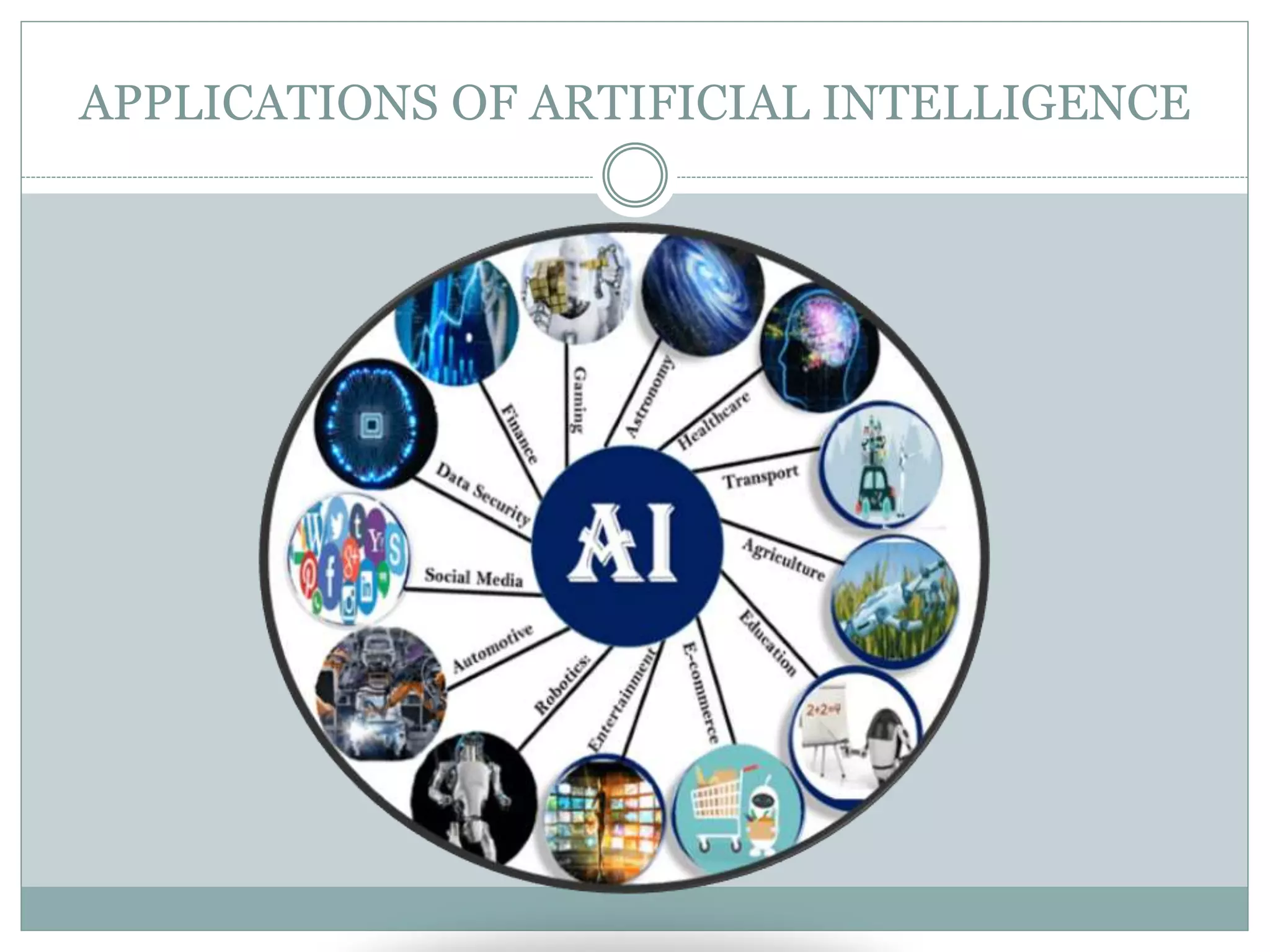
Applications
Advantages and Disadvantages
AGENDA
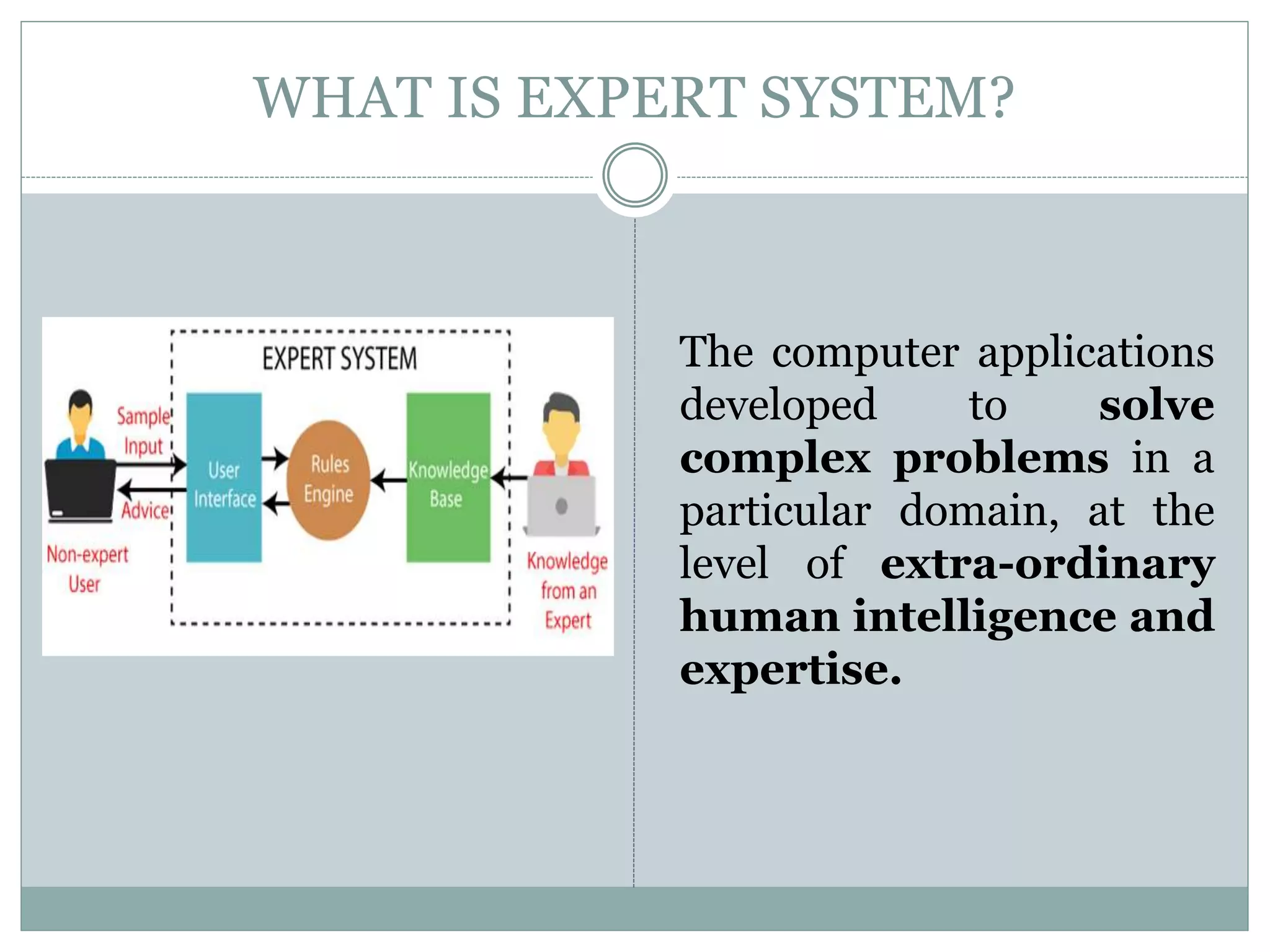
WHAT IS EXPERTSYSTEM?
The computer applications
developed to solve
complex problems in a
particular domain, at the
level of extra-ordinary
human intelligence and
expertise.
5.
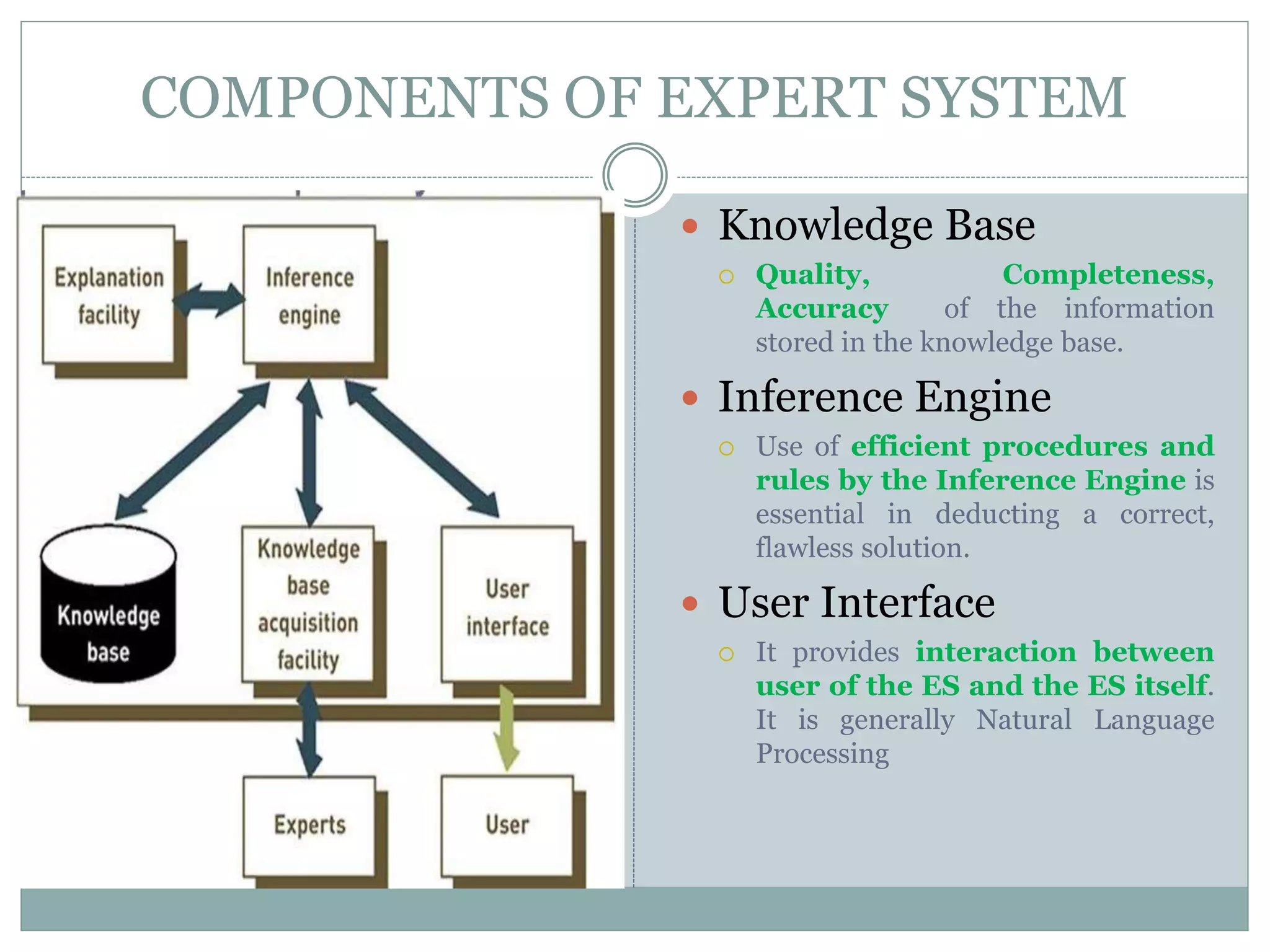
COMPONENTS OF EXPERTSYSTEM
Knowledge Base
Quality, Completeness,
Accuracy of the information
stored in the knowledge base.
Inference Engine
Use of efficient procedures and
rules by the Inference Engine is
essential in deducting a correct,
flawless solution.
User Interface
It provides interaction between
user of the ES and the ES itself.
It is generally Natural Language
Processing
6.
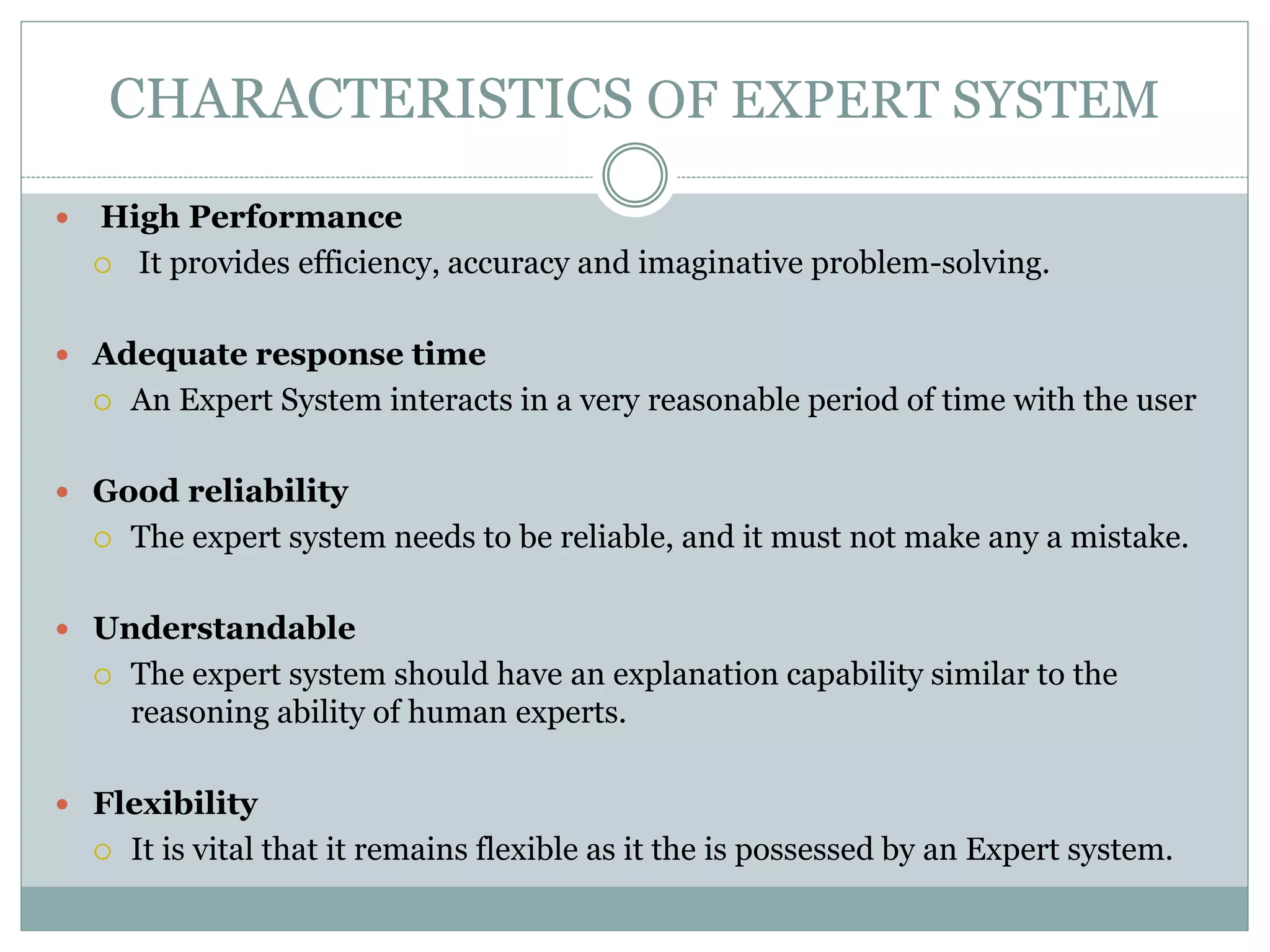
CHARACTERISTICS OF EXPERTSYSTEM
High Performance
It provides efficiency, accuracy and imaginative problem-solving.
Adequate response time
An Expert System interacts in a very reasonable period of time with the user
Good reliability
The expert system needs to be reliable, and it must not make any a mistake.
Understandable
The expert system should have an explanation capability similar to the
reasoning ability of human experts.
Flexibility
It is vital that it remains flexible as it the is possessed by an Expert system.
7.
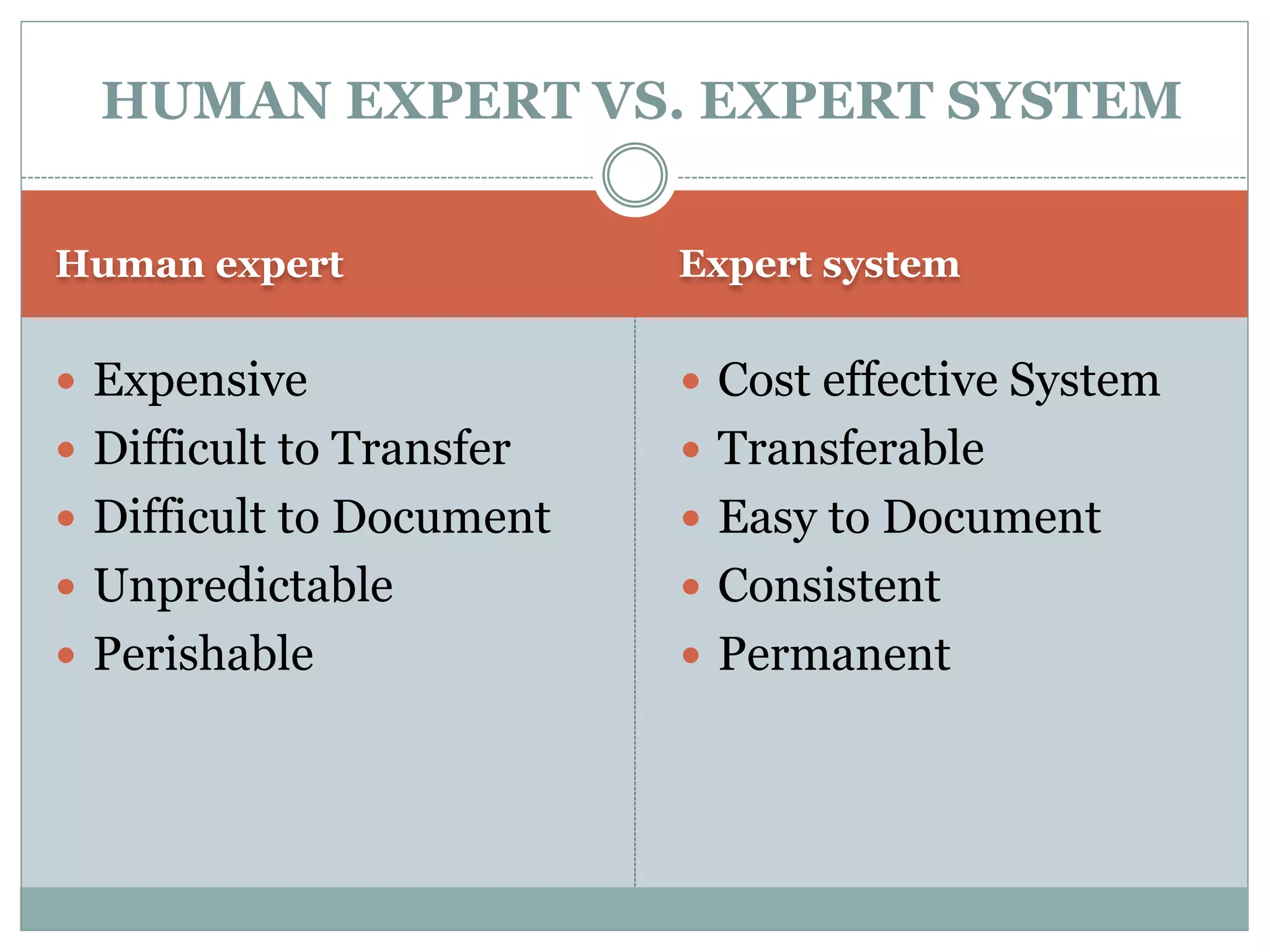
Human expert Expertsystem
Expensive
Difficult to Transfer
Difficult to Document
Unpredictable
Perishable
Cost effective System
Transferable
Easy to Document
Consistent
Permanent
HUMAN EXPERT VS. EXPERT SYSTEM
8.
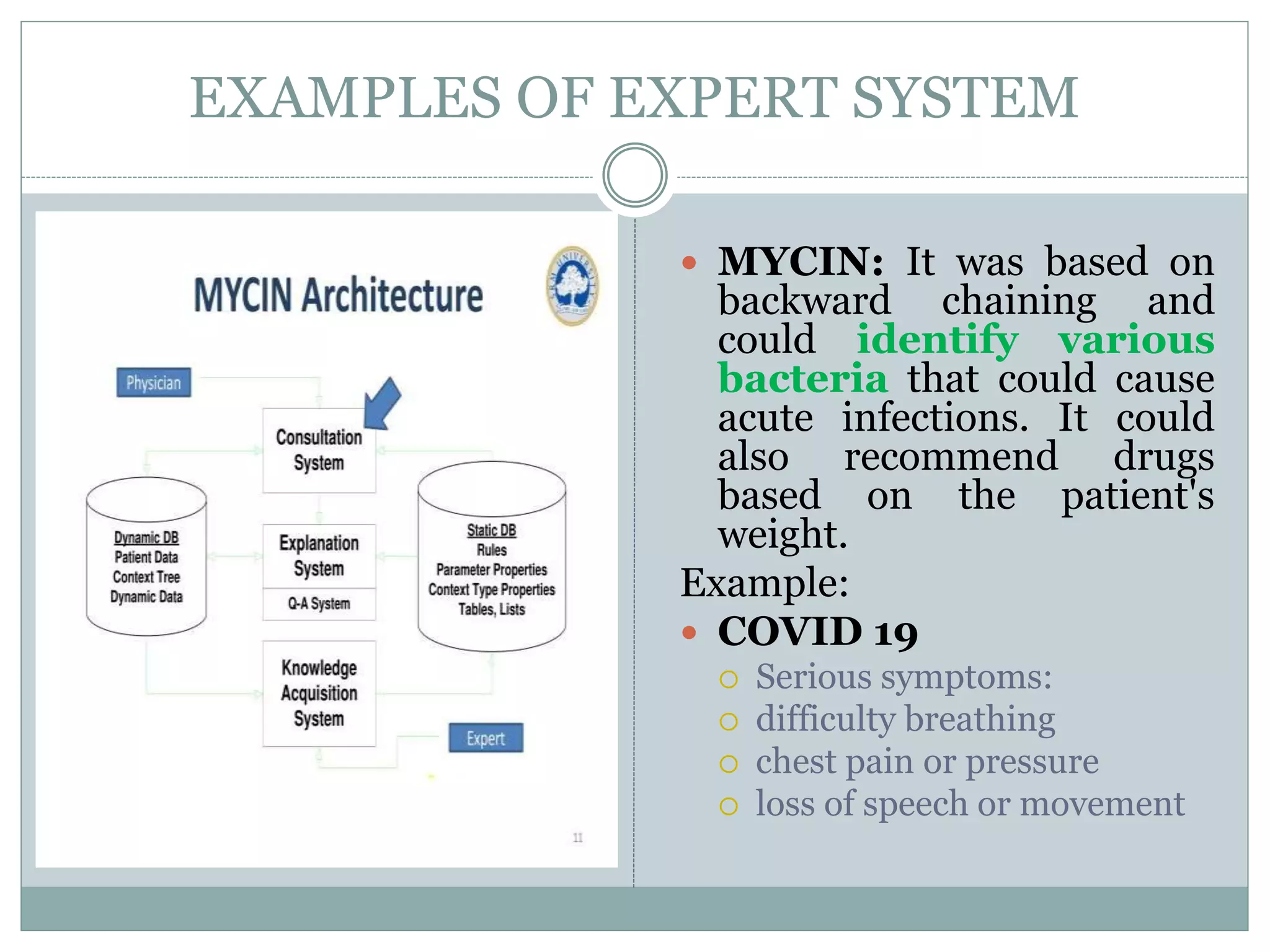
EXAMPLES OF EXPERTSYSTEM
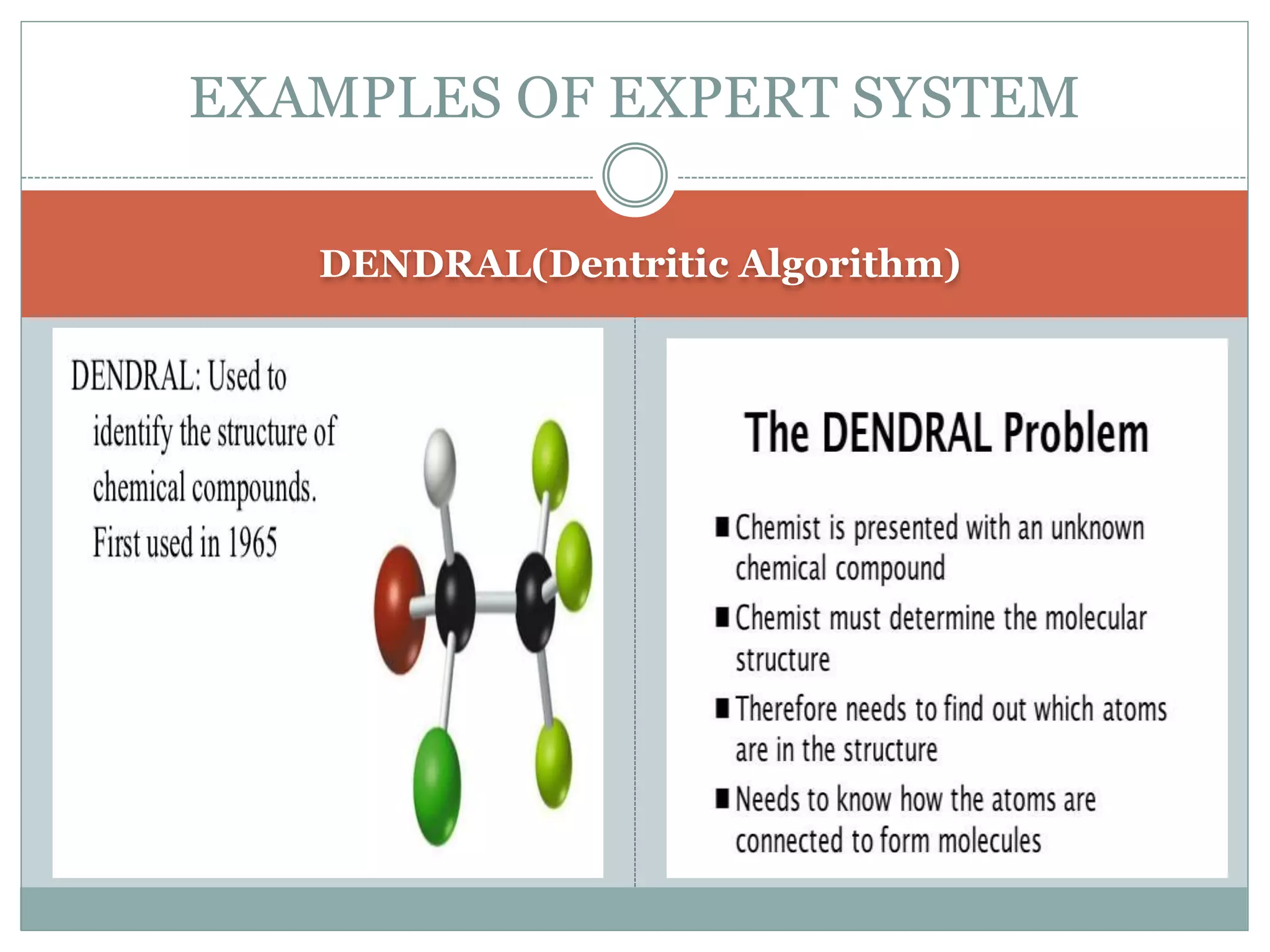
MYCIN: It was based on
backward chaining and
could identify various
bacteria that could cause
acute infections. It could
also recommend drugs
based on the patient's
weight.
Example:
COVID 19
Serious symptoms:
difficulty breathing
chest pain or pressure
loss of speech or movement
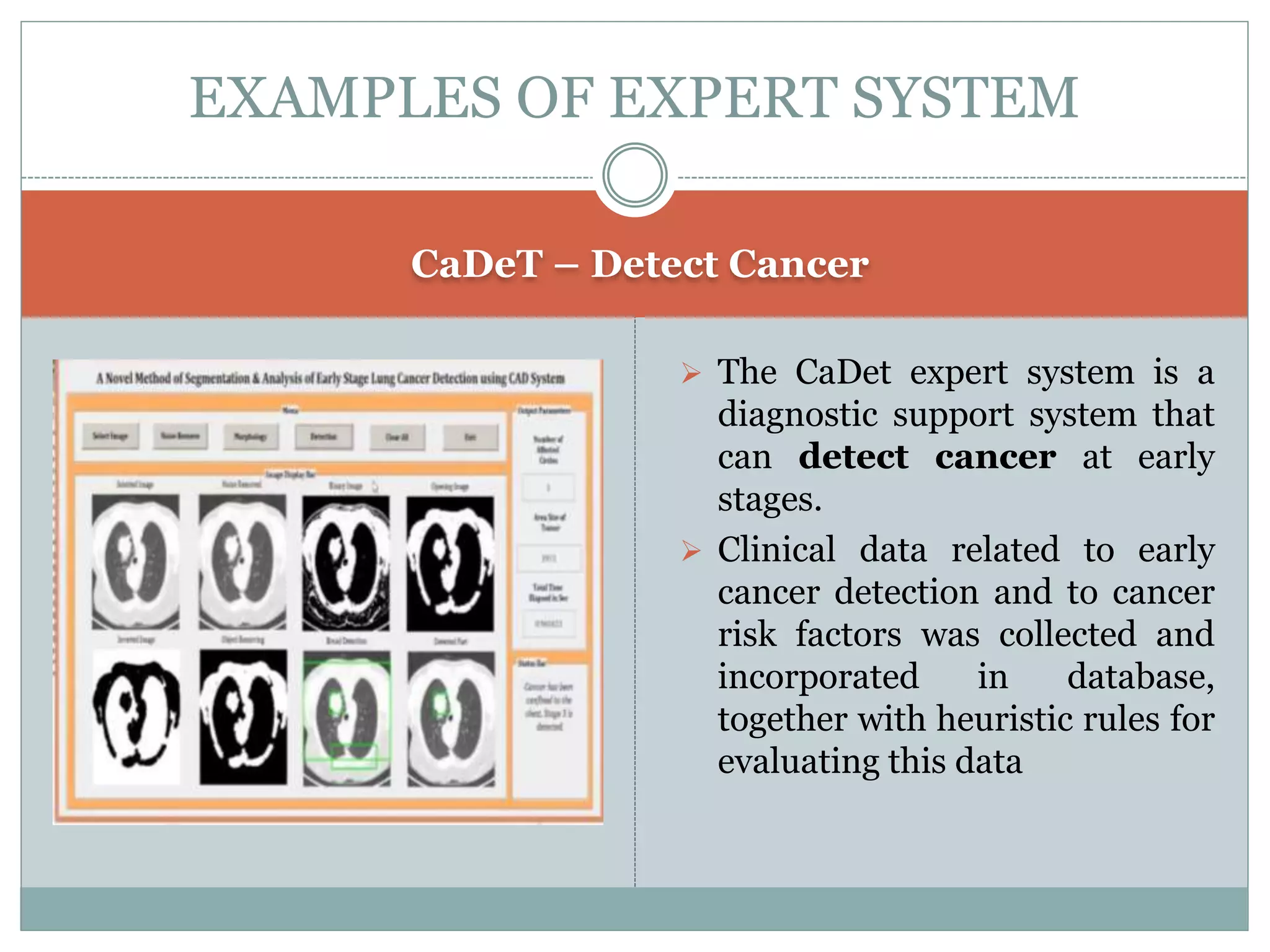
CaDeT – DetectCancer
EXAMPLES OF EXPERT SYSTEM
The CaDet expert system is a
diagnostic support system that
can detect cancer at early
stages.
Clinical data related to early
cancer detection and to cancer
risk factors was collected and
incorporated in database,
together with heuristic rules for
evaluating this data
11.
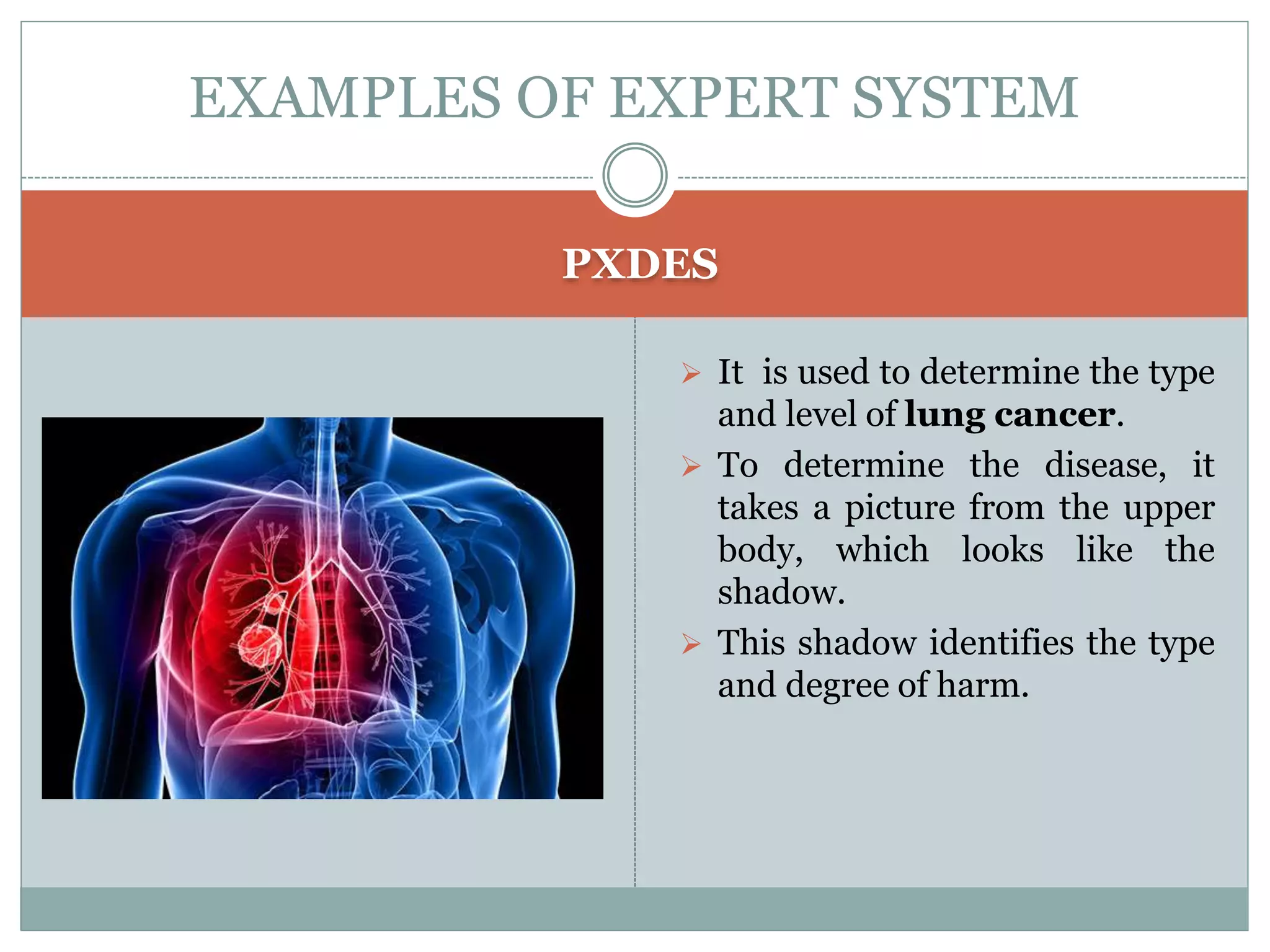
PXDES
EXAMPLES OF EXPERTSYSTEM
It is used to determine the type
and level of lung cancer.
To determine the disease, it
takes a picture from the upper
body, which looks like the
shadow.
This shadow identifies the type
and degree of harm.
12.
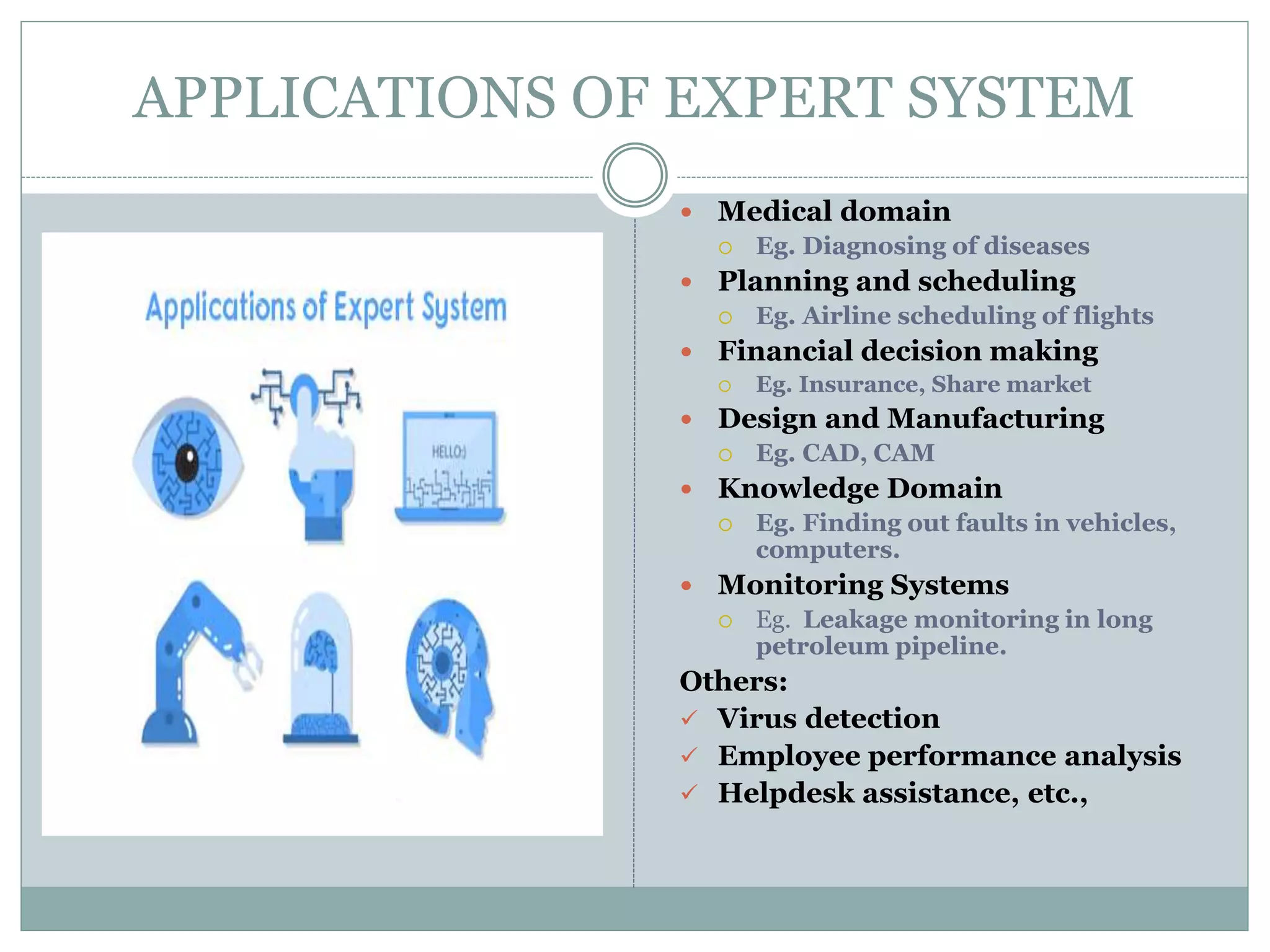
APPLICATIONS OF EXPERTSYSTEM
Medical domain
Eg. Diagnosing of diseases
Planning and scheduling
Eg. Airline scheduling of flights
Financial decision making
Eg. Insurance, Share market
Design and Manufacturing
Eg. CAD, CAM
Knowledge Domain
Eg. Finding out faults in vehicles,
computers.
Monitoring Systems
Eg. Leakage monitoring in long
petroleum pipeline.
Others:
Virus detection
Employee performance analysis
Helpdesk assistance, etc.,
13.
Advantages Disadvantages
Provideanswers for decisions
Hold huge amounts of information
Minimize employee training costs
Centralize the decision making process
More efficient by reducing the time
needed to solve problems
Combine various human expert
intelligences
Reduce the number of human errors
No common sense used in making
decisions
Lack of creative responses that
human experts are capable of
It is not easy to automate complex
processes
There is no flexibility and ability to
adapt to changing environments
Not able to recognize when there is
no answer
ADVANTAGES AND DISADVANTAGES OF
EXPERT SYSTEM
14.
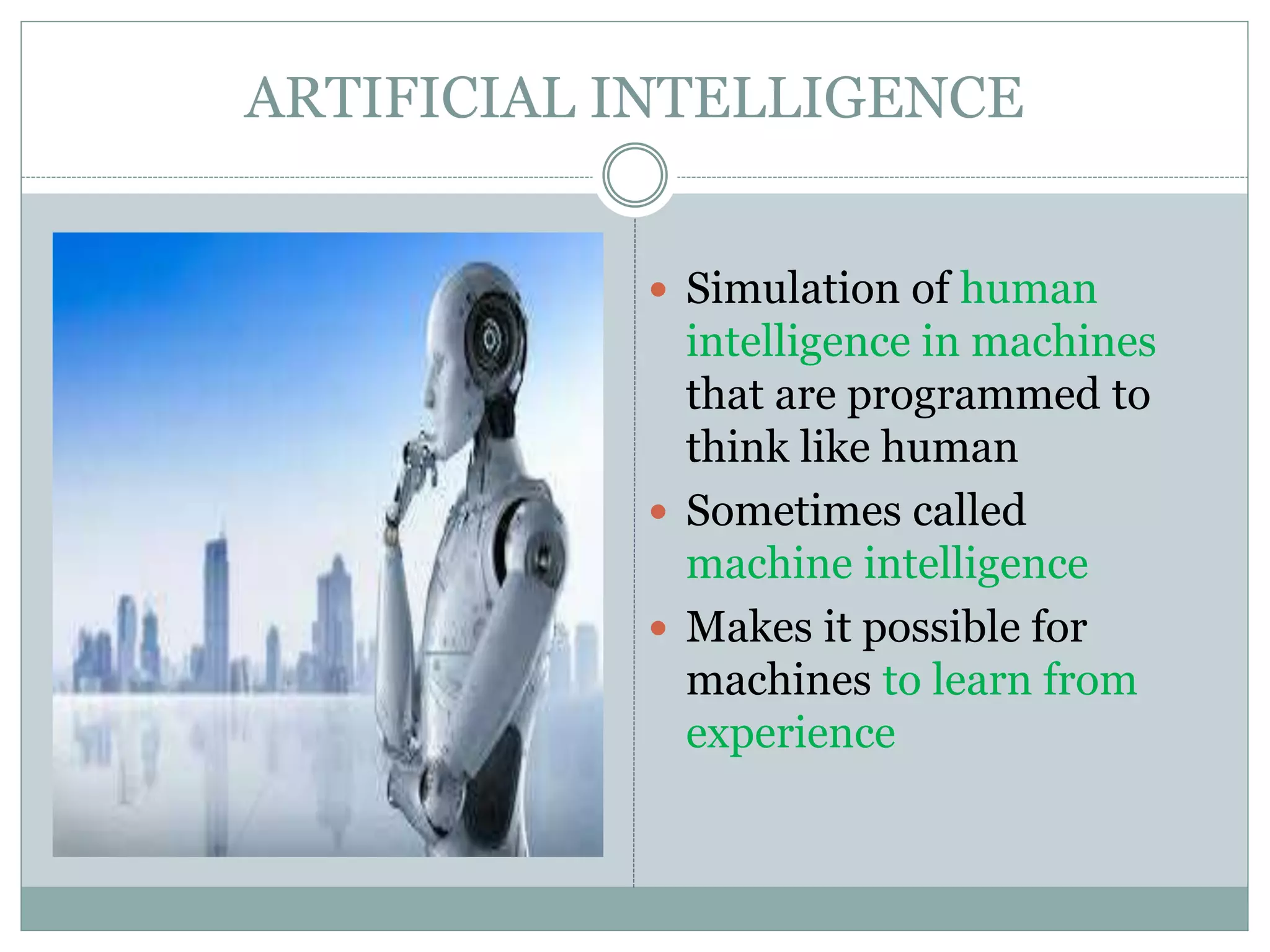
ARTIFICIAL INTELLIGENCE
Simulationof human
intelligence in machines
that are programmed to
think like human
Sometimes called
machine intelligence
Makes it possible for
machines to learn from
experience
15.
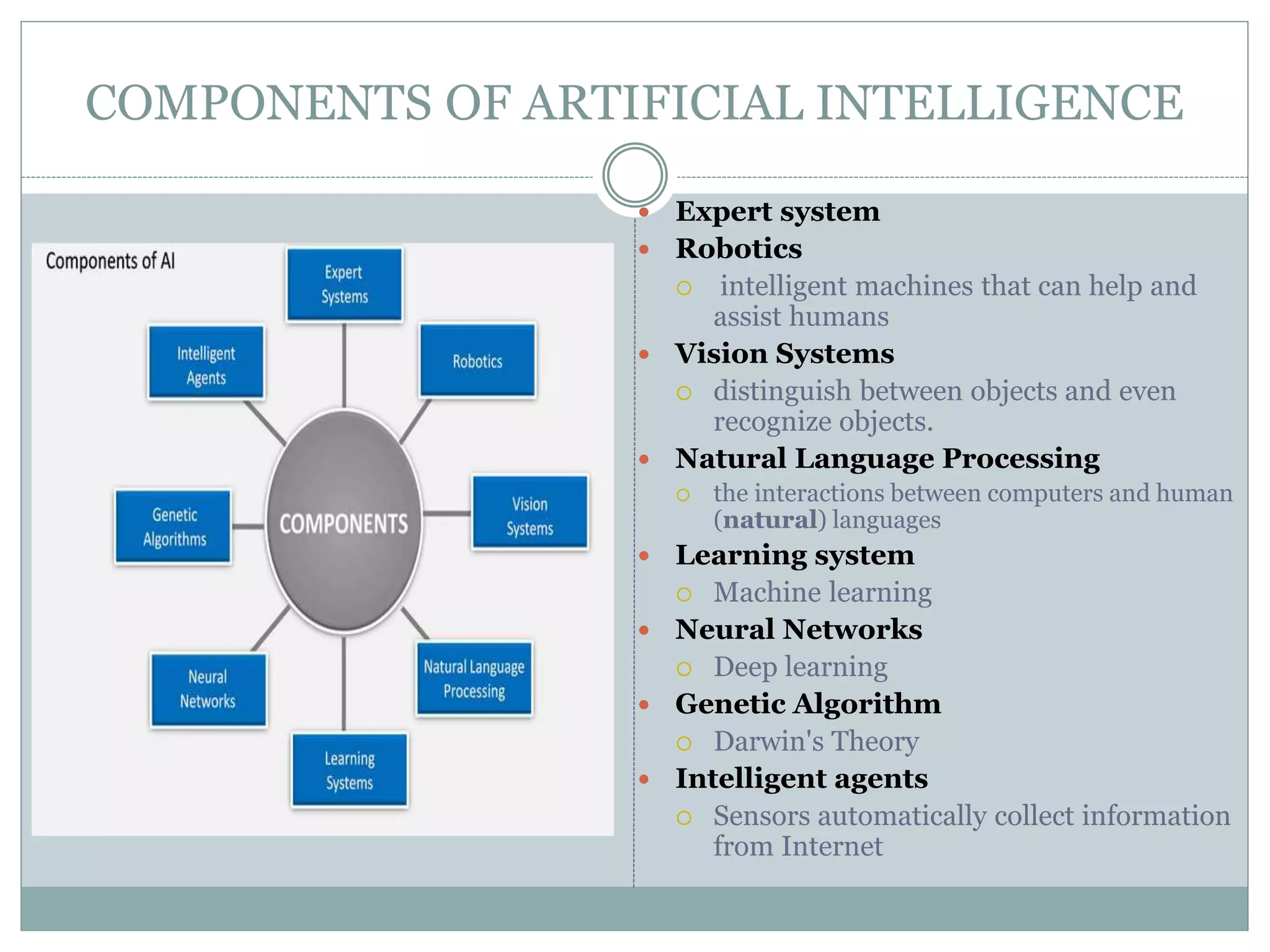
COMPONENTS OF ARTIFICIALINTELLIGENCE
Expert system
Robotics
intelligent machines that can help and
assist humans
Vision Systems
distinguish between objects and even
recognize objects.
Natural Language Processing
the interactions between computers and human
(natural) languages
Learning system
Machine learning
Neural Networks
Deep learning
Genetic Algorithm
Darwin's Theory
Intelligent agents
Sensors automatically collect information
from Internet
16.
CHARACTERISTICS OF ARTIFICIALINTELLIGENCE
Problem solving
Learning Ability
Rational thinking
Fast decision making
Imitates human cognition
Futuristic
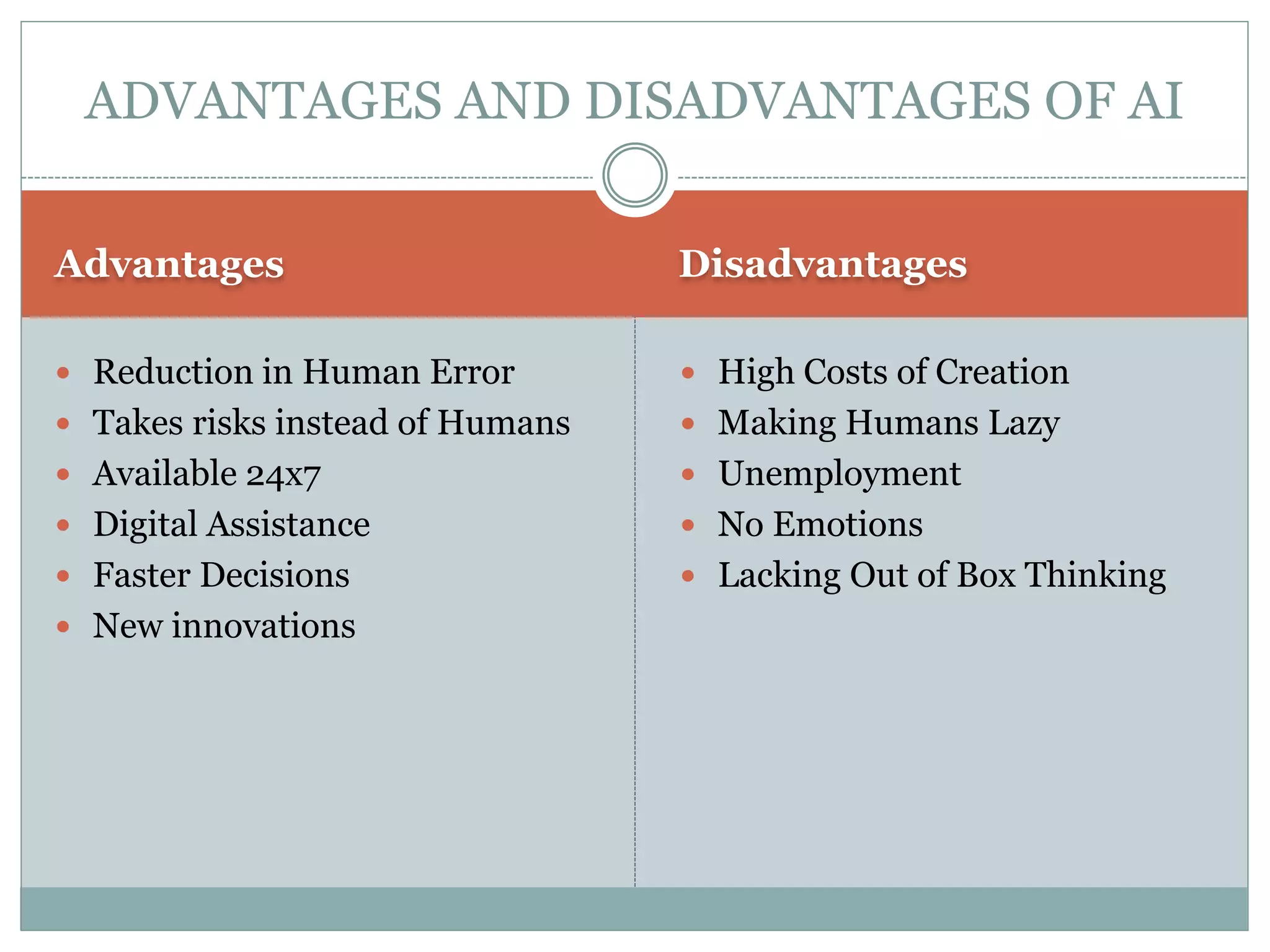
Advantages Disadvantages
Reductionin Human Error
Takes risks instead of Humans
Available 24x7
Digital Assistance
Faster Decisions
New innovations
High Costs of Creation
Making Humans Lazy
Unemployment
No Emotions
Lacking Out of Box Thinking
ADVANTAGES AND DISADVANTAGES OF AI