Contents :
 What is AI
 History Of AI
 Major Branches of AI
 Expert System An AI Programe
 Advantages of Expert System
 SoftWares Used In AI
 Summery
 References
Artificial Intelligence(AI) 1
CONTENTS
INTRODUCTION TO A.I.
History Of AI
EVOLUTION OF A.I.
BRANCHES OF A.I.
APPLICATIONS OF A.I.
CONCLUSIONS ON A.I.
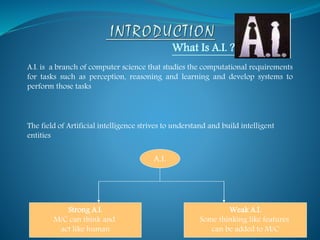
What Is A.I. ?
A.I. is a branch of computer science that studies the computational requirements
for tasks such as perception, reasoning and learning and develop systems to
perform those tasks
The field of Artificial intelligence strives to understand and build intelligent
entities
A.I.
Strong A.I.
M/C can think and
act like human
Weak A.I.
Some thinking like features
can be added to M/C
DEFINITIONS
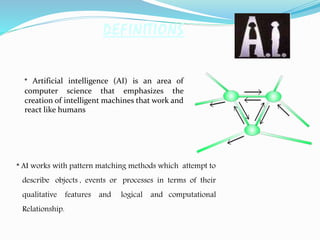
* Artificial intelligence (AI) is an area of
computer science that emphasizes the
creation of intelligent machines that work and
react like humans
* AI works with pattern matching methods which attempt to
describe objects , events or processes in terms of their
qualitative features and logical and computational
Relationship.
History Of AI
The branch of computer science concerned with making
computers behave like humans.
This term was coined in 1956 by John McCarthy at the
Massachusetts Institute of Technology
Currently, no computers exhibit full artificial
intelligence .In May, 1997,an IBM super-computer called
Deep Blue defeated world chess champion
Gary Kasparov in a chess match.
Artificial Intelligence(AI) 5
Major Branches Of AI
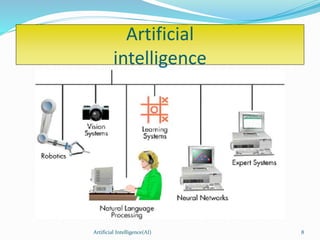
 Perceptive system
 A system that approximates the way a human sees, hears, and
feels objects
 Vision system
 Capture, store, and manipulate visual images and pictures
 Robotics
 Mechanical and computer devices that perform tedious tasks
with high precision
 Expert system
 Stores knowledge and makes inferences
Artificial Intelligence(AI) 6
Major Branches of AI (2)
 Learning system
 Computer changes how it functions or reacts to situations based
on feedback
 Natural language processing
 Computers understand and react to statements and commands
made in a “natural” language, such as English
 Neural network
 Computer system that can act like or simulate the functioning of
the human brain
Artificial Intelligence(AI) 7
Schematic
Artificial Intelligence(AI) 8
Artificial
intelligence
OverView Of Expert System
 Can…
 Explain their reasoning or suggested decisions
 Display intelligent behavior
 Draw conclusions from complex relationships
 Provide portable knowledge
 Expert system shell
 A collection of software packages and tools used to
develop expert systems
Artificial Intelligence(AI) 9
Fxpert System
Expert systems :
Expert system is an artificial intelligence
program that has expert-level knowledge about a
particular domain and knows how to use its
knowledge to respond properly
Artificial Intelligence(AI) 10
Limitations of Expert Systems
 Not widely used or tested
 Limited to relatively narrow problems
 Cannot readily deal with “mixed” knowledge
 Possibility of error
 Cannot refine own knowledge base
 Difficult to maintain
 May have high development costs
 Raise legal and ethical concerns
Artificial Intelligence(AI) 11
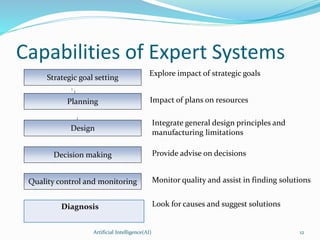
Capabilities of Expert Systems
Artificial Intelligence(AI) 12
Gfg Strategic goal setting
Decision making
Planning
Design
Quality control and monitoring
Explore impact of strategic goals
Impact of plans on resources
Integrate general design principles and
manufacturing limitations
Provide advise on decisions
Monitor quality and assist in finding solutions
Look for causes and suggest solutionsDiagnosis
When to Use an Expert System
 Provide a high potential payoff or significantly reduced
downside risk
 Capture and preserve irreplaceable human expertise
 Provide expertise needed at a number of locations at
the same time or in a hostile environment that is
dangerous to human health
 Provide expertise that is expensive or rare
 Develop a solution faster than human experts can
Artificial Intelligence(AI) 13
Components of an
Expert System (1)
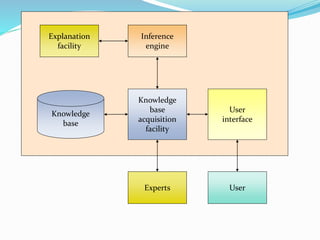
 Knowledge base
 Stores all relevant information, data, rules, cases, and
relationships used by the expert system
 Inference engine
 Seeks information and relationships from the
knowledge base and provides answers, predictions, and
suggestions in the way a human expert would
 Rule
 A conditional statement that links given conditions to
actions or outcomes
Components of an
Expert System (2)
 Fuzzy logic
 A specialty research area in computer science that allows
shades of gray and does not require everything to be
simply yes/no, or true/false
 Backward chaining
 A method of reasoning that starts with conclusions and
works backward to the supporting facts
 Forward chaining
 A method of reasoning that starts with the facts and
works forward to the conclusions
Schematic
Inference
engine
Explanation
facility
Knowledge
base
acquisition
facility
User
interface
Knowledge
base
Experts User
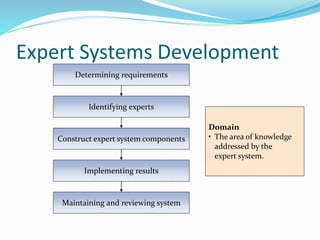
Determining requirements
Identifying experts
Construct expert system components
Implementing results
Maintaining and reviewing system
Expert Systems Development
Domain
• The area of knowledge
addressed by the
expert system.
Participants in Expert Systems
Development and Use
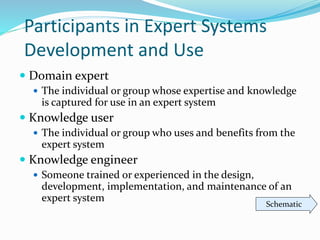
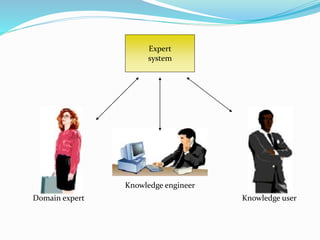
 Domain expert
 The individual or group whose expertise and knowledge
is captured for use in an expert system
 Knowledge user
 The individual or group who uses and benefits from the
expert system
 Knowledge engineer
 Someone trained or experienced in the design,
development, implementation, and maintenance of an
expert system
Schematic
Expert
system
Domain expert
Knowledge engineer
Knowledge user
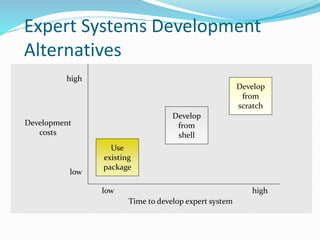
Expert Systems Development
Alternatives
low
high
low high
Development
costs
Time to develop expert system
Use
existing
package
Develop
from
shell
Develop
from
scratch
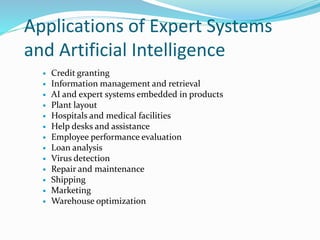
Applications of Expert Systems
and Artificial Intelligence
 Credit granting
 Information management and retrieval
 AI and expert systems embedded in products
 Plant layout
 Hospitals and medical facilities
 Help desks and assistance
 Employee performance evaluation
 Loan analysis
 Virus detection
 Repair and maintenance
 Shipping
 Marketing
 Warehouse optimization
Advantages of Expert Systems
 Easy to develop and modify
 The use of satisficing
 The use of heuristics
 Development by knowledge engineers and users
 Cheaper
 Fast response
 Reduced dange
Artificial Intelligence Software
 HPCC Systems : Open-source enterprise-proven platform for
Big Data analysis
 Weka : Machine learning software to solve data
mining problems
 MOEA Framework : Open Source Java Framework for
Multiobjective Optimization
 he RoboCup Soccer Simulator:
 CLIPS Rule Based Programming Language :
Expert System Tool
Artificial Intelligence(AI) 23
Summery:
Computers making decisions in real-world problems
Like Humains
This is the original idea from Turing and the well
known Turing Test
Artificial Intelligence(AI) 24
References:
 http://sourceforge.net/directory/science-
engineering/ai/os:windows/freshness:recently-
updated/
 https ://www.vanguardsw.com › Knowledge
Automation System
 https://www.google.com.pk/?gws_rd=cr&ei=_-
MWVcn0D8TuaPmdgJgE#q=software+used+in+exper
t+system
Artificial Intelligence(AI) 25

Artificial intelligance

  • 1.
    Contents :  Whatis AI  History Of AI  Major Branches of AI  Expert System An AI Programe  Advantages of Expert System  SoftWares Used In AI  Summery  References Artificial Intelligence(AI) 1
  • 2.
    CONTENTS INTRODUCTION TO A.I. HistoryOf AI EVOLUTION OF A.I. BRANCHES OF A.I. APPLICATIONS OF A.I. CONCLUSIONS ON A.I.
  • 3.
    What Is A.I.? A.I. is a branch of computer science that studies the computational requirements for tasks such as perception, reasoning and learning and develop systems to perform those tasks The field of Artificial intelligence strives to understand and build intelligent entities A.I. Strong A.I. M/C can think and act like human Weak A.I. Some thinking like features can be added to M/C
  • 4.
    DEFINITIONS * Artificial intelligence(AI) is an area of computer science that emphasizes the creation of intelligent machines that work and react like humans * AI works with pattern matching methods which attempt to describe objects , events or processes in terms of their qualitative features and logical and computational Relationship.
  • 5.
    History Of AI Thebranch of computer science concerned with making computers behave like humans. This term was coined in 1956 by John McCarthy at the Massachusetts Institute of Technology Currently, no computers exhibit full artificial intelligence .In May, 1997,an IBM super-computer called Deep Blue defeated world chess champion Gary Kasparov in a chess match. Artificial Intelligence(AI) 5
  • 6.
    Major Branches OfAI  Perceptive system  A system that approximates the way a human sees, hears, and feels objects  Vision system  Capture, store, and manipulate visual images and pictures  Robotics  Mechanical and computer devices that perform tedious tasks with high precision  Expert system  Stores knowledge and makes inferences Artificial Intelligence(AI) 6
  • 7.
    Major Branches ofAI (2)  Learning system  Computer changes how it functions or reacts to situations based on feedback  Natural language processing  Computers understand and react to statements and commands made in a “natural” language, such as English  Neural network  Computer system that can act like or simulate the functioning of the human brain Artificial Intelligence(AI) 7 Schematic
  • 8.
  • 9.
    OverView Of ExpertSystem  Can…  Explain their reasoning or suggested decisions  Display intelligent behavior  Draw conclusions from complex relationships  Provide portable knowledge  Expert system shell  A collection of software packages and tools used to develop expert systems Artificial Intelligence(AI) 9
  • 10.
    Fxpert System Expert systems: Expert system is an artificial intelligence program that has expert-level knowledge about a particular domain and knows how to use its knowledge to respond properly Artificial Intelligence(AI) 10
  • 11.
    Limitations of ExpertSystems  Not widely used or tested  Limited to relatively narrow problems  Cannot readily deal with “mixed” knowledge  Possibility of error  Cannot refine own knowledge base  Difficult to maintain  May have high development costs  Raise legal and ethical concerns Artificial Intelligence(AI) 11
  • 12.
    Capabilities of ExpertSystems Artificial Intelligence(AI) 12 Gfg Strategic goal setting Decision making Planning Design Quality control and monitoring Explore impact of strategic goals Impact of plans on resources Integrate general design principles and manufacturing limitations Provide advise on decisions Monitor quality and assist in finding solutions Look for causes and suggest solutionsDiagnosis
  • 13.
    When to Usean Expert System  Provide a high potential payoff or significantly reduced downside risk  Capture and preserve irreplaceable human expertise  Provide expertise needed at a number of locations at the same time or in a hostile environment that is dangerous to human health  Provide expertise that is expensive or rare  Develop a solution faster than human experts can Artificial Intelligence(AI) 13
  • 14.
    Components of an ExpertSystem (1)  Knowledge base  Stores all relevant information, data, rules, cases, and relationships used by the expert system  Inference engine  Seeks information and relationships from the knowledge base and provides answers, predictions, and suggestions in the way a human expert would  Rule  A conditional statement that links given conditions to actions or outcomes
  • 15.
    Components of an ExpertSystem (2)  Fuzzy logic  A specialty research area in computer science that allows shades of gray and does not require everything to be simply yes/no, or true/false  Backward chaining  A method of reasoning that starts with conclusions and works backward to the supporting facts  Forward chaining  A method of reasoning that starts with the facts and works forward to the conclusions Schematic
  • 16.
  • 17.
    Determining requirements Identifying experts Constructexpert system components Implementing results Maintaining and reviewing system Expert Systems Development Domain • The area of knowledge addressed by the expert system.
  • 18.
    Participants in ExpertSystems Development and Use  Domain expert  The individual or group whose expertise and knowledge is captured for use in an expert system  Knowledge user  The individual or group who uses and benefits from the expert system  Knowledge engineer  Someone trained or experienced in the design, development, implementation, and maintenance of an expert system Schematic
  • 19.
  • 20.
    Expert Systems Development Alternatives low high lowhigh Development costs Time to develop expert system Use existing package Develop from shell Develop from scratch
  • 21.
    Applications of ExpertSystems and Artificial Intelligence  Credit granting  Information management and retrieval  AI and expert systems embedded in products  Plant layout  Hospitals and medical facilities  Help desks and assistance  Employee performance evaluation  Loan analysis  Virus detection  Repair and maintenance  Shipping  Marketing  Warehouse optimization
  • 22.
    Advantages of ExpertSystems  Easy to develop and modify  The use of satisficing  The use of heuristics  Development by knowledge engineers and users  Cheaper  Fast response  Reduced dange
  • 23.
    Artificial Intelligence Software HPCC Systems : Open-source enterprise-proven platform for Big Data analysis  Weka : Machine learning software to solve data mining problems  MOEA Framework : Open Source Java Framework for Multiobjective Optimization  he RoboCup Soccer Simulator:  CLIPS Rule Based Programming Language : Expert System Tool Artificial Intelligence(AI) 23
  • 24.
    Summery: Computers making decisionsin real-world problems Like Humains This is the original idea from Turing and the well known Turing Test Artificial Intelligence(AI) 24
  • 25.
    References:  http://sourceforge.net/directory/science- engineering/ai/os:windows/freshness:recently- updated/  https://www.vanguardsw.com › Knowledge Automation System  https://www.google.com.pk/?gws_rd=cr&ei=_- MWVcn0D8TuaPmdgJgE#q=software+used+in+exper t+system Artificial Intelligence(AI) 25