Constraint satisfaction
problems (CSP)
T.ARCHANA
ASSISTANT PROFESSOR
COMPUTER SCIENCE AND ENGINEERING
DEPARTMENT
SRM INSTITUTE OF SCIENCE AND TECHNOLOGY
RAMAPURAM, CHENNAI
Introduction to CSP
What is a constraint
Crypto Arithmetic puzzles
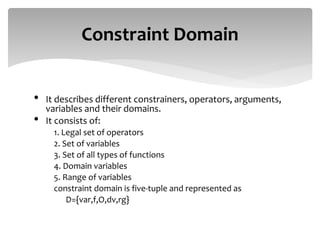
Constraint Domain
CSP as a search problem
Backtracking search for CSP
Role of Heuristics
AGENDA
• Constraint satisfaction problems (CSPs) are mathematical questions
defined as a set of objects whose state must satisfy a number of constraints
or limitations.
• CSPs represent the entities in a problem as a homogeneous collection of
finite constraints over variables, which is solved by constraint satisfaction
methods.
• It is a search procedure that operates in a space of constraints.
• Any problem in the world can mathematically be represented as CSP.
• The solution is typically a state that can satisfy all the constraints.
INTRODUCTION TO CSP
• A constraint satisfaction problem (CSP) consists of
– a set of variables,
– a domain for each variable, and
– a set of constraints.
• The aim is to choose a value for each variable so that the resulting possible
world satisfies the constraints; we want a model of the constraints.
csp
• It is mathematical/logical relationship among the attributes of one or more
objects.
• It is important to know the type of constraint.
– Unary Constraint - single variable.
– Binary Constraint - two variable.
– Higher order Constraint - 3 or more variables.
• Constraints can restrict the values of variables.
CONSTRAINT
• Assignment problems
– e.g., who teaches what class
• Timetabling problems
– e.g., which class is offered when and where?
• Transportation scheduling
• Factory scheduling
Real-World CSP’s
 Constraints:
 1. Variables: can take values from 0-9
 2. No two variables should take same value
 3. The values should be selected such a way that it should comply
with arithmetic properties.

Crypt Arithmetic Puzzles
• There should be a unique digit to be replaced with a unique
alphabet.
• The result should satisfy the predefined arithmetic rules, i.e., 2+2
=4, nothing else.
• Digits should be from 0-9 only.
• There should be only one carry forward, while performing the
addition operation on a problem.
• The problem can be solved from both sides, i.e., lefthand side
(L.H.S), or righthand side (R.H.S)
Rules for CSP problem
 Given a cryptarithmetic problem,
 i.e., S E N D + M O R E = M O N E Y
 In this example, add both terms S E N D and M O R E to
bring M O N E Y as a result.

problem
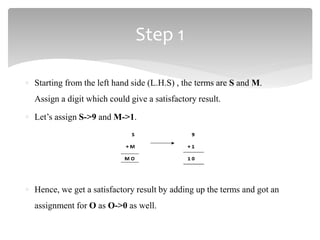
 Starting from the left hand side (L.H.S) , the terms are S and M.
Assign a digit which could give a satisfactory result.
 Let’s assign S->9 and M->1.
 Hence, we get a satisfactory result by adding up the terms and got an
assignment for O as O->0 as well.
Step 1
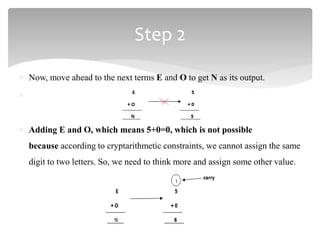
 Now, move ahead to the next terms E and O to get N as its output.

 Adding E and O, which means 5+0=0, which is not possible
because according to cryptarithmetic constraints, we cannot assign the same
digit to two letters. So, we need to think more and assign some other value.
Step 2
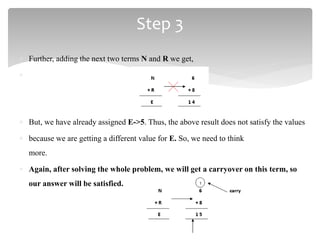
 Further, adding the next two terms N and R we get,

 But, we have already assigned E->5. Thus, the above result does not satisfy the values
 because we are getting a different value for E. So, we need to think
more.
 Again, after solving the whole problem, we will get a carryover on this term, so
our answer will be satisfied.
Step 3
 Again, on adding the last two terms, i.e., the rightmost
terms D and E, we get Y as its result.

Step 4
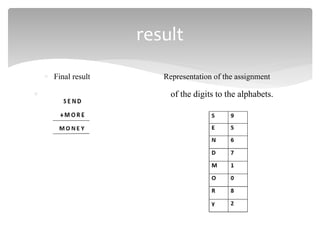
 Final result Representation of the assignment
 of the digits to the alphabets.
result
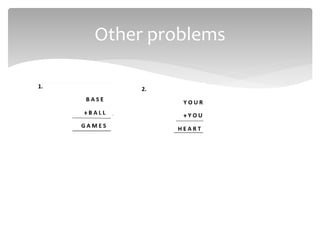
Other problems
• It describes different constrainers, operators, arguments,
variables and their domains.
• It consists of:
1. Legal set of operators
2. Set of variables
3. Set of all types of functions
4. Domain variables
5. Range of variables
constraint domain is five-tuple and represented as
D={var,f,O,dv,rg}
Constraint Domain
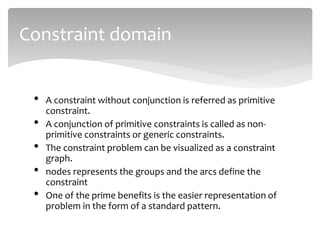
• A constraint without conjunction is referred as primitive
constraint.
• A conjunction of primitive constraints is called as non-
primitive constraints or generic constraints.
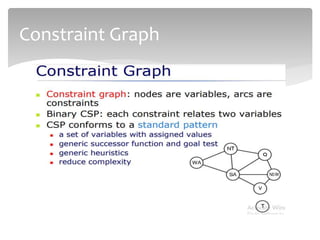
• The constraint problem can be visualized as a constraint
graph.
• nodes represents the groups and the arcs define the
constraint
• One of the prime benefits is the easier representation of
problem in the form of a standard pattern.
Constraint domain
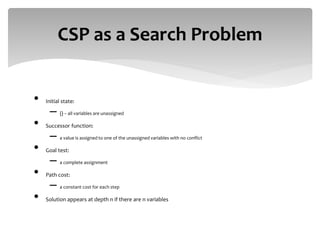
• Initial state:
– {} – all variables are unassigned
• Successor function:
– a value is assigned to one of the unassigned variables with no conflict
• Goal test:
– a complete assignment
• Path cost:
– a constant cost for each step
• Solution appears at depth n if there are n variables
CSP as a Search Problem
Map colouring
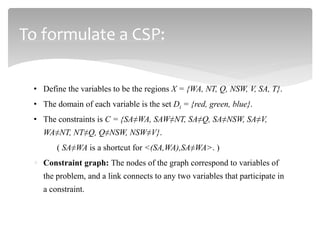
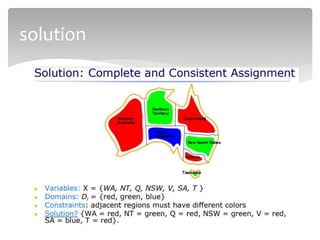
• Define the variables to be the regions X = {WA, NT, Q, NSW, V, SA, T}.
• The domain of each variable is the set Di = {red, green, blue}.
• The constraints is C = {SA≠WA, SAW≠NT, SA≠Q, SA≠NSW, SA≠V,
WA≠NT, NT≠Q, Q≠NSW, NSW≠V}.
( SA≠WA is a shortcut for <(SA,WA),SA≠WA>. )
 Constraint graph: The nodes of the graph correspond to variables of
the problem, and a link connects to any two variables that participate in
a constraint.
To formulate a CSP:
solution
Constraint Graph
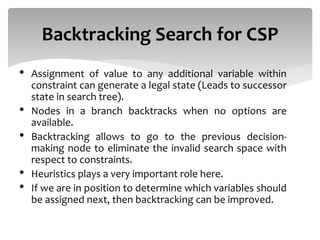
• Assignment of value to any additional variable within
constraint can generate a legal state (Leads to successor
state in search tree).
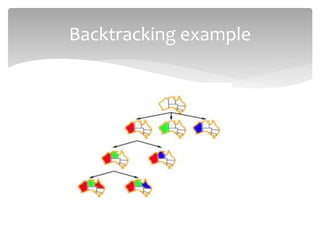
• Nodes in a branch backtracks when no options are
available.
• Backtracking allows to go to the previous decision-
making node to eliminate the invalid search space with
respect to constraints.
• Heuristics plays a very important role here.
• If we are in position to determine which variables should
be assigned next, then backtracking can be improved.
Backtracking Search for CSP
Algorithm
Backtracking example
• Heuristics help in deciding the initial state as well as subsequent selected states.
• Selection of a variable with minimum number of possible values can help in
simplifying the search.
• This is called as Minimum Remaining Values Heuristic (MRV) or Most
Constraint Variable Heuristic.
• The notion of selection is to detect a failure at an early stage.
• It restricts the most search which ends up in same variable (which would make
the backtracking ineffective).
Role of Heuristic
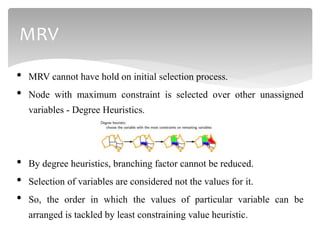
• MRV cannot have hold on initial selection process.
• Node with maximum constraint is selected over other unassigned
variables - Degree Heuristics.
• By degree heuristics, branching factor cannot be reduced.
• Selection of variables are considered not the values for it.
• So, the order in which the values of particular variable can be
arranged is tackled by least constraining value heuristic.
MRV
Thank you

Constraint satisfaction problems (csp)

  • 1.
    Constraint satisfaction problems (CSP) T.ARCHANA ASSISTANTPROFESSOR COMPUTER SCIENCE AND ENGINEERING DEPARTMENT SRM INSTITUTE OF SCIENCE AND TECHNOLOGY RAMAPURAM, CHENNAI
  • 2.
    Introduction to CSP Whatis a constraint Crypto Arithmetic puzzles Constraint Domain CSP as a search problem Backtracking search for CSP Role of Heuristics AGENDA
  • 3.
    • Constraint satisfactionproblems (CSPs) are mathematical questions defined as a set of objects whose state must satisfy a number of constraints or limitations. • CSPs represent the entities in a problem as a homogeneous collection of finite constraints over variables, which is solved by constraint satisfaction methods. • It is a search procedure that operates in a space of constraints. • Any problem in the world can mathematically be represented as CSP. • The solution is typically a state that can satisfy all the constraints. INTRODUCTION TO CSP
  • 4.
    • A constraintsatisfaction problem (CSP) consists of – a set of variables, – a domain for each variable, and – a set of constraints. • The aim is to choose a value for each variable so that the resulting possible world satisfies the constraints; we want a model of the constraints. csp
  • 5.
    • It ismathematical/logical relationship among the attributes of one or more objects. • It is important to know the type of constraint. – Unary Constraint - single variable. – Binary Constraint - two variable. – Higher order Constraint - 3 or more variables. • Constraints can restrict the values of variables. CONSTRAINT
  • 6.
    • Assignment problems –e.g., who teaches what class • Timetabling problems – e.g., which class is offered when and where? • Transportation scheduling • Factory scheduling Real-World CSP’s
  • 7.
     Constraints:  1.Variables: can take values from 0-9  2. No two variables should take same value  3. The values should be selected such a way that it should comply with arithmetic properties.  Crypt Arithmetic Puzzles
  • 8.
    • There shouldbe a unique digit to be replaced with a unique alphabet. • The result should satisfy the predefined arithmetic rules, i.e., 2+2 =4, nothing else. • Digits should be from 0-9 only. • There should be only one carry forward, while performing the addition operation on a problem. • The problem can be solved from both sides, i.e., lefthand side (L.H.S), or righthand side (R.H.S) Rules for CSP problem
  • 9.
     Given acryptarithmetic problem,  i.e., S E N D + M O R E = M O N E Y  In this example, add both terms S E N D and M O R E to bring M O N E Y as a result.  problem
  • 10.
     Starting fromthe left hand side (L.H.S) , the terms are S and M. Assign a digit which could give a satisfactory result.  Let’s assign S->9 and M->1.  Hence, we get a satisfactory result by adding up the terms and got an assignment for O as O->0 as well. Step 1
  • 11.
     Now, moveahead to the next terms E and O to get N as its output.   Adding E and O, which means 5+0=0, which is not possible because according to cryptarithmetic constraints, we cannot assign the same digit to two letters. So, we need to think more and assign some other value. Step 2
  • 12.
     Further, addingthe next two terms N and R we get,   But, we have already assigned E->5. Thus, the above result does not satisfy the values  because we are getting a different value for E. So, we need to think more.  Again, after solving the whole problem, we will get a carryover on this term, so our answer will be satisfied. Step 3
  • 13.
     Again, onadding the last two terms, i.e., the rightmost terms D and E, we get Y as its result.  Step 4
  • 14.
     Final resultRepresentation of the assignment  of the digits to the alphabets. result
  • 15.
  • 16.
    • It describesdifferent constrainers, operators, arguments, variables and their domains. • It consists of: 1. Legal set of operators 2. Set of variables 3. Set of all types of functions 4. Domain variables 5. Range of variables constraint domain is five-tuple and represented as D={var,f,O,dv,rg} Constraint Domain
  • 17.
    • A constraintwithout conjunction is referred as primitive constraint. • A conjunction of primitive constraints is called as non- primitive constraints or generic constraints. • The constraint problem can be visualized as a constraint graph. • nodes represents the groups and the arcs define the constraint • One of the prime benefits is the easier representation of problem in the form of a standard pattern. Constraint domain
  • 18.
    • Initial state: –{} – all variables are unassigned • Successor function: – a value is assigned to one of the unassigned variables with no conflict • Goal test: – a complete assignment • Path cost: – a constant cost for each step • Solution appears at depth n if there are n variables CSP as a Search Problem
  • 19.
  • 20.
    • Define thevariables to be the regions X = {WA, NT, Q, NSW, V, SA, T}. • The domain of each variable is the set Di = {red, green, blue}. • The constraints is C = {SA≠WA, SAW≠NT, SA≠Q, SA≠NSW, SA≠V, WA≠NT, NT≠Q, Q≠NSW, NSW≠V}. ( SA≠WA is a shortcut for <(SA,WA),SA≠WA>. )  Constraint graph: The nodes of the graph correspond to variables of the problem, and a link connects to any two variables that participate in a constraint. To formulate a CSP:
  • 21.
  • 22.
  • 23.
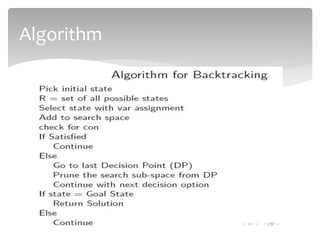
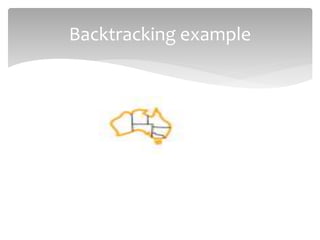
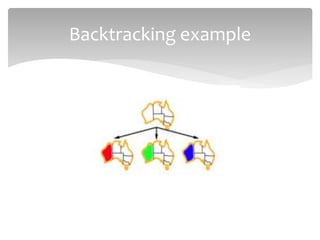
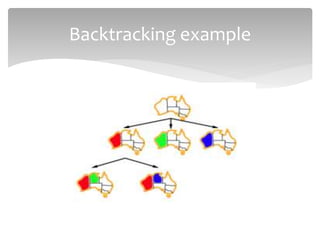
    • Assignment ofvalue to any additional variable within constraint can generate a legal state (Leads to successor state in search tree). • Nodes in a branch backtracks when no options are available. • Backtracking allows to go to the previous decision- making node to eliminate the invalid search space with respect to constraints. • Heuristics plays a very important role here. • If we are in position to determine which variables should be assigned next, then backtracking can be improved. Backtracking Search for CSP
  • 24.
  • 25.
  • 26.
  • 27.
  • 28.
  • 29.
    • Heuristics helpin deciding the initial state as well as subsequent selected states. • Selection of a variable with minimum number of possible values can help in simplifying the search. • This is called as Minimum Remaining Values Heuristic (MRV) or Most Constraint Variable Heuristic. • The notion of selection is to detect a failure at an early stage. • It restricts the most search which ends up in same variable (which would make the backtracking ineffective). Role of Heuristic
  • 30.
    • MRV cannothave hold on initial selection process. • Node with maximum constraint is selected over other unassigned variables - Degree Heuristics. • By degree heuristics, branching factor cannot be reduced. • Selection of variables are considered not the values for it. • So, the order in which the values of particular variable can be arranged is tackled by least constraining value heuristic. MRV
  • 31.