A. D. Patel Institute Of Technology
Artificial Intelligence [2180703] : A. Y. 2019-20
Semantic Net
Prepared By :
Dhruv V. Shah
B.E. (IT) Sem - VIII
Guided By :
Dr. Narendrasinh Chauhan
(Head Of IT , ADIT)
Department Of Information Technology
A.D. Patel Institute Of Technology (ADIT)
New Vallabh Vidyanagar , Anand , Gujarat
1
ALA Presentation
09/ 04 / 2020
Outline
Introduction
Simple Example of semantic net
Kinds of Semantic Nets
Advantages of Semantic network
Disadvantages of Semantic network
References
2
Introduction
What is Semantic Net ?
 Semantic networks are alternative of predicate logic for knowledge
representation.
 In Semantic networks, we can represent our knowledge in the form of
graphical networks.
 This network consists of nodes representing objects and arcs which describe
the relationship between those objects.
 Nodes are sometimes referred to as objects. Nodes are to represent
physical objects, concepts, or situation.
 Arcs as links or edges. The links are used to express relationships.
 It is also known as associative net due to the association of one node with
other.
 Semantic networks are easy to understand and can be easily extended.
3
Count…
 This representation consist of mainly two types of relations:
a) IS-A relation (Inheritance).
b) A-Kind-of relation (AKO).
4
a) IS-A relation :
 IS-A means “is an instance of” and refers to a specific member of a class.
 A class is related to the mathematical concept of a set in that it refers to a
group of objects.
 Ex. : {3,bat, blue, t-shirt, art}
b) A-Kind-of relation :
 The AKO relation is used to relate one class to another.
 AKO relates generic nodes to generic nodes while the IS-A relates an
instance or individual to a generic class.
Simple Example of Semantic net
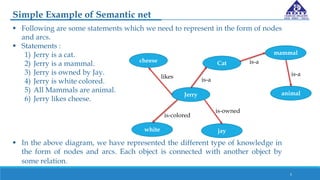
 Following are some statements which we need to represent in the form of nodes
and arcs.
 Statements :
1) Jerry is a cat.
2) Jerry is a mammal.
3) Jerry is owned by Jay.
4) Jerry is white colored.
5) All Mammals are animal.
6) Jerry likes cheese.
 In the above diagram, we have represented the different type of knowledge in
the form of nodes and arcs. Each object is connected with another object by
some relation.
5
Jerry
Cat
is-a
mammal
is-a
jay
is-owned
white
is-colored
animal
is-a
cheese
likes
Kinds of Semantic Nets
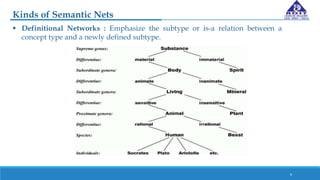
 Definitional Networks : Emphasize the subtype or is-a relation between a
concept type and a newly defined subtype.
6
Kinds of Semantic Nets
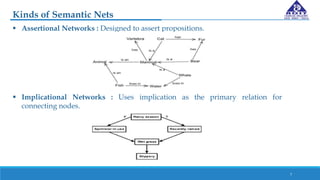
 Assertional Networks : Designed to assert propositions.
7
 Implicational Networks : Uses implication as the primary relation for
connecting nodes.
Kinds of Semantic Nets
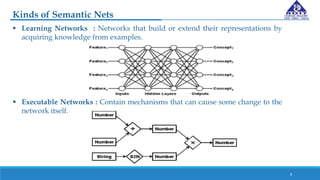
 Learning Networks : Networks that build or extend their representations by
acquiring knowledge from examples.
8
 Executable Networks : Contain mechanisms that can cause some change to the
network itself.
Advantages of Semantic network
1) Semantic networks are a natural representation of knowledge.
2) Semantic networks convey meaning in a transparent manner.
3) These networks are simple and easily understandable.
4) Efficient.
5) Translatable to PROLOG w/o difficulty.
9
Disadvantages of Semantic network
1) Semantic networks take more computational time at runtime as we need to
traverse the complete network tree to answer some questions. It might be
possible in the worst case scenario that after traversing the entire tree, we find
that the solution does not exist in this network.
2) These types of representations are inadequate as they do not have any
equivalent quantifier, e.g., for all, for some, none, etc.
3) Semantic networks do not have any standard definition for the link names.
4) These networks are not intelligent and depend on the creator of the system.
5) Semantic networks try to model human-like memory to store the information,
but in practice, it is not possible to build such a vast semantic network.
10
References
1) https://www.javatpoint.com/ai-techniques-of-knowledge-representation
2) http://www.jfsowa.com/pubs/semnet.htm
3) https://www.edureka.co/blog/knowledge-representation-in-ai/
11
12

Semantic net in AI

  • 1.
    A. D. PatelInstitute Of Technology Artificial Intelligence [2180703] : A. Y. 2019-20 Semantic Net Prepared By : Dhruv V. Shah B.E. (IT) Sem - VIII Guided By : Dr. Narendrasinh Chauhan (Head Of IT , ADIT) Department Of Information Technology A.D. Patel Institute Of Technology (ADIT) New Vallabh Vidyanagar , Anand , Gujarat 1 ALA Presentation 09/ 04 / 2020
  • 2.
    Outline Introduction Simple Example ofsemantic net Kinds of Semantic Nets Advantages of Semantic network Disadvantages of Semantic network References 2
  • 3.
    Introduction What is SemanticNet ?  Semantic networks are alternative of predicate logic for knowledge representation.  In Semantic networks, we can represent our knowledge in the form of graphical networks.  This network consists of nodes representing objects and arcs which describe the relationship between those objects.  Nodes are sometimes referred to as objects. Nodes are to represent physical objects, concepts, or situation.  Arcs as links or edges. The links are used to express relationships.  It is also known as associative net due to the association of one node with other.  Semantic networks are easy to understand and can be easily extended. 3
  • 4.
    Count…  This representationconsist of mainly two types of relations: a) IS-A relation (Inheritance). b) A-Kind-of relation (AKO). 4 a) IS-A relation :  IS-A means “is an instance of” and refers to a specific member of a class.  A class is related to the mathematical concept of a set in that it refers to a group of objects.  Ex. : {3,bat, blue, t-shirt, art} b) A-Kind-of relation :  The AKO relation is used to relate one class to another.  AKO relates generic nodes to generic nodes while the IS-A relates an instance or individual to a generic class.
  • 5.
    Simple Example ofSemantic net  Following are some statements which we need to represent in the form of nodes and arcs.  Statements : 1) Jerry is a cat. 2) Jerry is a mammal. 3) Jerry is owned by Jay. 4) Jerry is white colored. 5) All Mammals are animal. 6) Jerry likes cheese.  In the above diagram, we have represented the different type of knowledge in the form of nodes and arcs. Each object is connected with another object by some relation. 5 Jerry Cat is-a mammal is-a jay is-owned white is-colored animal is-a cheese likes
  • 6.
    Kinds of SemanticNets  Definitional Networks : Emphasize the subtype or is-a relation between a concept type and a newly defined subtype. 6
  • 7.
    Kinds of SemanticNets  Assertional Networks : Designed to assert propositions. 7  Implicational Networks : Uses implication as the primary relation for connecting nodes.
  • 8.
    Kinds of SemanticNets  Learning Networks : Networks that build or extend their representations by acquiring knowledge from examples. 8  Executable Networks : Contain mechanisms that can cause some change to the network itself.
  • 9.
    Advantages of Semanticnetwork 1) Semantic networks are a natural representation of knowledge. 2) Semantic networks convey meaning in a transparent manner. 3) These networks are simple and easily understandable. 4) Efficient. 5) Translatable to PROLOG w/o difficulty. 9
  • 10.
    Disadvantages of Semanticnetwork 1) Semantic networks take more computational time at runtime as we need to traverse the complete network tree to answer some questions. It might be possible in the worst case scenario that after traversing the entire tree, we find that the solution does not exist in this network. 2) These types of representations are inadequate as they do not have any equivalent quantifier, e.g., for all, for some, none, etc. 3) Semantic networks do not have any standard definition for the link names. 4) These networks are not intelligent and depend on the creator of the system. 5) Semantic networks try to model human-like memory to store the information, but in practice, it is not possible to build such a vast semantic network. 10
  • 11.
  • 12.