AI with Expert System
Preparead by
Peshawa Q.Nabi
Content
 Introduction AI
 Overview of AI
 Introduction Expert System
 Component of Expert System
 Capabilities of Expert System
 Participants in Expert System
 Expert System Development
 Evolution of Expert System Software
 Summary
Introduction to AI
The branch of computer science concerned with making computers
behave like humans. The term was coined in 1956 by John McCarthy
at the Massachusetts Institute of Technology. Artificial intelligence
includes :-
 games playing: programming computers to play games
such as chess and checkers .
 expert systems : programming computers to make
decisions in real-life .
 natural language : programming computers to
understand natural human languages .
Introduction to AI
 neural networks : Systems that simulate intelligence
by attempting to reproduce the types of physical
connections that occur in animal brains .
 robotics : programming computers to see and hear and
react to other sensory stimuli .
Currently, no computers exhibit full artificial intelligence
(that is, are
able to simulate human behavior).
Introduction of Expert System
 In arterial intelligent an expert system is a computer system that
emulates the decision –making ability of a human expert .
 Expert system are designed to solve complex problems by resoning about
knowledge , like a expert.
 Do not follow the procedure of a developer as the case in convectional
programming
Divided into two parts , one fixed in depended of the expert system : the
inference , and one variable : the knowledge base.
In the 80s a third part appeared : a dialog interface to communicate with
users.
This ability to conduct a conversation with users was latter called
“conversational” .
Components and Human Interfaces
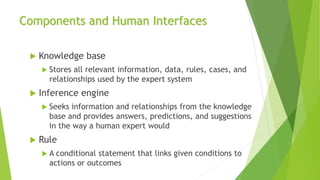
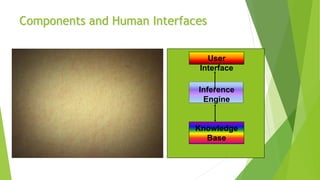
 Knowledge base
 Stores all relevant information, data, rules, cases, and
relationships used by the expert system
 Inference engine
 Seeks information and relationships from the knowledge
base and provides answers, predictions, and suggestions
in the way a human expert would
 Rule
 A conditional statement that links given conditions to
actions or outcomes
Components and Human Interfaces
User
Interface
Inference
Engine
Knowledge
Base
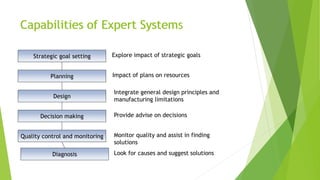
Capabilities of Expert SystemCapabilities of Expert Systems
Strategic goal setting
Decision making
Planning
Design
Quality control and monitoring
Diagnosis
Explore impact of strategic goals
Impact of plans on resources
Integrate general design principles and
manufacturing limitations
Provide advise on decisions
Monitor quality and assist in finding
solutions
Look for causes and suggest solutions
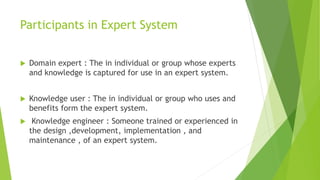
Participants in Expert System
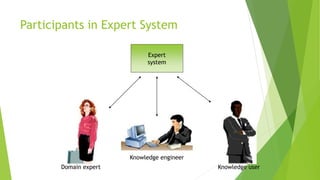
 Domain expert : The in individual or group whose experts
and knowledge is captured for use in an expert system.
 Knowledge user : The in individual or group who uses and
benefits form the expert system.
 Knowledge engineer : Someone trained or experienced in
the design ,development, implementation , and
maintenance , of an expert system.
Participants in Expert System
Expert
system
Domain expert
Knowledge engineer
Knowledge user
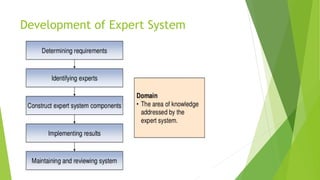
Development of Expert System
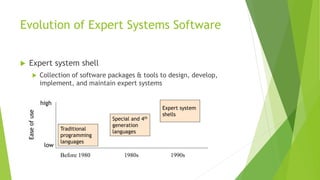
Evolution of Expert Systems Software
 Expert system shell
 Collection of software packages & tools to design, develop,
implement, and maintain expert systems
Easeofuse
low
high
Traditional
programming
languages
Special and 4th
generation
languages
Expert system
shells
Before 1980 1980s 1990s
Advantages of Expert Systems
 Will never “retire” .
 Essay to use .
 People can the initial diagnosis from home (Saving
money) .
 Easy to develop and modify .
 The use of heuristics .
 Etc……..
Applications of Expert Systems
 Credit granting
 Information management and retrieval
 AI and expert systems embedded in products
 Plant layout
 Hospitals and medical facilities
 Help desks and assistance
 Employee performance evaluation
 Loan analysis
 Virus detection
 Repair and maintenance
 Shipping
 Marketing
 Warehouse optimization
Summary
in this Video !
THANK YOU

AI with expert system

  • 1.
    AI with ExpertSystem Preparead by Peshawa Q.Nabi
  • 2.
    Content  Introduction AI Overview of AI  Introduction Expert System  Component of Expert System  Capabilities of Expert System  Participants in Expert System  Expert System Development  Evolution of Expert System Software  Summary
  • 3.
    Introduction to AI Thebranch of computer science concerned with making computers behave like humans. The term was coined in 1956 by John McCarthy at the Massachusetts Institute of Technology. Artificial intelligence includes :-  games playing: programming computers to play games such as chess and checkers .  expert systems : programming computers to make decisions in real-life .  natural language : programming computers to understand natural human languages .
  • 4.
    Introduction to AI neural networks : Systems that simulate intelligence by attempting to reproduce the types of physical connections that occur in animal brains .  robotics : programming computers to see and hear and react to other sensory stimuli . Currently, no computers exhibit full artificial intelligence (that is, are able to simulate human behavior).
  • 5.
    Introduction of ExpertSystem  In arterial intelligent an expert system is a computer system that emulates the decision –making ability of a human expert .  Expert system are designed to solve complex problems by resoning about knowledge , like a expert.  Do not follow the procedure of a developer as the case in convectional programming Divided into two parts , one fixed in depended of the expert system : the inference , and one variable : the knowledge base. In the 80s a third part appeared : a dialog interface to communicate with users. This ability to conduct a conversation with users was latter called “conversational” .
  • 6.
    Components and HumanInterfaces  Knowledge base  Stores all relevant information, data, rules, cases, and relationships used by the expert system  Inference engine  Seeks information and relationships from the knowledge base and provides answers, predictions, and suggestions in the way a human expert would  Rule  A conditional statement that links given conditions to actions or outcomes
  • 7.
    Components and HumanInterfaces User Interface Inference Engine Knowledge Base
  • 8.
    Capabilities of ExpertSystemCapabilities of Expert Systems Strategic goal setting Decision making Planning Design Quality control and monitoring Diagnosis Explore impact of strategic goals Impact of plans on resources Integrate general design principles and manufacturing limitations Provide advise on decisions Monitor quality and assist in finding solutions Look for causes and suggest solutions
  • 9.
    Participants in ExpertSystem  Domain expert : The in individual or group whose experts and knowledge is captured for use in an expert system.  Knowledge user : The in individual or group who uses and benefits form the expert system.  Knowledge engineer : Someone trained or experienced in the design ,development, implementation , and maintenance , of an expert system.
  • 10.
    Participants in ExpertSystem Expert system Domain expert Knowledge engineer Knowledge user
  • 11.
  • 12.
    Evolution of ExpertSystems Software  Expert system shell  Collection of software packages & tools to design, develop, implement, and maintain expert systems Easeofuse low high Traditional programming languages Special and 4th generation languages Expert system shells Before 1980 1980s 1990s
  • 13.
    Advantages of ExpertSystems  Will never “retire” .  Essay to use .  People can the initial diagnosis from home (Saving money) .  Easy to develop and modify .  The use of heuristics .  Etc……..
  • 14.
    Applications of ExpertSystems  Credit granting  Information management and retrieval  AI and expert systems embedded in products  Plant layout  Hospitals and medical facilities  Help desks and assistance  Employee performance evaluation  Loan analysis  Virus detection  Repair and maintenance  Shipping  Marketing  Warehouse optimization
  • 15.
  • 16.