1
C H A P T E R
Artificial
Intelligence and
Expert Systems
2
Overview of Artificial
Intelligence
• Artificial Intelligence (AI)
 Computers with the ability to mimic or
duplicate the functions of the human
brain.
• Artificial Intelligence Systems
 The people, procedures, hardware,
software, data, and knowledge needed to
develop computer systems and machines
that demonstrate the characteristics of
intelligence.
3
Overview of Artificial
Intelligence
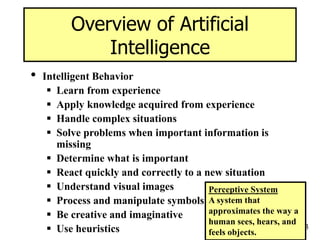
• Intelligent Behavior
 Learn from experience
 Apply knowledge acquired from experience
 Handle complex situations
 Solve problems when important information is
missing
 Determine what is important
 React quickly and correctly to a new situation
 Understand visual images
 Process and manipulate symbols
 Be creative and imaginative
 Use heuristics
Perceptive System
A system that
approximates the way a
human sees, hears, and
feels objects.
4
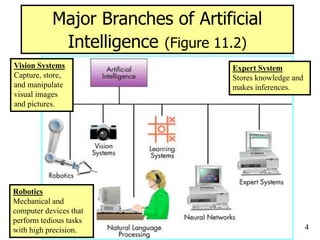
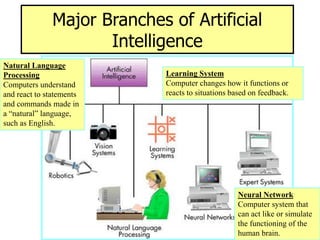
Major Branches of Artificial
Intelligence (Figure 11.2)
Expert System
Stores knowledge and
makes inferences.
Robotics
Mechanical and
computer devices that
perform tedious tasks
with high precision.
Vision Systems
Capture, store,
and manipulate
visual images
and pictures.
5
Major Branches of Artificial
Intelligence
Natural Language
Processing
Computers understand
and react to statements
and commands made in
a “natural” language,
such as English.
Learning System
Computer changes how it functions or
reacts to situations based on feedback.
Neural Network
Computer system that
can act like or simulate
the functioning of the
human brain.
6
Overview of Expert Systems
• Can explain their reasoning or
suggested decisions.
• Can display intelligent behavior.
• Can draw conclusions from
complex relationships.
• Can provide portable knowledge.
Expert System Shell
A collection of software packages and
tools used to develop expert systems.
7
Overview of Expert Systems -
Limitations
• Not widely used or tested.
• Limited to relatively narrow problems.
• Cannot readily deal with “mixed”
knowledge.
• Possibility of error.
• Cannot refine own knowledge base.
• Difficult to maintain.
• May have high development costs.
• Raise legal and ethical concerns.
8
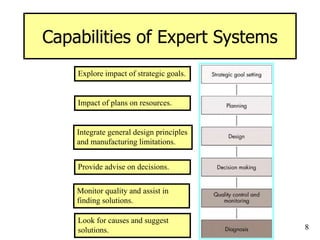
Capabilities of Expert Systems
Explore impact of strategic goals.
Impact of plans on resources.
Integrate general design principles
and manufacturing limitations.
Provide advise on decisions.
Monitor quality and assist in
finding solutions.
Look for causes and suggest
solutions.
9
When to Use Expert Systems
l Provide a high potential payoff or
significantly reduced downside risk.
l Capture and preserve irreplaceable
human expertise.
l Provide expertise needed at a
number of locations at the same
time or in a hostile environment
that is dangerous to human health.
10
When to Use Expert Systems
l Provide expertise that is expensive
or rare
l Develop a solution faster than
human experts can
l Provide expertise needed for
training and development to share
the wisdom of human experts with
a large number of people
11
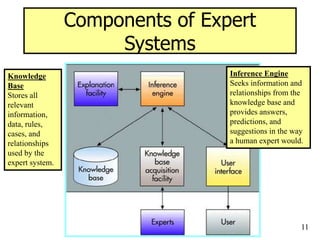
Components of Expert
Systems
Knowledge
Base
Stores all
relevant
information,
data, rules,
cases, and
relationships
used by the
expert system.
Inference Engine
Seeks information and
relationships from the
knowledge base and
provides answers,
predictions, and
suggestions in the way
a human expert would.
12
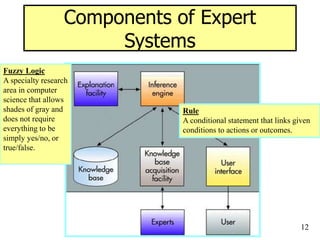
Components of Expert
Systems
Fuzzy Logic
A specialty research
area in computer
science that allows
shades of gray and
does not require
everything to be
simply yes/no, or
true/false.
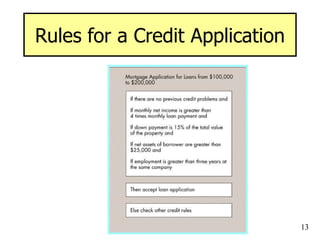
Rule
A conditional statement that links given
conditions to actions or outcomes.
13
Rules for a Credit Application
14
Explanation Facility
• Explanation Facility
 A part of the expert system that allows
a user or decision maker to
understand how the expert system
arrived at certain conclusions or
results.
15
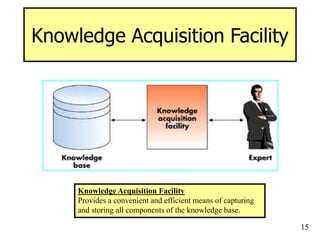
Knowledge Acquisition Facility
Provides a convenient and efficient means of capturing
and storing all components of the knowledge base.
16
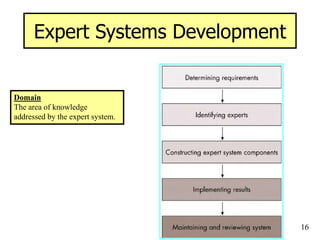
Expert Systems Development
Domain
The area of knowledge
addressed by the expert system.
17
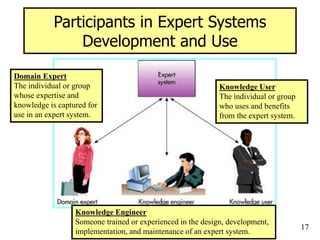
Participants in Expert Systems
Development and Use
Domain Expert
The individual or group
whose expertise and
knowledge is captured for
use in an expert system.
Knowledge Engineer
Someone trained or experienced in the design, development,
implementation, and maintenance of an expert system.
Knowledge User
The individual or group
who uses and benefits
from the expert system.
18
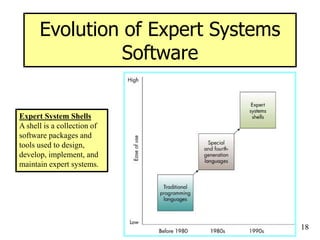
Evolution of Expert Systems
Software
Expert System Shells
A shell is a collection of
software packages and
tools used to design,
develop, implement, and
maintain expert systems.
19
Advantages of Expert Systems
Shells
• Easy to develop and modify
• The use of satisficing
• The use of heuristics
• Development by knowledge
engineers and users
20
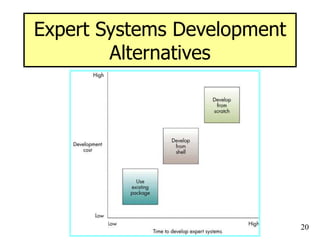
Expert Systems Development
Alternatives
21
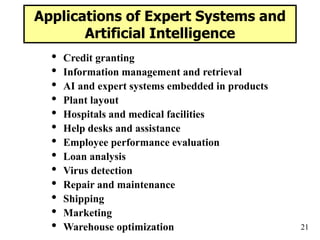
Applications of Expert Systems and
Artificial Intelligence
• Credit granting
• Information management and retrieval
• AI and expert systems embedded in products
• Plant layout
• Hospitals and medical facilities
• Help desks and assistance
• Employee performance evaluation
• Loan analysis
• Virus detection
• Repair and maintenance
• Shipping
• Marketing
• Warehouse optimization

Applied Artificial Intelligence presenttt

  • 1.
    1 C H AP T E R Artificial Intelligence and Expert Systems
  • 2.
    2 Overview of Artificial Intelligence •Artificial Intelligence (AI)  Computers with the ability to mimic or duplicate the functions of the human brain. • Artificial Intelligence Systems  The people, procedures, hardware, software, data, and knowledge needed to develop computer systems and machines that demonstrate the characteristics of intelligence.
  • 3.
    3 Overview of Artificial Intelligence •Intelligent Behavior  Learn from experience  Apply knowledge acquired from experience  Handle complex situations  Solve problems when important information is missing  Determine what is important  React quickly and correctly to a new situation  Understand visual images  Process and manipulate symbols  Be creative and imaginative  Use heuristics Perceptive System A system that approximates the way a human sees, hears, and feels objects.
  • 4.
    4 Major Branches ofArtificial Intelligence (Figure 11.2) Expert System Stores knowledge and makes inferences. Robotics Mechanical and computer devices that perform tedious tasks with high precision. Vision Systems Capture, store, and manipulate visual images and pictures.
  • 5.
    5 Major Branches ofArtificial Intelligence Natural Language Processing Computers understand and react to statements and commands made in a “natural” language, such as English. Learning System Computer changes how it functions or reacts to situations based on feedback. Neural Network Computer system that can act like or simulate the functioning of the human brain.
  • 6.
    6 Overview of ExpertSystems • Can explain their reasoning or suggested decisions. • Can display intelligent behavior. • Can draw conclusions from complex relationships. • Can provide portable knowledge. Expert System Shell A collection of software packages and tools used to develop expert systems.
  • 7.
    7 Overview of ExpertSystems - Limitations • Not widely used or tested. • Limited to relatively narrow problems. • Cannot readily deal with “mixed” knowledge. • Possibility of error. • Cannot refine own knowledge base. • Difficult to maintain. • May have high development costs. • Raise legal and ethical concerns.
  • 8.
    8 Capabilities of ExpertSystems Explore impact of strategic goals. Impact of plans on resources. Integrate general design principles and manufacturing limitations. Provide advise on decisions. Monitor quality and assist in finding solutions. Look for causes and suggest solutions.
  • 9.
    9 When to UseExpert Systems l Provide a high potential payoff or significantly reduced downside risk. l Capture and preserve irreplaceable human expertise. l Provide expertise needed at a number of locations at the same time or in a hostile environment that is dangerous to human health.
  • 10.
    10 When to UseExpert Systems l Provide expertise that is expensive or rare l Develop a solution faster than human experts can l Provide expertise needed for training and development to share the wisdom of human experts with a large number of people
  • 11.
    11 Components of Expert Systems Knowledge Base Storesall relevant information, data, rules, cases, and relationships used by the expert system. Inference Engine Seeks information and relationships from the knowledge base and provides answers, predictions, and suggestions in the way a human expert would.
  • 12.
    12 Components of Expert Systems FuzzyLogic A specialty research area in computer science that allows shades of gray and does not require everything to be simply yes/no, or true/false. Rule A conditional statement that links given conditions to actions or outcomes.
  • 13.
    13 Rules for aCredit Application
  • 14.
    14 Explanation Facility • ExplanationFacility  A part of the expert system that allows a user or decision maker to understand how the expert system arrived at certain conclusions or results.
  • 15.
    15 Knowledge Acquisition Facility KnowledgeAcquisition Facility Provides a convenient and efficient means of capturing and storing all components of the knowledge base.
  • 16.
    16 Expert Systems Development Domain Thearea of knowledge addressed by the expert system.
  • 17.
    17 Participants in ExpertSystems Development and Use Domain Expert The individual or group whose expertise and knowledge is captured for use in an expert system. Knowledge Engineer Someone trained or experienced in the design, development, implementation, and maintenance of an expert system. Knowledge User The individual or group who uses and benefits from the expert system.
  • 18.
    18 Evolution of ExpertSystems Software Expert System Shells A shell is a collection of software packages and tools used to design, develop, implement, and maintain expert systems.
  • 19.
    19 Advantages of ExpertSystems Shells • Easy to develop and modify • The use of satisficing • The use of heuristics • Development by knowledge engineers and users
  • 20.
  • 21.
    21 Applications of ExpertSystems and Artificial Intelligence • Credit granting • Information management and retrieval • AI and expert systems embedded in products • Plant layout • Hospitals and medical facilities • Help desks and assistance • Employee performance evaluation • Loan analysis • Virus detection • Repair and maintenance • Shipping • Marketing • Warehouse optimization