Cholinergic
Agent
Presented by-
- Ashok Gautam
Skb college of pharmacy
•Cholinergic Agent
These are drugs which produce actions
similar to that of Acetylcholine, either by
directly interacting with cholinergic
receptors (cholinergic agonist) or by
increasing availability of Acetylcholine at
these sites (anticholinesterases)
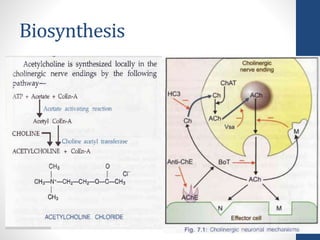
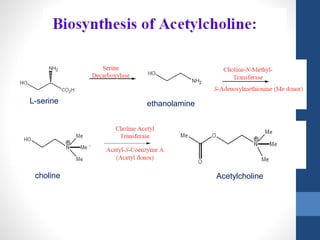
Biosynthesis
L-serine
choline Acetylcholine
ethanolamine
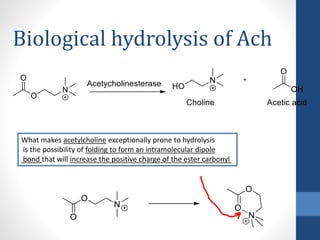
What makes acetylcholine exceptionally prone to hydrolysis
is the possibility of folding to form an intramolecular dipole
bond that will increase the positive charge of the ester carbonyl
Biological hydrolysis of Ach
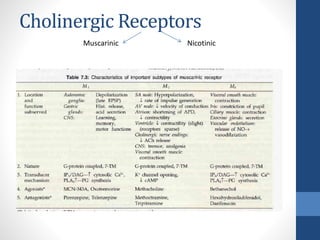
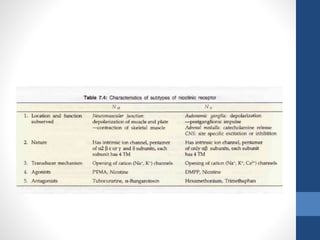
Cholinergic Receptors
Muscarinic Nicotinic
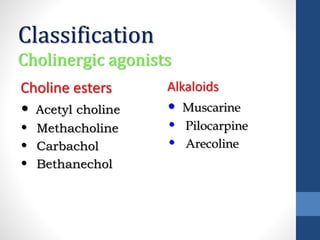
Classification
Cholinergic agonists
Choline esters
• Acetyl choline
• Methacholine
• Carbachol
• Bethanechol
Alkaloids
• Muscarine
• Pilocarpine
• Arecoline
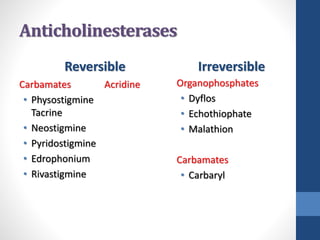
Anticholinesterases
Reversible
Carbamates Acridine
• Physostigmine
Tacrine
• Neostigmine
• Pyridostigmine
• Edrophonium
• Rivastigmine
Irreversible
Organophosphates
• Dyflos
• Echothiophate
• Malathion
Carbamates
• Carbaryl
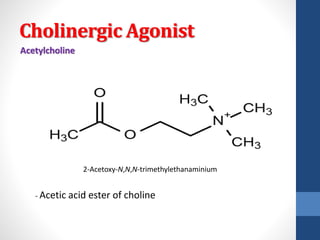
Cholinergic Agonist
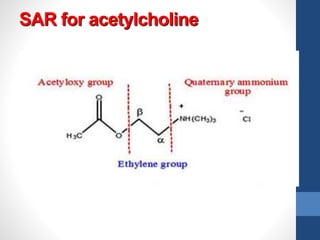
Acetylcholine
2-Acetoxy-N,N,N-trimethylethanaminium
- Acetic acid ester of choline
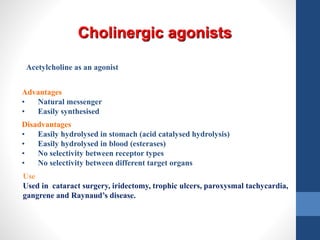
Cholinergic agonists
Acetylcholine as an agonist
Advantages
• Natural messenger
• Easily synthesised
Disadvantages
• Easily hydrolysed in stomach (acid catalysed hydrolysis)
• Easily hydrolysed in blood (esterases)
• No selectivity between receptor types
• No selectivity between different target organs
Use
Used in cataract surgery, iridectomy, trophic ulcers, paroxysmal tachycardia,
gangrene and Raynaud’s disease.
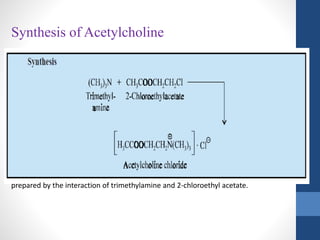
Synthesis of Acetylcholine
prepared by the interaction of trimethylamine and 2-chloroethyl acetate.
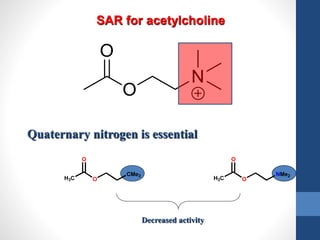
SAR for acetylcholine
Quaternary nitrogen is essential
Decreased activity
O
CMe3
H3C
O
O
NMe2
H3C
O
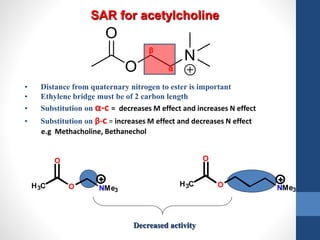
• Distance from quaternary nitrogen to ester is important
• Ethylene bridge must be of 2 carbon length
• Substitution on α-c = decreases M effect and increases N effect
• Substitution on β-c = increases M effect and decreases N effect
e.g Methacholine, Bethanechol
Decreased activity
O NMe3
H3C
O
OH3C
O
NMe3
SAR for acetylcholine
α
β
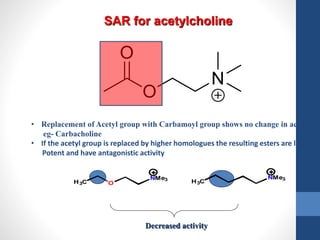
• Replacement of Acetyl group with Carbamoyl group shows no change in action
eg- Carbacholine
• If the acetyl group is replaced by higher homologues the resulting esters are less
Potent and have antagonistic activity
Decreased activity
O
NMe3
H3C
NMe3
H3C
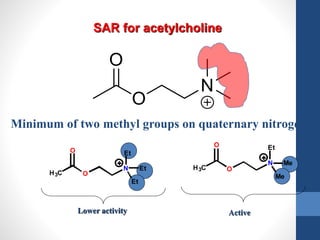
SAR for acetylcholine
Minimum of two methyl groups on quaternary nitrogen
Lower activity
O
N
H3C
O Et
Et
Et
Active
O
N
H3C
O Et
Me
Me
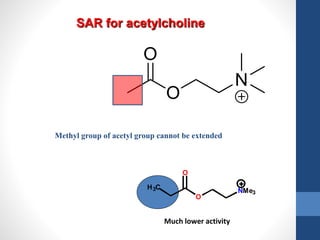
SAR for acetylcholine
Methyl group of acetyl group cannot be extended
SAR for acetylcholine
O
NMe3
O
H3C
Much lower activity
Trp-307
Asp311
Trp-613Trp-616
Asn-617
O N
H
H
CO2
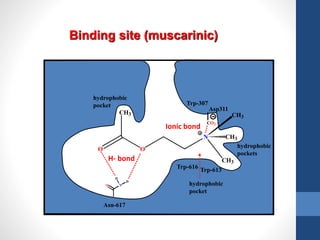
Binding site (muscarinic)
hydrophobic
pocket
hydrophobic
pocket
hydrophobic
pockets
O O
CH3
N
CH3
CH3
CH3
H- bond
Ionic bond
Conclusions:
• Tight fit between Ach and binding site (Receptor)
• Methyl groups fit into small hydrophobic pockets
• Ester interacting by H-bonding
• Quaternary nitrogen interacting by ionic bonding
SAR for acetylcholine
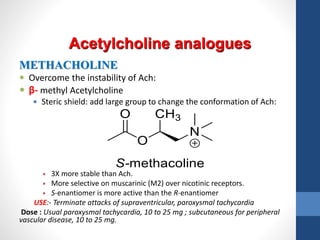
Acetylcholine analogues
METHACHOLINE
 Overcome the instability of Ach:
 β- methyl Acetylcholine
 Steric shield: add large group to change the conformation of Ach:
 3X more stable than Ach.
 More selective on muscarinic (M2) over nicotinic receptors.
 S-enantiomer is more active than the R-enantiomer
USE:- Terminate attacks of supraventricular, paroxysmal tachycardia
Dose : Usual paroxysmal tachycardia, 10 to 25 mg ; subcutaneous for peripheral
vascular disease, 10 to 25 mg.
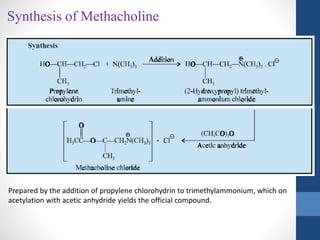
Synthesis of Methacholine
Prepared by the addition of propylene chlorohydrin to trimethylammonium, which on
acetylation with acetic anhydride yields the official compound.
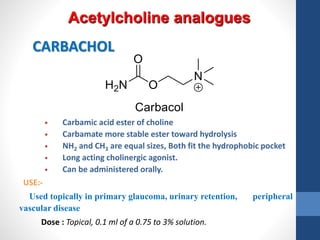
Acetylcholine analogues
 Carbamic acid ester of choline
 Carbamate more stable ester toward hydrolysis
 NH2 and CH3 are equal sizes, Both fit the hydrophobic pocket
 Long acting cholinergic agonist.
 Can be administered orally.
USE:-
Used topically in primary glaucoma, urinary retention, peripheral
vascular disease
Dose : Topical, 0.1 ml of a 0.75 to 3% solution.
CARBACHOL
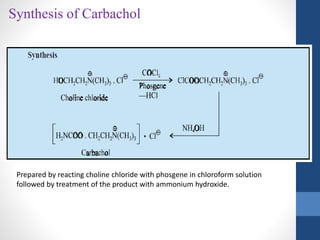
Synthesis of Carbachol
Prepared by reacting choline chloride with phosgene in chloroform solution
followed by treatment of the product with ammonium hydroxide.
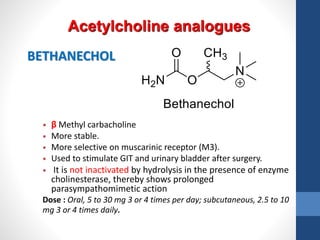
 β Methyl carbacholine
 More stable.
 More selective on muscarinic receptor (M3).
 Used to stimulate GIT and urinary bladder after surgery.
 It is not inactivated by hydrolysis in the presence of enzyme
cholinesterase, thereby shows prolonged
parasympathomimetic action
Dose : Oral, 5 to 30 mg 3 or 4 times per day; subcutaneous, 2.5 to 10
mg 3 or 4 times daily.
Acetylcholine analogues
BETHANECHOL
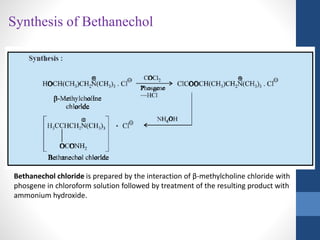
Synthesis of Bethanechol
Bethanechol chloride is prepared by the interaction of β-methylcholine chloride with
phosgene in chloroform solution followed by treatment of the resulting product with
ammonium hydroxide.
Muscarinic agonists
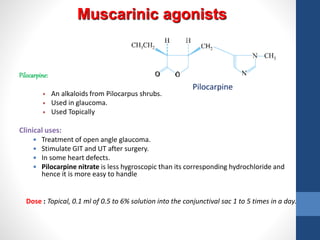
Pilocarpine:
 An alkaloids from Pilocarpus shrubs.
 Used in glaucoma.
 Used Topically
Clinical uses:
 Treatment of open angle glaucoma.
 Stimulate GIT and UT after surgery.
 In some heart defects.
 Pilocarpine nitrate is less hygroscopic than its corresponding hydrochloride and
hence it is more easy to handle
Dose : Topical, 0.1 ml of 0.5 to 6% solution into the conjunctival sac 1 to 5 times in a day.
Pilocarpine
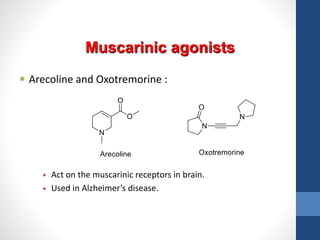
 Arecoline and Oxotremorine :
 Act on the muscarinic receptors in brain.
 Used in Alzheimer’s disease.
Muscarinic agonists
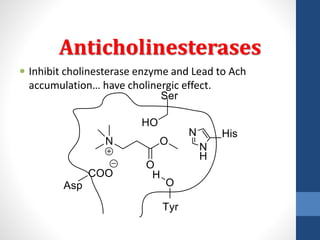
Anticholinesterases
 Inhibit cholinesterase enzyme and Lead to Ach
accumulation… have cholinergic effect.
Anticholinesterases
CARBAMATES:
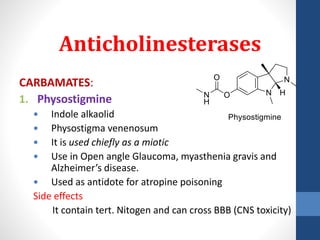
1. Physostigmine
 Indole alkaolid
 Physostigma venenosum
 It is used chiefly as a miotic
 Use in Open angle Glaucoma, myasthenia gravis and
Alzheimer’s disease.
 Used as antidote for atropine poisoning
Side effects
It contain tert. Nitogen and can cross BBB (CNS toxicity)
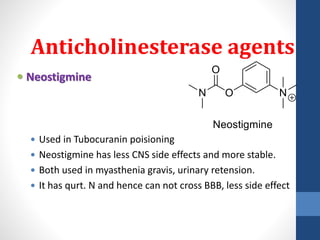
 Neostigmine
 Used in Tubocuranin poisioning
 Neostigmine has less CNS side effects and more stable.
 Both used in myasthenia gravis, urinary retension.
 It has qurt. N and hence can not cross BBB, less side effect
Anticholinesterase agents
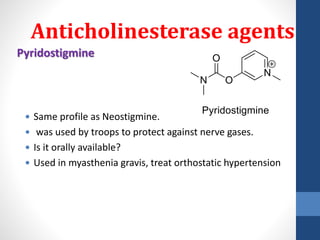
Pyridostigmine
 Same profile as Neostigmine.
 was used by troops to protect against nerve gases.
 Is it orally available?
 Used in myasthenia gravis, treat orthostatic hypertension
Anticholinesterase agents
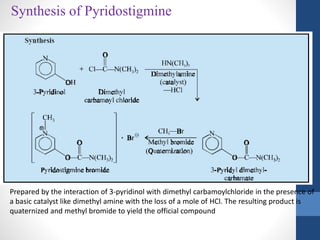
Synthesis of Pyridostigmine
Prepared by the interaction of 3-pyridinol with dimethyl carbamoylchloride in the presence of
a basic catalyst like dimethyl amine with the loss of a mole of HCl. The resulting product is
quaternized and methyl bromide to yield the official compound
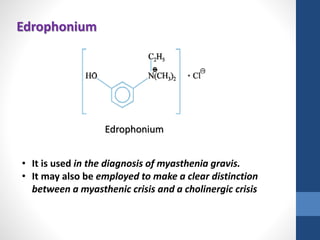
Edrophonium
• It is used in the diagnosis of myasthenia gravis.
• It may also be employed to make a clear distinction
between a myasthenic crisis and a cholinergic crisis
Edrophonium
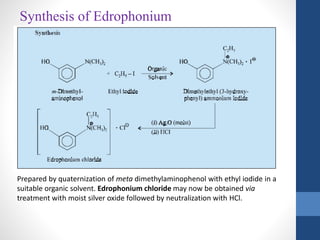
Synthesis of Edrophonium
Prepared by quaternization of meta dimethylaminophenol with ethyl iodide in a
suitable organic solvent. Edrophonium chloride may now be obtained via
treatment with moist silver oxide followed by neutralization with HCl.
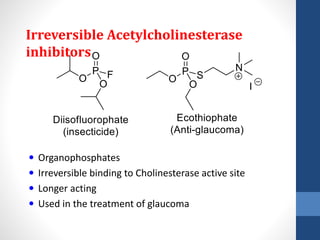
Irreversible Acetylcholinesterase
inhibitors
 Organophosphates
 Irreversible binding to Cholinesterase active site
 Longer acting
 Used in the treatment of glaucoma
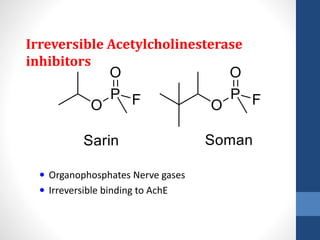
Irreversible Acetylcholinesterase
inhibitors
 Organophosphates Nerve gases
 Irreversible binding to AchE
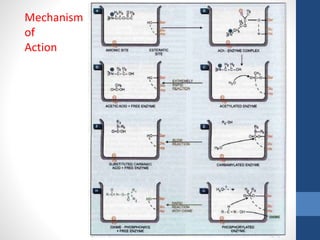
Mechanism
of
Action
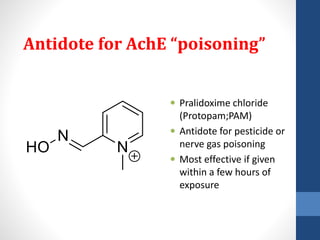
Antidote for AchE “poisoning”
 Pralidoxime chloride
(Protopam;PAM)
 Antidote for pesticide or
nerve gas poisoning
 Most effective if given
within a few hours of
exposure
Cl-
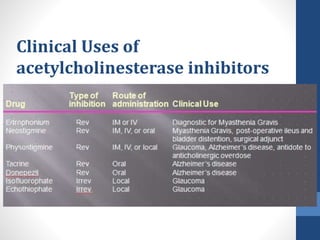
Clinical Uses of
acetylcholinesterase inhibitors
THANK
YOU

Cholinergic agent

  • 1.
    Cholinergic Agent Presented by- - AshokGautam Skb college of pharmacy
  • 2.
    •Cholinergic Agent These aredrugs which produce actions similar to that of Acetylcholine, either by directly interacting with cholinergic receptors (cholinergic agonist) or by increasing availability of Acetylcholine at these sites (anticholinesterases)
  • 3.
  • 4.
  • 5.
    What makes acetylcholineexceptionally prone to hydrolysis is the possibility of folding to form an intramolecular dipole bond that will increase the positive charge of the ester carbonyl Biological hydrolysis of Ach
  • 6.
  • 8.
    Classification Cholinergic agonists Choline esters •Acetyl choline • Methacholine • Carbachol • Bethanechol Alkaloids • Muscarine • Pilocarpine • Arecoline
  • 9.
    Anticholinesterases Reversible Carbamates Acridine • Physostigmine Tacrine •Neostigmine • Pyridostigmine • Edrophonium • Rivastigmine Irreversible Organophosphates • Dyflos • Echothiophate • Malathion Carbamates • Carbaryl
  • 10.
  • 11.
    Cholinergic agonists Acetylcholine asan agonist Advantages • Natural messenger • Easily synthesised Disadvantages • Easily hydrolysed in stomach (acid catalysed hydrolysis) • Easily hydrolysed in blood (esterases) • No selectivity between receptor types • No selectivity between different target organs Use Used in cataract surgery, iridectomy, trophic ulcers, paroxysmal tachycardia, gangrene and Raynaud’s disease.
  • 12.
    Synthesis of Acetylcholine preparedby the interaction of trimethylamine and 2-chloroethyl acetate.
  • 13.
  • 14.
    SAR for acetylcholine Quaternarynitrogen is essential Decreased activity O CMe3 H3C O O NMe2 H3C O
  • 15.
    • Distance fromquaternary nitrogen to ester is important • Ethylene bridge must be of 2 carbon length • Substitution on α-c = decreases M effect and increases N effect • Substitution on β-c = increases M effect and decreases N effect e.g Methacholine, Bethanechol Decreased activity O NMe3 H3C O OH3C O NMe3 SAR for acetylcholine α β
  • 16.
    • Replacement ofAcetyl group with Carbamoyl group shows no change in action eg- Carbacholine • If the acetyl group is replaced by higher homologues the resulting esters are less Potent and have antagonistic activity Decreased activity O NMe3 H3C NMe3 H3C SAR for acetylcholine
  • 17.
    Minimum of twomethyl groups on quaternary nitrogen Lower activity O N H3C O Et Et Et Active O N H3C O Et Me Me SAR for acetylcholine
  • 18.
    Methyl group ofacetyl group cannot be extended SAR for acetylcholine O NMe3 O H3C Much lower activity
  • 19.
    Trp-307 Asp311 Trp-613Trp-616 Asn-617 O N H H CO2 Binding site(muscarinic) hydrophobic pocket hydrophobic pocket hydrophobic pockets O O CH3 N CH3 CH3 CH3 H- bond Ionic bond
  • 20.
    Conclusions: • Tight fitbetween Ach and binding site (Receptor) • Methyl groups fit into small hydrophobic pockets • Ester interacting by H-bonding • Quaternary nitrogen interacting by ionic bonding SAR for acetylcholine
  • 21.
    Acetylcholine analogues METHACHOLINE  Overcomethe instability of Ach:  β- methyl Acetylcholine  Steric shield: add large group to change the conformation of Ach:  3X more stable than Ach.  More selective on muscarinic (M2) over nicotinic receptors.  S-enantiomer is more active than the R-enantiomer USE:- Terminate attacks of supraventricular, paroxysmal tachycardia Dose : Usual paroxysmal tachycardia, 10 to 25 mg ; subcutaneous for peripheral vascular disease, 10 to 25 mg.
  • 22.
    Synthesis of Methacholine Preparedby the addition of propylene chlorohydrin to trimethylammonium, which on acetylation with acetic anhydride yields the official compound.
  • 23.
    Acetylcholine analogues  Carbamicacid ester of choline  Carbamate more stable ester toward hydrolysis  NH2 and CH3 are equal sizes, Both fit the hydrophobic pocket  Long acting cholinergic agonist.  Can be administered orally. USE:- Used topically in primary glaucoma, urinary retention, peripheral vascular disease Dose : Topical, 0.1 ml of a 0.75 to 3% solution. CARBACHOL
  • 24.
    Synthesis of Carbachol Preparedby reacting choline chloride with phosgene in chloroform solution followed by treatment of the product with ammonium hydroxide.
  • 25.
     β Methylcarbacholine  More stable.  More selective on muscarinic receptor (M3).  Used to stimulate GIT and urinary bladder after surgery.  It is not inactivated by hydrolysis in the presence of enzyme cholinesterase, thereby shows prolonged parasympathomimetic action Dose : Oral, 5 to 30 mg 3 or 4 times per day; subcutaneous, 2.5 to 10 mg 3 or 4 times daily. Acetylcholine analogues BETHANECHOL
  • 26.
    Synthesis of Bethanechol Bethanecholchloride is prepared by the interaction of β-methylcholine chloride with phosgene in chloroform solution followed by treatment of the resulting product with ammonium hydroxide.
  • 27.
    Muscarinic agonists Pilocarpine:  Analkaloids from Pilocarpus shrubs.  Used in glaucoma.  Used Topically Clinical uses:  Treatment of open angle glaucoma.  Stimulate GIT and UT after surgery.  In some heart defects.  Pilocarpine nitrate is less hygroscopic than its corresponding hydrochloride and hence it is more easy to handle Dose : Topical, 0.1 ml of 0.5 to 6% solution into the conjunctival sac 1 to 5 times in a day. Pilocarpine
  • 28.
     Arecoline andOxotremorine :  Act on the muscarinic receptors in brain.  Used in Alzheimer’s disease. Muscarinic agonists
  • 29.
    Anticholinesterases  Inhibit cholinesteraseenzyme and Lead to Ach accumulation… have cholinergic effect.
  • 30.
    Anticholinesterases CARBAMATES: 1. Physostigmine  Indolealkaolid  Physostigma venenosum  It is used chiefly as a miotic  Use in Open angle Glaucoma, myasthenia gravis and Alzheimer’s disease.  Used as antidote for atropine poisoning Side effects It contain tert. Nitogen and can cross BBB (CNS toxicity)
  • 31.
     Neostigmine  Usedin Tubocuranin poisioning  Neostigmine has less CNS side effects and more stable.  Both used in myasthenia gravis, urinary retension.  It has qurt. N and hence can not cross BBB, less side effect Anticholinesterase agents
  • 32.
    Pyridostigmine  Same profileas Neostigmine.  was used by troops to protect against nerve gases.  Is it orally available?  Used in myasthenia gravis, treat orthostatic hypertension Anticholinesterase agents
  • 33.
    Synthesis of Pyridostigmine Preparedby the interaction of 3-pyridinol with dimethyl carbamoylchloride in the presence of a basic catalyst like dimethyl amine with the loss of a mole of HCl. The resulting product is quaternized and methyl bromide to yield the official compound
  • 34.
    Edrophonium • It isused in the diagnosis of myasthenia gravis. • It may also be employed to make a clear distinction between a myasthenic crisis and a cholinergic crisis Edrophonium
  • 35.
    Synthesis of Edrophonium Preparedby quaternization of meta dimethylaminophenol with ethyl iodide in a suitable organic solvent. Edrophonium chloride may now be obtained via treatment with moist silver oxide followed by neutralization with HCl.
  • 36.
    Irreversible Acetylcholinesterase inhibitors  Organophosphates Irreversible binding to Cholinesterase active site  Longer acting  Used in the treatment of glaucoma
  • 37.
    Irreversible Acetylcholinesterase inhibitors  OrganophosphatesNerve gases  Irreversible binding to AchE
  • 38.
  • 39.
    Antidote for AchE“poisoning”  Pralidoxime chloride (Protopam;PAM)  Antidote for pesticide or nerve gas poisoning  Most effective if given within a few hours of exposure Cl-
  • 40.
  • 41.