Anti-Malarial Drugs
8-aminoquinolines
Synthesis, SAR, Pharmacology
Department of Pharmacy
University of Peshawar
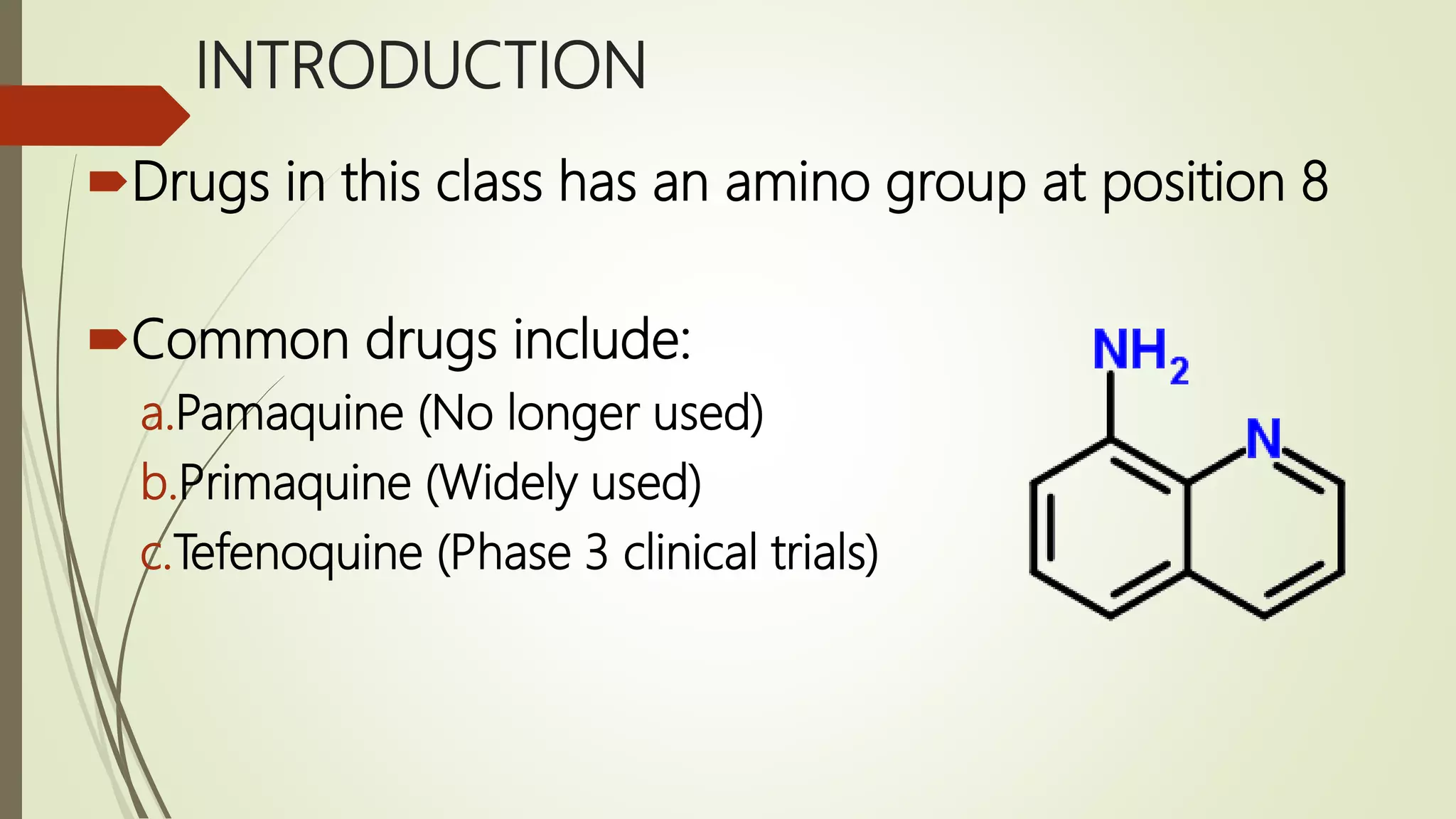
INTRODUCTION
Drugs in this class has an amino group at position 8
Common drugs include:
a.Pamaquine (No longer used)
b.Primaquine (Widely used)
c.Tefenoquine (Phase 3 clinical trials)
SYNTHESIS OF QUINOLINE NUCLEUS
STEP:1
P-acetamido anisole may be prepared by the sequential
nitration, reduction and acetylation of
anisole
STEP:2
P-acetamido anisole on further nitration yields 3-nitro-4-
acetamido anisole
STEP:3
3-nitro-4-acetamido anisole on hydrolysis gives 3-nitro-4-
anisidine
STEP:4
3-nitro-4-anisidine on treatment with glycerol in the
presence of concentrated sulphuric acid and nitrobenzene
undergoes cyclization through Skraup’s synthesis to yield
8-methoxy-6-nitro quinoline.
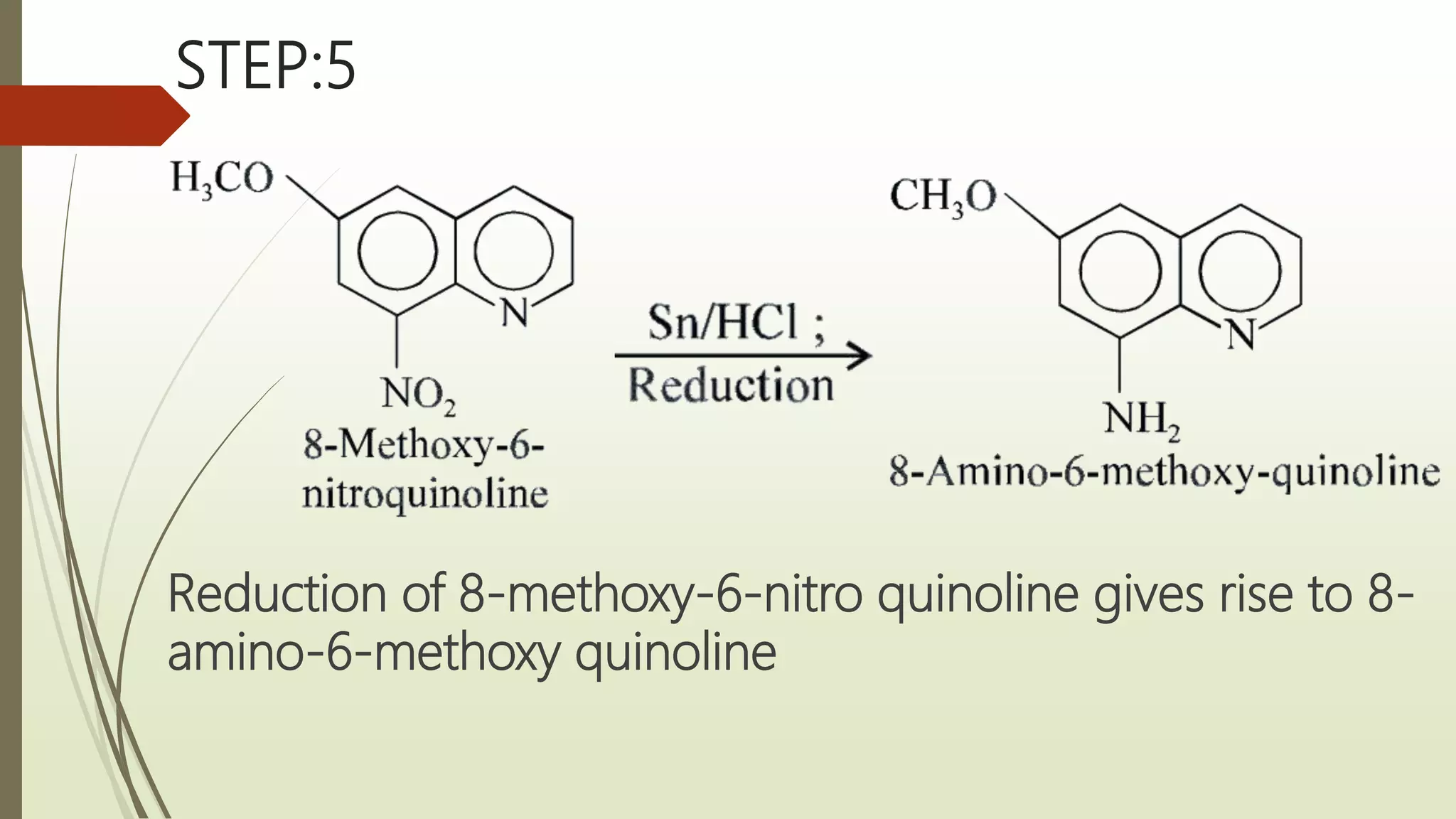
STEP:5
Reduction of 8-methoxy-6-nitro quinoline gives rise to 8-
amino-6-methoxy quinoline
SYNTHESIS OF SIDE CHAIN
STEP:1
2-Bromo-5-phthalimido pentane is prepared by the
interaction of 1, 4-dibromopentane with potassium
phthalimide
CONDESATION (NUCLEUS + SIDE CHAIN)
STEP:1
2-Bromo-5-phthalimido pentane on reaction with 8-
amino-6-methoxy quinoline yields the condensed
product
STEP:2
The condensed product when treated with hydrazine
eliminates the phthalimido residue and yields the
Primaquine base
STRUCTURE ACTIVITY RELATIONSHIP
QUINOLINE RING
 Presence of quinolone ring is necessary for activity
 If Pyridine ring is reduced to Piperidine the compound becomes
inactive.
SIDE CHAIN AT POSITION-8
 Introduction of side chain increases activity e.g Pamaquine
 Pentyl side chain has shown maximum activity
 Increase or decrease in side chain length will decrease activity
 Branched side chain if converted into straight chain will decrease
activity e.g Pentaquine
STRUCTURE ACTIVITY RELATIONSHIP
TERMINAL AMINO GROUP
 Presence of primary amino group has shown maximum activity and
less toxicity e.g Primaquine
 Substitution of primary amino with tertiary amino results in decreased
activity and increased toxicity e.g Pamaquine
SUBSTITUTION AT POSITION-6
 Methoxy group is necessary for optimum activity
 Methoxy group substitution with Ethoxy group reduces activity.
 Methoxy group substitution with methyl group leads to loss of
activity.
 Methoxy group substitution with Halide increases toxicity.
STRUCTURE ACTIVITY RELATIONSHIP
SUBSTITUTION OF PRIMAQUINE
 Substitution (Benzyloxy) at position-2 leads to decrease in activity
 Substitution (Phenyl) at position-3 leads to decrease in activity
 Substitution of Methyl at position-4 leads to almost 2x increase in
activity
 Substitution at position-5 leads to decrease in toxicity while having
almost same activity
 Substitution at position-7 leads to loss of activity
PHARMACOLOGY
In the blood, malaria parasites break down hemoglobin.
When this happens hemoglobin is divided into two parts; heme
& globin. Heme is toxic to the malaria parasite to prevent it
from being damaged, the malaria parasite produces an enzyme
which converts the toxic haem into a non-toxic haemozoin.
Primaquine acts by interfering with a part of the parasite
(mitochondria) that is responsible for supplying it with energy;
without energy the parasite dies.
Primaquine also interferes with protozoal DNA and alter its
properties
INDICATIONS & CONTRAINDICATIONS
INDICATION:
a. Eradicate malarial hypnozoites in liver (P.Vivax,
P.Ovale)
b.Malaria prophylaxis
c. Used in combination with Chloroquine for complete
eradication of malaria
CONTRAINDICATION:
a. G6PD deficient patients Fatal hemolysis

Anti-Malarial; 8-aminoquinolines

  • 1.
    Anti-Malarial Drugs 8-aminoquinolines Synthesis, SAR,Pharmacology Department of Pharmacy University of Peshawar
  • 2.
    INTRODUCTION Drugs in thisclass has an amino group at position 8 Common drugs include: a.Pamaquine (No longer used) b.Primaquine (Widely used) c.Tefenoquine (Phase 3 clinical trials)
  • 3.
  • 4.
    STEP:1 P-acetamido anisole maybe prepared by the sequential nitration, reduction and acetylation of anisole
  • 5.
    STEP:2 P-acetamido anisole onfurther nitration yields 3-nitro-4- acetamido anisole
  • 6.
    STEP:3 3-nitro-4-acetamido anisole onhydrolysis gives 3-nitro-4- anisidine
  • 7.
    STEP:4 3-nitro-4-anisidine on treatmentwith glycerol in the presence of concentrated sulphuric acid and nitrobenzene undergoes cyclization through Skraup’s synthesis to yield 8-methoxy-6-nitro quinoline.
  • 8.
    STEP:5 Reduction of 8-methoxy-6-nitroquinoline gives rise to 8- amino-6-methoxy quinoline
  • 9.
  • 10.
    STEP:1 2-Bromo-5-phthalimido pentane isprepared by the interaction of 1, 4-dibromopentane with potassium phthalimide
  • 11.
  • 12.
    STEP:1 2-Bromo-5-phthalimido pentane onreaction with 8- amino-6-methoxy quinoline yields the condensed product
  • 13.
    STEP:2 The condensed productwhen treated with hydrazine eliminates the phthalimido residue and yields the Primaquine base
  • 14.
    STRUCTURE ACTIVITY RELATIONSHIP QUINOLINERING  Presence of quinolone ring is necessary for activity  If Pyridine ring is reduced to Piperidine the compound becomes inactive. SIDE CHAIN AT POSITION-8  Introduction of side chain increases activity e.g Pamaquine  Pentyl side chain has shown maximum activity  Increase or decrease in side chain length will decrease activity  Branched side chain if converted into straight chain will decrease activity e.g Pentaquine
  • 15.
    STRUCTURE ACTIVITY RELATIONSHIP TERMINALAMINO GROUP  Presence of primary amino group has shown maximum activity and less toxicity e.g Primaquine  Substitution of primary amino with tertiary amino results in decreased activity and increased toxicity e.g Pamaquine SUBSTITUTION AT POSITION-6  Methoxy group is necessary for optimum activity  Methoxy group substitution with Ethoxy group reduces activity.  Methoxy group substitution with methyl group leads to loss of activity.  Methoxy group substitution with Halide increases toxicity.
  • 16.
    STRUCTURE ACTIVITY RELATIONSHIP SUBSTITUTIONOF PRIMAQUINE  Substitution (Benzyloxy) at position-2 leads to decrease in activity  Substitution (Phenyl) at position-3 leads to decrease in activity  Substitution of Methyl at position-4 leads to almost 2x increase in activity  Substitution at position-5 leads to decrease in toxicity while having almost same activity  Substitution at position-7 leads to loss of activity
  • 17.
    PHARMACOLOGY In the blood,malaria parasites break down hemoglobin. When this happens hemoglobin is divided into two parts; heme & globin. Heme is toxic to the malaria parasite to prevent it from being damaged, the malaria parasite produces an enzyme which converts the toxic haem into a non-toxic haemozoin. Primaquine acts by interfering with a part of the parasite (mitochondria) that is responsible for supplying it with energy; without energy the parasite dies. Primaquine also interferes with protozoal DNA and alter its properties
  • 18.
    INDICATIONS & CONTRAINDICATIONS INDICATION: a.Eradicate malarial hypnozoites in liver (P.Vivax, P.Ovale) b.Malaria prophylaxis c. Used in combination with Chloroquine for complete eradication of malaria CONTRAINDICATION: a. G6PD deficient patients Fatal hemolysis