citral
Presented by kiran khan
Serial no Topics Slide no
1 Definition of citral 3,4
2 Physical properties of citral 5
3 Isoprene units of citral 6
4 Occurrence of citral 7,8,9,10
5 Isolation of citral 11,12
6 Industrial synthesis of citral 13,14
7 Reactions of citral 15,16,17,18,19
8 Structure elucidation of citral 20,21,22,23,24,25,26
9 Uses of citral 27
Definition
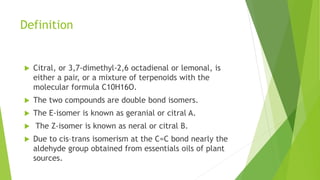
 Citral, or 3,7-dimethyl-2,6 octadienal or lemonal, is
either a pair, or a mixture of terpenoids with the
molecular formula C10H16O.
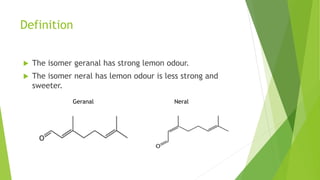
 The two compounds are double bond isomers.
 The E-isomer is known as geranial or citral A.
 The Z-isomer is known as neral or citral B.
 Due to cis–trans isomerism at the C=C bond nearly the
aldehyde group obtained from essentials oils of plant
sources.
Definition
 The isomer geranal has strong lemon odour.
 The isomer neral has lemon odour is less strong and
sweeter.
Geranal Neral
Physical properties of citral
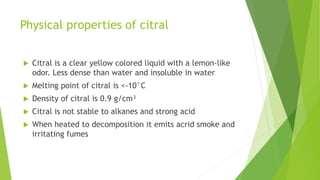
 Citral is a clear yellow colored liquid with a lemon-like
odor. Less dense than water and insoluble in water
 Melting point of citral is <-10°C
 Density of citral is 0.9 g/cm³
 Citral is not stable to alkanes and strong acid
 When heated to decomposition it emits acrid smoke and
irritating fumes
Isoprene units of citral
C
H
O
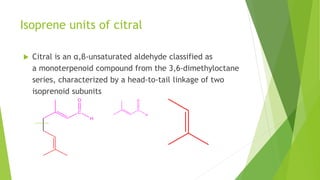
 Citral is an α,β-unsaturated aldehyde classified as
a monoterpenoid compound from the 3,6-dimethyloctane
series, characterized by a head-to-tail linkage of two
isoprenoid subunits
C
H
O
Occurance
 Citral is present in the oils of several plants including
 lemon myrtle
 cultivated in Australia for flavouring and essential oil.
 It is the highest natural source of citral.
 Citral as an isolate in steam distilled lemon myrtle oil is
typically 90–98%,
Occurrance
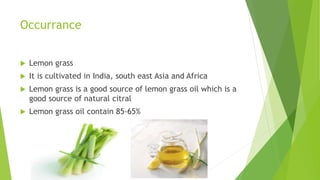
 Lemon grass
 It is cultivated in India, south east Asia and Africa
 Lemon grass is a good source of lemon grass oil which is a
good source of natural citral
 Lemon grass oil contain 85-65%
Occurrence
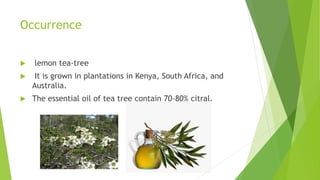
 lemon tea-tree
 It is grown in plantations in Kenya, South Africa, and
Australia.
 The essential oil of tea tree contain 70-80% citral.
Occurrence
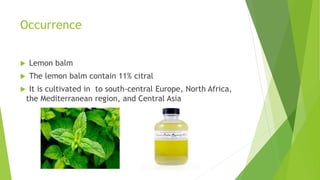
 Lemon balm
 The lemon balm contain 11% citral
 It is cultivated in to south-central Europe, North Africa,
the Mediterranean region, and Central Asia
Isolation of citral
 Citral is isolated from lemon grass oil which is obtained from lemon grass by
steam distillation.
Method:
 Lemon grass (chopped or un chopped) is filled in the distillation flask and
fitted tightly so that the vapours and oils was not leaked out now the steam is
injected in to it so that the upcoming steam carries away the essential oil from
the plant material then the lemon grass oil as well as the vapours are passed
through the condenser where they condensed as the oil is lighter then water so
it will float through the surface of water and it is then easily seprated now the
thus obtained is the lemon grass oil which contain 85%
Industrial synthesis of citral
 First part clasien rearrangement
 Involves and oxygen in a chair like transition state
 Second part cope rearrangement
 Only carbon is involved in a chair like transition state
 These two reactions happen in succession when the two
starting materials are heated together, and the reaction is
driven by formation of conjugated carbonyl group in the
product
Reactions of citral
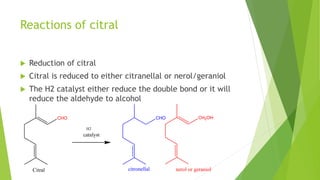
 Reduction of citral
 Citral is reduced to either citranellal or nerol/geraniol
 The H2 catalyst either reduce the double bond or it will
reduce the aldehyde to alcohol
CHO
H2
catalyst
CHO CH2OH
Citral citronellal nerol or geraniol
Reactions of citral
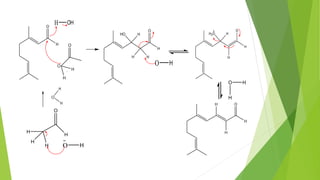
 Synthesis of ionone from citral in which an aldol
condensation reaction followed by the rearrangement
reaction
 First step is the nucleophillic addition of carbanion of
acetone on carbonyl carbon of citral is the base catalyzed
reaction
 The aldol condensation product eliminate water through
enolate ion
H
OH
H
H
O
H
H
O
H OH
HO H
H H
H
O
O H
H2O H
H
O
H
O H
H
H
H
H
O
H
O H
O
H
H
Reaction of citral
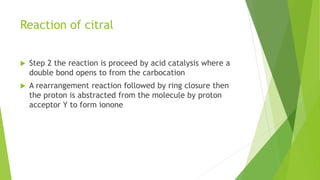
 Step 2 the reaction is proceed by acid catalysis where a
double bond opens to from the carbocation
 A rearrangement reaction followed by ring closure then
the proton is abstracted from the molecule by proton
acceptor Y to form ionone
O
H
O
H
H
O
Y
Structure elucidation of cital
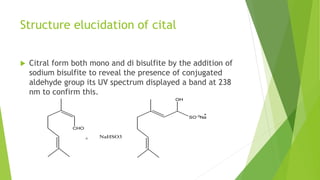
 Citral form both mono and di bisulfite by the addition of
sodium bisulfite to reveal the presence of conjugated
aldehyde group its UV spectrum displayed a band at 238
nm to confirm this.
CHO
OH
SO-3
Na
+ NaHSO3
Structure elucidation of citral
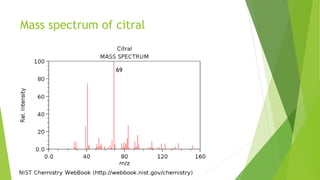
 Mass spectrum
 Molecular mass of citral is 152
 Citral show a peak at m/z 29 due to hemolytic alpha
cleavage
 It shows a peak at m/z 69 due to beta cleavage
 It shows a peak at m/z 124 due heterolytic alpha cleavage
Mass spectrum of citral
69
Structure elucidation of citral
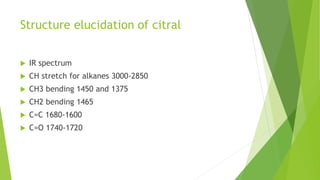
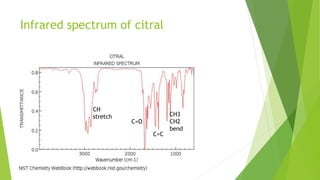
 IR spectrum
 CH stretch for alkanes 3000-2850
 CH3 bending 1450 and 1375
 CH2 bending 1465
 C=C 1680-1600
 C=O 1740-1720
Infrared spectrum of citral
CH
stretch CH3
CH2
bend
C=O
C=C
Structure elucidation of citral
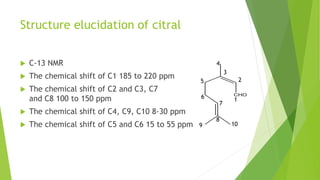
 C-13 NMR
 The chemical shift of C1 185 to 220 ppm
 The chemical shift of C2 and C3, C7
and C8 100 to 150 ppm
 The chemical shift of C4, C9, C10 8-30 ppm
 The chemical shift of C5 and C6 15 to 55 ppm
CHO
1
2
3
4
5
6
10
7
9
8
Structure elucidation of citral
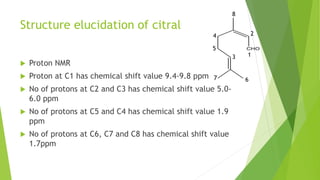
 Proton NMR
 Proton at C1 has chemical shift value 9.4-9.8 ppm
 No of protons at C2 and C3 has chemical shift value 5.0-
6.0 ppm
 No of protons at C5 and C4 has chemical shift value 1.9
ppm
 No of protons at C6, C7 and C8 has chemical shift value
1.7ppm
CHO
1
2
3
4
5
67
8
Uses of citral
 Citral is an aroma compound used in perfumery for its
citrus effect
 Citral is used as a flavor and for fortifying lemon oil
 Citral has strong antimicrobial qualities
 Citral is used in the synthesis of Vitamin A. ionone and
methylionone,
 Mask the smell of smoke
Reference
 https://en.wikipedia.org/wiki/Citral
 http://www.omicsonline.org/open-access/synthesis-of-citral-acetals-from-
lemon-grass-oil-jaa.1000091.php?aid=24074
 http://www.chemicalbook.com/ChemicalProductProperty_EN_CB8364074.ht
m
 http://onlinelibrary.wiley.com/doi/10.1002/hlca.19760590642/pdf
 http://www.revolvy.com/main/index.php?s=Citral&uid=0&gowriteups=1&cmd
=all
 http://www.process-nmr.com/citronella_essential_oil.htm
 https://pubchem.ncbi.nlm.nih.gov/compound/Citral#section=Stability
Citral

Citral

  • 1.
  • 2.
    Serial no TopicsSlide no 1 Definition of citral 3,4 2 Physical properties of citral 5 3 Isoprene units of citral 6 4 Occurrence of citral 7,8,9,10 5 Isolation of citral 11,12 6 Industrial synthesis of citral 13,14 7 Reactions of citral 15,16,17,18,19 8 Structure elucidation of citral 20,21,22,23,24,25,26 9 Uses of citral 27
  • 3.
    Definition  Citral, or3,7-dimethyl-2,6 octadienal or lemonal, is either a pair, or a mixture of terpenoids with the molecular formula C10H16O.  The two compounds are double bond isomers.  The E-isomer is known as geranial or citral A.  The Z-isomer is known as neral or citral B.  Due to cis–trans isomerism at the C=C bond nearly the aldehyde group obtained from essentials oils of plant sources.
  • 4.
    Definition  The isomergeranal has strong lemon odour.  The isomer neral has lemon odour is less strong and sweeter. Geranal Neral
  • 5.
    Physical properties ofcitral  Citral is a clear yellow colored liquid with a lemon-like odor. Less dense than water and insoluble in water  Melting point of citral is <-10°C  Density of citral is 0.9 g/cm³  Citral is not stable to alkanes and strong acid  When heated to decomposition it emits acrid smoke and irritating fumes
  • 6.
    Isoprene units ofcitral C H O  Citral is an α,β-unsaturated aldehyde classified as a monoterpenoid compound from the 3,6-dimethyloctane series, characterized by a head-to-tail linkage of two isoprenoid subunits C H O
  • 7.
    Occurance  Citral ispresent in the oils of several plants including  lemon myrtle  cultivated in Australia for flavouring and essential oil.  It is the highest natural source of citral.  Citral as an isolate in steam distilled lemon myrtle oil is typically 90–98%,
  • 8.
    Occurrance  Lemon grass It is cultivated in India, south east Asia and Africa  Lemon grass is a good source of lemon grass oil which is a good source of natural citral  Lemon grass oil contain 85-65%
  • 9.
    Occurrence  lemon tea-tree It is grown in plantations in Kenya, South Africa, and Australia.  The essential oil of tea tree contain 70-80% citral.
  • 10.
    Occurrence  Lemon balm The lemon balm contain 11% citral  It is cultivated in to south-central Europe, North Africa, the Mediterranean region, and Central Asia
  • 11.
    Isolation of citral Citral is isolated from lemon grass oil which is obtained from lemon grass by steam distillation. Method:  Lemon grass (chopped or un chopped) is filled in the distillation flask and fitted tightly so that the vapours and oils was not leaked out now the steam is injected in to it so that the upcoming steam carries away the essential oil from the plant material then the lemon grass oil as well as the vapours are passed through the condenser where they condensed as the oil is lighter then water so it will float through the surface of water and it is then easily seprated now the thus obtained is the lemon grass oil which contain 85%
  • 13.
    Industrial synthesis ofcitral  First part clasien rearrangement  Involves and oxygen in a chair like transition state  Second part cope rearrangement  Only carbon is involved in a chair like transition state  These two reactions happen in succession when the two starting materials are heated together, and the reaction is driven by formation of conjugated carbonyl group in the product
  • 15.
    Reactions of citral Reduction of citral  Citral is reduced to either citranellal or nerol/geraniol  The H2 catalyst either reduce the double bond or it will reduce the aldehyde to alcohol CHO H2 catalyst CHO CH2OH Citral citronellal nerol or geraniol
  • 16.
    Reactions of citral Synthesis of ionone from citral in which an aldol condensation reaction followed by the rearrangement reaction  First step is the nucleophillic addition of carbanion of acetone on carbonyl carbon of citral is the base catalyzed reaction  The aldol condensation product eliminate water through enolate ion
  • 17.
    H OH H H O H H O H OH HO H HH H O O H H2O H H O H O H H H H H O H O H O H H
  • 18.
    Reaction of citral Step 2 the reaction is proceed by acid catalysis where a double bond opens to from the carbocation  A rearrangement reaction followed by ring closure then the proton is abstracted from the molecule by proton acceptor Y to form ionone
  • 19.
  • 20.
    Structure elucidation ofcital  Citral form both mono and di bisulfite by the addition of sodium bisulfite to reveal the presence of conjugated aldehyde group its UV spectrum displayed a band at 238 nm to confirm this. CHO OH SO-3 Na + NaHSO3
  • 21.
    Structure elucidation ofcitral  Mass spectrum  Molecular mass of citral is 152  Citral show a peak at m/z 29 due to hemolytic alpha cleavage  It shows a peak at m/z 69 due to beta cleavage  It shows a peak at m/z 124 due heterolytic alpha cleavage
  • 22.
  • 23.
    Structure elucidation ofcitral  IR spectrum  CH stretch for alkanes 3000-2850  CH3 bending 1450 and 1375  CH2 bending 1465  C=C 1680-1600  C=O 1740-1720
  • 24.
    Infrared spectrum ofcitral CH stretch CH3 CH2 bend C=O C=C
  • 25.
    Structure elucidation ofcitral  C-13 NMR  The chemical shift of C1 185 to 220 ppm  The chemical shift of C2 and C3, C7 and C8 100 to 150 ppm  The chemical shift of C4, C9, C10 8-30 ppm  The chemical shift of C5 and C6 15 to 55 ppm CHO 1 2 3 4 5 6 10 7 9 8
  • 26.
    Structure elucidation ofcitral  Proton NMR  Proton at C1 has chemical shift value 9.4-9.8 ppm  No of protons at C2 and C3 has chemical shift value 5.0- 6.0 ppm  No of protons at C5 and C4 has chemical shift value 1.9 ppm  No of protons at C6, C7 and C8 has chemical shift value 1.7ppm CHO 1 2 3 4 5 67 8
  • 27.
    Uses of citral Citral is an aroma compound used in perfumery for its citrus effect  Citral is used as a flavor and for fortifying lemon oil  Citral has strong antimicrobial qualities  Citral is used in the synthesis of Vitamin A. ionone and methylionone,  Mask the smell of smoke
  • 28.
    Reference  https://en.wikipedia.org/wiki/Citral  http://www.omicsonline.org/open-access/synthesis-of-citral-acetals-from- lemon-grass-oil-jaa.1000091.php?aid=24074 http://www.chemicalbook.com/ChemicalProductProperty_EN_CB8364074.ht m  http://onlinelibrary.wiley.com/doi/10.1002/hlca.19760590642/pdf  http://www.revolvy.com/main/index.php?s=Citral&uid=0&gowriteups=1&cmd =all  http://www.process-nmr.com/citronella_essential_oil.htm  https://pubchem.ncbi.nlm.nih.gov/compound/Citral#section=Stability