Swine flu & Chikungunya
Saptarshi Samajdar
16mphyto02
SWINE FLU
INTRODUCTION
•Swine flu (swine influenza) is a respiratory disease caused by viruses
(influenza viruses) that infect the respiratory tract of pigs, resulting in nasal
secretions, a barking cough, decreased appetite, and listless behaviour.
•The H1N1 is said to be a new strain of virus that is mostly a combination of
human influenza, swine and avian.
•The first outbreak of a resembling virus was recorded in 1918, and it was
called the Spanish flu, although the disease killed 30 million people all around
Europe, not only in Spain.
•It is believed that the swine flu was a virus developed on this pandemic base in
the US laboratories that wanted to create a biological weapon.
STRUCTURE OF VIRUS
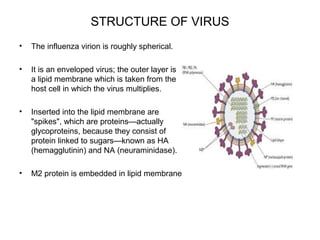
• The influenza virion is roughly spherical.
• It is an enveloped virus; the outer layer is
a lipid membrane which is taken from the
host cell in which the virus multiplies.
• Inserted into the lipid membrane are
"spikes", which are proteins—actually
glycoproteins, because they consist of
protein linked to sugars—known as HA
(hemagglutinin) and NA (neuraminidase).
• M2 protein is embedded in lipid membrane
PATHOGENESIS
• High affinity for tracheal cells with sialic acid receptors.
• HA attaches to sialic acid receptors, preferentially binds to N-acetylneuramic
acid attached to the penultimate sugar moiety by α 2,6 linkage.
• Multiplies in bronchial epithelium within 16 hours of infection causing
- Focal necrosis of bronchial epithelium
- Focal atelectasis, and gross hyperthermia of lungs
- Epithelial cell damage.
SYMPTOMS
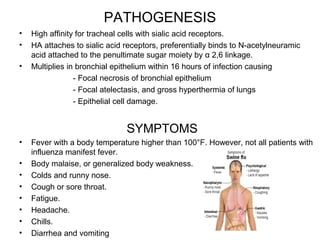
• Fever with a body temperature higher than 100°F. However, not all patients with
influenza manifest fever.
• Body malaise, or generalized body weakness.
• Colds and runny nose.
• Cough or sore throat.
• Fatigue.
• Headache.
• Chills.
• Diarrhea and vomiting
DIAGONOSIS
•Routine blood tests
•Chest X-ray
•Nose or throat swab
•Kit to diagnose flu
TREATMENTS
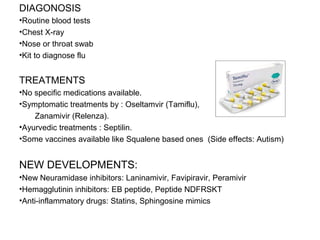
•No specific medications available.
•Symptomatic treatments by : Oseltamvir (Tamiflu),
Zanamivir (Relenza).
•Ayurvedic treatments : Septilin.
•Some vaccines available like Squalene based ones (Side effects: Autism)
NEW DEVELOPMENTS:
•New Neuramidase inhibitors: Laninamivir, Favipiravir, Peramivir
•Hemagglutinin inhibitors: EB peptide, Peptide NDFRSKT
•Anti-inflammatory drugs: Statins, Sphingosine mimics
CHIKUNGUNYA
INTRODUCTION:
•Chikungunya is a viral disease transmitted to humans by infected Aedes and
Culex mosquitoes. It causes fever and severe joint pain.
•The disease shares some clinical signs with dengue and zika, and can be
misdiagnosed in areas where they are common.
•There is no cure for the disease. Treatment is focused on relieving the
symptoms.
•The proximity of mosquito breeding sites to human habitation is a significant
risk factor for chikungunya.
•The disease mostly occurs in Africa, Asia and the Indian subcontinent.
However a major outbreak in 2015 affected several countries of the Region of
the Americas.
STRUCTURE OF VIRUS
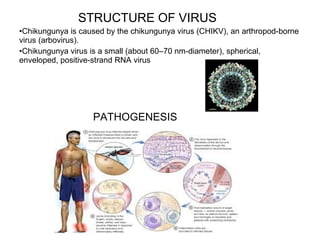
•Chikungunya is caused by the chikungunya virus (CHIKV), an arthropod-borne
virus (arbovirus).
•Chikungunya virus is a small (about 60–70 nm-diameter), spherical,
enveloped, positive-strand RNA virus
PATHOGENESIS
SYMPTOMS
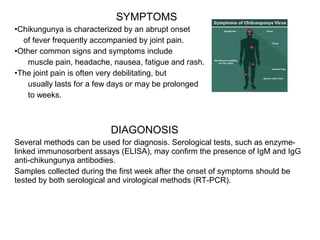
•Chikungunya is characterized by an abrupt onset
of fever frequently accompanied by joint pain.
•Other common signs and symptoms include
muscle pain, headache, nausea, fatigue and rash.
•The joint pain is often very debilitating, but
usually lasts for a few days or may be prolonged
to weeks.
DIAGONOSIS
Several methods can be used for diagnosis. Serological tests, such as enzyme-
linked immunosorbent assays (ELISA), may confirm the presence of IgM and IgG
anti-chikungunya antibodies.
Samples collected during the first week after the onset of symptoms should be
tested by both serological and virological methods (RT-PCR).
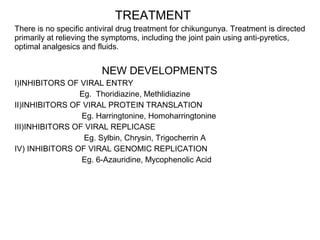
TREATMENT
There is no specific antiviral drug treatment for chikungunya. Treatment is directed
primarily at relieving the symptoms, including the joint pain using anti-pyretics,
optimal analgesics and fluids.
NEW DEVELOPMENTS
I)INHIBITORS OF VIRAL ENTRY
Eg. Thoridiazine, Methlidiazine
II)INHIBITORS OF VIRAL PROTEIN TRANSLATION
Eg. Harringtonine, Homoharringtonine
III)INHIBITORS OF VIRAL REPLICASE
Eg. Sylbin, Chrysin, Trigocherrin A
IV) INHIBITORS OF VIRAL GENOMIC REPLICATION
Eg. 6-Azauridine, Mycophenolic Acid
REFERENCES
• Barik, S. (2012). New treatments for influenza. BMC medicine, 10(1), 104.
• Couderc, T., & Lecuit, M. (2015). Chikungunya virus pathogenesis: From bedside to
bench. Antiviral research, 121, 120-131.
• Kaur, P., & Chu, J. J. H. (2013). Chikungunya virus: an update on antiviral
development and challenges. Drug discovery today, 18(19), 969-983.
• Neumann, G., Noda, T., & Kawaoka, Y. (2009). Emergence and pandemic potential
of swine-origin H1N1 influenza virus. Nature, 459(7249), 931-939.
• http://www.who.int/mediacentre/factsheets/fs327/en/ (accessed on 21/05/2017)
• http://nvbdcp.gov.in/Chikun-main.html (accessed on 24/05/2017)

Swine Flu & Chikungunya

  • 1.
    Swine flu &Chikungunya Saptarshi Samajdar 16mphyto02
  • 2.
    SWINE FLU INTRODUCTION •Swine flu(swine influenza) is a respiratory disease caused by viruses (influenza viruses) that infect the respiratory tract of pigs, resulting in nasal secretions, a barking cough, decreased appetite, and listless behaviour. •The H1N1 is said to be a new strain of virus that is mostly a combination of human influenza, swine and avian. •The first outbreak of a resembling virus was recorded in 1918, and it was called the Spanish flu, although the disease killed 30 million people all around Europe, not only in Spain. •It is believed that the swine flu was a virus developed on this pandemic base in the US laboratories that wanted to create a biological weapon.
  • 3.
    STRUCTURE OF VIRUS •The influenza virion is roughly spherical. • It is an enveloped virus; the outer layer is a lipid membrane which is taken from the host cell in which the virus multiplies. • Inserted into the lipid membrane are "spikes", which are proteins—actually glycoproteins, because they consist of protein linked to sugars—known as HA (hemagglutinin) and NA (neuraminidase). • M2 protein is embedded in lipid membrane
  • 4.
    PATHOGENESIS • High affinityfor tracheal cells with sialic acid receptors. • HA attaches to sialic acid receptors, preferentially binds to N-acetylneuramic acid attached to the penultimate sugar moiety by α 2,6 linkage. • Multiplies in bronchial epithelium within 16 hours of infection causing - Focal necrosis of bronchial epithelium - Focal atelectasis, and gross hyperthermia of lungs - Epithelial cell damage. SYMPTOMS • Fever with a body temperature higher than 100°F. However, not all patients with influenza manifest fever. • Body malaise, or generalized body weakness. • Colds and runny nose. • Cough or sore throat. • Fatigue. • Headache. • Chills. • Diarrhea and vomiting
  • 5.
    DIAGONOSIS •Routine blood tests •ChestX-ray •Nose or throat swab •Kit to diagnose flu TREATMENTS •No specific medications available. •Symptomatic treatments by : Oseltamvir (Tamiflu), Zanamivir (Relenza). •Ayurvedic treatments : Septilin. •Some vaccines available like Squalene based ones (Side effects: Autism) NEW DEVELOPMENTS: •New Neuramidase inhibitors: Laninamivir, Favipiravir, Peramivir •Hemagglutinin inhibitors: EB peptide, Peptide NDFRSKT •Anti-inflammatory drugs: Statins, Sphingosine mimics
  • 6.
    CHIKUNGUNYA INTRODUCTION: •Chikungunya is aviral disease transmitted to humans by infected Aedes and Culex mosquitoes. It causes fever and severe joint pain. •The disease shares some clinical signs with dengue and zika, and can be misdiagnosed in areas where they are common. •There is no cure for the disease. Treatment is focused on relieving the symptoms. •The proximity of mosquito breeding sites to human habitation is a significant risk factor for chikungunya. •The disease mostly occurs in Africa, Asia and the Indian subcontinent. However a major outbreak in 2015 affected several countries of the Region of the Americas.
  • 7.
    STRUCTURE OF VIRUS •Chikungunyais caused by the chikungunya virus (CHIKV), an arthropod-borne virus (arbovirus). •Chikungunya virus is a small (about 60–70 nm-diameter), spherical, enveloped, positive-strand RNA virus PATHOGENESIS
  • 8.
    SYMPTOMS •Chikungunya is characterizedby an abrupt onset of fever frequently accompanied by joint pain. •Other common signs and symptoms include muscle pain, headache, nausea, fatigue and rash. •The joint pain is often very debilitating, but usually lasts for a few days or may be prolonged to weeks. DIAGONOSIS Several methods can be used for diagnosis. Serological tests, such as enzyme- linked immunosorbent assays (ELISA), may confirm the presence of IgM and IgG anti-chikungunya antibodies. Samples collected during the first week after the onset of symptoms should be tested by both serological and virological methods (RT-PCR).
  • 9.
    TREATMENT There is nospecific antiviral drug treatment for chikungunya. Treatment is directed primarily at relieving the symptoms, including the joint pain using anti-pyretics, optimal analgesics and fluids. NEW DEVELOPMENTS I)INHIBITORS OF VIRAL ENTRY Eg. Thoridiazine, Methlidiazine II)INHIBITORS OF VIRAL PROTEIN TRANSLATION Eg. Harringtonine, Homoharringtonine III)INHIBITORS OF VIRAL REPLICASE Eg. Sylbin, Chrysin, Trigocherrin A IV) INHIBITORS OF VIRAL GENOMIC REPLICATION Eg. 6-Azauridine, Mycophenolic Acid
  • 10.
    REFERENCES • Barik, S.(2012). New treatments for influenza. BMC medicine, 10(1), 104. • Couderc, T., & Lecuit, M. (2015). Chikungunya virus pathogenesis: From bedside to bench. Antiviral research, 121, 120-131. • Kaur, P., & Chu, J. J. H. (2013). Chikungunya virus: an update on antiviral development and challenges. Drug discovery today, 18(19), 969-983. • Neumann, G., Noda, T., & Kawaoka, Y. (2009). Emergence and pandemic potential of swine-origin H1N1 influenza virus. Nature, 459(7249), 931-939. • http://www.who.int/mediacentre/factsheets/fs327/en/ (accessed on 21/05/2017) • http://nvbdcp.gov.in/Chikun-main.html (accessed on 24/05/2017)