Class 3 Artworlds
agenda 8.30.16
• can great art be made by anyone? why do some
artists become recognized as great talents, while
others languish?
• next time: what is folk art? how is a painting
designated as "folk art" different from a regular
painting?
art: question of media
• traditional fine arts: drawing, painting, sculpture,
architecture
• performing arts: music, dance, theater
what makes art valuable?
• are the most famous artists the best ones?
• are the ones whose art sells for the most money the best
artists?
• if an artist is unknown in the wider society, does that mean
he or she isn’t very good?
• how do we determine value in art? is there a neutral,
value-free way of comparing artists?
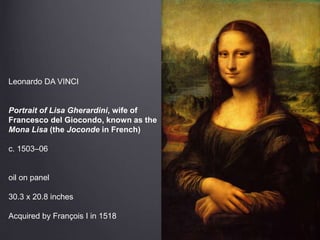
Leonardo DA VINCI
Portrait of Lisa Gherardini, wife of
Francesco del Giocondo, known as the
Mona Lisa (the Joconde in French)
c. 1503–06
oil on panel
30.3 x 20.8 inches
Acquired by François I in 1518
why is the Mona Lisa
so famous?
• because it is the best painting ever made?
• [qualities of object]
• because Leonardo is a genius?
• [qualities of the maker]
• are there other factors that might contribute to
the painting's reputation?
one answer: location, location,
location
• It is located in the Louvre, one of the most well-known art
museums in the world. [i.e., it’s benefited from a central art
world location since 1804]
• where critics who praise some artists and ignore others have
been able to see it
• where art historians have written it into history
• where artists have been influenced by it
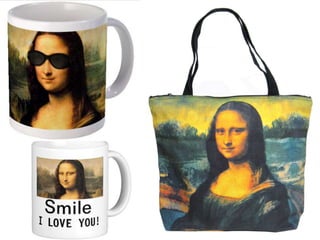
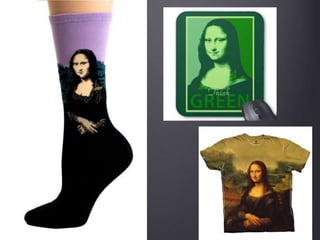
• where art lovers and visitors and tourists have come to see
it and photograph it, and buy coffee mugs and totebags with
this image on it
“Leonardo undertook to execute, for Francesco del Giocondo, the portrait
of Mona Lisa, his wife, and after he had lingered over it for four years, he
left it unfinished; and the work is today in the possession of King Francis of
France, at Fontainebleau.
Giorgio Vasari ‘The Lives of the Most Excellent
Painters, Sculptors, and Architects’ 1550
“Anyone wishing to see the degree to which art could imitate nature could
readily perceive this from the head; since therein are counterfeited all
those minutenesses that with subtlety are able to be painted: seeing that
the eyes had that lustre and moistness which are always seen in the living
creature, and around them were the lashes and all those rosy and pearly
tints that demand the greatest delicacy of execution.
Giorgio Vasari ‘The Lives of the Most Excellent
Painters, Sculptors, and Architects’ 1550
“The eyebrows, through his having shown the manner in which the hairs
spring from the flesh, here more close and here more scanty, and curve
according to the pores of the flesh, could not be more natural. The nose,
with its beautiful nostrils, rosy and tender, appeared to be alive. The mouth
with its opening , and with its ends united by the red of the lips to the flesh-
tints of the face, seemed, in truth, to be not colours but flesh. In the pit of
the throat, if one gazed upon it intently, could be seen the beating of the
pulse: and indeed it may be said that it was painted in such a manner as to
make every brave artificer, be he who he may, tremble and lose courage.
Giorgio Vasari ‘The Lives of the Most Excellent
Painters, Sculptors, and Architects’ 1550
“He employed also this device: Mona Lisa being very beautiful, while he
was painting her portrait, he retained those who played or sang, and
continually jested, who would make her to remain merry, in order to take
away that melancholy which painters are often wont to give to their
portraits. And in this work of Leonardo there was a smile so pleasing , that
it was a thing more divine than human to behold, and it was held to be
something marvelous, in that it was not other than alive.”
Giorgio Vasari ‘The Lives of the Most Excellent
Painters, Sculptors, and Architects’ 1550
Mona Lisa: art historians
follow Vasari's lead and give the Mona Lisa a central place in
art history
later art historians follow the lead of earlier ones, and so on,
to the present day.
Mona Lisa: artists
• artists of his day were somewhat influenced by Leonardo,
but not many of his works could be seen in Italy
• however, later artists in France looked to the Mona Lisa as
an icon of traditional art history
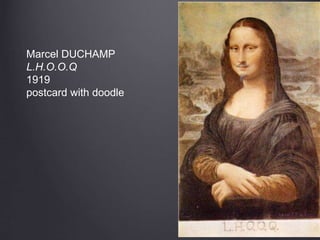
Marcel DUCHAMP
L.H.O.O.Q
1919
postcard with doodle
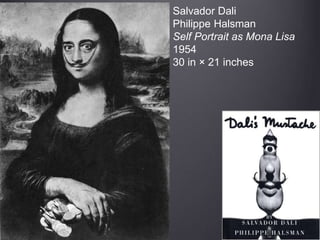
Salvador Dali
Philippe Halsman
Self Portrait as Mona Lisa
1954
30 in × 21 inches
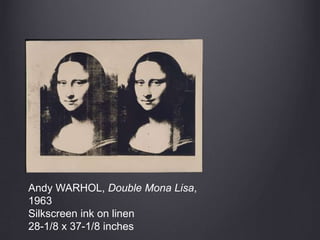
Andy WARHOL, Double Mona Lisa,
1963
Silkscreen ink on linen
28-1/8 x 37-1/8 inches
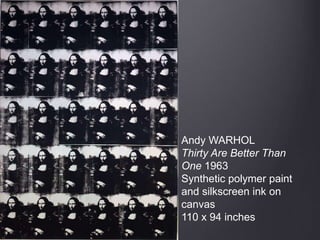
Andy WARHOL
Thirty Are Better Than
One 1963
Synthetic polymer paint
and silkscreen ink on
canvas
110 x 94 inches
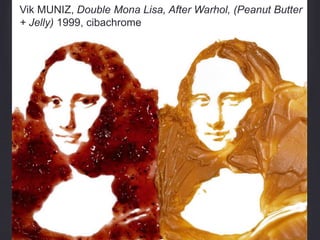
Vik MUNIZ, Double Mona Lisa, After Warhol, (Peanut Butter
+ Jelly) 1999, cibachrome
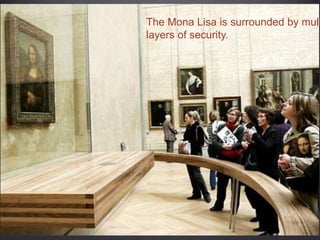
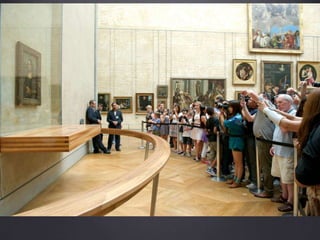
The Mona Lisa is surrounded by mult
layers of security.
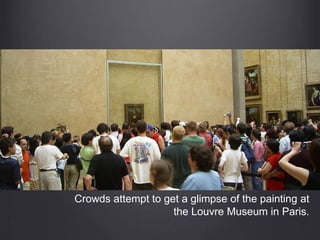
Crowds attempt to get a glimpse of the painting at
the Louvre Museum in Paris.
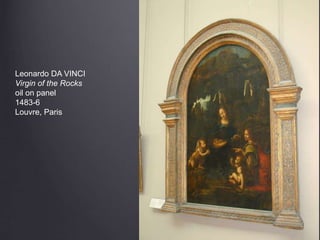
Leonardo DA VINCI
Virgin of the Rocks
oil on panel
1483-6
Louvre, Paris
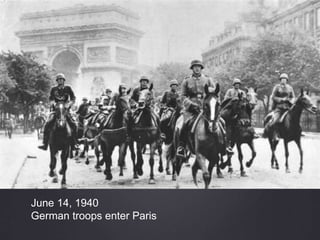
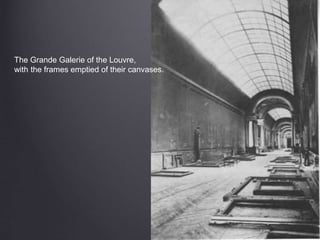
June 14, 1940
German troops enter Paris
The Grande Galerie of the Louvre,
with the frames emptied of their canvases.
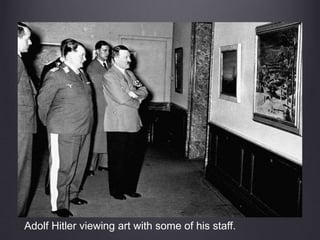
Adolf Hitler viewing art with some of his staff.
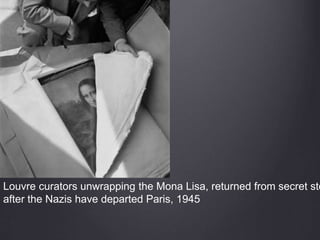
Louvre curators unwrapping the Mona Lisa, returned from secret sto
after the Nazis have departed Paris, 1945
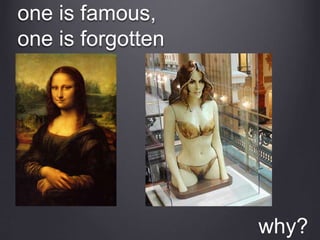
one is famous,
one is forgotten
why?
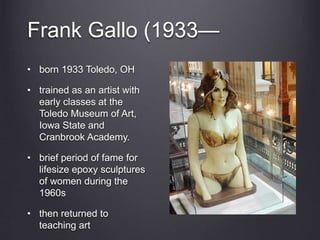
Frank Gallo (1933—
• born 1933 Toledo, OH
• trained as an artist with
early classes at the
Toledo Museum of Art,
Iowa State and
Cranbrook Academy.
• brief period of fame for
lifesize epoxy sculptures
of women during the
1960s
• then returned to
teaching art
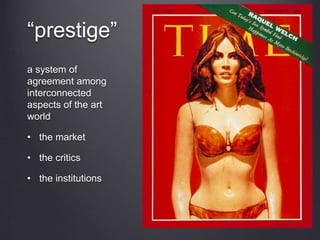
“prestige”
a system of
agreement among
interconnected
aspects of the art
world
• the market
• the critics
• the institutions
“The failure of art theory and criticism to talk about prestige is
an oversight with consequences, because the artworld and
art history cannot be understood without understanding how
prestige works, how it is generated and conferred, how it
privileges and excludes, and how it pervades the culture and
induces complicity. Without prestige as part of the analysis,
the important relational, social aspect of art is obscured; the
subtleties of social positioning in art are concealed. Prestige
opens the way for particular ways of understanding art’s
audience. This ranges from articulating social complicity in
elitism and creating value, but also in analyzing how
estimations of value are contested and resisted.”
(Van Laar and Diepeveen, 55)
defining prestige
“Prestige, which we define as a system of hierarchies of
agreed-upon social value, is a twofold thing: it is a quality
that people confer on others, but it is also a system
inextricably bound up with that conferral, a system that gives
the rationale for those value judgments."
(Van Laar and Diepeveen, 5)
In examining the workings of prestige, this book also deals
with the process of valuation, best and most sharply
understood through the loss of status. It demonstrates how
prestige works, as it disappears, as it eludes one’s grasp and
one is left behind….This dispatch is larger than the
reputations of individual artists: modes of artmaking take a
back seat, subject matters become banal, and forms of
aesthetic experience lose their luster.”
(Van Laar and Diepeveen, 5)
conclusion
Art is not an ontological, but a
sociological property.
conclusion
• In any society, some objects are called ‘art,’
others are not. These designations are a
matter of social tradition and convention.
Such labels can change over time as a
society’s values and preferences change.
What is visual culture?
• It includes everything that art excludes:
• All the objects that are left out from consideration in the
traditional fine arts (painting, sculpture, architecture)
• things made not for elite but ordinary audiences
• things made not primarily for aetrhetic contemplation but
because they have a use
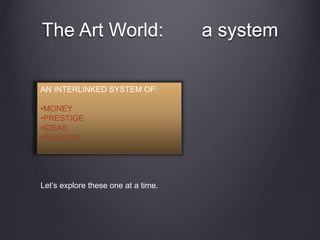
The Art World: a system
AN INTERLINKED SYSTEM OF:
•MONEY
•PRESTIGE
•IDEAS
•FASHION
Let’s explore these one at a time.
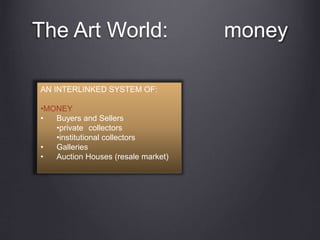
The Art World: money
AN INTERLINKED SYSTEM OF:
•MONEY
• Buyers and Sellers
•private collectors
•institutional collectors
• Galleries
• Auction Houses (resale market)
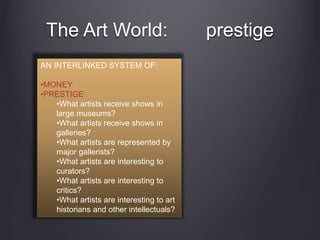
The Art World: prestige
AN INTERLINKED SYSTEM OF:
•MONEY
•PRESTIGE
•What artists receive shows in
large museums?
•What artists receive shows in
galleries?
•What artists are represented by
major gallerists?
•What artists are interesting to
curators?
•What artists are interesting to
critics?
•What artists are interesting to art
historians and other intellectuals?
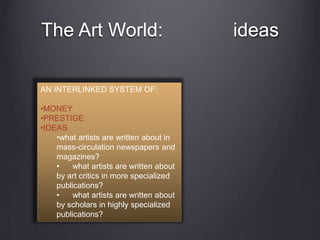
The Art World: ideas
AN INTERLINKED SYSTEM OF:
•MONEY
•PRESTIGE
•IDEAS
•what artists are written about in
mass-circulation newspapers and
magazines?
• what artists are written about
by art critics in more specialized
publications?
• what artists are written about
by scholars in highly specialized
publications?
The Art World: fashion
AN INTERLINKED SYSTEM OF:
•MONEY
•PRESTIGE
•IDEAS
•FASHION
“who’s up/down, who’s in/out”
“who’s pricey, or in demand?”
“who’s the latest, coolest thing?”
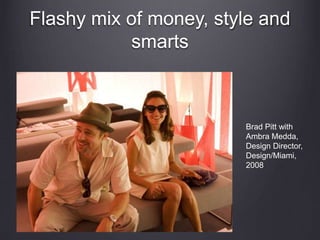
Flashy mix of money, style and
smarts
Brad Pitt with
Ambra Medda,
Design Director,
Design/Miami,
2008
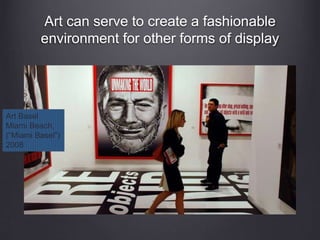
Art can serve to create a fashionable
environment for other forms of display
Art Basel
Miami Beach,
(“Miami Basel”)
2008
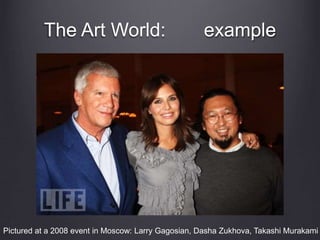
The Art World: example
Pictured at a 2008 event in Moscow: Larry Gagosian, Dasha Zukhova, Takashi Murakami
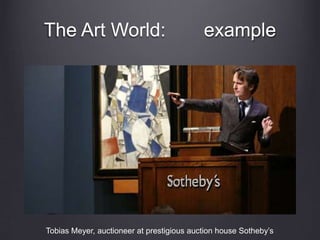
The Art World: example
Tobias Meyer, auctioneer at prestigious auction house Sotheby’s
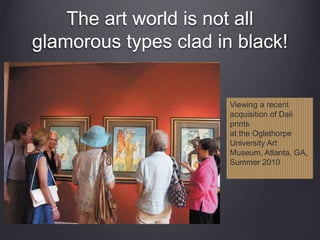
The art world is not all
glamorous types clad in black!
Viewing a recent
acquisition of Dali
prints
at the Oglethorpe
University Art
Museum, Atlanta, GA,
Summer 2010
OK, so who else?
Anyone who has an interest, whether casual or devoted, in
following the culture of contemporary art as it changes over time
•Art students
•Students in general
•People in general who are interested
in art or want to be culturally aware
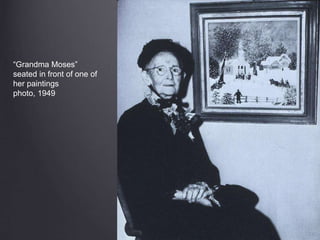
“Grandma Moses”
seated in front of one of
her paintings
photo, 1949
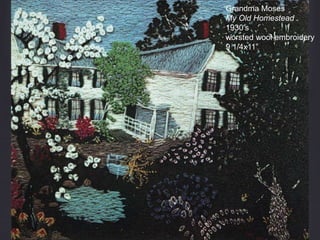
Grandma Moses
My Old Homestead
1930's
worsted wool embroidery
9 1/4x11”
Grandma Moses
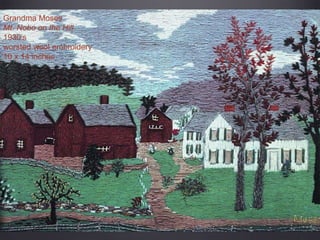
Mt. Nobo on the Hill
1930’s
worsted wool embroidery
10 x 14 inches
Grandma Moses
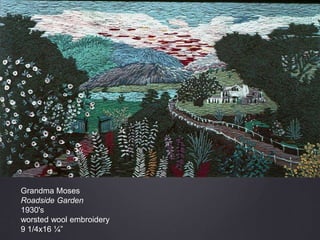
Roadside Garden
1930's
worsted wool embroidery
9 1/4x16 ¼”
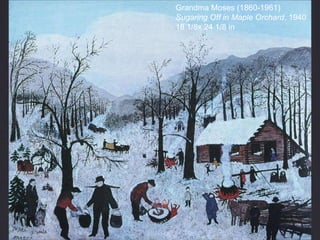
Grandma Moses (1860-1961)
Sugaring Off in Maple Orchard, 1940
18 1/8x 24 1/8 in
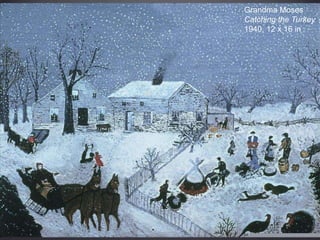
Grandma Moses
Catching the Turkey
1940, 12 x 16 in
Grandma Moses
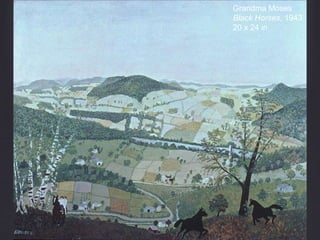
Black Horses, 1943
20 x 24 in
Grandma Moses
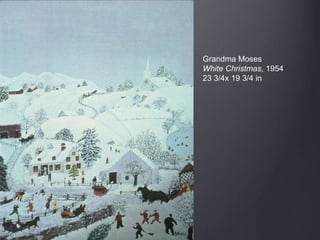
White Christmas, 1954
23 3/4x 19 3/4 in
UVC100_Fall16_Class3

UVC100_Fall16_Class3

  • 1.
  • 2.
    agenda 8.30.16 • cangreat art be made by anyone? why do some artists become recognized as great talents, while others languish? • next time: what is folk art? how is a painting designated as "folk art" different from a regular painting?
  • 3.
    art: question ofmedia • traditional fine arts: drawing, painting, sculpture, architecture • performing arts: music, dance, theater
  • 4.
    what makes artvaluable? • are the most famous artists the best ones? • are the ones whose art sells for the most money the best artists? • if an artist is unknown in the wider society, does that mean he or she isn’t very good? • how do we determine value in art? is there a neutral, value-free way of comparing artists?
  • 5.
    Leonardo DA VINCI Portraitof Lisa Gherardini, wife of Francesco del Giocondo, known as the Mona Lisa (the Joconde in French) c. 1503–06 oil on panel 30.3 x 20.8 inches Acquired by François I in 1518
  • 6.
    why is theMona Lisa so famous? • because it is the best painting ever made? • [qualities of object] • because Leonardo is a genius? • [qualities of the maker] • are there other factors that might contribute to the painting's reputation?
  • 7.
    one answer: location,location, location • It is located in the Louvre, one of the most well-known art museums in the world. [i.e., it’s benefited from a central art world location since 1804] • where critics who praise some artists and ignore others have been able to see it • where art historians have written it into history • where artists have been influenced by it • where art lovers and visitors and tourists have come to see it and photograph it, and buy coffee mugs and totebags with this image on it
  • 8.
    “Leonardo undertook toexecute, for Francesco del Giocondo, the portrait of Mona Lisa, his wife, and after he had lingered over it for four years, he left it unfinished; and the work is today in the possession of King Francis of France, at Fontainebleau. Giorgio Vasari ‘The Lives of the Most Excellent Painters, Sculptors, and Architects’ 1550
  • 9.
    “Anyone wishing tosee the degree to which art could imitate nature could readily perceive this from the head; since therein are counterfeited all those minutenesses that with subtlety are able to be painted: seeing that the eyes had that lustre and moistness which are always seen in the living creature, and around them were the lashes and all those rosy and pearly tints that demand the greatest delicacy of execution. Giorgio Vasari ‘The Lives of the Most Excellent Painters, Sculptors, and Architects’ 1550
  • 10.
    “The eyebrows, throughhis having shown the manner in which the hairs spring from the flesh, here more close and here more scanty, and curve according to the pores of the flesh, could not be more natural. The nose, with its beautiful nostrils, rosy and tender, appeared to be alive. The mouth with its opening , and with its ends united by the red of the lips to the flesh- tints of the face, seemed, in truth, to be not colours but flesh. In the pit of the throat, if one gazed upon it intently, could be seen the beating of the pulse: and indeed it may be said that it was painted in such a manner as to make every brave artificer, be he who he may, tremble and lose courage. Giorgio Vasari ‘The Lives of the Most Excellent Painters, Sculptors, and Architects’ 1550
  • 11.
    “He employed alsothis device: Mona Lisa being very beautiful, while he was painting her portrait, he retained those who played or sang, and continually jested, who would make her to remain merry, in order to take away that melancholy which painters are often wont to give to their portraits. And in this work of Leonardo there was a smile so pleasing , that it was a thing more divine than human to behold, and it was held to be something marvelous, in that it was not other than alive.” Giorgio Vasari ‘The Lives of the Most Excellent Painters, Sculptors, and Architects’ 1550
  • 12.
    Mona Lisa: arthistorians follow Vasari's lead and give the Mona Lisa a central place in art history later art historians follow the lead of earlier ones, and so on, to the present day.
  • 13.
    Mona Lisa: artists •artists of his day were somewhat influenced by Leonardo, but not many of his works could be seen in Italy • however, later artists in France looked to the Mona Lisa as an icon of traditional art history
  • 14.
  • 15.
    Salvador Dali Philippe Halsman SelfPortrait as Mona Lisa 1954 30 in × 21 inches
  • 16.
    Andy WARHOL, DoubleMona Lisa, 1963 Silkscreen ink on linen 28-1/8 x 37-1/8 inches
  • 17.
    Andy WARHOL Thirty AreBetter Than One 1963 Synthetic polymer paint and silkscreen ink on canvas 110 x 94 inches
  • 18.
    Vik MUNIZ, DoubleMona Lisa, After Warhol, (Peanut Butter + Jelly) 1999, cibachrome
  • 21.
    The Mona Lisais surrounded by mult layers of security.
  • 23.
    Crowds attempt toget a glimpse of the painting at the Louvre Museum in Paris.
  • 24.
    Leonardo DA VINCI Virginof the Rocks oil on panel 1483-6 Louvre, Paris
  • 25.
    June 14, 1940 Germantroops enter Paris
  • 26.
    The Grande Galerieof the Louvre, with the frames emptied of their canvases.
  • 27.
    Adolf Hitler viewingart with some of his staff.
  • 28.
    Louvre curators unwrappingthe Mona Lisa, returned from secret sto after the Nazis have departed Paris, 1945
  • 29.
    one is famous, oneis forgotten why?
  • 30.
    Frank Gallo (1933— •born 1933 Toledo, OH • trained as an artist with early classes at the Toledo Museum of Art, Iowa State and Cranbrook Academy. • brief period of fame for lifesize epoxy sculptures of women during the 1960s • then returned to teaching art
  • 31.
    “prestige” a system of agreementamong interconnected aspects of the art world • the market • the critics • the institutions
  • 32.
    “The failure ofart theory and criticism to talk about prestige is an oversight with consequences, because the artworld and art history cannot be understood without understanding how prestige works, how it is generated and conferred, how it privileges and excludes, and how it pervades the culture and induces complicity. Without prestige as part of the analysis, the important relational, social aspect of art is obscured; the subtleties of social positioning in art are concealed. Prestige opens the way for particular ways of understanding art’s audience. This ranges from articulating social complicity in elitism and creating value, but also in analyzing how estimations of value are contested and resisted.” (Van Laar and Diepeveen, 55)
  • 33.
    defining prestige “Prestige, whichwe define as a system of hierarchies of agreed-upon social value, is a twofold thing: it is a quality that people confer on others, but it is also a system inextricably bound up with that conferral, a system that gives the rationale for those value judgments." (Van Laar and Diepeveen, 5)
  • 34.
    In examining theworkings of prestige, this book also deals with the process of valuation, best and most sharply understood through the loss of status. It demonstrates how prestige works, as it disappears, as it eludes one’s grasp and one is left behind….This dispatch is larger than the reputations of individual artists: modes of artmaking take a back seat, subject matters become banal, and forms of aesthetic experience lose their luster.” (Van Laar and Diepeveen, 5)
  • 35.
    conclusion Art is notan ontological, but a sociological property.
  • 36.
    conclusion • In anysociety, some objects are called ‘art,’ others are not. These designations are a matter of social tradition and convention. Such labels can change over time as a society’s values and preferences change.
  • 37.
    What is visualculture? • It includes everything that art excludes: • All the objects that are left out from consideration in the traditional fine arts (painting, sculpture, architecture) • things made not for elite but ordinary audiences • things made not primarily for aetrhetic contemplation but because they have a use
  • 38.
    The Art World:a system AN INTERLINKED SYSTEM OF: •MONEY •PRESTIGE •IDEAS •FASHION Let’s explore these one at a time.
  • 39.
    The Art World:money AN INTERLINKED SYSTEM OF: •MONEY • Buyers and Sellers •private collectors •institutional collectors • Galleries • Auction Houses (resale market)
  • 40.
    The Art World:prestige AN INTERLINKED SYSTEM OF: •MONEY •PRESTIGE •What artists receive shows in large museums? •What artists receive shows in galleries? •What artists are represented by major gallerists? •What artists are interesting to curators? •What artists are interesting to critics? •What artists are interesting to art historians and other intellectuals?
  • 41.
    The Art World:ideas AN INTERLINKED SYSTEM OF: •MONEY •PRESTIGE •IDEAS •what artists are written about in mass-circulation newspapers and magazines? • what artists are written about by art critics in more specialized publications? • what artists are written about by scholars in highly specialized publications?
  • 42.
    The Art World:fashion AN INTERLINKED SYSTEM OF: •MONEY •PRESTIGE •IDEAS •FASHION “who’s up/down, who’s in/out” “who’s pricey, or in demand?” “who’s the latest, coolest thing?”
  • 43.
    Flashy mix ofmoney, style and smarts Brad Pitt with Ambra Medda, Design Director, Design/Miami, 2008
  • 44.
    Art can serveto create a fashionable environment for other forms of display Art Basel Miami Beach, (“Miami Basel”) 2008
  • 45.
    The Art World:example Pictured at a 2008 event in Moscow: Larry Gagosian, Dasha Zukhova, Takashi Murakami
  • 46.
    The Art World:example Tobias Meyer, auctioneer at prestigious auction house Sotheby’s
  • 47.
    The art worldis not all glamorous types clad in black! Viewing a recent acquisition of Dali prints at the Oglethorpe University Art Museum, Atlanta, GA, Summer 2010
  • 48.
    OK, so whoelse? Anyone who has an interest, whether casual or devoted, in following the culture of contemporary art as it changes over time •Art students •Students in general •People in general who are interested in art or want to be culturally aware
  • 49.
    “Grandma Moses” seated infront of one of her paintings photo, 1949
  • 50.
    Grandma Moses My OldHomestead 1930's worsted wool embroidery 9 1/4x11”
  • 51.
    Grandma Moses Mt. Noboon the Hill 1930’s worsted wool embroidery 10 x 14 inches
  • 52.
    Grandma Moses Roadside Garden 1930's worstedwool embroidery 9 1/4x16 ¼”
  • 53.
    Grandma Moses (1860-1961) SugaringOff in Maple Orchard, 1940 18 1/8x 24 1/8 in
  • 54.
    Grandma Moses Catching theTurkey 1940, 12 x 16 in
  • 55.
  • 56.
    Grandma Moses White Christmas,1954 23 3/4x 19 3/4 in

Editor's Notes

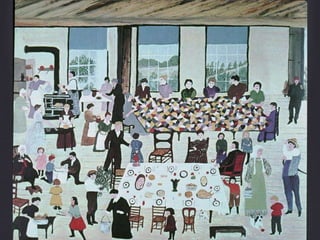
  • #58 Creator: Moses, Grandma, 1860-1961 Title: Quilting Bee Date: 1950 Measurements: 20 x 24 in
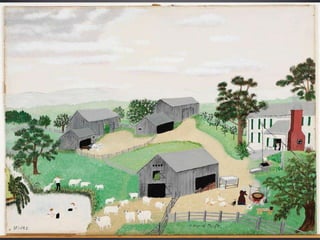
  • #59 Creator: Moses, Grandma (Anna Mary Robertson Moses), 1860 - 1961 Culture: American Title: In Days of Thrift Work Type: Painting Date: 11-May-43 Material: oil and tempera on paperboard Measurements: panel: 18 x 24 in.; 45.72 x 60.96 cm Description: signed at lower left: MOSES, inscribed at lower right: in days of Thrift Repository: Smith College Museum of Art, Northampton, MA Repository: Gift of Elinor Fosdick Downs, class of 1933, in memory of Elizabeth Miner Fosdick, class of 1918 Accession Number: SC 2004:33 Collection: Smith College Museum of Art Collection: http://www.smith.edu/artmuseum/ Rights: Contact info: Louise A. Laplante, Collections Manager/Registrar, Smith College Museum of Art, Northampton, MA 01063; Tel No.: 413-585-2765; Fax: 413-527-1595; llaplant@smith.edu Rights: Please note that if this image is under copyright, you may need to contact one or more copyright owners for any use that is not permitted under the ARTstor Terms and Conditions of Use or not otherwise permitted by law. While ARTstor tries to update contact information, it cannot guarantee that such information is always accurate. Determining whether those permissions are necessary, and obtaining such permissions, is your sole responsibility.