Romanticism, Realism &
Photography
THEME: Features of Romanticism
“Man is born free, but is everywhere in chains!” - Rousseau
P.I.N.E.
Past – Longing for the medieval past, pre-industrial Europe (Gothic architecture will be
revived)
Irrational/ Inner mind / Insanity – Romantic artists depict the human psyche and topics
that transcend the use of reason. One Romantic artist, Gericault, chose to do portraits of
people in insane asylums
Nature – longing for the purity of nature, which defies human rationality
Emotion/ Exotic – Romantics favored emotion and passion over reason. Exotic themes
and locales were also popular because they did not adhere to European emphasis on
rationality
Imagination, not reason, FEELING, not thinking = FREEDOM
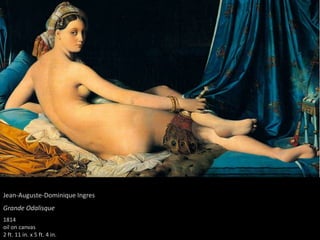
Jean-Auguste-Dominique Ingres
Grande Odalisque
1814
oil on canvas
2 ft. 11 in. x 5 ft. 4 in.
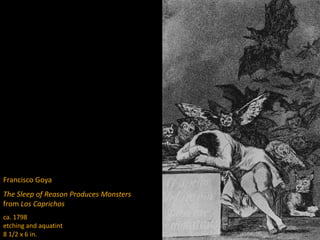
Francisco Goya
The Sleep of Reason Produces Monsters
from Los Caprichos
ca. 1798
etching and aquatint
8 1/2 x 6 in.
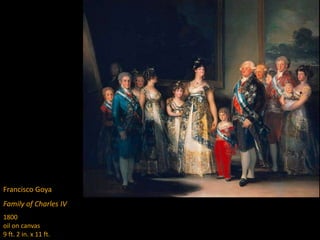
Francisco Goya
Family of Charles IV
1800
oil on canvas
9 ft. 2 in. x 11 ft.
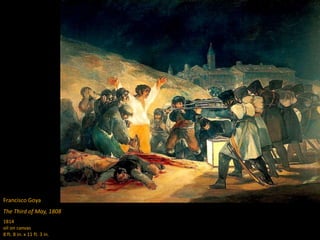
Francisco Goya
The Third of May, 1808
1814
oil on canvas
8 ft. 8 in. x 11 ft. 3 in.
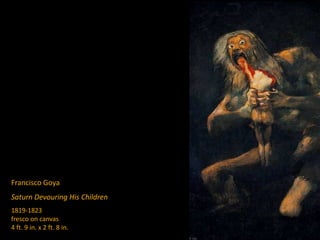
Francisco Goya
Saturn Devouring His Children
1819-1823
fresco on canvas
4 ft. 9 in. x 2 ft. 8 in.
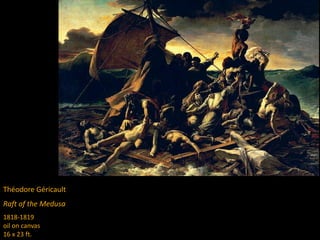
Théodore Géricault
Raft of the Medusa
1818-1819
oil on canvas
16 x 23 ft.
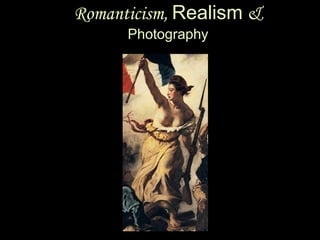
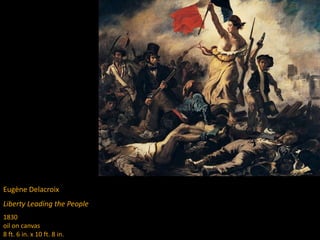
Eugène Delacroix
Liberty Leading the People
1830
oil on canvas
8 ft. 6 in. x 10 ft. 8 in.
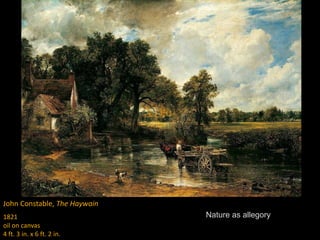
John Constable, The Haywain
1821
oil on canvas
4 ft. 3 in. x 6 ft. 2 in.
Nature as allegory
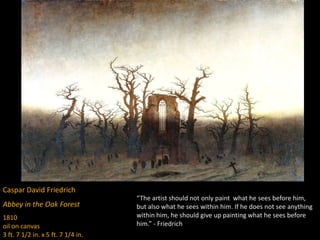
Caspar David Friedrich
Abbey in the Oak Forest
1810
oil on canvas
3 ft. 7 1/2 in. x 5 ft. 7 1/4 in.
“The artist should not only paint what he sees before him,
but also what he sees within him. If he does not see anything
within him, he should give up painting what he sees before
him.” - Friedrich
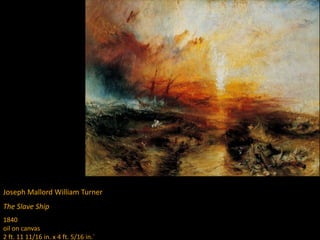
Joseph Mallord William Turner
The Slave Ship
1840
oil on canvas
2 ft. 11 11/16 in. x 4 ft. 5/16 in.`
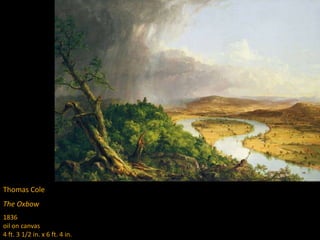
Thomas Cole
The Oxbow
1836
oil on canvas
4 ft. 3 1/2 in. x 6 ft. 4 in.
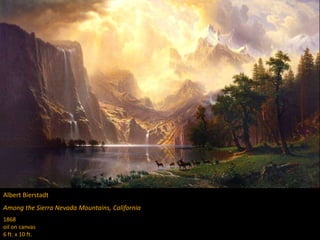
Albert Bierstadt
Among the Sierra Nevada Mountains, California
1868
oil on canvas
6 ft. x 10 ft.
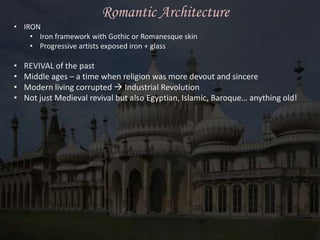
Romantic Architecture
• IRON
• Iron framework with Gothic or Romanesque skin
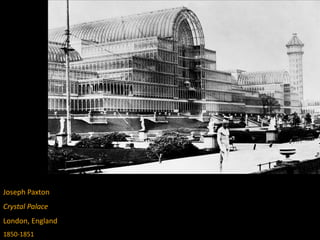
• Progressive artists exposed iron + glass
• REVIVAL of the past
• Middle ages – a time when religion was more devout and sincere
• Modern living corrupted  Industrial Revolution
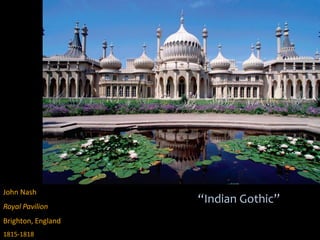
• Not just Medieval revival but also Egyptian, Islamic, Baroque… anything old!
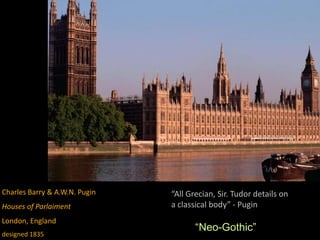
Charles Barry & A.W.N. Pugin
Houses of Parlaiment
London, England
designed 1835
“All Grecian, Sir. Tudor details on
a classical body” - Pugin
“Neo-Gothic”
John Nash
Royal Pavilion
Brighton, England
1815-1818
“Indian Gothic”
Joseph Paxton
Crystal Palace
London, England
1850-1851
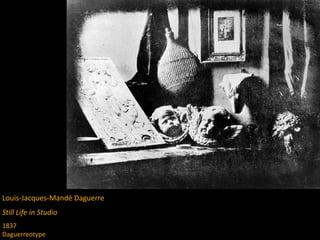
Louis-Jacques-Mandé Daguerre
Still Life in Studio
1837
Daguerreotype
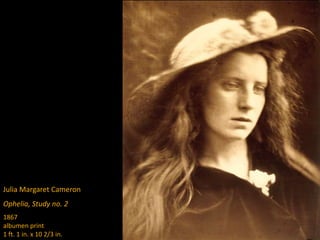
Julia Margaret Cameron
Ophelia, Study no. 2
1867
albumen print
1 ft. 1 in. x 10 2/3 in.
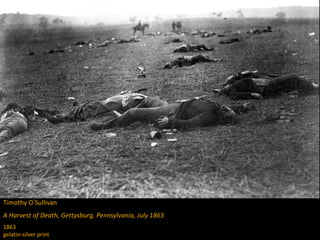
Timothy O’Sullivan
A Harvest of Death, Gettysburg, Pennsylvania, July 1863
1863
gelatin-silver print
PRE-MODERNISM: REALISM & THE
PRE-RAPHAELITE BROTHERHOOD
19th century continued…
Ah, Romanticism…isn’t it romantic?
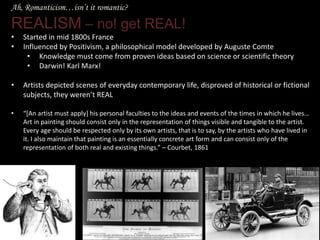
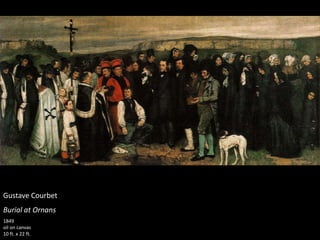
REALISM – no! get REAL!
• Started in mid 1800s France
• Influenced by Positivism, a philosophical model developed by Auguste Comte
• Knowledge must come from proven ideas based on science or scientific theory
• Darwin! Karl Marx!
• Artists depicted scenes of everyday contemporary life, disproved of historical or fictional
subjects, they weren’t REAL
• “*An artist must apply+ his personal faculties to the ideas and events of the times in which he lives…
Art in painting should consist only in the representation of things visible and tangible to the artist.
Every age should be respected only by its own artists, that is to say, by the artists who have lived in
it. I also maintain that painting is an essentially concrete art form and can consist only of the
representation of both real and existing things.” – Courbet, 1861
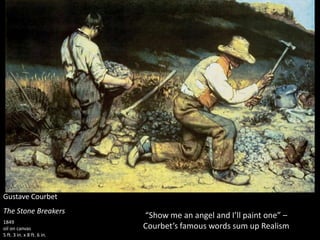
Gustave Courbet
The Stone Breakers
1849
oil on canvas
5 ft. 3 in. x 8 ft. 6 in.
“Show me an angel and I’ll paint one” –
Courbet’s famous words sum up Realism
Gustave Courbet
Burial at Ornans
1849
oil on canvas
10 ft. x 22 ft.
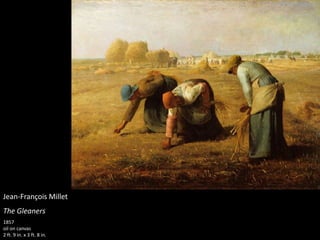
Jean-François Millet
The Gleaners
1857
oil on canvas
2 ft. 9 in. x 3 ft. 8 in.
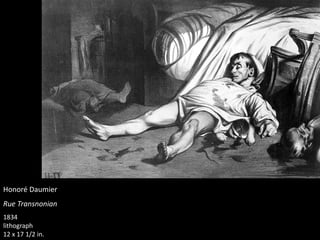
Honoré Daumier
Rue Transnonian
1834
lithograph
12 x 17 1/2 in.
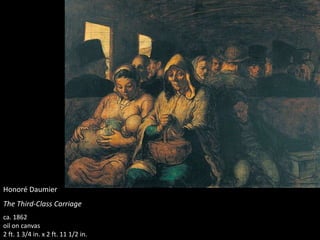
Honoré Daumier
The Third-Class Carriage
ca. 1862
oil on canvas
2 ft. 1 3/4 in. x 2 ft. 11 1/2 in.
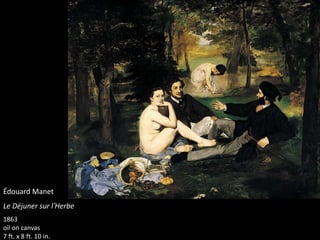
Édouard Manet
Le Déjuner sur l’Herbe
1863
oil on canvas
7 ft. x 8 ft. 10 in.
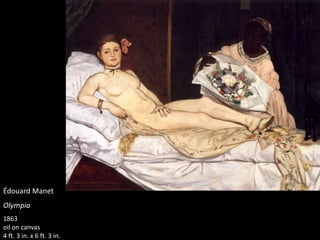
Édouard Manet
Olympia
1863
oil on canvas
4 ft. 3 in. x 6 ft. 3 in.
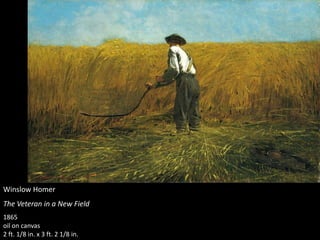
Winslow Homer
The Veteran in a New Field
1865
oil on canvas
2 ft. 1/8 in. x 3 ft. 2 1/8 in.
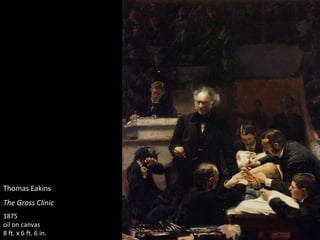
Thomas Eakins
The Gross Clinic
1875
oil on canvas
8 ft. x 6 ft. 6 in.
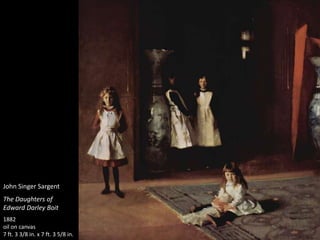
John Singer Sargent
The Daughters of
Edward Darley Boit
1882
oil on canvas
7 ft. 3 3/8 in. x 7 ft. 3 5/8 in.
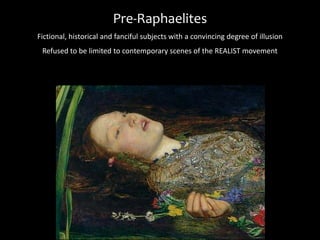
Pre-Raphaelites
Fictional, historical and fanciful subjects with a convincing degree of illusion
Refused to be limited to contemporary scenes of the REALIST movement
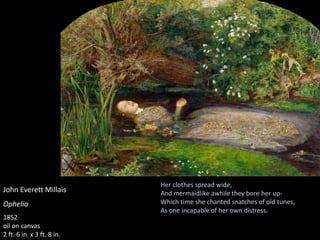
John Everett Millais
Ophelia
1852
oil on canvas
2 ft. 6 in. x 3 ft. 8 in.
Her clothes spread wide,
And mermaidlike awhile they bore her up-
Which time she chanted snatches of old tunes,
As one incapable of her own distress.
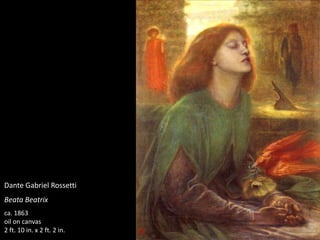
Dante Gabriel Rossetti
Beata Beatrix
ca. 1863
oil on canvas
2 ft. 10 in. x 2 ft. 2 in.
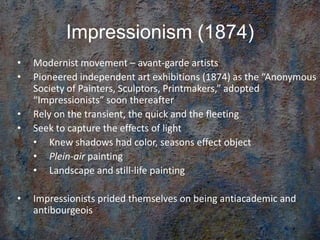
Impressionism (1874)
• Modernist movement – avant-garde artists
• Pioneered independent art exhibitions (1874) as the “Anonymous
Society of Painters, Sculptors, Printmakers,” adopted
“Impressionists” soon thereafter
• Rely on the transient, the quick and the fleeting
• Seek to capture the effects of light
• Knew shadows had color, seasons effect object
• Plein-air painting
• Landscape and still-life painting
• Impressionists prided themselves on being antiacademic and
antibourgeois
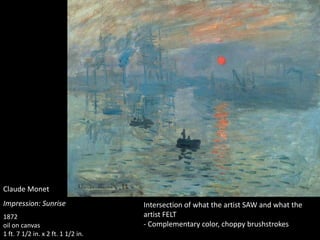
Claude Monet
Impression: Sunrise
1872
oil on canvas
1 ft. 7 1/2 in. x 2 ft. 1 1/2 in.
Intersection of what the artist SAW and what the
artist FELT
- Complementary color, choppy brushstrokes
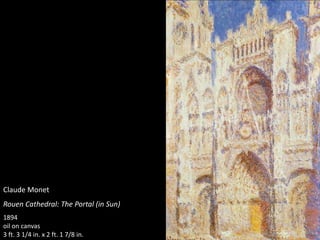
Claude Monet
Rouen Cathedral: The Portal (in Sun)
1894
oil on canvas
3 ft. 3 1/4 in. x 2 ft. 1 7/8 in.
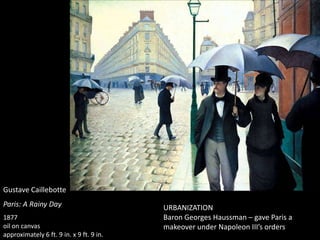
Gustave Caillebotte
Paris: A Rainy Day
1877
oil on canvas
approximately 6 ft. 9 in. x 9 ft. 9 in.
URBANIZATION
Baron Georges Haussman – gave Paris a
makeover under Napoleon III’s orders
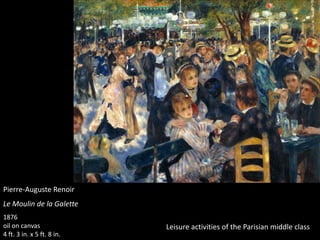
Pierre-Auguste Renoir
Le Moulin de la Galette
1876
oil on canvas
4 ft. 3 in. x 5 ft. 8 in.
Leisure activities of the Parisian middle class
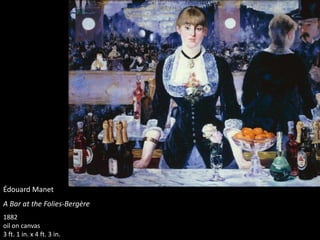
Édouard Manet
A Bar at the Folies-Bergère
1882
oil on canvas
3 ft. 1 in. x 4 ft. 3 in.
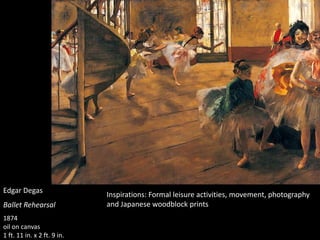
Edgar Degas
Ballet Rehearsal
1874
oil on canvas
1 ft. 11 in. x 2 ft. 9 in.
Inspirations: Formal leisure activities, movement, photography
and Japanese woodblock prints
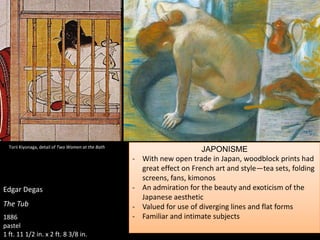
Edgar Degas
The Tub
1886
pastel
1 ft. 11 1/2 in. x 2 ft. 8 3/8 in.
JAPONISME
- With new open trade in Japan, woodblock prints had
great effect on French art and style—tea sets, folding
screens, fans, kimonos
- An admiration for the beauty and exoticism of the
Japanese aesthetic
- Valued for use of diverging lines and flat forms
- Familiar and intimate subjects
Torii Kiyonaga, detail of Two Women at the Bath
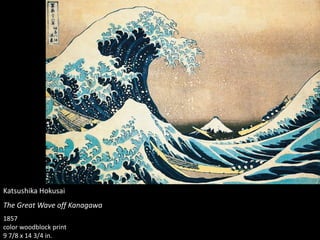
Katsushika Hokusai
The Great Wave off Kanagawa
1857
color woodblock print
9 7/8 x 14 3/4 in.
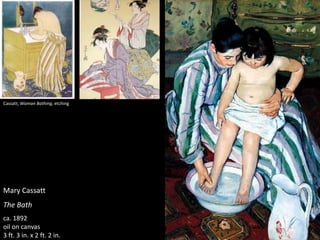
Mary Cassatt
The Bath
ca. 1892
oil on canvas
3 ft. 3 in. x 2 ft. 2 in.
Cassatt, Woman Bathing, etching
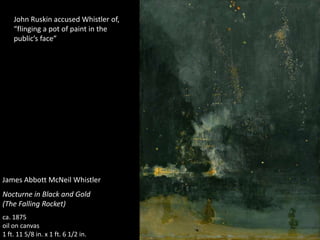
James Abbott McNeil Whistler
Nocturne in Black and Gold
(The Falling Rocket)
ca. 1875
oil on canvas
1 ft. 11 5/8 in. x 1 ft. 6 1/2 in.
John Ruskin accused Whistler of,
“flinging a pot of paint in the
public’s face”
POST-Impressionism (1880s-
1890s)Back to picture making rather than copying nature
• Just as the Impressionists were being taken seriously as artists, a new group
came along feeling that the Impressionists neglected too many traditional
elements in favor of capturing a fleeting moment
• Artists explore the properties and expressive qualities of formal elements
• Borrows from Impressionism in new and unique ways
• Combine Impressionist ideals (light, shading and color) with structure
• Nearing abstraction while retaining volume or depth
Cezanne, the quintessential Post-Impressionist wished to,
“make Impressionism something solid and durable, like the art
of the museums”
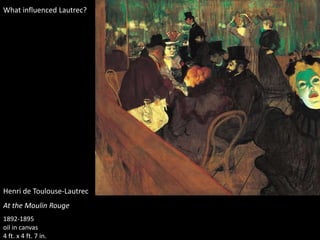
Henri de Toulouse-Lautrec
At the Moulin Rouge
1892-1895
oil in canvas
4 ft. x 4 ft. 7 in.
What influenced Lautrec?
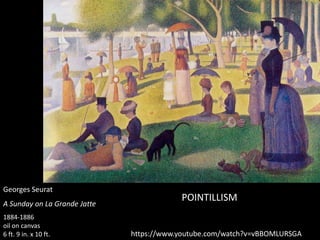
Georges Seurat
A Sunday on La Grande Jatte
1884-1886
oil on canvas
6 ft. 9 in. x 10 ft. https://www.youtube.com/watch?v=vBBOMLURSGA
POINTILLISM
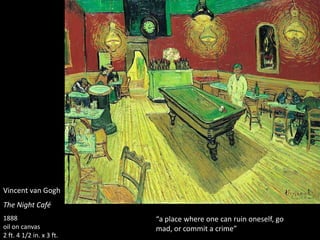
Vincent van Gogh
The Night Café
1888
oil on canvas
2 ft. 4 1/2 in. x 3 ft.
“a place where one can ruin oneself, go
mad, or commit a crime”
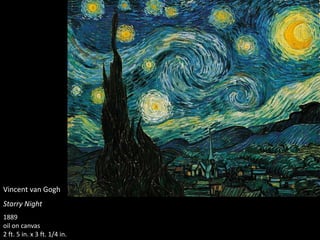
Vincent van Gogh
Starry Night
1889
oil on canvas
2 ft. 5 in. x 3 ft. 1/4 in.
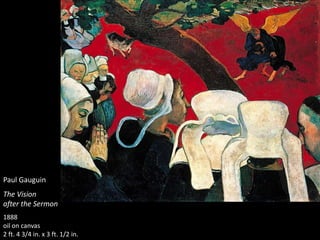
Paul Gauguin
The Vision
after the Sermon
1888
oil on canvas
2 ft. 4 3/4 in. x 3 ft. 1/2 in.
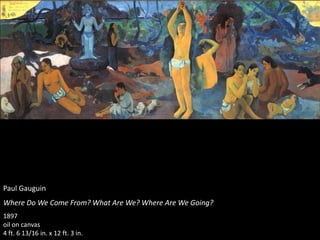
Paul Gauguin
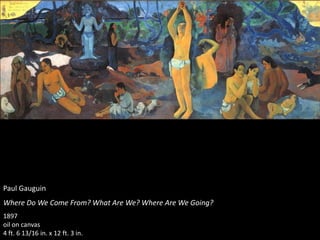
Where Do We Come From? What Are We? Where Are We Going?
1897
oil on canvas
4 ft. 6 13/16 in. x 12 ft. 3 in.
Paul Gauguin
Where Do We Come From? What Are We? Where Are We Going?
1897
oil on canvas
4 ft. 6 13/16 in. x 12 ft. 3 in.
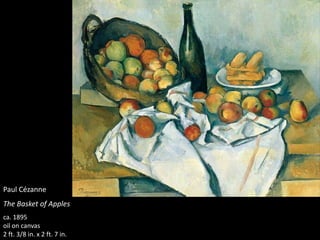
Paul Cézanne
The Basket of Apples
ca. 1895
oil on canvas
2 ft. 3/8 in. x 2 ft. 7 in.

Enlightenment thru post imp

  • 2.
  • 3.
    THEME: Features ofRomanticism “Man is born free, but is everywhere in chains!” - Rousseau P.I.N.E. Past – Longing for the medieval past, pre-industrial Europe (Gothic architecture will be revived) Irrational/ Inner mind / Insanity – Romantic artists depict the human psyche and topics that transcend the use of reason. One Romantic artist, Gericault, chose to do portraits of people in insane asylums Nature – longing for the purity of nature, which defies human rationality Emotion/ Exotic – Romantics favored emotion and passion over reason. Exotic themes and locales were also popular because they did not adhere to European emphasis on rationality Imagination, not reason, FEELING, not thinking = FREEDOM
  • 4.
    Jean-Auguste-Dominique Ingres Grande Odalisque 1814 oilon canvas 2 ft. 11 in. x 5 ft. 4 in.
  • 5.
    Francisco Goya The Sleepof Reason Produces Monsters from Los Caprichos ca. 1798 etching and aquatint 8 1/2 x 6 in.
  • 6.
    Francisco Goya Family ofCharles IV 1800 oil on canvas 9 ft. 2 in. x 11 ft.
  • 7.
    Francisco Goya The Thirdof May, 1808 1814 oil on canvas 8 ft. 8 in. x 11 ft. 3 in.
  • 8.
    Francisco Goya Saturn DevouringHis Children 1819-1823 fresco on canvas 4 ft. 9 in. x 2 ft. 8 in.
  • 9.
    Théodore Géricault Raft ofthe Medusa 1818-1819 oil on canvas 16 x 23 ft.
  • 10.
    Eugène Delacroix Liberty Leadingthe People 1830 oil on canvas 8 ft. 6 in. x 10 ft. 8 in.
  • 11.
    John Constable, TheHaywain 1821 oil on canvas 4 ft. 3 in. x 6 ft. 2 in. Nature as allegory
  • 12.
    Caspar David Friedrich Abbeyin the Oak Forest 1810 oil on canvas 3 ft. 7 1/2 in. x 5 ft. 7 1/4 in. “The artist should not only paint what he sees before him, but also what he sees within him. If he does not see anything within him, he should give up painting what he sees before him.” - Friedrich
  • 13.
    Joseph Mallord WilliamTurner The Slave Ship 1840 oil on canvas 2 ft. 11 11/16 in. x 4 ft. 5/16 in.`
  • 14.
    Thomas Cole The Oxbow 1836 oilon canvas 4 ft. 3 1/2 in. x 6 ft. 4 in.
  • 15.
    Albert Bierstadt Among theSierra Nevada Mountains, California 1868 oil on canvas 6 ft. x 10 ft.
  • 16.
    Romantic Architecture • IRON •Iron framework with Gothic or Romanesque skin • Progressive artists exposed iron + glass • REVIVAL of the past • Middle ages – a time when religion was more devout and sincere • Modern living corrupted  Industrial Revolution • Not just Medieval revival but also Egyptian, Islamic, Baroque… anything old!
  • 17.
    Charles Barry &A.W.N. Pugin Houses of Parlaiment London, England designed 1835 “All Grecian, Sir. Tudor details on a classical body” - Pugin “Neo-Gothic”
  • 18.
    John Nash Royal Pavilion Brighton,England 1815-1818 “Indian Gothic”
  • 19.
  • 20.
    Louis-Jacques-Mandé Daguerre Still Lifein Studio 1837 Daguerreotype
  • 21.
    Julia Margaret Cameron Ophelia,Study no. 2 1867 albumen print 1 ft. 1 in. x 10 2/3 in.
  • 22.
    Timothy O’Sullivan A Harvestof Death, Gettysburg, Pennsylvania, July 1863 1863 gelatin-silver print
  • 23.
    PRE-MODERNISM: REALISM &THE PRE-RAPHAELITE BROTHERHOOD 19th century continued…
  • 24.
    Ah, Romanticism…isn’t itromantic? REALISM – no! get REAL! • Started in mid 1800s France • Influenced by Positivism, a philosophical model developed by Auguste Comte • Knowledge must come from proven ideas based on science or scientific theory • Darwin! Karl Marx! • Artists depicted scenes of everyday contemporary life, disproved of historical or fictional subjects, they weren’t REAL • “*An artist must apply+ his personal faculties to the ideas and events of the times in which he lives… Art in painting should consist only in the representation of things visible and tangible to the artist. Every age should be respected only by its own artists, that is to say, by the artists who have lived in it. I also maintain that painting is an essentially concrete art form and can consist only of the representation of both real and existing things.” – Courbet, 1861
  • 25.
    Gustave Courbet The StoneBreakers 1849 oil on canvas 5 ft. 3 in. x 8 ft. 6 in. “Show me an angel and I’ll paint one” – Courbet’s famous words sum up Realism
  • 26.
    Gustave Courbet Burial atOrnans 1849 oil on canvas 10 ft. x 22 ft.
  • 27.
    Jean-François Millet The Gleaners 1857 oilon canvas 2 ft. 9 in. x 3 ft. 8 in.
  • 28.
  • 29.
    Honoré Daumier The Third-ClassCarriage ca. 1862 oil on canvas 2 ft. 1 3/4 in. x 2 ft. 11 1/2 in.
  • 30.
    Édouard Manet Le Déjunersur l’Herbe 1863 oil on canvas 7 ft. x 8 ft. 10 in.
  • 31.
    Édouard Manet Olympia 1863 oil oncanvas 4 ft. 3 in. x 6 ft. 3 in.
  • 32.
    Winslow Homer The Veteranin a New Field 1865 oil on canvas 2 ft. 1/8 in. x 3 ft. 2 1/8 in.
  • 33.
    Thomas Eakins The GrossClinic 1875 oil on canvas 8 ft. x 6 ft. 6 in.
  • 34.
    John Singer Sargent TheDaughters of Edward Darley Boit 1882 oil on canvas 7 ft. 3 3/8 in. x 7 ft. 3 5/8 in.
  • 35.
    Pre-Raphaelites Fictional, historical andfanciful subjects with a convincing degree of illusion Refused to be limited to contemporary scenes of the REALIST movement
  • 36.
    John Everett Millais Ophelia 1852 oilon canvas 2 ft. 6 in. x 3 ft. 8 in. Her clothes spread wide, And mermaidlike awhile they bore her up- Which time she chanted snatches of old tunes, As one incapable of her own distress.
  • 37.
    Dante Gabriel Rossetti BeataBeatrix ca. 1863 oil on canvas 2 ft. 10 in. x 2 ft. 2 in.
  • 38.
    Impressionism (1874) • Modernistmovement – avant-garde artists • Pioneered independent art exhibitions (1874) as the “Anonymous Society of Painters, Sculptors, Printmakers,” adopted “Impressionists” soon thereafter • Rely on the transient, the quick and the fleeting • Seek to capture the effects of light • Knew shadows had color, seasons effect object • Plein-air painting • Landscape and still-life painting • Impressionists prided themselves on being antiacademic and antibourgeois
  • 39.
    Claude Monet Impression: Sunrise 1872 oilon canvas 1 ft. 7 1/2 in. x 2 ft. 1 1/2 in. Intersection of what the artist SAW and what the artist FELT - Complementary color, choppy brushstrokes
  • 40.
    Claude Monet Rouen Cathedral:The Portal (in Sun) 1894 oil on canvas 3 ft. 3 1/4 in. x 2 ft. 1 7/8 in.
  • 41.
    Gustave Caillebotte Paris: ARainy Day 1877 oil on canvas approximately 6 ft. 9 in. x 9 ft. 9 in. URBANIZATION Baron Georges Haussman – gave Paris a makeover under Napoleon III’s orders
  • 42.
    Pierre-Auguste Renoir Le Moulinde la Galette 1876 oil on canvas 4 ft. 3 in. x 5 ft. 8 in. Leisure activities of the Parisian middle class
  • 43.
    Édouard Manet A Barat the Folies-Bergère 1882 oil on canvas 3 ft. 1 in. x 4 ft. 3 in.
  • 44.
    Edgar Degas Ballet Rehearsal 1874 oilon canvas 1 ft. 11 in. x 2 ft. 9 in. Inspirations: Formal leisure activities, movement, photography and Japanese woodblock prints
  • 45.
    Edgar Degas The Tub 1886 pastel 1ft. 11 1/2 in. x 2 ft. 8 3/8 in. JAPONISME - With new open trade in Japan, woodblock prints had great effect on French art and style—tea sets, folding screens, fans, kimonos - An admiration for the beauty and exoticism of the Japanese aesthetic - Valued for use of diverging lines and flat forms - Familiar and intimate subjects Torii Kiyonaga, detail of Two Women at the Bath
  • 46.
    Katsushika Hokusai The GreatWave off Kanagawa 1857 color woodblock print 9 7/8 x 14 3/4 in.
  • 47.
    Mary Cassatt The Bath ca.1892 oil on canvas 3 ft. 3 in. x 2 ft. 2 in. Cassatt, Woman Bathing, etching
  • 48.
    James Abbott McNeilWhistler Nocturne in Black and Gold (The Falling Rocket) ca. 1875 oil on canvas 1 ft. 11 5/8 in. x 1 ft. 6 1/2 in. John Ruskin accused Whistler of, “flinging a pot of paint in the public’s face”
  • 49.
    POST-Impressionism (1880s- 1890s)Back topicture making rather than copying nature • Just as the Impressionists were being taken seriously as artists, a new group came along feeling that the Impressionists neglected too many traditional elements in favor of capturing a fleeting moment • Artists explore the properties and expressive qualities of formal elements • Borrows from Impressionism in new and unique ways • Combine Impressionist ideals (light, shading and color) with structure • Nearing abstraction while retaining volume or depth Cezanne, the quintessential Post-Impressionist wished to, “make Impressionism something solid and durable, like the art of the museums”
  • 50.
    Henri de Toulouse-Lautrec Atthe Moulin Rouge 1892-1895 oil in canvas 4 ft. x 4 ft. 7 in. What influenced Lautrec?
  • 51.
    Georges Seurat A Sundayon La Grande Jatte 1884-1886 oil on canvas 6 ft. 9 in. x 10 ft. https://www.youtube.com/watch?v=vBBOMLURSGA POINTILLISM
  • 52.
    Vincent van Gogh TheNight Café 1888 oil on canvas 2 ft. 4 1/2 in. x 3 ft. “a place where one can ruin oneself, go mad, or commit a crime”
  • 53.
    Vincent van Gogh StarryNight 1889 oil on canvas 2 ft. 5 in. x 3 ft. 1/4 in.
  • 54.
    Paul Gauguin The Vision afterthe Sermon 1888 oil on canvas 2 ft. 4 3/4 in. x 3 ft. 1/2 in.
  • 55.
    Paul Gauguin Where DoWe Come From? What Are We? Where Are We Going? 1897 oil on canvas 4 ft. 6 13/16 in. x 12 ft. 3 in.
  • 56.
    Paul Gauguin Where DoWe Come From? What Are We? Where Are We Going? 1897 oil on canvas 4 ft. 6 13/16 in. x 12 ft. 3 in.
  • 57.
    Paul Cézanne The Basketof Apples ca. 1895 oil on canvas 2 ft. 3/8 in. x 2 ft. 7 in.