Chapter 21
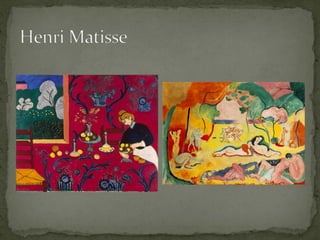
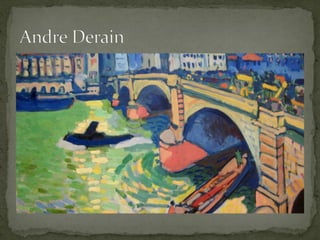
 Les fauves-the wild beasts
 Matisse is considered the forerunner of this
  movement that only lasted two years
 Matisse was trying to express his enthusiasm for life
 He simplified his forms to preserve the initial feeling
  he got from the object
 Expressionism-emphasizes inner feelings over
  objective description
 Simplifications of the subject’s form
 Bright expressive colors
 Areas of intense brushwork and areas of flat color
  coincide in the same work
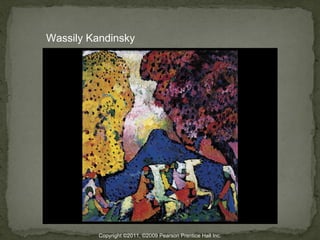
Wassily Kandinsky


          Copyright ©2011, ©2009 Pearson Prentice Hall Inc.
 By 1910 Kandinsky was breaking a key rule in art
   He was making art that was completely
    nonrepresentational
 He thought that art should transcend physical reality
 He sought to make a visual language akin to how we
  hear music or taste….
 The content of the paintings is simply what the viewer
  experiences under the effect of the forms and color
  combinations
 Emphasized pictorial composition over personal
  expression
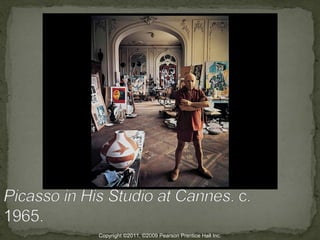
 Pablo Picasso is generally considered the inventor of
  Cubism
 Deconstructed and reconstructed forms
   Often a forward view and a side view of a person or
    object is shown simultaneously
   Abstracted forms
 Considered the main player in the creation of cubism
 Began as a traditional painter and began to
  experiment with collage and abstracted forms
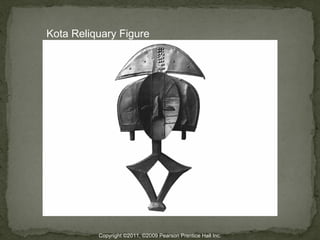
 He was very influenced by African sculpture,
  especially African masks
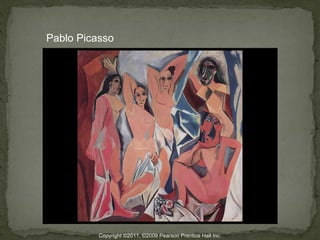
Pablo Picasso


          Copyright ©2011, ©2009 Pearson Prentice Hall Inc.
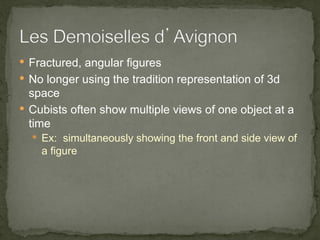
 Fractured, angular figures
 No longer using the tradition representation of 3d
  space
 Cubists often show multiple views of one object at a
  time
   Ex: simultaneously showing the front and side view of
    a figure
Kota Reliquary Figure


          Copyright ©2011, ©2009 Pearson Prentice Hall Inc.
Copyright ©2011, ©2009 Pearson Prentice Hall Inc.
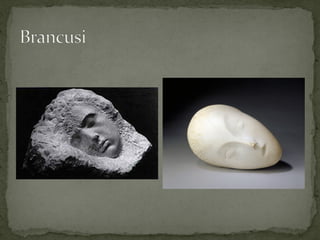
 Constantin Brancusi was a pioneer in the movement
  from 19th century to 20th century art
 He was inspired by the Cycladic sculptures and their
  abstract style
 He wanted his viewer to be conscious of form
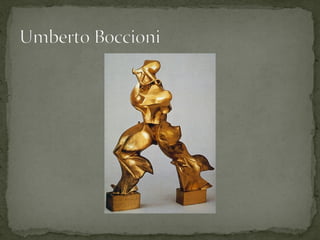
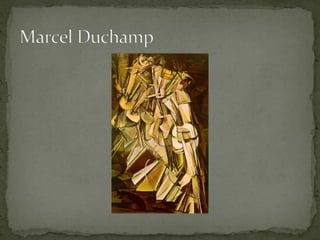
 Italian Futurists were a group of artists inspired by
  cubism
 They often wanted to show fast motion and a love for
  the machine
 Multiplying the image and using lots of repetition
  became a strong way to show movement
 Curved and diagonal lines also gave a feeling of
  movement in their compositions
Art Appreciation-Chapter21-Early 20th Century

Art Appreciation-Chapter21-Early 20th Century

  • 1.
  • 2.
     Les fauves-thewild beasts  Matisse is considered the forerunner of this movement that only lasted two years  Matisse was trying to express his enthusiasm for life  He simplified his forms to preserve the initial feeling he got from the object
  • 4.
     Expressionism-emphasizes innerfeelings over objective description  Simplifications of the subject’s form  Bright expressive colors  Areas of intense brushwork and areas of flat color coincide in the same work
  • 6.
    Wassily Kandinsky Copyright ©2011, ©2009 Pearson Prentice Hall Inc.
  • 7.
     By 1910Kandinsky was breaking a key rule in art  He was making art that was completely nonrepresentational  He thought that art should transcend physical reality  He sought to make a visual language akin to how we hear music or taste….  The content of the paintings is simply what the viewer experiences under the effect of the forms and color combinations
  • 8.
     Emphasized pictorialcomposition over personal expression  Pablo Picasso is generally considered the inventor of Cubism  Deconstructed and reconstructed forms  Often a forward view and a side view of a person or object is shown simultaneously  Abstracted forms
  • 9.
     Considered themain player in the creation of cubism  Began as a traditional painter and began to experiment with collage and abstracted forms  He was very influenced by African sculpture, especially African masks
  • 10.
    Pablo Picasso Copyright ©2011, ©2009 Pearson Prentice Hall Inc.
  • 11.
     Fractured, angularfigures  No longer using the tradition representation of 3d space  Cubists often show multiple views of one object at a time  Ex: simultaneously showing the front and side view of a figure
  • 12.
    Kota Reliquary Figure Copyright ©2011, ©2009 Pearson Prentice Hall Inc.
  • 13.
    Copyright ©2011, ©2009Pearson Prentice Hall Inc.
  • 14.
     Constantin Brancusiwas a pioneer in the movement from 19th century to 20th century art  He was inspired by the Cycladic sculptures and their abstract style  He wanted his viewer to be conscious of form
  • 16.
     Italian Futuristswere a group of artists inspired by cubism  They often wanted to show fast motion and a love for the machine  Multiplying the image and using lots of repetition became a strong way to show movement  Curved and diagonal lines also gave a feeling of movement in their compositions

Editor's Notes

  • #7 The Solomon R. Guggenheim Museum, New York. Gift, Solomon R. Guggenheim, 1941. 41. 505. Photograph by David Heald. © The Solomon R. Guggenheim Foundation, New York. © 2010 Artists Rights Society (ARS), New York/ADAGP, Paris.
  • #11 The Museum of Modern Art/Licensed by Scala-Art Resource, NY. Acquired through the Lillie P. Bliss Bequest. Photograph: © 2002 The Museum of Modern Art, New York. © 2010 Estate of Pablo Picasso/Artists Rights Society (ARS), New York.
  • #13 Department of Anthropology, Smithsonian Institution. Cat. No. 323686, Neg. No 36712A.
  • #14 © Arnold Newman/Getty Images.