Presentation of Pablo Picasso

       By Christian S. Rima
Pablo Picasso
Full Name: Pablo Diego José Francisco de Paula Juan
Nepomuceno Maria de los Remedios Cipriano de la Santísima
Trinidad Ruiz y Picasso
Birth Date: October 25, 1881
Birthplace: Malaga, Spain
Nationality:Spanish
Death Date: April 8, 1973
Death place: Mougins, France
Father’s Name: Don José Ruiz y Blasco
Mother’s Name: María Picasso y López
Siblings: Dolores “Lola” Picasso, Concepcion “Conchita”
Picasso
Wife/Wives: Olga Khokhlova(1918-1955), Jacqueline
Roque(1961-1973)
Children: Paulo (4 February 1921 – 5 June 1975) (Born Paul
Joseph Picasso) — with Olga Khokhlova; Maya (5 September
1935 – ) (Born Maria de la Concepcion Picasso) — with Marie-
Thérèse Walter; Claude (15 May 1947 –) (Born Claude Pierre
Pablo Picasso) — with Françoise Gilot; Paloma (19 April 1949 –
) (Born Anne Paloma Picasso) — with Françoise Gilot
Movement: Cubism
Famous works: Les Demoiselles d'Avignon (1907)
Guernica (1937)
The Weeping Woman (1937)
Early life
   Picasso’s first words were “piz” , a shortened form
    of the word lapiz.
   From the age of seven, he received formal artistic
    training from his father in figure drawing and oil
    painting. Ruiz was a traditional, academic artist
    and instructor who believed that proper training
    required disciplined copying of the masters, and
    drawing the human body from plaster casts and
    live models. His son became preoccupied with art
    to the detriment of his classwork.
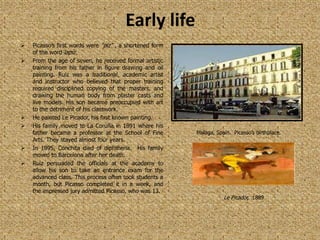
   He painted Le Picador, his first known painting.
   His family moved to La Coruña in 1891 where his
    father became a professor at the School of Fine       Malaga, Spain. Picasso’s birthplace.
    Arts. They stayed almost four years.
   In 1895, Conchita died of diphtheria. His family
    moved to Barcelona after her death.
   Ruiz persuaded the officials at the academy to
    allow his son to take an entrance exam for the
    advanced class. This process often took students a
    month, but Picasso completed it in a week, and
    the impressed jury admitted Picasso, who was 13.
                                                                     Le Picador, 1889
Career beginnings
   After studying art in Madrid, Picasso
    made his first trip to Paris in 1900, then
    the art capital of Europe. He met the
    poet Max Jacob wherein he learned
    French from him.
   By 1905 Picasso became a favorite of the
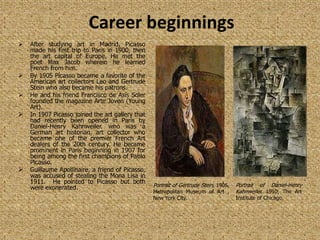
    American art collectors Leo and Gertrude
    Stein who also became his patrons.
   He and his friend Francisco de Asís Soler
    founded the magazine Arte Joven (Young
    Art).
   In 1907 Picasso joined the art gallery that
    had recently been opened in Paris by
    Daniel-Henry Kahnweiler. who was a
    German art historian, art collector who
    became one of the premier French Art
    dealers of the 20th century. He became
    prominent in Paris beginning in 1907 for
    being among the first champions of Pablo
    Picasso.
   Guillaume Apollinaire, a friend of Picasso,
    was accused of stealing the Mona Lisa in
    1911. He pointed to Picasso but both
    were exonerated.                              Portrait of Gertrude Stein, 1906,   Portrait of Daniel-Henry
                                                  Metropolitan Museum of Art ,        Kahnweiler, 1910, The Art
                                                  New York City.                      Institute of Chicago.
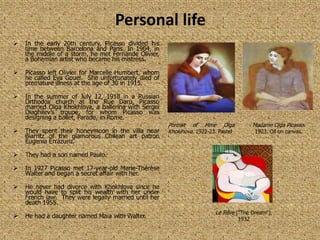
Personal life
   In the early 20th century, Picasso divided his
    time between Barcelona and Paris. In 1904, in
    the middle of a storm, he met Fernande Olivier,
    a Bohemian artist who became his mistress.

   Picasso left Olivier for Marcelle Humbert, whom
    he called Eva Gouel. She unfortunately died of
    premature illness at the age of 30 in 1915.

   In the summer of July 12, 1918 in a Russian
    Orthodox church at the Rue Daru, Picasso
    married Olga Khokhlova, a ballerina with Sergei
    Diaghilev’s troupe, for whom Picasso was
    designing a ballet, Parade, in Rome.
                                                      Portrait of Mme Olga                Madame Olga Picasso.
   They spent their honeymoon in the villa near      Khoklhova. 1922-23. Pastel          1923. Oil on canvas.
    Biarritz of the glamorous Chilean art patron
    Eugenia Errázuriz.

   They had a son named Paulo.

   In 1927 Picasso met 17-year-old Marie-Thérèse
    Walter and began a secret affair with her.

   He never had divorce with Khokhlova since he
    would have to split his wealth with her under
    French law. They were legally married until her
    death 1955.
                                                                        Le Rêve ("The Dream"),
   He had a daughter named Maia with Walter.                                      1932
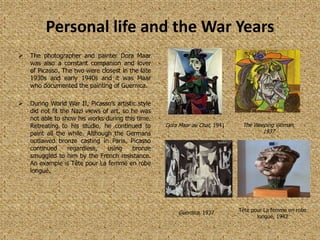
Personal life and the War Years
   The photographer and painter Dora Maar
    was also a constant companion and lover
    of Picasso. The two were closest in the late
    1930s and early 1940s and it was Maar
    who documented the painting of Guernica.

   During World War II, Picasso’s artistic style
    did not fit the Nazi views of art, so he was
    not able to show his works during this time.
    Retreating to his studio, he continued to       Dora Maar au Chat, 1941    The Weeping Woman,
    paint all the while. Although the Germans                                         1937
    outlawed bronze casting in Paris, Picasso
    continued      regardless,   using    bronze
    smuggled to him by the French resistance.
    An example is Tête pour La femme en robe
    longué.


                                                         Guernica, 1937       Tête pour La femme en robe
                                                                                     longué, 1942
Later Life
   After the liberation of Paris in 1944, Picasso
    began to keep company with a young art student,
    Françoise Gilot. The two eventually became
    lovers, and had two children together, Claude and
    Paloma. Unique among Picasso’s women, Gilot
    left Picasso in 1953, allegedly because of abusive
    treatment and infidelities. This was a severe blow
    to Picasso.
   He joined the joined the French Communist Party,
    attended an international peace conference in
    Poland, and in 1950 received the Lenin Peace
    Prize from the Soviet government.         He also    Françoise, Claude and Paloma. 1954. Oil on
    received the prize in 1962.                                           canvas.


   He went through a difficult period after Gilot’s
    departure, coming to terms with his advancing
    age and his belief that, now in his 70s, he was no
    longer handsome, but rather the opposite to
    young women.

   He met Jacqueline Roque in the Madoura Pottery
    and married on 2 March 1961 in Vallauris,
    France.
                                                             Jacqueline in Studio. 1957. Oil on
                                                                          canvas.
Death
 Pablo Picasso died on 8 April 1973 in
  Mougins, France, while he and his wife
  Jacqueline entertained friends for dinner. His
  final words were “Drink to me, drink to my
  health, you know I can’t drink any more.” He
  was interred at Castle Vauvenargues’ park, in
  Vauvenargues,             Bouches-du-Rhône.
  Jacqueline Roque prevented his children
  Claude and Paloma from attending the
  funeral. Devastated and lonely after the
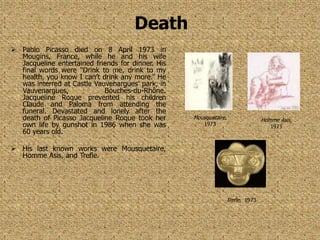
  death of Picasso Jacqueline Roque took her       Mousquetaire,              Homme Asis,
  own life by gunshot in 1986 when she was             1973                      1973
  60 years old.

 His last known works were Mousquetaire,
  Homme Asis, and Trefle.


                                                               Trefle, 1973
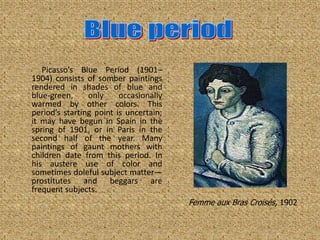
Picasso’s Blue Period (1901–
1904) consists of somber paintings
rendered in shades of blue and
blue-green,     only     occasionally
warmed by other colors. This
period’s starting point is uncertain;
it may have begun in Spain in the
spring of 1901, or in Paris in the
second half of the year. Many
paintings of gaunt mothers with
children date from this period. In
his austere use of color and
sometimes doleful subject matter—
prostitutes and beggars are
frequent subjects.
                                        Femme aux Bras Croisés, 1902
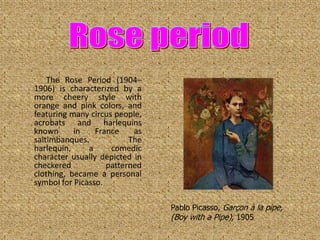
The Rose Period (1904–
1906) is characterized by a
more cheery style with
orange and pink colors, and
featuring many circus people,
acrobats and harlequins
known      in    France    as
saltimbanques.            The
harlequin,     a     comedic
character usually depicted in
checkered           patterned
clothing, became a personal
symbol for Picasso.

                                Pablo Picasso, Garçon à la pipe,
                                (Boy with a Pipe), 1905
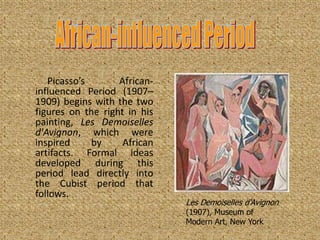
Picasso’s       African-
influenced Period (1907–
1909) begins with the two
figures on the right in his
painting, Les Demoiselles
d'Avignon, which were
inspired     by     African
artifacts. Formal ideas
developed during this
period lead directly into
the Cubist period that
follows.
                              Les Demoiselles d'Avignon
                              (1907), Museum of
                              Modern Art, New York
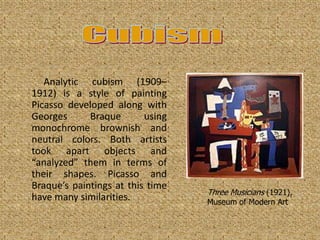
Analytic cubism (1909–
1912) is a style of painting
Picasso developed along with
Georges      Braque       using
monochrome brownish and
neutral colors. Both artists
took apart objects and
“analyzed” them in terms of
their shapes. Picasso and
Braque’s paintings at this time
                                  Three Musicians (1921),
have many similarities.           Museum of Modern Art
In    the     period
following the upheaval
of World War I, Picasso
produced work in a
neoclassical       style.
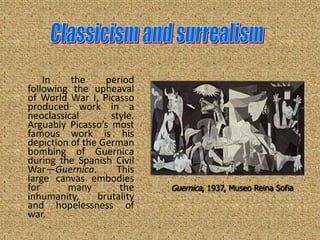
Arguably Picasso’s most
famous work is his
depiction of the German
bombing of Guernica
during the Spanish Civil
War—Guernica.       This
large canvas embodies
for      many        the    Guernica, 1937, Museo Reina Sofia
inhumanity,     brutality
and hopelessness of
war.
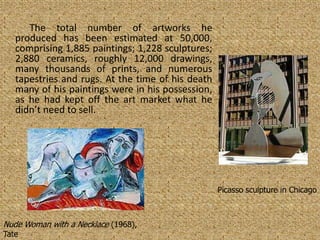
The total number of artworks he
   produced has been estimated at 50,000,
   comprising 1,885 paintings; 1,228 sculptures;
   2,880 ceramics, roughly 12,000 drawings,
   many thousands of prints, and numerous
   tapestries and rugs. At the time of his death
   many of his paintings were in his possession,
   as he had kept off the art market what he
   didn’t need to sell.


                                                   Picasso sculpture in Chicago


Nude Woman with a Necklace (1968),
Tate
Trivia
•   Since he left no will, his death duties (estate tax) to the French state were paid in
    the form of his works and others from his collection. These works form the core of
    the immense and representative collection of the Musée Picasso in Paris.

•   He is currently ranked as Top 2 of the Top 100 artists in the world in terms of sales
    of his works at auctions.

•   Most of his paintings have been stolen than those by any other artist.

•   He had numerous lovers but he only had two wives.
•
•   Upon Picasso's death in 1973, actor Dustin Hoffman was having dinner with
    former Beatle Paul McCartney and told him about Picasso's last words. McCartney
    started creating and singing a song around those words and included the song on
    his 1973 album, Band on the Run.

•   He had a film career as well. He always played himself in every role.

Pablo Picasso Presentation 25/1/2010

  • 1.
    Presentation of PabloPicasso By Christian S. Rima
  • 2.
    Pablo Picasso Full Name:Pablo Diego José Francisco de Paula Juan Nepomuceno Maria de los Remedios Cipriano de la Santísima Trinidad Ruiz y Picasso Birth Date: October 25, 1881 Birthplace: Malaga, Spain Nationality:Spanish Death Date: April 8, 1973 Death place: Mougins, France Father’s Name: Don José Ruiz y Blasco Mother’s Name: María Picasso y López Siblings: Dolores “Lola” Picasso, Concepcion “Conchita” Picasso Wife/Wives: Olga Khokhlova(1918-1955), Jacqueline Roque(1961-1973) Children: Paulo (4 February 1921 – 5 June 1975) (Born Paul Joseph Picasso) — with Olga Khokhlova; Maya (5 September 1935 – ) (Born Maria de la Concepcion Picasso) — with Marie- Thérèse Walter; Claude (15 May 1947 –) (Born Claude Pierre Pablo Picasso) — with Françoise Gilot; Paloma (19 April 1949 – ) (Born Anne Paloma Picasso) — with Françoise Gilot Movement: Cubism Famous works: Les Demoiselles d'Avignon (1907) Guernica (1937) The Weeping Woman (1937)
  • 3.
    Early life  Picasso’s first words were “piz” , a shortened form of the word lapiz.  From the age of seven, he received formal artistic training from his father in figure drawing and oil painting. Ruiz was a traditional, academic artist and instructor who believed that proper training required disciplined copying of the masters, and drawing the human body from plaster casts and live models. His son became preoccupied with art to the detriment of his classwork.  He painted Le Picador, his first known painting.  His family moved to La Coruña in 1891 where his father became a professor at the School of Fine Malaga, Spain. Picasso’s birthplace. Arts. They stayed almost four years.  In 1895, Conchita died of diphtheria. His family moved to Barcelona after her death.  Ruiz persuaded the officials at the academy to allow his son to take an entrance exam for the advanced class. This process often took students a month, but Picasso completed it in a week, and the impressed jury admitted Picasso, who was 13. Le Picador, 1889
  • 4.
    Career beginnings  After studying art in Madrid, Picasso made his first trip to Paris in 1900, then the art capital of Europe. He met the poet Max Jacob wherein he learned French from him.  By 1905 Picasso became a favorite of the American art collectors Leo and Gertrude Stein who also became his patrons.  He and his friend Francisco de Asís Soler founded the magazine Arte Joven (Young Art).  In 1907 Picasso joined the art gallery that had recently been opened in Paris by Daniel-Henry Kahnweiler. who was a German art historian, art collector who became one of the premier French Art dealers of the 20th century. He became prominent in Paris beginning in 1907 for being among the first champions of Pablo Picasso.  Guillaume Apollinaire, a friend of Picasso, was accused of stealing the Mona Lisa in 1911. He pointed to Picasso but both were exonerated. Portrait of Gertrude Stein, 1906, Portrait of Daniel-Henry Metropolitan Museum of Art , Kahnweiler, 1910, The Art New York City. Institute of Chicago.
  • 5.
    Personal life  In the early 20th century, Picasso divided his time between Barcelona and Paris. In 1904, in the middle of a storm, he met Fernande Olivier, a Bohemian artist who became his mistress.  Picasso left Olivier for Marcelle Humbert, whom he called Eva Gouel. She unfortunately died of premature illness at the age of 30 in 1915.  In the summer of July 12, 1918 in a Russian Orthodox church at the Rue Daru, Picasso married Olga Khokhlova, a ballerina with Sergei Diaghilev’s troupe, for whom Picasso was designing a ballet, Parade, in Rome. Portrait of Mme Olga Madame Olga Picasso.  They spent their honeymoon in the villa near Khoklhova. 1922-23. Pastel 1923. Oil on canvas. Biarritz of the glamorous Chilean art patron Eugenia Errázuriz.  They had a son named Paulo.  In 1927 Picasso met 17-year-old Marie-Thérèse Walter and began a secret affair with her.  He never had divorce with Khokhlova since he would have to split his wealth with her under French law. They were legally married until her death 1955. Le Rêve ("The Dream"),  He had a daughter named Maia with Walter. 1932
  • 6.
    Personal life andthe War Years  The photographer and painter Dora Maar was also a constant companion and lover of Picasso. The two were closest in the late 1930s and early 1940s and it was Maar who documented the painting of Guernica.  During World War II, Picasso’s artistic style did not fit the Nazi views of art, so he was not able to show his works during this time. Retreating to his studio, he continued to Dora Maar au Chat, 1941 The Weeping Woman, paint all the while. Although the Germans 1937 outlawed bronze casting in Paris, Picasso continued regardless, using bronze smuggled to him by the French resistance. An example is Tête pour La femme en robe longué. Guernica, 1937 Tête pour La femme en robe longué, 1942
  • 7.
    Later Life  After the liberation of Paris in 1944, Picasso began to keep company with a young art student, Françoise Gilot. The two eventually became lovers, and had two children together, Claude and Paloma. Unique among Picasso’s women, Gilot left Picasso in 1953, allegedly because of abusive treatment and infidelities. This was a severe blow to Picasso.  He joined the joined the French Communist Party, attended an international peace conference in Poland, and in 1950 received the Lenin Peace Prize from the Soviet government. He also Françoise, Claude and Paloma. 1954. Oil on received the prize in 1962. canvas.  He went through a difficult period after Gilot’s departure, coming to terms with his advancing age and his belief that, now in his 70s, he was no longer handsome, but rather the opposite to young women.  He met Jacqueline Roque in the Madoura Pottery and married on 2 March 1961 in Vallauris, France. Jacqueline in Studio. 1957. Oil on canvas.
  • 8.
    Death  Pablo Picassodied on 8 April 1973 in Mougins, France, while he and his wife Jacqueline entertained friends for dinner. His final words were “Drink to me, drink to my health, you know I can’t drink any more.” He was interred at Castle Vauvenargues’ park, in Vauvenargues, Bouches-du-Rhône. Jacqueline Roque prevented his children Claude and Paloma from attending the funeral. Devastated and lonely after the death of Picasso Jacqueline Roque took her Mousquetaire, Homme Asis, own life by gunshot in 1986 when she was 1973 1973 60 years old.  His last known works were Mousquetaire, Homme Asis, and Trefle. Trefle, 1973
  • 10.
    Picasso’s Blue Period(1901– 1904) consists of somber paintings rendered in shades of blue and blue-green, only occasionally warmed by other colors. This period’s starting point is uncertain; it may have begun in Spain in the spring of 1901, or in Paris in the second half of the year. Many paintings of gaunt mothers with children date from this period. In his austere use of color and sometimes doleful subject matter— prostitutes and beggars are frequent subjects. Femme aux Bras Croisés, 1902
  • 11.
    The Rose Period(1904– 1906) is characterized by a more cheery style with orange and pink colors, and featuring many circus people, acrobats and harlequins known in France as saltimbanques. The harlequin, a comedic character usually depicted in checkered patterned clothing, became a personal symbol for Picasso. Pablo Picasso, Garçon à la pipe, (Boy with a Pipe), 1905
  • 12.
    Picasso’s African- influenced Period (1907– 1909) begins with the two figures on the right in his painting, Les Demoiselles d'Avignon, which were inspired by African artifacts. Formal ideas developed during this period lead directly into the Cubist period that follows. Les Demoiselles d'Avignon (1907), Museum of Modern Art, New York
  • 13.
    Analytic cubism (1909– 1912)is a style of painting Picasso developed along with Georges Braque using monochrome brownish and neutral colors. Both artists took apart objects and “analyzed” them in terms of their shapes. Picasso and Braque’s paintings at this time Three Musicians (1921), have many similarities. Museum of Modern Art
  • 14.
    In the period following the upheaval of World War I, Picasso produced work in a neoclassical style. Arguably Picasso’s most famous work is his depiction of the German bombing of Guernica during the Spanish Civil War—Guernica. This large canvas embodies for many the Guernica, 1937, Museo Reina Sofia inhumanity, brutality and hopelessness of war.
  • 15.
    The total numberof artworks he produced has been estimated at 50,000, comprising 1,885 paintings; 1,228 sculptures; 2,880 ceramics, roughly 12,000 drawings, many thousands of prints, and numerous tapestries and rugs. At the time of his death many of his paintings were in his possession, as he had kept off the art market what he didn’t need to sell. Picasso sculpture in Chicago Nude Woman with a Necklace (1968), Tate
  • 16.
    Trivia • Since he left no will, his death duties (estate tax) to the French state were paid in the form of his works and others from his collection. These works form the core of the immense and representative collection of the Musée Picasso in Paris. • He is currently ranked as Top 2 of the Top 100 artists in the world in terms of sales of his works at auctions. • Most of his paintings have been stolen than those by any other artist. • He had numerous lovers but he only had two wives. • • Upon Picasso's death in 1973, actor Dustin Hoffman was having dinner with former Beatle Paul McCartney and told him about Picasso's last words. McCartney started creating and singing a song around those words and included the song on his 1973 album, Band on the Run. • He had a film career as well. He always played himself in every role.