C
Post-modern
architecture
NAR-607 HISTORY OF ARCHITECTURE
B.ARCH. 6TH SEMESTER SECTION-A
SUNDER DEEP COLLEGE OF ARCHITECTURE
SUBMITTED TO:
AR.ASHISH SIR
SESSION: 2015-16
SUBMITTED BY: ANSHIKA
JUHI ABHISHEK RASTOGI
ALEXJENDAR DIVYA
INTRODUCTION
• An international style from the 1950s, but become a movement until the late 1970s.
• Return of "WIT(intelligent humor), ORNAMENT AND REFERENCE(past sources)“.
• The functional and formalized shapes and spaces of the modernist style are
replaced by diverse aesthetics.
• Architects rediscovered past architectural ornament and forms which had been
abstracted by the Modernist Architects.
• modernism is rooted in minimal and true use of material as well as absence of
ornament.
• While postmodernism is a rejection of strict rules set by the early modernist and seeks
meaning and expression in the use of building techniques, forms, and stylistic
references.
• Venturi ( postmodernist) opined that "LESS IS A BORE", inverting Mies Van Der Rohe's
(modernist) dictum that "LESS IS MORE“.
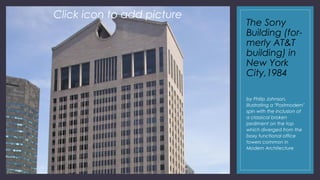
The Sony
Building (for-
merly AT&T
building) in
New York
City,1984
Click icon to add picture
by Philip Johnson,
illustrating a "Postmodern"
spin with the inclusion of
a classical broken
pediment on the top
which diverged from the
boxy functional office
towers common in
Modern Architecture
RELATIONSHIP TO PREVIOUS STYLES
• These architects turned towards the past, quoting past aspects
of various buildings and melding them together (even
sometimes in an inharmonious manner) to create a new
means of designing buildings.
• In Modernism, the traditional column (as a design feature) was
treated as a cylindrical pipe form.
• The revival of the column was an aesthetic, rather than a
technological necessity.
• Terra cotta decorative façades and bronze or stainless steel
embellishments of the Beaux-Arts and Art Deco periods.
• Contextualism is centered on the belief that all knowledge is
“context-sensitive”.
• postmodern architecture often addressed the context in terms
of the materials, forms and details of the buildings around it—
the cultural context.
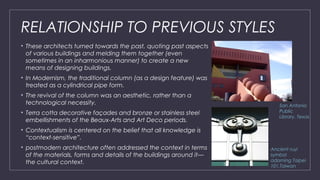
San Antonio
Public
Library, Texas
Ancient ruyi
symbol
adorning Taipei
101,Taiwan
ROOTS OF POSTMODERNISM
• The Postmodernist movement is often seen (especially in the USA) as
an American movement, starting in America around the 1960s–1970s
and then spreading to Europe and the rest of the world, to remain
right through to the present.
• The job of defining Postmodernism was subsequently taken over by
a younger generation who welcomed rather than rejected what
they saw happening and, in the case of Robert Venturi, contributed
to it.
• The aims of Postmodernism or Late-modernism begin with its
reaction to Modernism.
• Many felt the buildings failed to meet the human need for comfort
both for body and for the eye, that modernism did not account for
the desire for beauty.
• In response, architects sought to reintroduce ornament, color,
decoration and human scale to buildings. Form was no longer to be
defined solely by its functional requirements or minimal appearance.
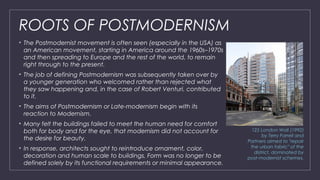
125 London Wall (1992)
by Terry Farrell and
Partners aimed to "repair
the urban fabric" of the
district, dominated by
post-modernist schemes.
CHANGING THE CONCEPT
• Robert Venturi was at the forefront of the postmodern movement.
• His book, Complexity and Contradiction in Architecture (published in 1966), was instrumental in
opening readers eyes to new ways of thinking about buildings, as it drew from the entire history of
architecture—both high-style and vernacular, both historic and modern—and criticizing overly
simplistic Functional Modernism.
• He explains this and his criticism of Modernism in his Complexity and Contradiction in Architecture by
saying that
Architects can bemoan or try to ignore them (referring to the ornamental and decorative elements in
buildings) or even try to abolish them, but they will not go away. Or they will not go away for a long time,
because architects do not have the power to replace them (nor do they know what to replace them
with).
• Venturi's second book, Learning from Las Vegas (1972) further developed his take on modernism. Co-
authored with his wife, Denise Scott Brown, and Steven Izenour, Learning from Las Vegas argues that
ornamental and decorative elements “accommodate existing needs for variety and communication”
AIMS & CHARACTERSTICS
• solving the problems of Modernism, and
sensitivity for the building’s context.  use of
sculptural forms, ornaments, and materials
which perform illusions.
•  These physical characteristics are
combined with conceptual characteristics
of meaning.
• These characteristics of meaning include
pluralism, double understanding, high
ceilings etc.
• The sculptural forms, not necessarily organic,
were created with much passion.
• did not exclude the needs of humans from
the building, yet it must not cause the visitor
to become depressed.
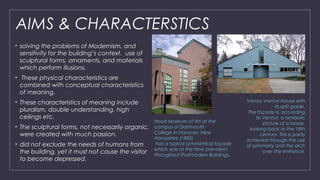
Vanna Venturi House with
its split gable.
The façade is, according
to Venturi, a symbolic
picture of a house,
looking back to the 18th
century. This is partly
achieved through the use
of symmetry and the arch
over the entrance.
Hood Museum of Art at the
campus of Dartmouth
College in Hanover, New
Hampshire (1983)
has a typical symmetrical façade
which was at the time prevalent
throughout Postmodern Buildings.
INFLUENTIAL ARCHITECTS
•Michael Graves
•Philip Johnson
•Charles Moore
•I.M. Pei
•Robert Venturi
•Frank Ghery
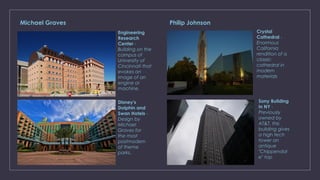
Michael Graves
Engineering
Research
Center -
Building on the
campus of
University of
Cincinnati that
evokes an
image of an
engine or
machine.
Disney's
Dolphin and
Swan Hotels -
Design by
Michael
Graves for
the most
postmodern
of theme
parks.
Sony Building
in NY -
Previously
owned by
AT&T, this
building gives
a high tech
tower an
antique
"Chippendal
e" top
Crystal
Cathedral -
Enormous
California
rendition of a
classic
cathedral in
modern
materials
Philip Johnson
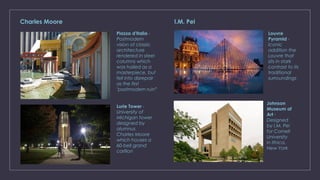
Charles Moore
Lurie Tower -
University of
Michigan tower
designed by
alumnus
Charles Moore
which houses a
60-bell grand
carillon
Piazza d'Italia -
Postmodern
vision of classic
architecture
rendered in steel
columns which
was hailed as a
masterpiece, but
fell into disrepair
as the first
"postmodern ruin"
Johnson
Museum of
Art -
Designed
by I.M. Pei
for Cornell
University
in Ithica,
New York
Louvre
Pyramid -
Iconic
addition the
Louvre that
sits in stark
contrast to its
traditional
surroundings
I.M. Pei
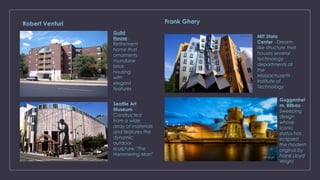
Robert Venturi
Guild
House -
Retirement
home that
ornaments
mundane
brick
housing
with
elegant
features
Seattle Art
Museum -
Constructed
from a wide
array of materials
and features the
dynamic
outdoor
sculpture: "The
Hammering Man"
Guggenhei
m, Bilbao -
Sweeping
design
whose
iconic
status has
eclipsed
the modern
original by
Frank Lloyd
Wright
MIT Stata
Center - Dream-
like structure that
houses several
technology
departments at
the
Massachusetts
Institute of
Technology
Frank Ghery
THANKYOU
RRFERENCES
https://en.wikipedia.org/wiki/Postmodern_architecture
http://www.onpostmodernism.com/architecture
https://www.flickr.com/photos

Post modernism

  • 1.
    C Post-modern architecture NAR-607 HISTORY OFARCHITECTURE B.ARCH. 6TH SEMESTER SECTION-A SUNDER DEEP COLLEGE OF ARCHITECTURE SUBMITTED TO: AR.ASHISH SIR SESSION: 2015-16 SUBMITTED BY: ANSHIKA JUHI ABHISHEK RASTOGI ALEXJENDAR DIVYA
  • 2.
    INTRODUCTION • An internationalstyle from the 1950s, but become a movement until the late 1970s. • Return of "WIT(intelligent humor), ORNAMENT AND REFERENCE(past sources)“. • The functional and formalized shapes and spaces of the modernist style are replaced by diverse aesthetics. • Architects rediscovered past architectural ornament and forms which had been abstracted by the Modernist Architects. • modernism is rooted in minimal and true use of material as well as absence of ornament. • While postmodernism is a rejection of strict rules set by the early modernist and seeks meaning and expression in the use of building techniques, forms, and stylistic references. • Venturi ( postmodernist) opined that "LESS IS A BORE", inverting Mies Van Der Rohe's (modernist) dictum that "LESS IS MORE“.
  • 3.
    The Sony Building (for- merly AT&T building) in NewYork City,1984 Click icon to add picture by Philip Johnson, illustrating a "Postmodern" spin with the inclusion of a classical broken pediment on the top which diverged from the boxy functional office towers common in Modern Architecture
  • 4.
    RELATIONSHIP TO PREVIOUSSTYLES • These architects turned towards the past, quoting past aspects of various buildings and melding them together (even sometimes in an inharmonious manner) to create a new means of designing buildings. • In Modernism, the traditional column (as a design feature) was treated as a cylindrical pipe form. • The revival of the column was an aesthetic, rather than a technological necessity. • Terra cotta decorative façades and bronze or stainless steel embellishments of the Beaux-Arts and Art Deco periods. • Contextualism is centered on the belief that all knowledge is “context-sensitive”. • postmodern architecture often addressed the context in terms of the materials, forms and details of the buildings around it— the cultural context. San Antonio Public Library, Texas Ancient ruyi symbol adorning Taipei 101,Taiwan
  • 5.
    ROOTS OF POSTMODERNISM •The Postmodernist movement is often seen (especially in the USA) as an American movement, starting in America around the 1960s–1970s and then spreading to Europe and the rest of the world, to remain right through to the present. • The job of defining Postmodernism was subsequently taken over by a younger generation who welcomed rather than rejected what they saw happening and, in the case of Robert Venturi, contributed to it. • The aims of Postmodernism or Late-modernism begin with its reaction to Modernism. • Many felt the buildings failed to meet the human need for comfort both for body and for the eye, that modernism did not account for the desire for beauty. • In response, architects sought to reintroduce ornament, color, decoration and human scale to buildings. Form was no longer to be defined solely by its functional requirements or minimal appearance. 125 London Wall (1992) by Terry Farrell and Partners aimed to "repair the urban fabric" of the district, dominated by post-modernist schemes.
  • 6.
    CHANGING THE CONCEPT •Robert Venturi was at the forefront of the postmodern movement. • His book, Complexity and Contradiction in Architecture (published in 1966), was instrumental in opening readers eyes to new ways of thinking about buildings, as it drew from the entire history of architecture—both high-style and vernacular, both historic and modern—and criticizing overly simplistic Functional Modernism. • He explains this and his criticism of Modernism in his Complexity and Contradiction in Architecture by saying that Architects can bemoan or try to ignore them (referring to the ornamental and decorative elements in buildings) or even try to abolish them, but they will not go away. Or they will not go away for a long time, because architects do not have the power to replace them (nor do they know what to replace them with). • Venturi's second book, Learning from Las Vegas (1972) further developed his take on modernism. Co- authored with his wife, Denise Scott Brown, and Steven Izenour, Learning from Las Vegas argues that ornamental and decorative elements “accommodate existing needs for variety and communication”
  • 7.
    AIMS & CHARACTERSTICS •solving the problems of Modernism, and sensitivity for the building’s context.  use of sculptural forms, ornaments, and materials which perform illusions. •  These physical characteristics are combined with conceptual characteristics of meaning. • These characteristics of meaning include pluralism, double understanding, high ceilings etc. • The sculptural forms, not necessarily organic, were created with much passion. • did not exclude the needs of humans from the building, yet it must not cause the visitor to become depressed. Vanna Venturi House with its split gable. The façade is, according to Venturi, a symbolic picture of a house, looking back to the 18th century. This is partly achieved through the use of symmetry and the arch over the entrance. Hood Museum of Art at the campus of Dartmouth College in Hanover, New Hampshire (1983) has a typical symmetrical façade which was at the time prevalent throughout Postmodern Buildings.
  • 8.
    INFLUENTIAL ARCHITECTS •Michael Graves •PhilipJohnson •Charles Moore •I.M. Pei •Robert Venturi •Frank Ghery
  • 9.
    Michael Graves Engineering Research Center - Building onthe campus of University of Cincinnati that evokes an image of an engine or machine. Disney's Dolphin and Swan Hotels - Design by Michael Graves for the most postmodern of theme parks. Sony Building in NY - Previously owned by AT&T, this building gives a high tech tower an antique "Chippendal e" top Crystal Cathedral - Enormous California rendition of a classic cathedral in modern materials Philip Johnson
  • 10.
    Charles Moore Lurie Tower - Universityof Michigan tower designed by alumnus Charles Moore which houses a 60-bell grand carillon Piazza d'Italia - Postmodern vision of classic architecture rendered in steel columns which was hailed as a masterpiece, but fell into disrepair as the first "postmodern ruin" Johnson Museum of Art - Designed by I.M. Pei for Cornell University in Ithica, New York Louvre Pyramid - Iconic addition the Louvre that sits in stark contrast to its traditional surroundings I.M. Pei
  • 11.
    Robert Venturi Guild House - Retirement home that ornaments mundane brick housing with elegant features SeattleArt Museum - Constructed from a wide array of materials and features the dynamic outdoor sculpture: "The Hammering Man" Guggenhei m, Bilbao - Sweeping design whose iconic status has eclipsed the modern original by Frank Lloyd Wright MIT Stata Center - Dream- like structure that houses several technology departments at the Massachusetts Institute of Technology Frank Ghery
  • 12.