PABLO PICASSO

  BIOGRAPHY
• Born October 25, 1881, in Malaga, Spain, Pablo Picasso, became
  one of the greatest and most influential artists of the 20th century
  and the creator (with Georges Braque) of Cubism. A Spanish
  expatriate painter, sculptor, printmaker, ceramicist, and stage
  designer, Picasso was considered radical in his work. After a long
  prolific career, he died April 8, 1973 in Mougins, France.
• For nearly 80 of his 91 years Picasso
  devoted himself to an artistic production
  that contributed significantly to the whole
  development of modern art in the 20th
  century.
• Picasso's mother was Doña Maria Picasso y
  Lopez and his father was Don José Ruiz
  Blasco, a painter and art teacher.
• "When I was a child, my mother said to me, 'If you
  become a soldier, you'll be a general. If you become a
  monk you'll end up as the pope.' Instead I became a
  painter and wound up as Picasso."
• Picasso displayed a prodigious
                                                    talent for drawing from a very
                                                    young age.

                                                  • According to legend, his first
                                                    words were "piz, piz," his
                                                    childish attempt at lápiz, the
                                                    Spanish word for pencil.

                                                  • By the time he was 13 years
                                                    old his paintings were already
                                                    better executed than his
                                                    father's.
Le Picador, 1890
Pablo was nine years old when he completed this
painting!
• When Picasso was fourteen
  years old, his family moved to
  Barcelona and he immediately
  applied to the city's prestigious
  School of Fine Arts.

• Although the school typically
  only accepted students several
  years his senior, Picasso's
  entrance exam was so
  extraordinary that the school
  made an exception and
  admitted him immediately.
• Years later, in Barcelona, he joined a crowd
  of artists and intellectuals who made their
  headquarters at a café called El Quatre
  Gats.

• Inspired by the anarchists and radicals he
  met there, Picasso made his decisive break
  with the classical methods in which he had
  been trained and began a lifelong process of
  experimentation and innovation.
• At the turn of the
  twentieth century,
  Picasso moved to Paris,
  the cultural center of
  Europe.
• Art critics and historians
  typically break Picasso's
  adult career into distinct
  periods. The first of these,
  which lasted from
  1901-1904, is called his
  Blue Period after the color
  that dominated nearly all of
  Picasso's paintings during
  these years.
BLUE PERIOD
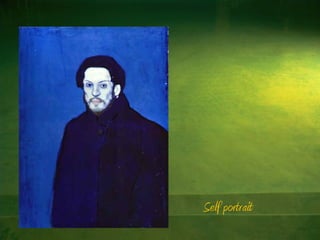
• Lonely and deeply depressed over the death of
  his close friend Carlos Casagemas, he painted
  scenes of poverty, isolation and anguish using
  almost exclusively blues and greens.
• Blue dominates the paintings.
• Marvelous expression of poetic subtlety
• Picasso's style from classicism to abstract art.
Self portrait
The old guitarrist
1903
Blue nude
Woman with Her Arms Crossed, 1903
ROSE PERIOD

• By 1905, Picasso had largely overcome his
  depression of the previous years.

• The artistic manifestation of Picasso's
  improved spirits was the introduction of
  warmer colors like beiges, pinks and reds in
  what is known as his Rose Period.
This is a
happier
period,
Picasso paints
clowns and
circus scenes
using brighter
colours.

Family at
Saltimbanques (1905)
Gertrude Stein (1905-1906)
Two Nudes (1906).
Acrobat
and Young Harlequin,
1906
• In 1907, Picasso produced a painting unlike
  anything he or anyone else had ever painted before,
  a work that would profoundly influence the
  direction of art in the twentieth century: Les
  Demoiselles d'Avignon, a chilling depiction
  of five beige figures, prostitutes, abstracted and
  distorted with sharp geometric features and stark
  blotches of blues, greens and grays.
• Les Demoiselles d'Avignon is considered the
  precursor and inspiration of Cubism, an artistic
  style pioneered by Picasso and Georges Braque.
Aspect 3: Black Period
              1906-1907
• Influenced by African art, on which
  he bases a series of drawings,
  paintings and woodcarvings
1907- Cubism
• In Cubist paintings, objects are broken apart
  and reassembled in an abstracted form,
  highlighting their composite geometric
  shapes and depicting the object from
  multiple viewpoints at once to create
  physics-defying, collage-like effects.
Three Women (1907)
Bread and Fruit Dish on a Table
 (1909)
Girl with Mandolin (1910)
Still Life with Chair Caning (1912)
Card Player (1913-1914)
Three Musicians (1921)
CLASSIC PERIOD
• Picasso's works between 1918-1927 are
  considered his Classical Period, a brief
  return to realism in a career otherwise
  dominated by experimentation. His most
  interesting and important works from this
  period are…Three Women at the
  Spring (1921), Two Women Running on the
  Beach/The Race (1922) and The Pipes of
  Pan (1923).
Three women at spring
(1921)
Two women running on the beach/ the race (1922)
Te pipes of pan (1923)
Surrealism (expressionism)
• From 1927 onward, Picasso was caught up
  in a new philosophical and cultural
  movement, Surrealism, whose artistic
  manifestation was an offspring of his own
  Cubism.
• Picasso's greatest surrealistic painting, one
  of the greatest paintings of all time, was
  completed in 1937, this painting is…
Guernica (1937)
Picasso shows his hate of war and the bombing of
Guernica’s population during the Spanish civil war
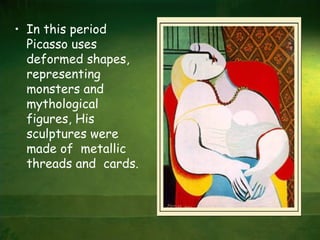
• In this period
  Picasso uses
  deformed shapes,
  representing
  monsters and
  mythological
  figures, His
  sculptures were
  made of metallic
  threads and cards.
• In the aftermath of World War II, Picasso
  became more overtly political. He joined
  the Communist Party and was twice
  honored with the International Lenin Peace
  Prize, once in 1950 and again in 1961. By
  this point in his life, Picasso was also an
  international celebrity, the world's most
  famous living artist.
Pablo Picasso Says...
"Every child is an artist. The problem is
 how to remain an artist once he grows
                   up."
Upon passing a group of school kids in his old age Picasso
remarked, "When I was as old as these children, I could draw
like Raphael, but it took me a lifetime to learn to draw like
them."
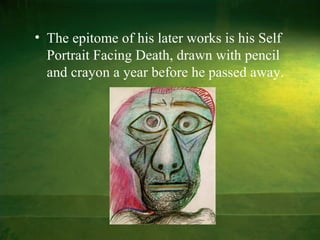
• The epitome of his later works is his Self
  Portrait Facing Death, drawn with pencil
  and crayon a year before he passed away.
• Picasso was an incorrigible womanizer who had
  countless relationships with girlfriends, mistresses,
  muses and prostitutes over the course of his long life.
• However, he had only two wives. He married a
  ballerina named Olga Khokhlova in 1918, and they
  remained together for nine years before parting ways
  in 1927. He married his second wife, Jacqueline
  Roque, at the age of 69 in 1961.
• Picasso had four children: Paul, Maya, Claude and
  Paloma.
• He passed away on April 8, 1973 at the age of 91.
The total number of works of art he produced has been estimated
at 50,000
 1,885 paintings; 1,228 sculptures; 2,880 ceramics, about
12,000 drawings, many thousands of prints, and numerous
tapestries and rugs!

• The most expensive
  painting ever sold was
  this one by Picasso. In
  2004 it was sold for
• $104 million!!!!
Pablo picasso

Pablo picasso

  • 1.
    PABLO PICASSO BIOGRAPHY
  • 2.
    • Born October25, 1881, in Malaga, Spain, Pablo Picasso, became one of the greatest and most influential artists of the 20th century and the creator (with Georges Braque) of Cubism. A Spanish expatriate painter, sculptor, printmaker, ceramicist, and stage designer, Picasso was considered radical in his work. After a long prolific career, he died April 8, 1973 in Mougins, France.
  • 3.
    • For nearly80 of his 91 years Picasso devoted himself to an artistic production that contributed significantly to the whole development of modern art in the 20th century.
  • 4.
    • Picasso's motherwas Doña Maria Picasso y Lopez and his father was Don José Ruiz Blasco, a painter and art teacher.
  • 5.
    • "When Iwas a child, my mother said to me, 'If you become a soldier, you'll be a general. If you become a monk you'll end up as the pope.' Instead I became a painter and wound up as Picasso."
  • 6.
    • Picasso displayeda prodigious talent for drawing from a very young age. • According to legend, his first words were "piz, piz," his childish attempt at lápiz, the Spanish word for pencil. • By the time he was 13 years old his paintings were already better executed than his father's. Le Picador, 1890 Pablo was nine years old when he completed this painting!
  • 7.
    • When Picassowas fourteen years old, his family moved to Barcelona and he immediately applied to the city's prestigious School of Fine Arts. • Although the school typically only accepted students several years his senior, Picasso's entrance exam was so extraordinary that the school made an exception and admitted him immediately.
  • 8.
    • Years later,in Barcelona, he joined a crowd of artists and intellectuals who made their headquarters at a café called El Quatre Gats. • Inspired by the anarchists and radicals he met there, Picasso made his decisive break with the classical methods in which he had been trained and began a lifelong process of experimentation and innovation.
  • 9.
    • At theturn of the twentieth century, Picasso moved to Paris, the cultural center of Europe.
  • 10.
    • Art criticsand historians typically break Picasso's adult career into distinct periods. The first of these, which lasted from 1901-1904, is called his Blue Period after the color that dominated nearly all of Picasso's paintings during these years.
  • 11.
    BLUE PERIOD • Lonelyand deeply depressed over the death of his close friend Carlos Casagemas, he painted scenes of poverty, isolation and anguish using almost exclusively blues and greens. • Blue dominates the paintings. • Marvelous expression of poetic subtlety • Picasso's style from classicism to abstract art.
  • 12.
  • 13.
  • 14.
  • 15.
    Woman with HerArms Crossed, 1903
  • 16.
    ROSE PERIOD • By1905, Picasso had largely overcome his depression of the previous years. • The artistic manifestation of Picasso's improved spirits was the introduction of warmer colors like beiges, pinks and reds in what is known as his Rose Period.
  • 17.
    This is a happier period, Picassopaints clowns and circus scenes using brighter colours. Family at Saltimbanques (1905)
  • 18.
  • 19.
  • 20.
  • 21.
    • In 1907,Picasso produced a painting unlike anything he or anyone else had ever painted before, a work that would profoundly influence the direction of art in the twentieth century: Les Demoiselles d'Avignon, a chilling depiction of five beige figures, prostitutes, abstracted and distorted with sharp geometric features and stark blotches of blues, greens and grays. • Les Demoiselles d'Avignon is considered the precursor and inspiration of Cubism, an artistic style pioneered by Picasso and Georges Braque.
  • 23.
    Aspect 3: BlackPeriod 1906-1907 • Influenced by African art, on which he bases a series of drawings, paintings and woodcarvings
  • 24.
    1907- Cubism • InCubist paintings, objects are broken apart and reassembled in an abstracted form, highlighting their composite geometric shapes and depicting the object from multiple viewpoints at once to create physics-defying, collage-like effects.
  • 25.
  • 26.
    Bread and FruitDish on a Table  (1909)
  • 27.
  • 28.
    Still Life withChair Caning (1912)
  • 29.
  • 30.
  • 31.
    CLASSIC PERIOD • Picasso'sworks between 1918-1927 are considered his Classical Period, a brief return to realism in a career otherwise dominated by experimentation. His most interesting and important works from this period are…Three Women at the Spring (1921), Two Women Running on the Beach/The Race (1922) and The Pipes of Pan (1923).
  • 32.
    Three women atspring (1921)
  • 33.
    Two women runningon the beach/ the race (1922)
  • 34.
    Te pipes ofpan (1923)
  • 35.
    Surrealism (expressionism) • From1927 onward, Picasso was caught up in a new philosophical and cultural movement, Surrealism, whose artistic manifestation was an offspring of his own Cubism. • Picasso's greatest surrealistic painting, one of the greatest paintings of all time, was completed in 1937, this painting is…
  • 36.
    Guernica (1937) Picasso showshis hate of war and the bombing of Guernica’s population during the Spanish civil war
  • 37.
    • In thisperiod Picasso uses deformed shapes, representing monsters and mythological figures, His sculptures were made of metallic threads and cards.
  • 38.
    • In theaftermath of World War II, Picasso became more overtly political. He joined the Communist Party and was twice honored with the International Lenin Peace Prize, once in 1950 and again in 1961. By this point in his life, Picasso was also an international celebrity, the world's most famous living artist.
  • 40.
    Pablo Picasso Says... "Everychild is an artist. The problem is how to remain an artist once he grows up."
  • 41.
    Upon passing agroup of school kids in his old age Picasso remarked, "When I was as old as these children, I could draw like Raphael, but it took me a lifetime to learn to draw like them."
  • 42.
    • The epitomeof his later works is his Self Portrait Facing Death, drawn with pencil and crayon a year before he passed away.
  • 43.
    • Picasso wasan incorrigible womanizer who had countless relationships with girlfriends, mistresses, muses and prostitutes over the course of his long life. • However, he had only two wives. He married a ballerina named Olga Khokhlova in 1918, and they remained together for nine years before parting ways in 1927. He married his second wife, Jacqueline Roque, at the age of 69 in 1961. • Picasso had four children: Paul, Maya, Claude and Paloma. • He passed away on April 8, 1973 at the age of 91.
  • 44.
    The total numberof works of art he produced has been estimated at 50,000 1,885 paintings; 1,228 sculptures; 2,880 ceramics, about 12,000 drawings, many thousands of prints, and numerous tapestries and rugs! • The most expensive painting ever sold was this one by Picasso. In 2004 it was sold for • $104 million!!!!