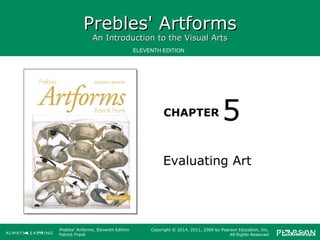
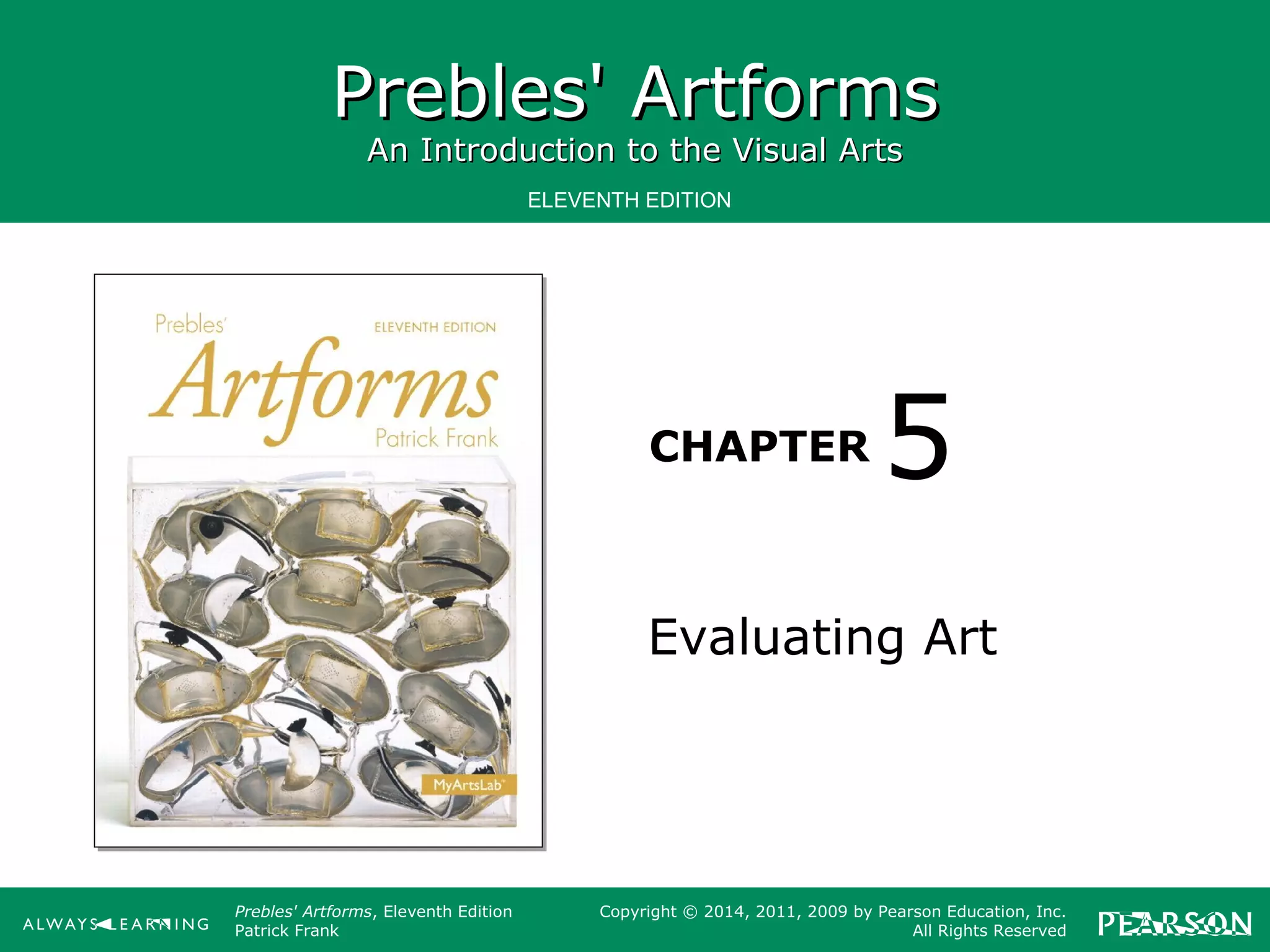
Prebles' ArtformsPrebles' Artforms
An Introduction to the Visual ArtsAn Introduction to the Visual Arts
CHAPTER
ELEVENTH EDITION
Prebles' Artforms, Eleventh Edition
Patrick Frank
Copyright © 2014, 2011, 2009 by Pearson Education, Inc.
All Rights Reserved
Evaluating Art
5
Prebles' Artforms, Eleventh Edition
Patrick Frank
Copyright © 2014, 2011, 2009 by Pearson Education, Inc.
All Rights Reserved
Learning ObjectivesLearning Objectives
1. Discuss the subjective biases involved in
evaluating a work of art.
2. Compare formal, contextual, and expressive
approaches used in art criticism.
3. Examine the relationship of art’s economic,
cultural, and personal value to issues of quality
and social context.
4. Combine factual, analytical, and evaluative
information to write an essay about an artwork.
5. Explain censorship as a type of evaluation,
based on political, moral, or religious values.
Prebles' Artforms, Eleventh Edition
Patrick Frank
Copyright © 2014, 2011, 2009 by Pearson Education, Inc.
All Rights Reserved
EvaluationEvaluation
• Selecting one thing over another
 Includes the creative process
• Appreciating the specialness of
something
• Quality
 Relative between people and cultures
 Simply “skillful” vs. communication of a
“life breath” in Chinese culture
 Changing reputations in Europe
Prebles' Artforms, Eleventh Edition
Patrick Frank
Copyright © 2014, 2011, 2009 by Pearson Education, Inc.
All Rights Reserved
EvaluationEvaluation
• Value judgments necessarily involve
subjectivity.
 Shy Glance, Jingagian
• Recovered from a trash bin
• Lacking skill but embarrassingly sweet
 Self-Portrait, Vigée-LeBrun
• Great assuredness of anatomy
• May seem conventional to the
contemporary eye
Prebles' Artforms, Eleventh Edition
Patrick Frank
Copyright © 2014, 2011, 2009 by Pearson Education, Inc.
All Rights Reserved
Dawn Marie Jingagian. Shy Glance. 1976.
Acrylic on canvas. 24" × 18".
The Museum of Bad Art, Dedham, MA. [Fig. 5-1]
Prebles' Artforms, Eleventh Edition
Patrick Frank
Copyright © 2014, 2011, 2009 by Pearson Education, Inc.
All Rights Reserved
Marie Louise Elisabeth Vigée-LeBrun. Self-Portrait in a Straw Hat. 1782.
Oil on canvas. 38-1/2" × 27-3/4".
The National Gallery, London ng1653. © 2013. Copyright The National Gallery,
London/Scala, Florence. [Fig. 5-2]
Prebles' Artforms, Eleventh Edition
Patrick Frank
Copyright © 2014, 2011, 2009 by Pearson Education, Inc.
All Rights Reserved
EvaluationEvaluation
• What we find in a work depends on
what we are looking for.
 Personal value judgments
 Involves viewer’s personality
• Begin with an open mind to go beyond
snap judgments
• Practice seeing rather than looking
Prebles' Artforms, Eleventh Edition
Patrick Frank
Copyright © 2014, 2011, 2009 by Pearson Education, Inc.
All Rights Reserved
Art CriticismArt Criticism
• Making discriminating judgments, both
favorable and unfavorable
• Three basic theories
 Formal
• Looking at how a work is made
• Parts of a composition coming together
• Organization most important factor
• Values innovation in style above all
• Comparison to a work’s contemporaries
Prebles' Artforms, Eleventh Edition
Patrick Frank
Copyright © 2014, 2011, 2009 by Pearson Education, Inc.
All Rights Reserved
Art CriticismArt Criticism
• Three basic theories
 Formal
• Titian’s Pietà
• Innovative brushwork
• Understood predecessors’ methods and
made his brushwork more painterly
• Bold new compositional devices
• Delaunay-Terk, Simultaneous Contrasts
• Influenced by Cubism but without
overlapping planes
Prebles' Artforms, Eleventh Edition
Patrick Frank
Copyright © 2014, 2011, 2009 by Pearson Education, Inc.
All Rights Reserved
Titian. Pietà. 1576.
Oil on canvas. 149" × 136".
Accademia, Venice. © Cameraphoto Arte, Venice. [Fig. 5-3]
Closer Look: Titian, Pietà
Video: Students on Site:
Titian, Pietà
Prebles' Artforms, Eleventh Edition
Patrick Frank
Copyright © 2014, 2011, 2009 by Pearson Education, Inc.
All Rights Reserved
Sonia Delaunay-Terk. Simultaneous Contrasts. 1913.
Oil on canvas. 18-1/2" × 21-1/2".
Museo Thyssen-Bornemisza, Madrid. 518 (1976.81). Photo Museo Thyssen-
Bornemisza/Scala, Florence © Pracusa. 2013020. [Fig. 5-4]
Prebles' Artforms, Eleventh Edition
Patrick Frank
Copyright © 2014, 2011, 2009 by Pearson Education, Inc.
All Rights Reserved
Art CriticismArt Criticism
• Three basic theories
 Formal
• Delaunay-Terk, Simultaneous Contrasts
• Novel treatment of landscape as subject
• Basquiat, Horn Players
• Techniques learned from graffiti
• Three panels avoid making the work seem
like separate paintings
• May look improvised, but result of
discipline
Prebles' Artforms, Eleventh Edition
Patrick Frank
Copyright © 2014, 2011, 2009 by Pearson Education, Inc.
All Rights Reserved
Jean-Michel Basquiat. Horn Players. 1983.
Acrylic and oil paintstick on three canvas panels. Overall 8' × 6' 5".
The Broad Art Foundation, Santa Monica. Photograph: Douglas M. Parker Studio,
Los Angeles. © The Estate of Jean-Michel Basquiat/ADAGP, Paris/ARS, New York 2013.
[Fig. 5-5]
Prebles' Artforms, Eleventh Edition
Patrick Frank
Copyright © 2014, 2011, 2009 by Pearson Education, Inc.
All Rights Reserved
Art CriticismArt Criticism
• Three basic theories
 Contextual
• First examines environmental influences
on a work of art
• Economic system
• Cultural values
• Politics
• “What else was going on at the time?”
Prebles' Artforms, Eleventh Edition
Patrick Frank
Copyright © 2014, 2011, 2009 by Pearson Education, Inc.
All Rights Reserved
Art CriticismArt Criticism
• Three basic theories
 Contextual
• Pietà
• Altarpiece for public viewing in a chapel
• During a time of epidemic of plague
- Mortality and grief
• Simultaneous Contrasts
• Seems to be a sunlit landscape
• Scientist Michel-Eugène Chevreul’s
research, “Law of Simultaneous Contrasts”
Prebles' Artforms, Eleventh Edition
Patrick Frank
Copyright © 2014, 2011, 2009 by Pearson Education, Inc.
All Rights Reserved
Art CriticismArt Criticism
• Three basic theories
 Contextual
• Horn Players
• Bebop movement of jazz in 1940s
• Cut-off ear representing Charlie Parker
being “cut off” in his prime, mirroring van
Gogh
• “Ornithology,” a track recorded by Parker
and Dizzy Gillespie
Prebles' Artforms, Eleventh Edition
Patrick Frank
Copyright © 2014, 2011, 2009 by Pearson Education, Inc.
All Rights Reserved
Art CriticismArt Criticism
• Three basic theories
 Expressive
• “Who made it, and who is s/he?”
• Look for personal meanings, deep
psychological insight, or human concern
• Psychoanalysis and gender studies
• Pietà
• Painted in Titian’s last year of life
• Somber reflection of mortality
Prebles' Artforms, Eleventh Edition
Patrick Frank
Copyright © 2014, 2011, 2009 by Pearson Education, Inc.
All Rights Reserved
Art CriticismArt Criticism
• Three basic theories
 Expressive
• Simultaneous Contrasts
• Compared to artist’s ebullient personality
• Color palette recalls bright folk costumes
of native Ukraine
• Horn Players
• Like a three-verse song
• Artist’s history as an African American
• Intent and intense personality
Prebles' Artforms, Eleventh Edition
Patrick Frank
Copyright © 2014, 2011, 2009 by Pearson Education, Inc.
All Rights Reserved
What Makes Art Great?What Makes Art Great?
• Art market and art auctions can only
show what a certain group of collectors
wants to pay for a given work at a
given time.
 Record-holding $119.9 million for
Edvard Munch’s The Scream
• Dollar values only loosely correlate with
historical importance or innovation of a
work.
Prebles' Artforms, Eleventh Edition
Patrick Frank
Copyright © 2014, 2011, 2009 by Pearson Education, Inc.
All Rights Reserved
What Makes Art Great?What Makes Art Great?
• At least one element of art criticism
must be strongly present for it to be
regarded as a “masterpiece.”
 Museum
• Self-examination can uncover why a
viewer values a work as “great.”
 Why we “relate” to art in the context of
the three art criticism theories
Prebles' Artforms, Eleventh Edition
Patrick Frank
Copyright © 2014, 2011, 2009 by Pearson Education, Inc.
All Rights Reserved
Evaluating Art with WordsEvaluating Art with Words
• Methods to write about art
1. Get the facts about the work.
• Name of creator, title, date, subject,
medium, size, and location of work
• If reproduction, clarify original medium
and size
1. Analyze.
• Parts of work and how they fit together
• Formal elements, context, artist’s input
Prebles' Artforms, Eleventh Edition
Patrick Frank
Copyright © 2014, 2011, 2009 by Pearson Education, Inc.
All Rights Reserved
Evaluating Art with WordsEvaluating Art with Words
• Methods to write about art
3. Evaluate.
• Assess the quality or importance of the
work in relation to art criticism technique
• Innovative
• “Moves your feelings”
• Reflects time period or personality
• Beautiful or challenging to the eye
• This step should lead to a debatable
thesis.
Prebles' Artforms, Eleventh Edition
Patrick Frank
Copyright © 2014, 2011, 2009 by Pearson Education, Inc.
All Rights Reserved
Censorship: The UltimateCensorship: The Ultimate
EvaluationEvaluation
• The alteration or removal of works of
art from public view
• Carried out for religious, moral, or
political reasons
 Artist’s freedom takes back seat to
values of civil authorities
• Practiced over history
 Byzantine Empire and the Iconoclastic
Controversy destroying religious images
Prebles' Artforms, Eleventh Edition
Patrick Frank
Copyright © 2014, 2011, 2009 by Pearson Education, Inc.
All Rights Reserved
Censorship: The UltimateCensorship: The Ultimate
EvaluationEvaluation
• Practiced over history
 The Last Judgment, Michelangelo
• Later popes found figures to be revealing
and order loincloths to be painted over
genitals.
 Nazi Germany
• Confiscation of over 16,000 modern art
pieces
• Artists banned from working
Prebles' Artforms, Eleventh Edition
Patrick Frank
Copyright © 2014, 2011, 2009 by Pearson Education, Inc.
All Rights Reserved
Censorship: The UltimateCensorship: The Ultimate
EvaluationEvaluation
• In the United States
 Miller v. California (1973)
• Work may only be censored if it is
demonstrably obscene to the “average
person.”
 Freedom of individual expression valued
• If a work benefits from public funds, may
be controversial
Prebles' Artforms, Eleventh Edition
Patrick Frank
Copyright © 2014, 2011, 2009 by Pearson Education, Inc.
All Rights Reserved
Censorship: The UltimateCensorship: The Ultimate
EvaluationEvaluation
• In the United States
 NYC Mayor Giuliani, 1999, tried to close
the Brooklyn Museum because of Chris
Ofili’s Holy Virgin Mary.
• Elephant dung in the piece
• Offensive to Roman Catholicism
• An art medium in certain African cultures
 Nudity controversy
• 2010, YouTube and Amy Greenfield
Prebles' Artforms, Eleventh Edition
Patrick Frank
Copyright © 2014, 2011, 2009 by Pearson Education, Inc.
All Rights Reserved
Chris Ofili. Holy Virgin Mary. 1996.
Acrylic, oil, resin, paper collage, glitter, map pins, and elephant dung on linen. 8' × 6'.
MONA, Museum of Old and New Art, Hobart, Tasmania, Australia.
Courtesy Victoria Miro Gallery, London © Chris Ofili. [Fig. 5-6]
Prebles' Artforms, Eleventh Edition
Patrick Frank
Copyright © 2014, 2011, 2009 by Pearson Education, Inc.
All Rights Reserved
Censorship: The UltimateCensorship: The Ultimate
EvaluationEvaluation
• In the United States
 Nudity controversy
• 2011, Facebook and drawings of models
from the New York Academy of Art
 Political censorship in Maine, 2011
• Mural from the Labor Department
• Showed bias toward organized labor
• Implied a bias against business
• Defense that it is not one-sided but
based in historical fact
Prebles' Artforms, Eleventh Edition
Patrick Frank
Copyright © 2014, 2011, 2009 by Pearson Education, Inc.
All Rights Reserved
Judy Taylor. History of Labor in Maine. 2007.
Oil on particle board, eleven joined panels. 8' × 36'.
Courtesy of Judy Taylor Studio. [Fig. 5-7]

3b evaluating art

  • 1.
    Prebles' ArtformsPrebles' Artforms AnIntroduction to the Visual ArtsAn Introduction to the Visual Arts CHAPTER ELEVENTH EDITION Prebles' Artforms, Eleventh Edition Patrick Frank Copyright © 2014, 2011, 2009 by Pearson Education, Inc. All Rights Reserved Evaluating Art 5
  • 2.
    Prebles' Artforms, EleventhEdition Patrick Frank Copyright © 2014, 2011, 2009 by Pearson Education, Inc. All Rights Reserved Learning ObjectivesLearning Objectives 1. Discuss the subjective biases involved in evaluating a work of art. 2. Compare formal, contextual, and expressive approaches used in art criticism. 3. Examine the relationship of art’s economic, cultural, and personal value to issues of quality and social context. 4. Combine factual, analytical, and evaluative information to write an essay about an artwork. 5. Explain censorship as a type of evaluation, based on political, moral, or religious values.
  • 3.
    Prebles' Artforms, EleventhEdition Patrick Frank Copyright © 2014, 2011, 2009 by Pearson Education, Inc. All Rights Reserved EvaluationEvaluation • Selecting one thing over another  Includes the creative process • Appreciating the specialness of something • Quality  Relative between people and cultures  Simply “skillful” vs. communication of a “life breath” in Chinese culture  Changing reputations in Europe
  • 4.
    Prebles' Artforms, EleventhEdition Patrick Frank Copyright © 2014, 2011, 2009 by Pearson Education, Inc. All Rights Reserved EvaluationEvaluation • Value judgments necessarily involve subjectivity.  Shy Glance, Jingagian • Recovered from a trash bin • Lacking skill but embarrassingly sweet  Self-Portrait, Vigée-LeBrun • Great assuredness of anatomy • May seem conventional to the contemporary eye
  • 5.
    Prebles' Artforms, EleventhEdition Patrick Frank Copyright © 2014, 2011, 2009 by Pearson Education, Inc. All Rights Reserved Dawn Marie Jingagian. Shy Glance. 1976. Acrylic on canvas. 24" × 18". The Museum of Bad Art, Dedham, MA. [Fig. 5-1]
  • 6.
    Prebles' Artforms, EleventhEdition Patrick Frank Copyright © 2014, 2011, 2009 by Pearson Education, Inc. All Rights Reserved Marie Louise Elisabeth Vigée-LeBrun. Self-Portrait in a Straw Hat. 1782. Oil on canvas. 38-1/2" × 27-3/4". The National Gallery, London ng1653. © 2013. Copyright The National Gallery, London/Scala, Florence. [Fig. 5-2]
  • 7.
    Prebles' Artforms, EleventhEdition Patrick Frank Copyright © 2014, 2011, 2009 by Pearson Education, Inc. All Rights Reserved EvaluationEvaluation • What we find in a work depends on what we are looking for.  Personal value judgments  Involves viewer’s personality • Begin with an open mind to go beyond snap judgments • Practice seeing rather than looking
  • 8.
    Prebles' Artforms, EleventhEdition Patrick Frank Copyright © 2014, 2011, 2009 by Pearson Education, Inc. All Rights Reserved Art CriticismArt Criticism • Making discriminating judgments, both favorable and unfavorable • Three basic theories  Formal • Looking at how a work is made • Parts of a composition coming together • Organization most important factor • Values innovation in style above all • Comparison to a work’s contemporaries
  • 9.
    Prebles' Artforms, EleventhEdition Patrick Frank Copyright © 2014, 2011, 2009 by Pearson Education, Inc. All Rights Reserved Art CriticismArt Criticism • Three basic theories  Formal • Titian’s Pietà • Innovative brushwork • Understood predecessors’ methods and made his brushwork more painterly • Bold new compositional devices • Delaunay-Terk, Simultaneous Contrasts • Influenced by Cubism but without overlapping planes
  • 10.
    Prebles' Artforms, EleventhEdition Patrick Frank Copyright © 2014, 2011, 2009 by Pearson Education, Inc. All Rights Reserved Titian. Pietà. 1576. Oil on canvas. 149" × 136". Accademia, Venice. © Cameraphoto Arte, Venice. [Fig. 5-3] Closer Look: Titian, Pietà Video: Students on Site: Titian, Pietà
  • 11.
    Prebles' Artforms, EleventhEdition Patrick Frank Copyright © 2014, 2011, 2009 by Pearson Education, Inc. All Rights Reserved Sonia Delaunay-Terk. Simultaneous Contrasts. 1913. Oil on canvas. 18-1/2" × 21-1/2". Museo Thyssen-Bornemisza, Madrid. 518 (1976.81). Photo Museo Thyssen- Bornemisza/Scala, Florence © Pracusa. 2013020. [Fig. 5-4]
  • 12.
    Prebles' Artforms, EleventhEdition Patrick Frank Copyright © 2014, 2011, 2009 by Pearson Education, Inc. All Rights Reserved Art CriticismArt Criticism • Three basic theories  Formal • Delaunay-Terk, Simultaneous Contrasts • Novel treatment of landscape as subject • Basquiat, Horn Players • Techniques learned from graffiti • Three panels avoid making the work seem like separate paintings • May look improvised, but result of discipline
  • 13.
    Prebles' Artforms, EleventhEdition Patrick Frank Copyright © 2014, 2011, 2009 by Pearson Education, Inc. All Rights Reserved Jean-Michel Basquiat. Horn Players. 1983. Acrylic and oil paintstick on three canvas panels. Overall 8' × 6' 5". The Broad Art Foundation, Santa Monica. Photograph: Douglas M. Parker Studio, Los Angeles. © The Estate of Jean-Michel Basquiat/ADAGP, Paris/ARS, New York 2013. [Fig. 5-5]
  • 14.
    Prebles' Artforms, EleventhEdition Patrick Frank Copyright © 2014, 2011, 2009 by Pearson Education, Inc. All Rights Reserved Art CriticismArt Criticism • Three basic theories  Contextual • First examines environmental influences on a work of art • Economic system • Cultural values • Politics • “What else was going on at the time?”
  • 15.
    Prebles' Artforms, EleventhEdition Patrick Frank Copyright © 2014, 2011, 2009 by Pearson Education, Inc. All Rights Reserved Art CriticismArt Criticism • Three basic theories  Contextual • Pietà • Altarpiece for public viewing in a chapel • During a time of epidemic of plague - Mortality and grief • Simultaneous Contrasts • Seems to be a sunlit landscape • Scientist Michel-Eugène Chevreul’s research, “Law of Simultaneous Contrasts”
  • 16.
    Prebles' Artforms, EleventhEdition Patrick Frank Copyright © 2014, 2011, 2009 by Pearson Education, Inc. All Rights Reserved Art CriticismArt Criticism • Three basic theories  Contextual • Horn Players • Bebop movement of jazz in 1940s • Cut-off ear representing Charlie Parker being “cut off” in his prime, mirroring van Gogh • “Ornithology,” a track recorded by Parker and Dizzy Gillespie
  • 17.
    Prebles' Artforms, EleventhEdition Patrick Frank Copyright © 2014, 2011, 2009 by Pearson Education, Inc. All Rights Reserved Art CriticismArt Criticism • Three basic theories  Expressive • “Who made it, and who is s/he?” • Look for personal meanings, deep psychological insight, or human concern • Psychoanalysis and gender studies • Pietà • Painted in Titian’s last year of life • Somber reflection of mortality
  • 18.
    Prebles' Artforms, EleventhEdition Patrick Frank Copyright © 2014, 2011, 2009 by Pearson Education, Inc. All Rights Reserved Art CriticismArt Criticism • Three basic theories  Expressive • Simultaneous Contrasts • Compared to artist’s ebullient personality • Color palette recalls bright folk costumes of native Ukraine • Horn Players • Like a three-verse song • Artist’s history as an African American • Intent and intense personality
  • 19.
    Prebles' Artforms, EleventhEdition Patrick Frank Copyright © 2014, 2011, 2009 by Pearson Education, Inc. All Rights Reserved What Makes Art Great?What Makes Art Great? • Art market and art auctions can only show what a certain group of collectors wants to pay for a given work at a given time.  Record-holding $119.9 million for Edvard Munch’s The Scream • Dollar values only loosely correlate with historical importance or innovation of a work.
  • 20.
    Prebles' Artforms, EleventhEdition Patrick Frank Copyright © 2014, 2011, 2009 by Pearson Education, Inc. All Rights Reserved What Makes Art Great?What Makes Art Great? • At least one element of art criticism must be strongly present for it to be regarded as a “masterpiece.”  Museum • Self-examination can uncover why a viewer values a work as “great.”  Why we “relate” to art in the context of the three art criticism theories
  • 21.
    Prebles' Artforms, EleventhEdition Patrick Frank Copyright © 2014, 2011, 2009 by Pearson Education, Inc. All Rights Reserved Evaluating Art with WordsEvaluating Art with Words • Methods to write about art 1. Get the facts about the work. • Name of creator, title, date, subject, medium, size, and location of work • If reproduction, clarify original medium and size 1. Analyze. • Parts of work and how they fit together • Formal elements, context, artist’s input
  • 22.
    Prebles' Artforms, EleventhEdition Patrick Frank Copyright © 2014, 2011, 2009 by Pearson Education, Inc. All Rights Reserved Evaluating Art with WordsEvaluating Art with Words • Methods to write about art 3. Evaluate. • Assess the quality or importance of the work in relation to art criticism technique • Innovative • “Moves your feelings” • Reflects time period or personality • Beautiful or challenging to the eye • This step should lead to a debatable thesis.
  • 23.
    Prebles' Artforms, EleventhEdition Patrick Frank Copyright © 2014, 2011, 2009 by Pearson Education, Inc. All Rights Reserved Censorship: The UltimateCensorship: The Ultimate EvaluationEvaluation • The alteration or removal of works of art from public view • Carried out for religious, moral, or political reasons  Artist’s freedom takes back seat to values of civil authorities • Practiced over history  Byzantine Empire and the Iconoclastic Controversy destroying religious images
  • 24.
    Prebles' Artforms, EleventhEdition Patrick Frank Copyright © 2014, 2011, 2009 by Pearson Education, Inc. All Rights Reserved Censorship: The UltimateCensorship: The Ultimate EvaluationEvaluation • Practiced over history  The Last Judgment, Michelangelo • Later popes found figures to be revealing and order loincloths to be painted over genitals.  Nazi Germany • Confiscation of over 16,000 modern art pieces • Artists banned from working
  • 25.
    Prebles' Artforms, EleventhEdition Patrick Frank Copyright © 2014, 2011, 2009 by Pearson Education, Inc. All Rights Reserved Censorship: The UltimateCensorship: The Ultimate EvaluationEvaluation • In the United States  Miller v. California (1973) • Work may only be censored if it is demonstrably obscene to the “average person.”  Freedom of individual expression valued • If a work benefits from public funds, may be controversial
  • 26.
    Prebles' Artforms, EleventhEdition Patrick Frank Copyright © 2014, 2011, 2009 by Pearson Education, Inc. All Rights Reserved Censorship: The UltimateCensorship: The Ultimate EvaluationEvaluation • In the United States  NYC Mayor Giuliani, 1999, tried to close the Brooklyn Museum because of Chris Ofili’s Holy Virgin Mary. • Elephant dung in the piece • Offensive to Roman Catholicism • An art medium in certain African cultures  Nudity controversy • 2010, YouTube and Amy Greenfield
  • 27.
    Prebles' Artforms, EleventhEdition Patrick Frank Copyright © 2014, 2011, 2009 by Pearson Education, Inc. All Rights Reserved Chris Ofili. Holy Virgin Mary. 1996. Acrylic, oil, resin, paper collage, glitter, map pins, and elephant dung on linen. 8' × 6'. MONA, Museum of Old and New Art, Hobart, Tasmania, Australia. Courtesy Victoria Miro Gallery, London © Chris Ofili. [Fig. 5-6]
  • 28.
    Prebles' Artforms, EleventhEdition Patrick Frank Copyright © 2014, 2011, 2009 by Pearson Education, Inc. All Rights Reserved Censorship: The UltimateCensorship: The Ultimate EvaluationEvaluation • In the United States  Nudity controversy • 2011, Facebook and drawings of models from the New York Academy of Art  Political censorship in Maine, 2011 • Mural from the Labor Department • Showed bias toward organized labor • Implied a bias against business • Defense that it is not one-sided but based in historical fact
  • 29.
    Prebles' Artforms, EleventhEdition Patrick Frank Copyright © 2014, 2011, 2009 by Pearson Education, Inc. All Rights Reserved Judy Taylor. History of Labor in Maine. 2007. Oil on particle board, eleven joined panels. 8' × 36'. Courtesy of Judy Taylor Studio. [Fig. 5-7]

Editor's Notes

  • #6 Dawn Marie Jingagian. Shy Glance. 1976.Acrylic on canvas. 24" × 18".The Museum of Bad Art, Dedham, MA. [Fig. 5-1]
  • #7 Marie Louise Elisabeth Vigée-LeBrun. Self-Portrait in a Straw Hat. 1782.Oil on canvas. 38-1/2" × 27-3/4".The National Gallery, London ng1653. © 2013. Copyright The National Gallery, London/Scala, Florence. [Fig. 5-2]
  • #11 Titian. Pietà. 1576.Oil on canvas. 149" × 136".Accademia, Venice. © Cameraphoto Arte, Venice. [Fig. 5-3]
  • #12 Sonia Delaunay-Terk. Simultaneous Contrasts. 1913.Oil on canvas. 18-1/2" × 21-1/2".Museo Thyssen-Bornemisza, Madrid. 518 (1976.81). Photo Museo Thyssen-Bornemisza/Scala, Florence © Pracusa. 2013020. [Fig. 5-4]
  • #14 Jean-Michel Basquiat. Horn Players. 1983.Acrylic and oil paintstick on three canvas panels. Overall 8' × 6' 5".The Broad Art Foundation, Santa Monica. Photograph: Douglas M. Parker Studio,Los Angeles. © The Estate of Jean-Michel Basquiat/ADAGP, Paris/ARS, New York 2013. [Fig. 5-5]
  • #28 Chris Ofili. Holy Virgin Mary. 1996.Acrylic, oil, resin, paper collage, glitter, map pins, and elephant dung on linen. 8' × 6'.MONA, Museum of Old and New Art, Hobart, Tasmania, Australia.Courtesy Victoria Miro Gallery, London © Chris Ofili. [Fig. 5-6]
  • #30 Judy Taylor. History of Labor in Maine. 2007.Oil on particle board, eleven joined panels. 8' × 36'.Courtesy of Judy Taylor Studio. [Fig. 5-7]