

Grade 10 – Mathematics
Quarter I
ARITHMETIC SERIES
Objectives:
•define arithmetic series; and
•find the sum of n terms of arithmetic
sequence given the first few terms of an
arithmetic sequence.
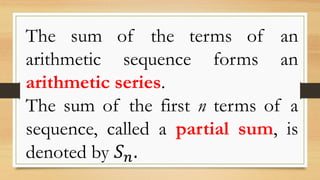
The sum of the terms of an
arithmetic sequence forms an
arithmetic series.
The sum of the first n terms of a
sequence, called a partial sum, is
denoted by 𝑆 𝑛.
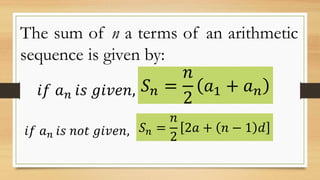
The sum of n a terms of an arithmetic
sequence is given by:
𝑖𝑓 𝑎 𝑛 𝑖𝑠 𝑔𝑖𝑣𝑒𝑛, 𝑆 𝑛 =
𝑛
2
𝑎1 + 𝑎 𝑛
𝑖𝑓 𝑎 𝑛 𝑖𝑠 𝑛𝑜𝑡 𝑔𝑖𝑣𝑒𝑛, 𝑆 𝑛 =
𝑛
2
2𝑎 + 𝑛 − 1 𝑑
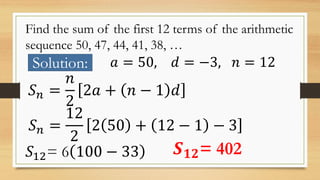
Find the sum of the first 12 terms of the arithmetic
sequence 50, 47, 44, 41, 38, …
Solution: 𝑎 = 50, 𝑑 = −3, 𝑛 = 12
𝑆 𝑛 =
𝑛
2
2𝑎 + 𝑛 − 1 𝑑
𝑆 𝑛 =
12
2
2 50 + 12 − 1 − 3
𝑆12= 6 100 − 33 𝑺 𝟏𝟐= 402
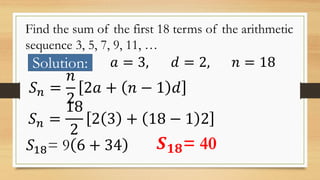
Find the sum of the first 18 terms of the arithmetic
sequence 3, 5, 7, 9, 11, …
Solution: 𝑎 = 3, 𝑑 = 2, 𝑛 = 18
𝑆 𝑛 =
𝑛
2
2𝑎 + 𝑛 − 1 𝑑
𝑆 𝑛 =
18
2
2 3 + 18 − 1 2
𝑆18= 9 6 + 34 𝑺 𝟏𝟖= 40
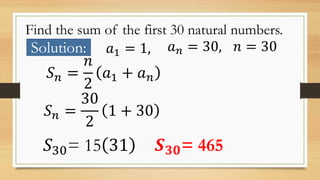
Find the sum of the first 30 natural numbers.
Solution: 𝑎1 = 1, 𝑎 𝑛 = 30, 𝑛 = 30
𝑆 𝑛 =
𝑛
2
𝑎1 + 𝑎 𝑛
𝑆 𝑛 =
30
2
1 + 30
𝑆30= 15 31 𝑺 𝟑𝟎= 465
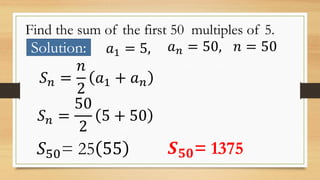
Find the sum of the first 50 multiples of 5.
Solution: 𝑎1 = 5, 𝑎 𝑛 = 50, 𝑛 = 50
𝑆 𝑛 =
𝑛
2
𝑎1 + 𝑎 𝑛
𝑆 𝑛 =
50
2
5 + 50
𝑆50= 25 55 𝑺 𝟓𝟎= 1375
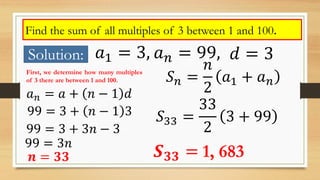
Find the sum of all multiples of 3 between 1 and 100.
Solution: 𝑎1 = 3, 𝑎 𝑛 = 99, 𝑑 = 3
First, we determine how many multiples
of 3 there are between 1 and 100.
𝑎 𝑛 = 𝑎 + 𝑛 − 1 𝑑
99 = 3 + 𝑛 − 1 3
99 = 3 + 3𝑛 − 3
99 = 3𝑛
𝒏 = 𝟑𝟑
𝑆 𝑛 =
𝑛
2
𝑎1 + 𝑎 𝑛
𝑆33 =
33
2
3 + 99
𝑺 𝟑𝟑 = 1, 683
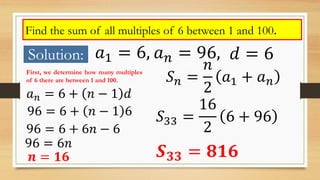
Find the sum of all multiples of 6 between 1 and 100.
Solution: 𝑎1 = 6, 𝑎 𝑛 = 96, 𝑑 = 6
First, we determine how many multiples
of 6 there are between 1 and 100.
𝑎 𝑛 = 6 + 𝑛 − 1 𝑑
96 = 6 + 𝑛 − 1 6
96 = 6 + 6𝑛 − 6
96 = 6𝑛
𝒏 = 𝟏𝟔
𝑆 𝑛 =
𝑛
2
𝑎1 + 𝑎 𝑛
𝑆33 =
16
2
6 + 96
𝑺 𝟑𝟑 = 𝟖𝟏𝟔

Arithmetic Series

  • 1.
    Grade 10 –Mathematics Quarter I ARITHMETIC SERIES
  • 2.
    Objectives: •define arithmetic series;and •find the sum of n terms of arithmetic sequence given the first few terms of an arithmetic sequence.
  • 3.
    The sum ofthe terms of an arithmetic sequence forms an arithmetic series. The sum of the first n terms of a sequence, called a partial sum, is denoted by 𝑆 𝑛.
  • 4.
    The sum ofn a terms of an arithmetic sequence is given by: 𝑖𝑓 𝑎 𝑛 𝑖𝑠 𝑔𝑖𝑣𝑒𝑛, 𝑆 𝑛 = 𝑛 2 𝑎1 + 𝑎 𝑛 𝑖𝑓 𝑎 𝑛 𝑖𝑠 𝑛𝑜𝑡 𝑔𝑖𝑣𝑒𝑛, 𝑆 𝑛 = 𝑛 2 2𝑎 + 𝑛 − 1 𝑑
  • 5.
    Find the sumof the first 12 terms of the arithmetic sequence 50, 47, 44, 41, 38, … Solution: 𝑎 = 50, 𝑑 = −3, 𝑛 = 12 𝑆 𝑛 = 𝑛 2 2𝑎 + 𝑛 − 1 𝑑 𝑆 𝑛 = 12 2 2 50 + 12 − 1 − 3 𝑆12= 6 100 − 33 𝑺 𝟏𝟐= 402
  • 6.
    Find the sumof the first 18 terms of the arithmetic sequence 3, 5, 7, 9, 11, … Solution: 𝑎 = 3, 𝑑 = 2, 𝑛 = 18 𝑆 𝑛 = 𝑛 2 2𝑎 + 𝑛 − 1 𝑑 𝑆 𝑛 = 18 2 2 3 + 18 − 1 2 𝑆18= 9 6 + 34 𝑺 𝟏𝟖= 40
  • 7.
    Find the sumof the first 30 natural numbers. Solution: 𝑎1 = 1, 𝑎 𝑛 = 30, 𝑛 = 30 𝑆 𝑛 = 𝑛 2 𝑎1 + 𝑎 𝑛 𝑆 𝑛 = 30 2 1 + 30 𝑆30= 15 31 𝑺 𝟑𝟎= 465
  • 8.
    Find the sumof the first 50 multiples of 5. Solution: 𝑎1 = 5, 𝑎 𝑛 = 50, 𝑛 = 50 𝑆 𝑛 = 𝑛 2 𝑎1 + 𝑎 𝑛 𝑆 𝑛 = 50 2 5 + 50 𝑆50= 25 55 𝑺 𝟓𝟎= 1375
  • 9.
    Find the sumof all multiples of 3 between 1 and 100. Solution: 𝑎1 = 3, 𝑎 𝑛 = 99, 𝑑 = 3 First, we determine how many multiples of 3 there are between 1 and 100. 𝑎 𝑛 = 𝑎 + 𝑛 − 1 𝑑 99 = 3 + 𝑛 − 1 3 99 = 3 + 3𝑛 − 3 99 = 3𝑛 𝒏 = 𝟑𝟑 𝑆 𝑛 = 𝑛 2 𝑎1 + 𝑎 𝑛 𝑆33 = 33 2 3 + 99 𝑺 𝟑𝟑 = 1, 683
  • 10.
    Find the sumof all multiples of 6 between 1 and 100. Solution: 𝑎1 = 6, 𝑎 𝑛 = 96, 𝑑 = 6 First, we determine how many multiples of 6 there are between 1 and 100. 𝑎 𝑛 = 6 + 𝑛 − 1 𝑑 96 = 6 + 𝑛 − 1 6 96 = 6 + 6𝑛 − 6 96 = 6𝑛 𝒏 = 𝟏𝟔 𝑆 𝑛 = 𝑛 2 𝑎1 + 𝑎 𝑛 𝑆33 = 16 2 6 + 96 𝑺 𝟑𝟑 = 𝟖𝟏𝟔