DOMINIC DALTON L. CALING
Mathematics | Grade 10
 An arithmetic sequence is a sequence in which each
term after the first is obtained by adding a constant
(called the common difference) to the preceding term.
 If the nth term of an arithmetic sequence is an and the
common difference is d, then
𝒂𝒏 = 𝒂𝟏 + (𝒏 − 𝟏)𝒅
where:
𝑎1= 𝑓𝑜𝑟 𝑡ℎ𝑒 𝑓𝑖𝑟𝑠𝑡 𝑡𝑒𝑟𝑚
𝑎𝑛 = 𝑓𝑜𝑟 𝑡ℎ𝑒 𝑛𝑡ℎ 𝑡𝑒𝑟𝑚
𝑑 = 𝑐𝑜𝑚𝑚𝑜𝑛 𝑑𝑖𝑓𝑓𝑒𝑟𝑒𝑛𝑐𝑒
𝑛 = 𝑓𝑜𝑟 𝑡ℎ𝑒 𝑛𝑢𝑚𝑏𝑒𝑟 𝑜𝑓 𝑡𝑒𝑟𝑚 𝑓𝑟𝑜𝑚 𝑎1𝑡𝑜 𝑎𝑛
1. Find the 5th term and 11th terms of the arithmetic
sequence with the first term 3 and the common
difference 4.
Solution:
𝑎1 = 3, 𝑑 = 4
𝑎𝑛 = 𝑎1 + 𝑛 − 1 𝑑
𝑎5 = 3 + 5 − 1 4 = 3 + 16 = 19
𝑎11 = 3 + 11 − 1 4 = 3 + 40 = 43
Therefore, 19 and 43 are the 5th and the 11th terms of the
sequence, respectively.
1). 1, 5, 9, 13, … (a10)
2). 13, 9, 5, 1, … (a10)
3). -8, -5, -2, 1, 4, … (a12)
𝑎𝑛 = 𝑎1 + 𝑛 − 1 𝑑
𝑎10 = 1 + (10 − 1)4
𝑎10 = 1 + 9 4
𝒂𝟏𝟎 = 𝟑𝟕
𝑎𝑛 = 𝑎1 + 𝑛 − 1 𝑑
𝑎10 = 13 + 10 − 1 (−4)
𝑎10 = 13 + 9 −4
𝑎10 = 13 − 36
𝒂𝟏𝟎 = −𝟐𝟑
𝑎𝑛 = 𝑎1 + 𝑛 − 1 𝑑
𝑎12 = −8 + 12 − 1 (3)
𝑎12 = −8 + 11 3
𝑎12 = −8 + 33
𝒂𝟏𝟐 = 𝟐𝟓
𝒅 = 𝟒
𝒅 = −𝟒
𝒅 = 𝟑
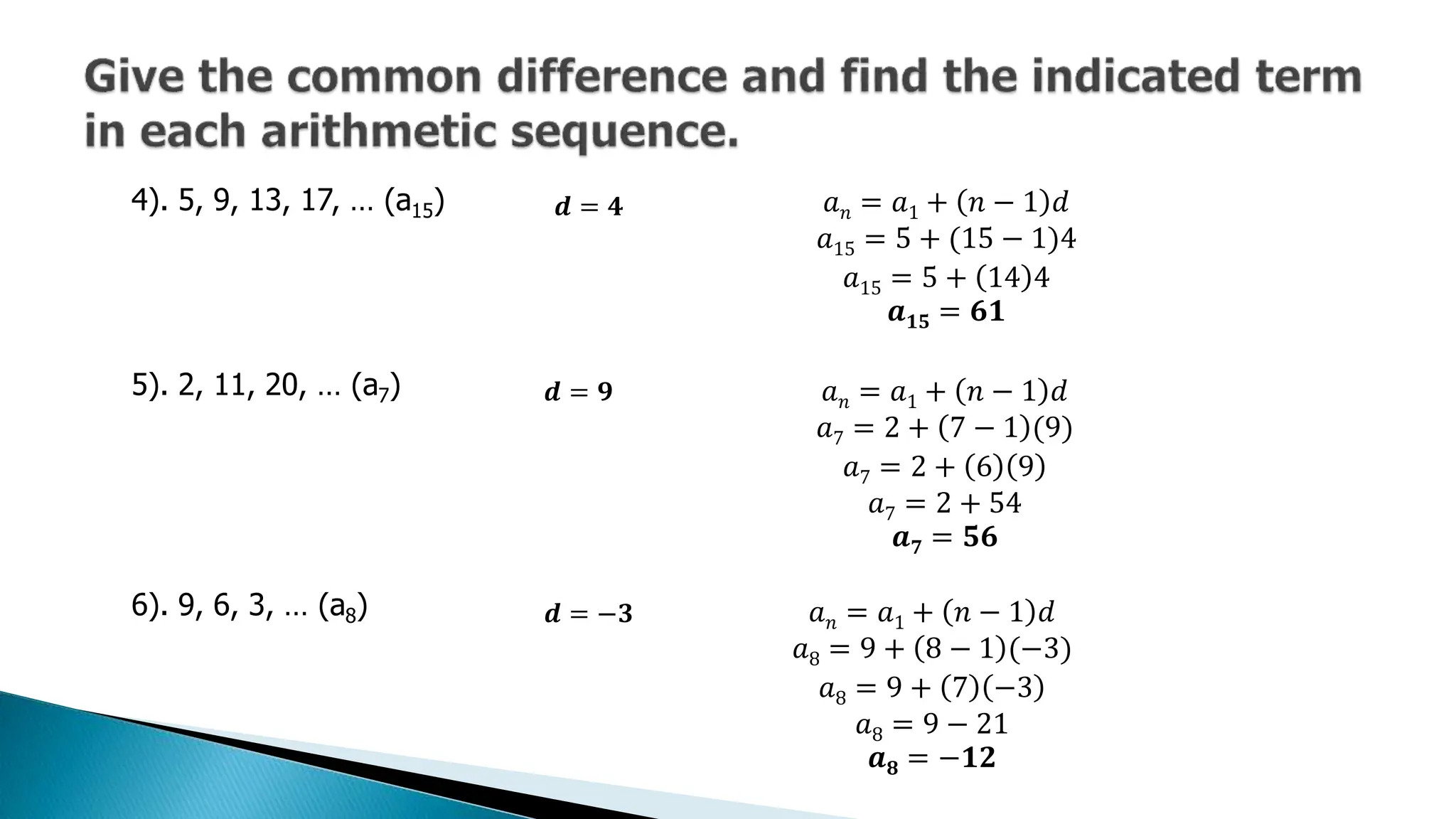
4). 5, 9, 13, 17, … (a15)
5). 2, 11, 20, … (a7)
6). 9, 6, 3, … (a8)
𝑎𝑛 = 𝑎1 + 𝑛 − 1 𝑑
𝑎15 = 5 + (15 − 1)4
𝑎15 = 5 + 14 4
𝒂𝟏𝟓 = 𝟔𝟏
𝑎𝑛 = 𝑎1 + 𝑛 − 1 𝑑
𝑎7 = 2 + 7 − 1 (9)
𝑎7 = 2 + 6 9
𝑎7 = 2 + 54
𝒂𝟕 = 𝟓𝟔
𝑎𝑛 = 𝑎1 + 𝑛 − 1 𝑑
𝑎8 = 9 + 8 − 1 (−3)
𝑎8 = 9 + 7 −3
𝑎8 = 9 − 21
𝒂𝟖 = −𝟏𝟐
𝒅 = 𝟒
𝒅 = 𝟗
𝒅 = −𝟑
1. The 4th term of an arithmetic sequence is 18 and the sixth term is
28. Give the first 3 terms.
𝑎1 = 18, 𝑎𝑛 = 28, 𝑛 = 3
𝑎𝑛 = 𝑎1 + 𝑛 − 1 𝑑
28 = 18 + 3 − 1 𝑑
28 = 18 + 2𝑑
10 = 2𝑑
𝒅 = 𝟓
18 – 5 = 13, 13 – 5 = 8, 8 – 5 = 3
The first three terms of the arithmetic sequence are 3, 8, and 13.
2. Write the third and fifth terms of an arithmetic sequence whose
fourth term is 9 and the common difference is 2.
𝑑 = 2
_____, 9, _____
The third term of the arithmetic sequence is 7 and the fifth term is 11.
3rd term 5th term
7, 9, 11
3. Write the first three terms of an arithmetic sequence if the fourth
term is 10 and d = -3
𝑑 = −3
_____, _____, _____, 10
The first three terms of the arithmetic sequence are 19, 16, and 13.
13
19 16
1. 2, 6, 10, …(a6)
2. Find the 42nd term of the sequence 5, 10, 15, …
3. If a1=5, an=395, and d=5, find the value of n.
𝑎𝑛 = 𝑎1 + 𝑛 − 1 𝑑
𝑎6 = 2 + (6 − 1)4
𝑎6 = 2 + 5 4
𝒂𝟔 = 𝟐𝟐
𝑎𝑛 = 𝑎1 + 𝑛 − 1 𝑑
𝑎42 = 5 + 42 − 1 5
𝑎42 = 5 + 41 5
𝒂𝟒𝟐 = 𝟐𝟏𝟎
𝑎𝑛 = 𝑎1 + 𝑛 − 1 𝑑
395 = 5 + 𝑛 − 1 5
395 = 5 + 5𝑛 − 5
395 = 5𝑛
𝒏 = 𝟕𝟗
A sequence is arithmetic if the differences between
consecutive terms are the same.
4, 9, 14, 19, 24, . . .
9 – 4 = 5
14 – 9 = 5
19 – 14 = 5
24 – 19 = 5
arithmetic
sequence
The common difference, d, is 5.
Example: Find the first five terms of the sequence and
determine if it is arithmetic.
an = 1 + (n – 1)4
This is an arithmetic sequence.
d = 4
a1 = 1 + (1 – 1)4 = 1 + 0 = 1
a2 = 1 + (2 – 1)4 = 1 + 4 = 5
a3 = 1 + (3 – 1)4 = 1 + 8 = 9
a4 = 1 + (4 – 1)4 = 1 + 12 = 13
a5 = 1 + (5 – 1)4 = 1 + 16 = 17
The nth term of an arithmetic sequence has the form
an = dn + c
where d is the common difference and c = a1 – d.
2, 8, 14, 20, 26, . . .
d = 8 – 2 = 6
a1 = 2
c = 2 – 6 = – 4
The nth term is 𝟔𝒏 − 𝟒.
1. 1, 5, 9, 13, …
2. 13, 9, 5, 1, …
3. -7, -4, -1, 2,…
4. 5, 3, 1, -1, -3, …
5. 2, 6, 10, …
Find the nth term for each sequence below. (𝒂𝒏 = 𝒅𝒏 + 𝒄)
𝒂𝒏 = 𝟒𝒏 − 𝟑
(𝒄 = 𝒂𝟏 − 𝒅)
𝒂𝒏 = −𝟒𝒏 + 𝟏𝟕
𝒂𝒏 = 𝟑𝒏 − 𝟏𝟎
𝒂𝒏 = −𝟐𝒏 + 𝟕
𝒂𝒏 = 𝟒𝒏 − 𝟐
a1 – d =
Example 1: Find the formula for the nth term of an
arithmetic sequence whose common difference is 4 and
whose first term is 15. Find the first five terms of the
sequence.
an = dn + c
= 4n + 11
15,
d = 4
a1 = 15
19, 23, 27, 31.
The first five terms are
15 – 4 = 11
a1 – d =
Example 2: Find the formula for the nth term of an
arithmetic sequence whose common difference is 3 and
whose first term is 5. Find the first five terms of the
sequence.
an = dn + c
= 3n + 2
5,
d = 3
a1 = 5
8, 11, 14, 17.
The first five terms are
5 – 3 = 2
a1 – d =
Example 3: The first term of an arithmetic sequence is
equal to 6 and the common difference is equal to 3. Find a
formula for the nth term of an arithmetic sequence.
an = dn + c
= 3n + 3
The formula for the nth term is
6 – 3 = 3
𝒂𝒏 = 𝟑𝒏 + 𝟑.
a1 – d =
Example 4: Find the formula for the nth term of an
arithmetic sequence whose common difference is -18 and
whose first term is 7. Find the first five terms of the
sequence.
an = dn + c
= -18n + 25
7,
d = -18
a1 = 7
-11, -29, -47, -65
The first five terms are
7 – (-18) = 25
1. Find the formula for the nth term of an arithmetic
sequence whose common difference is 15 and whose
first term is 3. Find the first five terms of the sequence.
2. The first term of an arithmetic sequence is 5 and the
common difference is 5, find the nth term of the
sequence and its first 6 terms.
1. 17, 13, 9, … d = -4
2. 5, 10, 15,… d = 5
3. 2, 11, 20,… d = 9
4. 9, 6, 3, … d = -3
5. 5, 9, 13, 17,... d = 4
𝒂𝒏 = −𝟒𝒏 + 𝟐𝟏
𝒂𝒏 = 𝟓𝒏
𝒂𝒏 = 𝟗𝒏 − 𝟕
𝒂𝒏 = −𝟑𝒏 + 𝟏𝟐
𝒂𝒏 = 𝟒𝒏 + 𝟏
DOMINIC DALTON L. CALING
Mathematics | Grade 10
Guide Question:
1. Were you able to get the 3 terms in each sequence?
1. Find four arithmetic means between 8 and -7.
Answer: Since we must insert four numbers between 8 and -7, there are six
numbers in the arithmetic sequence. Thus, 𝑎1 = 8 and 𝑎6 = −7, we can
solve for 𝑑 using the formula 𝑎𝑛 = 𝑎1 + 𝑛 − 1 𝑑.
−7 = 8 + 6 − 1 𝑑
𝑑 = −3
Hence, 𝑎2 = 𝑎1 + 𝑑 = 8 − 3 = 5
𝑎3 = 𝑎2 + 𝑑 = 5 − 3 = 2
𝑎4 = 𝑎3 + 𝑑 = 2 − 3 = −1
𝑎5 = 𝑎4 + 𝑑 = −1 − 3 = −4
Therefore, the four arithmetic means between 8 and -7 are 5, 2, -1, and -4.
 The terms between 𝑎1 and 𝑎𝑛 of an arithmetic
sequence are called arithmetic means of 𝑎1 and 𝑎𝑛.
Thus, the arithmetic means between 𝑎1 and 𝑎5 are
𝑎2, 𝑎3 and 𝑎4
 The arithmetic mean or the “mean” between two
numbers is sometimes called the average of two
numbers.
1. Insert seven arithmetic means between 3 and 23.
23 = 3 + 9 − 1 𝑑 = 23 − 3 = 8𝑑
𝑑 =
20
8
𝑜𝑟 2.5
Hence, 𝑎2 = 𝑎1 + 𝑑 = 3 + 2.5 = 5.5
𝑎3 = 𝑎2 + 𝑑 = 5.5 + 2.5 = 8
𝑎4 = 𝑎3 + 𝑑 = 8 + 2.5 = 10.5
𝑎5 = 𝑎4 + 𝑑 = 10.5 + 2.5 = 13
𝑎6 = 𝑎5 + 𝑑 = 13 + 2.5 = 15.5
𝑎7 = 𝑎6 + 𝑑 = 15.5 + 2.5 = 18
𝑎8 = 𝑎7 + 𝑑 = 18 + 2.5 = 20.5
Therefore, the seven arithmetic means between 3 and 23 are 5.5, 8, 10.5,
13, 15.5, 18, and 20.5.
2. Insert four arithmetic means between 8 and 18.
18 = 8 + 6 − 1 𝑑 = 10 + 5𝑑
𝑑 = 2
Hence, 𝑎2 = 𝑎1 + 𝑑 = 8 + 2 = 10
𝑎3 = 𝑎2 + 𝑑 = 10 + 2 = 12
𝑎4 = 𝑎3 + 𝑑 = 12 + 2 = 14
𝑎5 = 𝑎4 + 𝑑 = 14 + 2 = 16
Therefore, the four arithmetic means between 8 and 18 are
10, 12, 14, and 16.
3. Insert 5 arithmetic means between 7 and 70.
70 = 7 + 7 − 1 𝑑 = 63 + 6𝑑
𝑑 = 10.5
Hence, 𝑎2 = 𝑎1 + 𝑑 = 7 + 10.5 = 17.5
𝑎3 = 𝑎2 + 𝑑 = 17.5 + 10.5 = 28
𝑎4 = 𝑎3 + 𝑑 = 28 + 10.5 = 38.5
𝑎5 = 𝑎4 + 𝑑 = 38.5 + 10.5 = 49
𝑎6 = 𝑎5 + 𝑑 = 49 + 10.5 = 59.5
Therefore, the five arithmetic means between 7 and 70 are 17.5, 28, 38.5, 49, and 59.5.
1. Insert 4 arithmetic means between 5 and 25.
2. What is the arithmetic mean between 27 and -3?
3. Insert three arithmetic means between 2 and 14.
4. Insert eight arithmetic means between 47 and 2.
9, 13, 17, 21
12
5, 8, 11
42, 37, 32, 27, 22, 17, 12, 7
What is the sum of the terms of each finite sequence below?
1. 1, 4, 7, 10
2. 3, 5, 7, 9, 11
3. 10, 5, 0, -5, -10, -15
4. 81, 64, 47, 30, 13, -4
5. -2, -5, -8, -11, -14, -17
22
35
-15
231
-57
DOMINIC DALTON L. CALING
Mathematics | Grade 10
What is 1 + 2 + 3 + … + 50 + 51 + … + 98 + 99 + 100?
A famous story tells that this was the problem given by
an elementary school teacher to a famous mathematician to
keep him busy. Do you know that he was able to get the sum
within seconds only? Can you know how he did it? Let us find
out by doing the activity below.
Determine the answer to the above problem. Discuss your technique
(if any) in getting the answer quickly. Then answer the question
below.
1. What is the sum of each of the pairs 1 and 100, 2 and 99, 3 and
98, … , 50 and 51?
2. How many pairs are there in #1?
3. From your answer in #1 and #2, how do you get the sum of the
integers from 1 to 100?
4. What is the sum of the integers from 1 to 100?
101
50
Multiply answer in #1 by answer in #2
101 x 50 = 5,050
𝑆𝑛=
𝑛
2
2𝑎1 + 𝑛 − 1 𝑑
S𝑛 =
𝑛[2𝑎1 + 𝑛 − 1 𝑑]
2
S𝑛 =
𝑛(𝑎1 + 𝑎𝑛)
2
A SERIES represents the sum of the terms of a sequence.
1. Find the sum of the first 10 terms of the arithmetic
sequence 5, 9, 13, 17, …
S𝑛 =
𝑛(𝑎1 + 𝑎𝑛)
2
S𝑛 =
10(5 + 41)
2
𝑎1 = 5 𝑑 = 4 𝑛 = 10 𝑎𝑛 = ?
S𝑛 =
10(46)
2
=
460
2
𝑎𝑛 = 𝑎1 + 𝑛 − 1 𝑑
𝑎10 = 5 + 10 − 1 4
𝑎10 = 5 + 36
𝒂𝟏𝟎 = 𝟒𝟏
𝑺𝒏 = 𝟐𝟑𝟎
2. Find the sum of the first 20 terms of the arithmetic
sequence -2, -5, -8, -11, …
S𝑛 =
𝑛(𝑎1 + 𝑎𝑛)
2
S𝑛 =
20(−2 + −59 )
2
𝑎1 = −2 𝑑 = −3 𝑛 = 20 𝑎𝑛 = ?
S𝑛 =
20(−61)
2
=
−1220
2
𝑎𝑛 = 𝑎1 + 𝑛 − 1 𝑑
𝑎20 = −2 + 20 − 1 − 3
𝑎20 = −2 − 57
𝒂𝟐𝟎 = −𝟓𝟗
𝑺𝒏 = −𝟔𝟏𝟎
3. Find the sum of the first ten terms of the arithmetic
sequence 4, 10, 16, …
S𝑛 =
𝑛(𝑎1 + 𝑎𝑛)
2
S𝑛 =
10(4 + 58)
2
𝑎1 = 4 𝑑 = 6 𝑛 = 10 𝑎𝑛 = ?
S𝑛 =
10(62)
2
=
620
2
𝑎𝑛 = 𝑎1 + 𝑛 − 1 𝑑
𝑎10 = 4 + 10 − 1 6
𝑎10 = 4 + 54
𝒂𝟏𝟎 = 𝟓𝟖
𝑺𝒏 = 𝟑𝟏𝟎
4. How many terms of the arithmetic sequence 20, 18, 16,…
must be added so that the sum will be -100?
−100 =
𝑛[2 20 + 𝑛 − 1 − 2]
2
𝑎1 = 20 𝑑 = −2 𝑛 = 25 S𝑛 = −100
−200 = 𝑛(40 − 2𝑛 + 2)
𝒏 = 𝟐𝟓
S𝑛 =
𝑛[2𝑎1 + 𝑛 − 1 𝑑]
2
−200 = 42𝑛 − 2𝑛2
42𝑛 − 2𝑛2 + 200 = 0
−𝑛2 + 21𝑛 + 100 = 0
𝑛2 − 21𝑛 − 100 = 0
𝑛 − 25 𝑛 + 4 = 0
𝒏 = −𝟒
4. How many terms of the arithmetic sequence 20, 18, 16,…
must be added so that the sum will be -100?
𝑎1 = 20 𝑑 = −2 𝑛 = 25 𝑎𝑛 = ?
S𝑛 =
𝑛(𝑎1 + 𝑎𝑛)
2
S𝑛 =
25(20 − 28)
2
S𝑛 =
25(−8)
2
= −
200
2
𝑺𝒏 = −𝟏𝟎𝟎
𝑎𝑛 = 𝑎1 + 𝑛 − 1 𝑑
𝑎25 = 20 + 25 − 1 − 2
𝑎25 = 20 − 48
𝒂𝟏𝟎 = −𝟐𝟖
5. Find the sum of integers from 1 to 50.
𝑎1 = 1 𝑛 = 50 𝑎𝑛 = 50
S𝑛 =
𝑛(𝑎1 + 𝑎𝑛)
2
S𝑛 =
50(1 + 50)
2
S𝑛 =
50(51)
2
=
2550
2
𝑺𝒏 = 𝟏𝟐𝟕𝟓
6. Find the sum of odd integers from 1 to 100.
𝑎1 = 1 𝑛 = 50 𝑎𝑛 = 99
S𝑛 =
𝑛(𝑎1 + 𝑎𝑛)
2
S𝑛 =
50(1 + 99)
2
S𝑛 =
50(100)
2
=
5000
2
𝑺𝒏 = 𝟐𝟓𝟎𝟎
7. Find the sum of even integers from 1 to 101.
𝑎1 = 2 𝑛 = 50 𝑎𝑛 = 100
S𝑛 =
𝑛(𝑎1 + 𝑎𝑛)
2
S𝑛 =
50(2 + 100)
2
S𝑛 =
50(102)
2
=
5100
2
𝑺𝒏 = 𝟐𝟓𝟓𝟎
Find the sum of the arithmetic sequence wherein:
1. a1= 2; d=4, n=10
2. a1=10; d= -4; n=8
3. a1= -7; n=18; d= 8
4. Find the sum of multiples of 3 between 15 and 45.
5. Find the sum of the first eight terms of the arithmetic
sequence 5, 7, 9,…
2-Arithmetic-Sequhgtfwsfedddddences.pptx

2-Arithmetic-Sequhgtfwsfedddddences.pptx

  • 1.
    DOMINIC DALTON L.CALING Mathematics | Grade 10
  • 2.
     An arithmeticsequence is a sequence in which each term after the first is obtained by adding a constant (called the common difference) to the preceding term.  If the nth term of an arithmetic sequence is an and the common difference is d, then
  • 3.
    𝒂𝒏 = 𝒂𝟏+ (𝒏 − 𝟏)𝒅 where: 𝑎1= 𝑓𝑜𝑟 𝑡ℎ𝑒 𝑓𝑖𝑟𝑠𝑡 𝑡𝑒𝑟𝑚 𝑎𝑛 = 𝑓𝑜𝑟 𝑡ℎ𝑒 𝑛𝑡ℎ 𝑡𝑒𝑟𝑚 𝑑 = 𝑐𝑜𝑚𝑚𝑜𝑛 𝑑𝑖𝑓𝑓𝑒𝑟𝑒𝑛𝑐𝑒 𝑛 = 𝑓𝑜𝑟 𝑡ℎ𝑒 𝑛𝑢𝑚𝑏𝑒𝑟 𝑜𝑓 𝑡𝑒𝑟𝑚 𝑓𝑟𝑜𝑚 𝑎1𝑡𝑜 𝑎𝑛
  • 4.
    1. Find the5th term and 11th terms of the arithmetic sequence with the first term 3 and the common difference 4. Solution: 𝑎1 = 3, 𝑑 = 4 𝑎𝑛 = 𝑎1 + 𝑛 − 1 𝑑 𝑎5 = 3 + 5 − 1 4 = 3 + 16 = 19 𝑎11 = 3 + 11 − 1 4 = 3 + 40 = 43 Therefore, 19 and 43 are the 5th and the 11th terms of the sequence, respectively.
  • 5.
    1). 1, 5,9, 13, … (a10) 2). 13, 9, 5, 1, … (a10) 3). -8, -5, -2, 1, 4, … (a12) 𝑎𝑛 = 𝑎1 + 𝑛 − 1 𝑑 𝑎10 = 1 + (10 − 1)4 𝑎10 = 1 + 9 4 𝒂𝟏𝟎 = 𝟑𝟕 𝑎𝑛 = 𝑎1 + 𝑛 − 1 𝑑 𝑎10 = 13 + 10 − 1 (−4) 𝑎10 = 13 + 9 −4 𝑎10 = 13 − 36 𝒂𝟏𝟎 = −𝟐𝟑 𝑎𝑛 = 𝑎1 + 𝑛 − 1 𝑑 𝑎12 = −8 + 12 − 1 (3) 𝑎12 = −8 + 11 3 𝑎12 = −8 + 33 𝒂𝟏𝟐 = 𝟐𝟓 𝒅 = 𝟒 𝒅 = −𝟒 𝒅 = 𝟑
  • 6.
    4). 5, 9,13, 17, … (a15) 5). 2, 11, 20, … (a7) 6). 9, 6, 3, … (a8) 𝑎𝑛 = 𝑎1 + 𝑛 − 1 𝑑 𝑎15 = 5 + (15 − 1)4 𝑎15 = 5 + 14 4 𝒂𝟏𝟓 = 𝟔𝟏 𝑎𝑛 = 𝑎1 + 𝑛 − 1 𝑑 𝑎7 = 2 + 7 − 1 (9) 𝑎7 = 2 + 6 9 𝑎7 = 2 + 54 𝒂𝟕 = 𝟓𝟔 𝑎𝑛 = 𝑎1 + 𝑛 − 1 𝑑 𝑎8 = 9 + 8 − 1 (−3) 𝑎8 = 9 + 7 −3 𝑎8 = 9 − 21 𝒂𝟖 = −𝟏𝟐 𝒅 = 𝟒 𝒅 = 𝟗 𝒅 = −𝟑
  • 7.
    1. The 4thterm of an arithmetic sequence is 18 and the sixth term is 28. Give the first 3 terms. 𝑎1 = 18, 𝑎𝑛 = 28, 𝑛 = 3 𝑎𝑛 = 𝑎1 + 𝑛 − 1 𝑑 28 = 18 + 3 − 1 𝑑 28 = 18 + 2𝑑 10 = 2𝑑 𝒅 = 𝟓 18 – 5 = 13, 13 – 5 = 8, 8 – 5 = 3 The first three terms of the arithmetic sequence are 3, 8, and 13.
  • 8.
    2. Write thethird and fifth terms of an arithmetic sequence whose fourth term is 9 and the common difference is 2. 𝑑 = 2 _____, 9, _____ The third term of the arithmetic sequence is 7 and the fifth term is 11. 3rd term 5th term 7, 9, 11
  • 9.
    3. Write thefirst three terms of an arithmetic sequence if the fourth term is 10 and d = -3 𝑑 = −3 _____, _____, _____, 10 The first three terms of the arithmetic sequence are 19, 16, and 13. 13 19 16
  • 10.
    1. 2, 6,10, …(a6) 2. Find the 42nd term of the sequence 5, 10, 15, … 3. If a1=5, an=395, and d=5, find the value of n. 𝑎𝑛 = 𝑎1 + 𝑛 − 1 𝑑 𝑎6 = 2 + (6 − 1)4 𝑎6 = 2 + 5 4 𝒂𝟔 = 𝟐𝟐 𝑎𝑛 = 𝑎1 + 𝑛 − 1 𝑑 𝑎42 = 5 + 42 − 1 5 𝑎42 = 5 + 41 5 𝒂𝟒𝟐 = 𝟐𝟏𝟎 𝑎𝑛 = 𝑎1 + 𝑛 − 1 𝑑 395 = 5 + 𝑛 − 1 5 395 = 5 + 5𝑛 − 5 395 = 5𝑛 𝒏 = 𝟕𝟗
  • 11.
    A sequence isarithmetic if the differences between consecutive terms are the same. 4, 9, 14, 19, 24, . . . 9 – 4 = 5 14 – 9 = 5 19 – 14 = 5 24 – 19 = 5 arithmetic sequence The common difference, d, is 5.
  • 12.
    Example: Find thefirst five terms of the sequence and determine if it is arithmetic. an = 1 + (n – 1)4 This is an arithmetic sequence. d = 4 a1 = 1 + (1 – 1)4 = 1 + 0 = 1 a2 = 1 + (2 – 1)4 = 1 + 4 = 5 a3 = 1 + (3 – 1)4 = 1 + 8 = 9 a4 = 1 + (4 – 1)4 = 1 + 12 = 13 a5 = 1 + (5 – 1)4 = 1 + 16 = 17
  • 13.
    The nth termof an arithmetic sequence has the form an = dn + c where d is the common difference and c = a1 – d. 2, 8, 14, 20, 26, . . . d = 8 – 2 = 6 a1 = 2 c = 2 – 6 = – 4 The nth term is 𝟔𝒏 − 𝟒.
  • 14.
    1. 1, 5,9, 13, … 2. 13, 9, 5, 1, … 3. -7, -4, -1, 2,… 4. 5, 3, 1, -1, -3, … 5. 2, 6, 10, … Find the nth term for each sequence below. (𝒂𝒏 = 𝒅𝒏 + 𝒄) 𝒂𝒏 = 𝟒𝒏 − 𝟑 (𝒄 = 𝒂𝟏 − 𝒅) 𝒂𝒏 = −𝟒𝒏 + 𝟏𝟕 𝒂𝒏 = 𝟑𝒏 − 𝟏𝟎 𝒂𝒏 = −𝟐𝒏 + 𝟕 𝒂𝒏 = 𝟒𝒏 − 𝟐
  • 15.
    a1 – d= Example 1: Find the formula for the nth term of an arithmetic sequence whose common difference is 4 and whose first term is 15. Find the first five terms of the sequence. an = dn + c = 4n + 11 15, d = 4 a1 = 15 19, 23, 27, 31. The first five terms are 15 – 4 = 11
  • 16.
    a1 – d= Example 2: Find the formula for the nth term of an arithmetic sequence whose common difference is 3 and whose first term is 5. Find the first five terms of the sequence. an = dn + c = 3n + 2 5, d = 3 a1 = 5 8, 11, 14, 17. The first five terms are 5 – 3 = 2
  • 17.
    a1 – d= Example 3: The first term of an arithmetic sequence is equal to 6 and the common difference is equal to 3. Find a formula for the nth term of an arithmetic sequence. an = dn + c = 3n + 3 The formula for the nth term is 6 – 3 = 3 𝒂𝒏 = 𝟑𝒏 + 𝟑.
  • 18.
    a1 – d= Example 4: Find the formula for the nth term of an arithmetic sequence whose common difference is -18 and whose first term is 7. Find the first five terms of the sequence. an = dn + c = -18n + 25 7, d = -18 a1 = 7 -11, -29, -47, -65 The first five terms are 7 – (-18) = 25
  • 19.
    1. Find theformula for the nth term of an arithmetic sequence whose common difference is 15 and whose first term is 3. Find the first five terms of the sequence.
  • 20.
    2. The firstterm of an arithmetic sequence is 5 and the common difference is 5, find the nth term of the sequence and its first 6 terms.
  • 21.
    1. 17, 13,9, … d = -4 2. 5, 10, 15,… d = 5 3. 2, 11, 20,… d = 9 4. 9, 6, 3, … d = -3 5. 5, 9, 13, 17,... d = 4 𝒂𝒏 = −𝟒𝒏 + 𝟐𝟏 𝒂𝒏 = 𝟓𝒏 𝒂𝒏 = 𝟗𝒏 − 𝟕 𝒂𝒏 = −𝟑𝒏 + 𝟏𝟐 𝒂𝒏 = 𝟒𝒏 + 𝟏
  • 22.
    DOMINIC DALTON L.CALING Mathematics | Grade 10
  • 23.
    Guide Question: 1. Wereyou able to get the 3 terms in each sequence?
  • 24.
    1. Find fourarithmetic means between 8 and -7. Answer: Since we must insert four numbers between 8 and -7, there are six numbers in the arithmetic sequence. Thus, 𝑎1 = 8 and 𝑎6 = −7, we can solve for 𝑑 using the formula 𝑎𝑛 = 𝑎1 + 𝑛 − 1 𝑑. −7 = 8 + 6 − 1 𝑑 𝑑 = −3 Hence, 𝑎2 = 𝑎1 + 𝑑 = 8 − 3 = 5 𝑎3 = 𝑎2 + 𝑑 = 5 − 3 = 2 𝑎4 = 𝑎3 + 𝑑 = 2 − 3 = −1 𝑎5 = 𝑎4 + 𝑑 = −1 − 3 = −4 Therefore, the four arithmetic means between 8 and -7 are 5, 2, -1, and -4.
  • 25.
     The termsbetween 𝑎1 and 𝑎𝑛 of an arithmetic sequence are called arithmetic means of 𝑎1 and 𝑎𝑛. Thus, the arithmetic means between 𝑎1 and 𝑎5 are 𝑎2, 𝑎3 and 𝑎4  The arithmetic mean or the “mean” between two numbers is sometimes called the average of two numbers.
  • 26.
    1. Insert sevenarithmetic means between 3 and 23. 23 = 3 + 9 − 1 𝑑 = 23 − 3 = 8𝑑 𝑑 = 20 8 𝑜𝑟 2.5 Hence, 𝑎2 = 𝑎1 + 𝑑 = 3 + 2.5 = 5.5 𝑎3 = 𝑎2 + 𝑑 = 5.5 + 2.5 = 8 𝑎4 = 𝑎3 + 𝑑 = 8 + 2.5 = 10.5 𝑎5 = 𝑎4 + 𝑑 = 10.5 + 2.5 = 13 𝑎6 = 𝑎5 + 𝑑 = 13 + 2.5 = 15.5 𝑎7 = 𝑎6 + 𝑑 = 15.5 + 2.5 = 18 𝑎8 = 𝑎7 + 𝑑 = 18 + 2.5 = 20.5 Therefore, the seven arithmetic means between 3 and 23 are 5.5, 8, 10.5, 13, 15.5, 18, and 20.5.
  • 27.
    2. Insert fourarithmetic means between 8 and 18. 18 = 8 + 6 − 1 𝑑 = 10 + 5𝑑 𝑑 = 2 Hence, 𝑎2 = 𝑎1 + 𝑑 = 8 + 2 = 10 𝑎3 = 𝑎2 + 𝑑 = 10 + 2 = 12 𝑎4 = 𝑎3 + 𝑑 = 12 + 2 = 14 𝑎5 = 𝑎4 + 𝑑 = 14 + 2 = 16 Therefore, the four arithmetic means between 8 and 18 are 10, 12, 14, and 16.
  • 28.
    3. Insert 5arithmetic means between 7 and 70. 70 = 7 + 7 − 1 𝑑 = 63 + 6𝑑 𝑑 = 10.5 Hence, 𝑎2 = 𝑎1 + 𝑑 = 7 + 10.5 = 17.5 𝑎3 = 𝑎2 + 𝑑 = 17.5 + 10.5 = 28 𝑎4 = 𝑎3 + 𝑑 = 28 + 10.5 = 38.5 𝑎5 = 𝑎4 + 𝑑 = 38.5 + 10.5 = 49 𝑎6 = 𝑎5 + 𝑑 = 49 + 10.5 = 59.5 Therefore, the five arithmetic means between 7 and 70 are 17.5, 28, 38.5, 49, and 59.5.
  • 29.
    1. Insert 4arithmetic means between 5 and 25. 2. What is the arithmetic mean between 27 and -3? 3. Insert three arithmetic means between 2 and 14. 4. Insert eight arithmetic means between 47 and 2. 9, 13, 17, 21 12 5, 8, 11 42, 37, 32, 27, 22, 17, 12, 7
  • 30.
    What is thesum of the terms of each finite sequence below? 1. 1, 4, 7, 10 2. 3, 5, 7, 9, 11 3. 10, 5, 0, -5, -10, -15 4. 81, 64, 47, 30, 13, -4 5. -2, -5, -8, -11, -14, -17 22 35 -15 231 -57
  • 31.
    DOMINIC DALTON L.CALING Mathematics | Grade 10
  • 32.
    What is 1+ 2 + 3 + … + 50 + 51 + … + 98 + 99 + 100? A famous story tells that this was the problem given by an elementary school teacher to a famous mathematician to keep him busy. Do you know that he was able to get the sum within seconds only? Can you know how he did it? Let us find out by doing the activity below.
  • 33.
    Determine the answerto the above problem. Discuss your technique (if any) in getting the answer quickly. Then answer the question below. 1. What is the sum of each of the pairs 1 and 100, 2 and 99, 3 and 98, … , 50 and 51? 2. How many pairs are there in #1? 3. From your answer in #1 and #2, how do you get the sum of the integers from 1 to 100? 4. What is the sum of the integers from 1 to 100? 101 50 Multiply answer in #1 by answer in #2 101 x 50 = 5,050
  • 34.
    𝑆𝑛= 𝑛 2 2𝑎1 + 𝑛− 1 𝑑 S𝑛 = 𝑛[2𝑎1 + 𝑛 − 1 𝑑] 2 S𝑛 = 𝑛(𝑎1 + 𝑎𝑛) 2 A SERIES represents the sum of the terms of a sequence.
  • 35.
    1. Find thesum of the first 10 terms of the arithmetic sequence 5, 9, 13, 17, … S𝑛 = 𝑛(𝑎1 + 𝑎𝑛) 2 S𝑛 = 10(5 + 41) 2 𝑎1 = 5 𝑑 = 4 𝑛 = 10 𝑎𝑛 = ? S𝑛 = 10(46) 2 = 460 2 𝑎𝑛 = 𝑎1 + 𝑛 − 1 𝑑 𝑎10 = 5 + 10 − 1 4 𝑎10 = 5 + 36 𝒂𝟏𝟎 = 𝟒𝟏 𝑺𝒏 = 𝟐𝟑𝟎
  • 36.
    2. Find thesum of the first 20 terms of the arithmetic sequence -2, -5, -8, -11, … S𝑛 = 𝑛(𝑎1 + 𝑎𝑛) 2 S𝑛 = 20(−2 + −59 ) 2 𝑎1 = −2 𝑑 = −3 𝑛 = 20 𝑎𝑛 = ? S𝑛 = 20(−61) 2 = −1220 2 𝑎𝑛 = 𝑎1 + 𝑛 − 1 𝑑 𝑎20 = −2 + 20 − 1 − 3 𝑎20 = −2 − 57 𝒂𝟐𝟎 = −𝟓𝟗 𝑺𝒏 = −𝟔𝟏𝟎
  • 37.
    3. Find thesum of the first ten terms of the arithmetic sequence 4, 10, 16, … S𝑛 = 𝑛(𝑎1 + 𝑎𝑛) 2 S𝑛 = 10(4 + 58) 2 𝑎1 = 4 𝑑 = 6 𝑛 = 10 𝑎𝑛 = ? S𝑛 = 10(62) 2 = 620 2 𝑎𝑛 = 𝑎1 + 𝑛 − 1 𝑑 𝑎10 = 4 + 10 − 1 6 𝑎10 = 4 + 54 𝒂𝟏𝟎 = 𝟓𝟖 𝑺𝒏 = 𝟑𝟏𝟎
  • 38.
    4. How manyterms of the arithmetic sequence 20, 18, 16,… must be added so that the sum will be -100? −100 = 𝑛[2 20 + 𝑛 − 1 − 2] 2 𝑎1 = 20 𝑑 = −2 𝑛 = 25 S𝑛 = −100 −200 = 𝑛(40 − 2𝑛 + 2) 𝒏 = 𝟐𝟓 S𝑛 = 𝑛[2𝑎1 + 𝑛 − 1 𝑑] 2 −200 = 42𝑛 − 2𝑛2 42𝑛 − 2𝑛2 + 200 = 0 −𝑛2 + 21𝑛 + 100 = 0 𝑛2 − 21𝑛 − 100 = 0 𝑛 − 25 𝑛 + 4 = 0 𝒏 = −𝟒
  • 39.
    4. How manyterms of the arithmetic sequence 20, 18, 16,… must be added so that the sum will be -100? 𝑎1 = 20 𝑑 = −2 𝑛 = 25 𝑎𝑛 = ? S𝑛 = 𝑛(𝑎1 + 𝑎𝑛) 2 S𝑛 = 25(20 − 28) 2 S𝑛 = 25(−8) 2 = − 200 2 𝑺𝒏 = −𝟏𝟎𝟎 𝑎𝑛 = 𝑎1 + 𝑛 − 1 𝑑 𝑎25 = 20 + 25 − 1 − 2 𝑎25 = 20 − 48 𝒂𝟏𝟎 = −𝟐𝟖
  • 40.
    5. Find thesum of integers from 1 to 50. 𝑎1 = 1 𝑛 = 50 𝑎𝑛 = 50 S𝑛 = 𝑛(𝑎1 + 𝑎𝑛) 2 S𝑛 = 50(1 + 50) 2 S𝑛 = 50(51) 2 = 2550 2 𝑺𝒏 = 𝟏𝟐𝟕𝟓
  • 41.
    6. Find thesum of odd integers from 1 to 100. 𝑎1 = 1 𝑛 = 50 𝑎𝑛 = 99 S𝑛 = 𝑛(𝑎1 + 𝑎𝑛) 2 S𝑛 = 50(1 + 99) 2 S𝑛 = 50(100) 2 = 5000 2 𝑺𝒏 = 𝟐𝟓𝟎𝟎
  • 42.
    7. Find thesum of even integers from 1 to 101. 𝑎1 = 2 𝑛 = 50 𝑎𝑛 = 100 S𝑛 = 𝑛(𝑎1 + 𝑎𝑛) 2 S𝑛 = 50(2 + 100) 2 S𝑛 = 50(102) 2 = 5100 2 𝑺𝒏 = 𝟐𝟓𝟓𝟎
  • 43.
    Find the sumof the arithmetic sequence wherein: 1. a1= 2; d=4, n=10 2. a1=10; d= -4; n=8 3. a1= -7; n=18; d= 8 4. Find the sum of multiples of 3 between 15 and 45. 5. Find the sum of the first eight terms of the arithmetic sequence 5, 7, 9,…