Lesson 1.4
Arithmetic Series
Learning Competency
At the end of the lesson, the learners should be able
to determine arithmetic means, nth term of an
arithmetic sequence, and sum of the terms of a given
arithmetic sequence.
Objectives
At the end of this lesson, the learners should be able to
do the following:
● Accurately differentiate an arithmetic series from
arithmetic sequence.
● Correctly solve for the sum of the first 𝑛 terms of an
arithmetic sequence.
● Correctly solve real-life problems involving
arithmetic series.
Let us say that you are in a
theater. You noticed that there
are 15 seats in the first row, 16
on the second row, 17 on the
third row, and so on, until the
last row.
How would you know how many
chairs are there?
We can easily determine how many chairs are there through
the use of arithmetic sequence.
In this lesson, we will discuss about arithmetic series and its
applications.
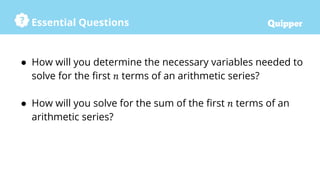
Essential Questions
● How will you determine the necessary variables needed to
solve for the first 𝑛 terms of an arithmetic series?
● How will you solve for the sum of the first 𝑛 terms of an
arithmetic series?
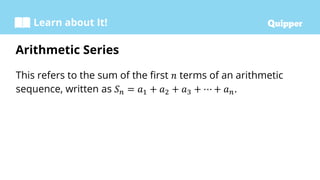
Learn about It!
This refers to the sum of the first 𝑛 terms of an arithmetic
sequence, written as 𝑆𝑛 = 𝑎1 + 𝑎2 + 𝑎3 + ⋯ + 𝑎𝑛.
Arithmetic Series
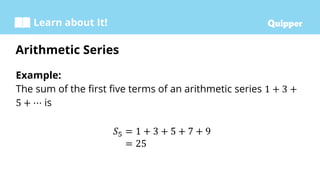
Learn about It!
Example:
The sum of the first five terms of an arithmetic series 1 + 3 +
5 + ⋯ is
𝑆5 = 1 + 3 + 5 + 7 + 9
= 25
Arithmetic Series
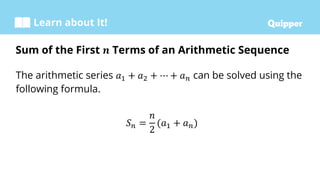
Learn about It!
The arithmetic series 𝑎1 + 𝑎2 + ⋯ + 𝑎𝑛 can be solved using the
following formula.
𝑆𝑛 =
𝑛
2
(𝑎1 + 𝑎𝑛)
Sum of the First 𝒏 Terms of an Arithmetic Sequence
Learn about It!
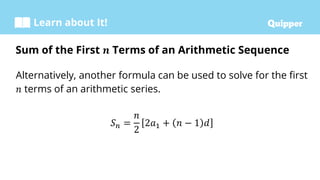
Alternatively, another formula can be used to solve for the first
𝑛 terms of an arithmetic series.
𝑆𝑛 =
𝑛
2
2𝑎1 + 𝑛 − 1 𝑑
Sum of the First 𝒏 Terms of an Arithmetic Sequence
Learn about It!
Example:
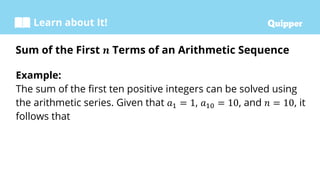
The sum of the first ten positive integers can be solved using
the arithmetic series. Given that 𝑎1 = 1, 𝑎10 = 10, and 𝑛 = 10, it
follows that
Sum of the First 𝒏 Terms of an Arithmetic Sequence
Learn about It!
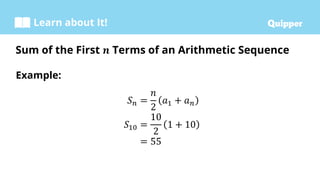
Example:
𝑆𝑛 =
𝑛
2
𝑎1 + 𝑎𝑛
𝑆10 =
10
2
1 + 10
= 55
Sum of the First 𝒏 Terms of an Arithmetic Sequence
Try it!
Let’s Practice
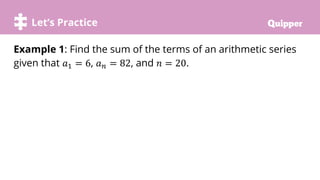
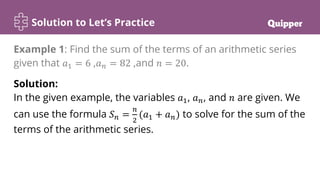
Example 1: Find the sum of the terms of an arithmetic series
given that 𝑎1 = 6, 𝑎𝑛 = 82, and 𝑛 = 20.
Solution to Let’s Practice
Solution:
In the given example, the variables 𝑎1, 𝑎𝑛, and 𝑛 are given. We
can use the formula 𝑆𝑛 =
𝑛
2
(𝑎1 + 𝑎𝑛) to solve for the sum of the
terms of the arithmetic series.
Example 1: Find the sum of the terms of an arithmetic series
given that 𝑎1 = 6 ,𝑎𝑛 = 82 ,and 𝑛 = 20.
Solution to Let’s Practice
Solution:
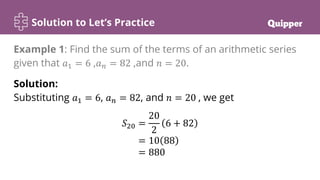
Substituting 𝑎1 = 6, 𝑎𝑛 = 82, and 𝑛 = 20 , we get
𝑆20 =
20
2
6 + 82
= 10 88
= 880
Example 1: Find the sum of the terms of an arithmetic series
given that 𝑎1 = 6 ,𝑎𝑛 = 82 ,and 𝑛 = 20.
Solution to Let’s Practice
Solution:
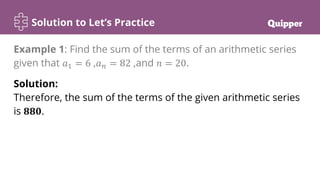
Therefore, the sum of the terms of the given arithmetic series
is 𝟖𝟖𝟎.
Example 1: Find the sum of the terms of an arithmetic series
given that 𝑎1 = 6 ,𝑎𝑛 = 82 ,and 𝑛 = 20.
Try it!
Let’s Practice
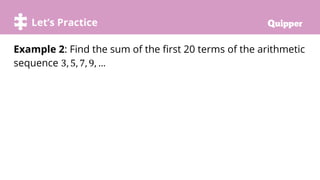
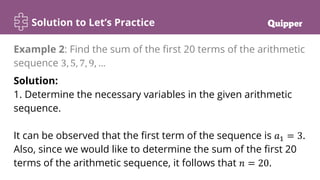
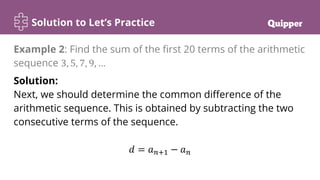
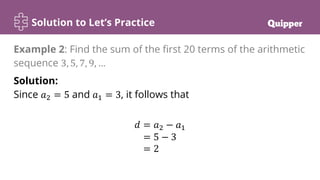
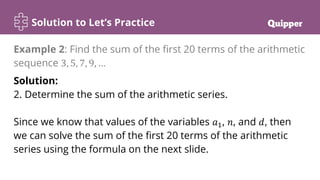
Example 2: Find the sum of the first 20 terms of the arithmetic
sequence 3, 5, 7, 9, …
Solution to Let’s Practice
Solution:
1. Determine the necessary variables in the given arithmetic
sequence.
It can be observed that the first term of the sequence is 𝑎1 = 3.
Also, since we would like to determine the sum of the first 20
terms of the arithmetic sequence, it follows that 𝑛 = 20.
Example 2: Find the sum of the first 20 terms of the arithmetic
sequence 3, 5, 7, 9, …
Solution to Let’s Practice
Solution:
Next, we should determine the common difference of the
arithmetic sequence. This is obtained by subtracting the two
consecutive terms of the sequence.
𝑑 = 𝑎𝑛+1 − 𝑎𝑛
Example 2: Find the sum of the first 20 terms of the arithmetic
sequence 3, 5, 7, 9, …
Solution to Let’s Practice
Solution:
Since 𝑎2 = 5 and 𝑎1 = 3, it follows that
𝑑 = 𝑎2 − 𝑎1
= 5 − 3
= 2
Example 2: Find the sum of the first 20 terms of the arithmetic
sequence 3, 5, 7, 9, …
Solution to Let’s Practice
Solution:
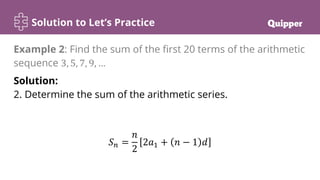
2. Determine the sum of the arithmetic series.
Since we know that values of the variables 𝑎1, 𝑛, and 𝑑, then
we can solve the sum of the first 20 terms of the arithmetic
series using the formula on the next slide.
Example 2: Find the sum of the first 20 terms of the arithmetic
sequence 3, 5, 7, 9, …
Solution to Let’s Practice
Solution:
2. Determine the sum of the arithmetic series.
𝑆𝑛 =
𝑛
2
2𝑎1 + 𝑛 − 1 𝑑
Example 2: Find the sum of the first 20 terms of the arithmetic
sequence 3, 5, 7, 9, …
Solution to Let’s Practice
Solution:
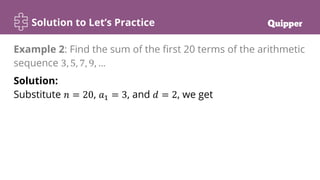
Substitute 𝑛 = 20, 𝑎1 = 3, and 𝑑 = 2, we get
Example 2: Find the sum of the first 20 terms of the arithmetic
sequence 3, 5, 7, 9, …
Solution to Let’s Practice
Solution:
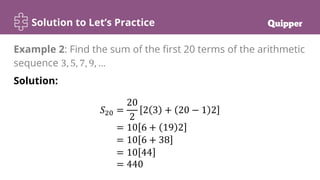
𝑆20 =
20
2
2 3 + 20 − 1 2
= 10 6 + 19 2
= 10 6 + 38
= 10 44
= 440
Example 2: Find the sum of the first 20 terms of the arithmetic
sequence 3, 5, 7, 9, …
Solution to Let’s Practice
Solution:
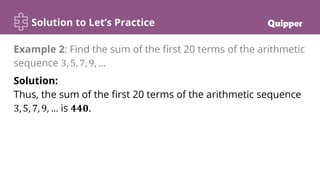
Thus, the sum of the first 20 terms of the arithmetic sequence
3, 5, 7, 9, … is 𝟒𝟒𝟎.
Example 2: Find the sum of the first 20 terms of the arithmetic
sequence 3, 5, 7, 9, …
Try It!
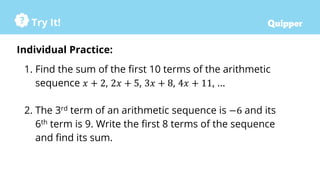
Individual Practice:
1. Find the sum of the first 10 terms of the arithmetic
sequence 𝑥 + 2, 2𝑥 + 5, 3𝑥 + 8, 4𝑥 + 11, …
2. The 3rd term of an arithmetic sequence is −6 and its
6th term is 9. Write the first 8 terms of the sequence
and find its sum.
Try It!
Group Practice: To be done in groups of two to five
The drama club of a school will stage a benefit play for the
victims of the recent typhoon. There are 20 rows of seats in
the school auditorium: 25 seats are in the 1st row, 27 seats
on the 2nd row, 29 seats on the 3rd row, and so on. If the
club plans to give complimentary tickets on the last row,
how many complimentary tickets will they give? How much
is the seating capacity of the school auditorium?
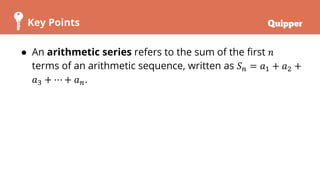
Key Points
● An arithmetic series refers to the sum of the first 𝑛
terms of an arithmetic sequence, written as 𝑆𝑛 = 𝑎1 + 𝑎2 +
𝑎3 + ⋯ + 𝑎𝑛.
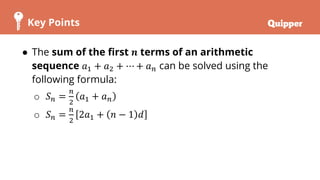
Key Points
● The sum of the first 𝒏 terms of an arithmetic
sequence 𝑎1 + 𝑎2 + ⋯ + 𝑎𝑛 can be solved using the
following formula:
o 𝑆𝑛 =
𝑛
2
𝑎1 + 𝑎𝑛
o 𝑆𝑛 =
𝑛
2
2𝑎1 + 𝑛 − 1 𝑑
Bibliography
Pierce, Rod. (16 Jan 2018). "Arithmetic Sequences and Sums". Math Is Fun. Retrieved 18 Feb 2019 from
http://www.mathsisfun.com/algebra/sequences-sums-arithmetic.html

ME Math 10 Q1 0104 PS.pptx

  • 1.
  • 2.
    Learning Competency At theend of the lesson, the learners should be able to determine arithmetic means, nth term of an arithmetic sequence, and sum of the terms of a given arithmetic sequence.
  • 3.
    Objectives At the endof this lesson, the learners should be able to do the following: ● Accurately differentiate an arithmetic series from arithmetic sequence. ● Correctly solve for the sum of the first 𝑛 terms of an arithmetic sequence. ● Correctly solve real-life problems involving arithmetic series.
  • 4.
    Let us saythat you are in a theater. You noticed that there are 15 seats in the first row, 16 on the second row, 17 on the third row, and so on, until the last row. How would you know how many chairs are there?
  • 5.
    We can easilydetermine how many chairs are there through the use of arithmetic sequence. In this lesson, we will discuss about arithmetic series and its applications.
  • 6.
    Essential Questions ● Howwill you determine the necessary variables needed to solve for the first 𝑛 terms of an arithmetic series? ● How will you solve for the sum of the first 𝑛 terms of an arithmetic series?
  • 7.
    Learn about It! Thisrefers to the sum of the first 𝑛 terms of an arithmetic sequence, written as 𝑆𝑛 = 𝑎1 + 𝑎2 + 𝑎3 + ⋯ + 𝑎𝑛. Arithmetic Series
  • 8.
    Learn about It! Example: Thesum of the first five terms of an arithmetic series 1 + 3 + 5 + ⋯ is 𝑆5 = 1 + 3 + 5 + 7 + 9 = 25 Arithmetic Series
  • 9.
    Learn about It! Thearithmetic series 𝑎1 + 𝑎2 + ⋯ + 𝑎𝑛 can be solved using the following formula. 𝑆𝑛 = 𝑛 2 (𝑎1 + 𝑎𝑛) Sum of the First 𝒏 Terms of an Arithmetic Sequence
  • 10.
    Learn about It! Alternatively,another formula can be used to solve for the first 𝑛 terms of an arithmetic series. 𝑆𝑛 = 𝑛 2 2𝑎1 + 𝑛 − 1 𝑑 Sum of the First 𝒏 Terms of an Arithmetic Sequence
  • 11.
    Learn about It! Example: Thesum of the first ten positive integers can be solved using the arithmetic series. Given that 𝑎1 = 1, 𝑎10 = 10, and 𝑛 = 10, it follows that Sum of the First 𝒏 Terms of an Arithmetic Sequence
  • 12.
    Learn about It! Example: 𝑆𝑛= 𝑛 2 𝑎1 + 𝑎𝑛 𝑆10 = 10 2 1 + 10 = 55 Sum of the First 𝒏 Terms of an Arithmetic Sequence
  • 13.
    Try it! Let’s Practice Example1: Find the sum of the terms of an arithmetic series given that 𝑎1 = 6, 𝑎𝑛 = 82, and 𝑛 = 20.
  • 14.
    Solution to Let’sPractice Solution: In the given example, the variables 𝑎1, 𝑎𝑛, and 𝑛 are given. We can use the formula 𝑆𝑛 = 𝑛 2 (𝑎1 + 𝑎𝑛) to solve for the sum of the terms of the arithmetic series. Example 1: Find the sum of the terms of an arithmetic series given that 𝑎1 = 6 ,𝑎𝑛 = 82 ,and 𝑛 = 20.
  • 15.
    Solution to Let’sPractice Solution: Substituting 𝑎1 = 6, 𝑎𝑛 = 82, and 𝑛 = 20 , we get 𝑆20 = 20 2 6 + 82 = 10 88 = 880 Example 1: Find the sum of the terms of an arithmetic series given that 𝑎1 = 6 ,𝑎𝑛 = 82 ,and 𝑛 = 20.
  • 16.
    Solution to Let’sPractice Solution: Therefore, the sum of the terms of the given arithmetic series is 𝟖𝟖𝟎. Example 1: Find the sum of the terms of an arithmetic series given that 𝑎1 = 6 ,𝑎𝑛 = 82 ,and 𝑛 = 20.
  • 17.
    Try it! Let’s Practice Example2: Find the sum of the first 20 terms of the arithmetic sequence 3, 5, 7, 9, …
  • 18.
    Solution to Let’sPractice Solution: 1. Determine the necessary variables in the given arithmetic sequence. It can be observed that the first term of the sequence is 𝑎1 = 3. Also, since we would like to determine the sum of the first 20 terms of the arithmetic sequence, it follows that 𝑛 = 20. Example 2: Find the sum of the first 20 terms of the arithmetic sequence 3, 5, 7, 9, …
  • 19.
    Solution to Let’sPractice Solution: Next, we should determine the common difference of the arithmetic sequence. This is obtained by subtracting the two consecutive terms of the sequence. 𝑑 = 𝑎𝑛+1 − 𝑎𝑛 Example 2: Find the sum of the first 20 terms of the arithmetic sequence 3, 5, 7, 9, …
  • 20.
    Solution to Let’sPractice Solution: Since 𝑎2 = 5 and 𝑎1 = 3, it follows that 𝑑 = 𝑎2 − 𝑎1 = 5 − 3 = 2 Example 2: Find the sum of the first 20 terms of the arithmetic sequence 3, 5, 7, 9, …
  • 21.
    Solution to Let’sPractice Solution: 2. Determine the sum of the arithmetic series. Since we know that values of the variables 𝑎1, 𝑛, and 𝑑, then we can solve the sum of the first 20 terms of the arithmetic series using the formula on the next slide. Example 2: Find the sum of the first 20 terms of the arithmetic sequence 3, 5, 7, 9, …
  • 22.
    Solution to Let’sPractice Solution: 2. Determine the sum of the arithmetic series. 𝑆𝑛 = 𝑛 2 2𝑎1 + 𝑛 − 1 𝑑 Example 2: Find the sum of the first 20 terms of the arithmetic sequence 3, 5, 7, 9, …
  • 23.
    Solution to Let’sPractice Solution: Substitute 𝑛 = 20, 𝑎1 = 3, and 𝑑 = 2, we get Example 2: Find the sum of the first 20 terms of the arithmetic sequence 3, 5, 7, 9, …
  • 24.
    Solution to Let’sPractice Solution: 𝑆20 = 20 2 2 3 + 20 − 1 2 = 10 6 + 19 2 = 10 6 + 38 = 10 44 = 440 Example 2: Find the sum of the first 20 terms of the arithmetic sequence 3, 5, 7, 9, …
  • 25.
    Solution to Let’sPractice Solution: Thus, the sum of the first 20 terms of the arithmetic sequence 3, 5, 7, 9, … is 𝟒𝟒𝟎. Example 2: Find the sum of the first 20 terms of the arithmetic sequence 3, 5, 7, 9, …
  • 26.
    Try It! Individual Practice: 1.Find the sum of the first 10 terms of the arithmetic sequence 𝑥 + 2, 2𝑥 + 5, 3𝑥 + 8, 4𝑥 + 11, … 2. The 3rd term of an arithmetic sequence is −6 and its 6th term is 9. Write the first 8 terms of the sequence and find its sum.
  • 27.
    Try It! Group Practice:To be done in groups of two to five The drama club of a school will stage a benefit play for the victims of the recent typhoon. There are 20 rows of seats in the school auditorium: 25 seats are in the 1st row, 27 seats on the 2nd row, 29 seats on the 3rd row, and so on. If the club plans to give complimentary tickets on the last row, how many complimentary tickets will they give? How much is the seating capacity of the school auditorium?
  • 28.
    Key Points ● Anarithmetic series refers to the sum of the first 𝑛 terms of an arithmetic sequence, written as 𝑆𝑛 = 𝑎1 + 𝑎2 + 𝑎3 + ⋯ + 𝑎𝑛.
  • 29.
    Key Points ● Thesum of the first 𝒏 terms of an arithmetic sequence 𝑎1 + 𝑎2 + ⋯ + 𝑎𝑛 can be solved using the following formula: o 𝑆𝑛 = 𝑛 2 𝑎1 + 𝑎𝑛 o 𝑆𝑛 = 𝑛 2 2𝑎1 + 𝑛 − 1 𝑑
  • 30.
    Bibliography Pierce, Rod. (16Jan 2018). "Arithmetic Sequences and Sums". Math Is Fun. Retrieved 18 Feb 2019 from http://www.mathsisfun.com/algebra/sequences-sums-arithmetic.html