

ARITHMETIC
SEQUENCE
Finding the nth term
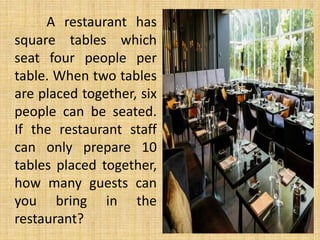
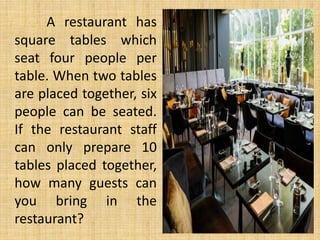
A restaurant has
square tables which
seat four people per
table. When two tables
are placed together, six
people can be seated.
If the restaurant staff
can only prepare 10
tables placed together,
how many guests can
you bring in the
restaurant?
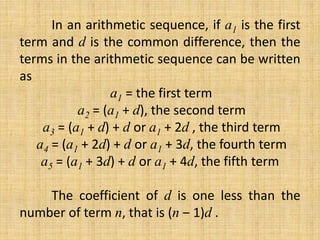
In an arithmetic sequence, if a1 is the first
term and d is the common difference, then the
terms in the arithmetic sequence can be written
as
a1 = the first term
a2 = (a1 + d), the second term
a3 = (a1 + d) + d or a1 + 2d , the third term
a4 = (a1 + 2d) + d or a1 + 3d, the fourth term
a5 = (a1 + 3d) + d or a1 + 4d, the fifth term
The coefficient of d is one less than the
number of term n, that is (n ‒ 1)d .
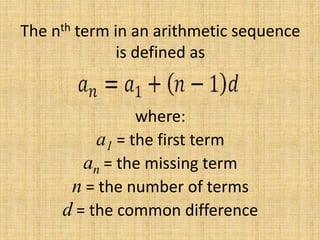
The nth term in an arithmetic sequence
is defined as
where:
a1 = the first term
an = the missing term
n = the number of terms
d = the common difference
A restaurant has
square tables which
seat four people per
table. When two tables
are placed together, six
people can be seated.
If the restaurant staff
can only prepare 10
tables placed together,
how many guests can
you bring in the
restaurant?
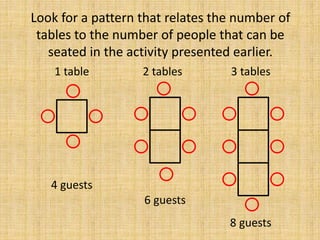
Look for a pattern that relates the number of
tables to the number of people that can be
seated in the activity presented earlier.
1 table 2 tables 3 tables
4 guests
6 guests
8 guests
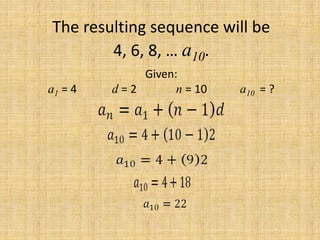
The resulting sequence will be
4, 6, 8, … a10.
Given:
a1 = 4 d = 2 n = 10 a10 = ?
Consider the following:
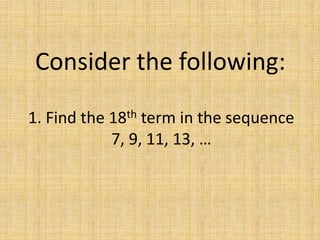
1. Find the 18th term in the sequence
7, 9, 11, 13, …
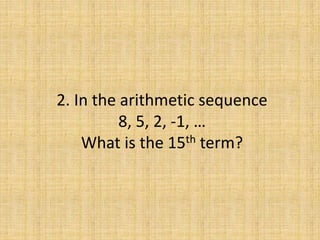
2. In the arithmetic sequence
8, 5, 2, -1, …
What is the 15th term?
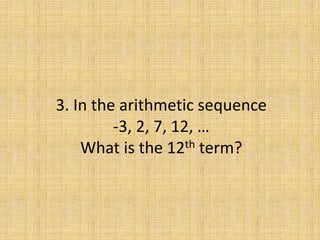
3. In the arithmetic sequence
-3, 2, 7, 12, …
What is the 12th term?
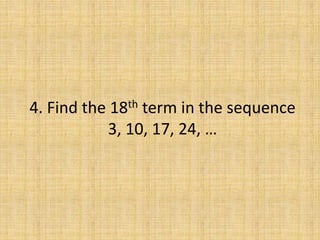
4. Find the 18th term in the sequence
3, 10, 17, 24, …
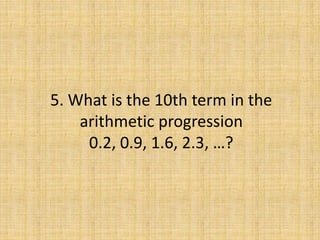
5. What is the 10th term in the
arithmetic progression
0.2, 0.9, 1.6, 2.3, …?
VALUES INTEGRATION
Inlife, you experience a sequenceof
ups anddowns.
What should
one’s attitude be
towards ups and
downs in life?
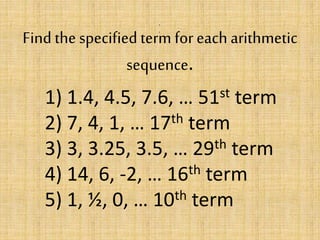
Find the specified term for each arithmetic
sequence.
,
,
1) 1.4, 4.5, 7.6, … 51st term
2) 7, 4, 1, … 17th term
3) 3, 3.25, 3.5, … 29th term
4) 14, 6, -2, … 16th term
5) 1, ½, 0, … 10th term
Thank you!

Arithmetic Sequence: Finding the nth Term

  • 1.
  • 2.
    A restaurant has squaretables which seat four people per table. When two tables are placed together, six people can be seated. If the restaurant staff can only prepare 10 tables placed together, how many guests can you bring in the restaurant?
  • 3.
    In an arithmeticsequence, if a1 is the first term and d is the common difference, then the terms in the arithmetic sequence can be written as a1 = the first term a2 = (a1 + d), the second term a3 = (a1 + d) + d or a1 + 2d , the third term a4 = (a1 + 2d) + d or a1 + 3d, the fourth term a5 = (a1 + 3d) + d or a1 + 4d, the fifth term The coefficient of d is one less than the number of term n, that is (n ‒ 1)d .
  • 4.
    The nth termin an arithmetic sequence is defined as where: a1 = the first term an = the missing term n = the number of terms d = the common difference
  • 5.
    A restaurant has squaretables which seat four people per table. When two tables are placed together, six people can be seated. If the restaurant staff can only prepare 10 tables placed together, how many guests can you bring in the restaurant?
  • 6.
    Look for apattern that relates the number of tables to the number of people that can be seated in the activity presented earlier. 1 table 2 tables 3 tables 4 guests 6 guests 8 guests
  • 7.
    The resulting sequencewill be 4, 6, 8, … a10. Given: a1 = 4 d = 2 n = 10 a10 = ?
  • 8.
    Consider the following: 1.Find the 18th term in the sequence 7, 9, 11, 13, …
  • 9.
    2. In thearithmetic sequence 8, 5, 2, -1, … What is the 15th term?
  • 10.
    3. In thearithmetic sequence -3, 2, 7, 12, … What is the 12th term?
  • 11.
    4. Find the18th term in the sequence 3, 10, 17, 24, …
  • 12.
    5. What isthe 10th term in the arithmetic progression 0.2, 0.9, 1.6, 2.3, …?
  • 13.
    VALUES INTEGRATION Inlife, youexperience a sequenceof ups anddowns. What should one’s attitude be towards ups and downs in life?
  • 14.
    Find the specifiedterm for each arithmetic sequence. , , 1) 1.4, 4.5, 7.6, … 51st term 2) 7, 4, 1, … 17th term 3) 3, 3.25, 3.5, … 29th term 4) 14, 6, -2, … 16th term 5) 1, ½, 0, … 10th term
  • 15.