THYROID GLANDS
Verdeflor, Dungog, Nepomuceno
THYROID GLAND
The location of
the thyroid gland
in the neck, in
front of the
windpipe
(trachea). The
voice box (larynx)
sits just above the
thyroid.
THYROID (HUMAN ANATOMY)
Thyroid Gland
 The thyroid gland is part of the endocrine
system and is responsible for producing and
releasing thyroid hormones into the
bloodstream.
 The thyroid is a butterfly-shaped gland that sits
low on the front of the neck. Your thyroid lies
below your Adam’s apple, along the front of
the windpipe. The thyroid has two side lobes,
connected by a bridge (isthmus) in the middle.
When the thyroid is its normal size, you can’t
feel it.
 Brownish-red in color, the thyroid is rich with
Thyroid Gland
 The thyroid secretes several hormones,
collectively called thyroid hormones. The main
hormone is thyroxine, also called T4. Thyroid
hormones act throughout the body, influencing
metabolism, growth and development, and
body temperature. During infancy and
childhood, adequate thyroid hormone is crucial
for brain development.
Where is my thyroid gland?
 The thyroid gland is located at the
front of the neck just below
the Adam's apple (larynx). It is
butterfly-shaped and consists of two
lobes located either side of the
windpipe (trachea). A normal thyroid
gland is not usually outwardly visible
or able to be felt if finger pressure is
applied to the neck.
What does my thyroid gland do?
 The thyroid gland produces hormones which
regulate the body’s metabolic rate as well as heart
and digestive function, muscle control, brain
development and bone maintenance. Its correct
functioning depends on having a good supply of
iodine from the diet.
 The release of thyroid hormones from the thyroid
gland is controlled by thyrotrophin-releasing
hormone(TRH) from the hypothalamus in the
brain and by thyroid stimulating hormone (TSH)
produced by the pituitary gland. This forms part of
a feedback loop called the hypothalamic-pituitary-
thyroid axis.
What hormones does my thyroid
gland produce?
 The thyroid gland produces thyroxine (T4), which
is a relatively inactive prohormone and lower
amounts of the active hormone,
triiodothyronine (T3). Collectively, T3 and T4 are
referred to as the thyroid hormones. Twenty
percent of the body’s triiodothyronine is made by
the thyroid gland; the other 80% comes from
thyroxine converted by organs such as the liver
or kidneys.
 The thyroid gland also produces calcitonin from
cells called C-cells. Calcitonin is understood to
play a role in regulating calcium levels in the body,
but its exact function in humans remains unclear.
Thyroid Conditions
 Goiter: A general term for thyroid swelling. Goiters can
be harmless, or can represent iodine deficiency or a
condition associated with thyroid inflammation called
Hashimoto’s thyroiditis.
 Thyroiditis: Inflammation of the thyroid, usually from a
viral infection or autoimmune condition. Thyroiditis can
be painful, or have no symptoms at all.
 Hyperthyroidism: Excessive thyroid hormone
production. Hyperthyroidism is most often caused by
Graves disease or an overactive thyroid nodule.
 Hypothyroidism: Low production of thyroid hormone.
Thyroid damage caused by autoimmune disease is
the most common cause of hypothyroidism .
Thyroid Conditions
 Graves disease: An autoimmune condition in which
the thyroid is overstimulated, causing hyperthyroidism.
 Thyroid cancer: An uncommon form of cancer, thyroid
cancer is usually curable. Surgery, radiation, and
hormone treatments may be used to treat thyroid
cancer.
 Thyroid nodule: A small abnormal mass or lump in the
thyroid gland. Thyroid nodules are extremely
common. Few are cancerous. They may secrete
excess hormones, causing hyperthyroidism, or cause
no problems.
 Thyroid storm: A rare form of hyperthyroidism in which
extremely high thyroid hormone levels cause severe
illness.
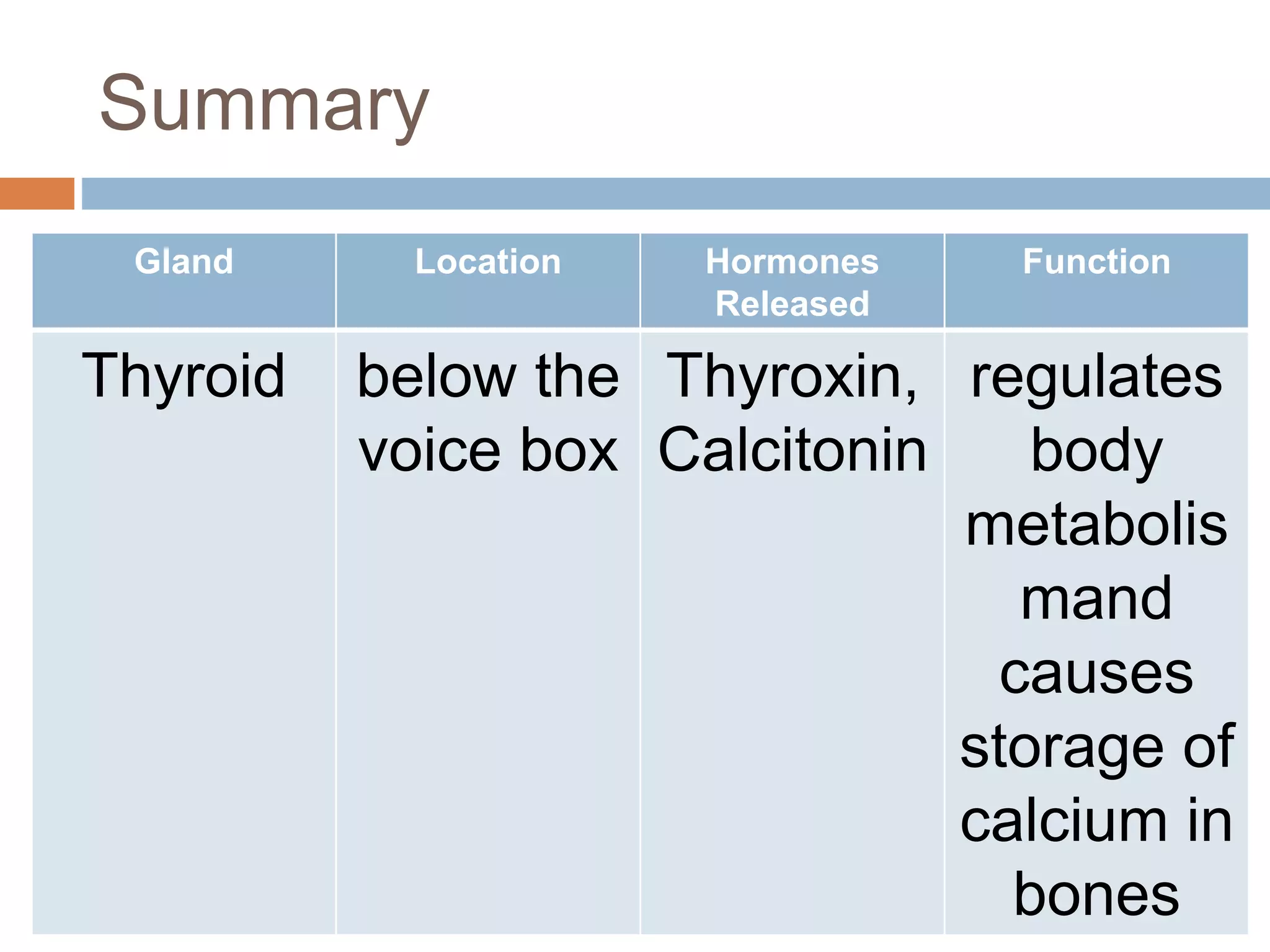
Summary
Gland Location Hormones
Released
Function
Thyroid below the
voice box
Thyroxin,
Calcitonin
regulates
body
metabolis
mand
causes
storage of
calcium in
bones

Thyroid Glands

  • 1.
  • 2.
    THYROID GLAND The locationof the thyroid gland in the neck, in front of the windpipe (trachea). The voice box (larynx) sits just above the thyroid.
  • 3.
  • 4.
    Thyroid Gland  Thethyroid gland is part of the endocrine system and is responsible for producing and releasing thyroid hormones into the bloodstream.  The thyroid is a butterfly-shaped gland that sits low on the front of the neck. Your thyroid lies below your Adam’s apple, along the front of the windpipe. The thyroid has two side lobes, connected by a bridge (isthmus) in the middle. When the thyroid is its normal size, you can’t feel it.  Brownish-red in color, the thyroid is rich with
  • 5.
    Thyroid Gland  Thethyroid secretes several hormones, collectively called thyroid hormones. The main hormone is thyroxine, also called T4. Thyroid hormones act throughout the body, influencing metabolism, growth and development, and body temperature. During infancy and childhood, adequate thyroid hormone is crucial for brain development.
  • 6.
    Where is mythyroid gland?  The thyroid gland is located at the front of the neck just below the Adam's apple (larynx). It is butterfly-shaped and consists of two lobes located either side of the windpipe (trachea). A normal thyroid gland is not usually outwardly visible or able to be felt if finger pressure is applied to the neck.
  • 7.
    What does mythyroid gland do?  The thyroid gland produces hormones which regulate the body’s metabolic rate as well as heart and digestive function, muscle control, brain development and bone maintenance. Its correct functioning depends on having a good supply of iodine from the diet.  The release of thyroid hormones from the thyroid gland is controlled by thyrotrophin-releasing hormone(TRH) from the hypothalamus in the brain and by thyroid stimulating hormone (TSH) produced by the pituitary gland. This forms part of a feedback loop called the hypothalamic-pituitary- thyroid axis.
  • 8.
    What hormones doesmy thyroid gland produce?  The thyroid gland produces thyroxine (T4), which is a relatively inactive prohormone and lower amounts of the active hormone, triiodothyronine (T3). Collectively, T3 and T4 are referred to as the thyroid hormones. Twenty percent of the body’s triiodothyronine is made by the thyroid gland; the other 80% comes from thyroxine converted by organs such as the liver or kidneys.  The thyroid gland also produces calcitonin from cells called C-cells. Calcitonin is understood to play a role in regulating calcium levels in the body, but its exact function in humans remains unclear.
  • 9.
    Thyroid Conditions  Goiter:A general term for thyroid swelling. Goiters can be harmless, or can represent iodine deficiency or a condition associated with thyroid inflammation called Hashimoto’s thyroiditis.  Thyroiditis: Inflammation of the thyroid, usually from a viral infection or autoimmune condition. Thyroiditis can be painful, or have no symptoms at all.  Hyperthyroidism: Excessive thyroid hormone production. Hyperthyroidism is most often caused by Graves disease or an overactive thyroid nodule.  Hypothyroidism: Low production of thyroid hormone. Thyroid damage caused by autoimmune disease is the most common cause of hypothyroidism .
  • 10.
    Thyroid Conditions  Gravesdisease: An autoimmune condition in which the thyroid is overstimulated, causing hyperthyroidism.  Thyroid cancer: An uncommon form of cancer, thyroid cancer is usually curable. Surgery, radiation, and hormone treatments may be used to treat thyroid cancer.  Thyroid nodule: A small abnormal mass or lump in the thyroid gland. Thyroid nodules are extremely common. Few are cancerous. They may secrete excess hormones, causing hyperthyroidism, or cause no problems.  Thyroid storm: A rare form of hyperthyroidism in which extremely high thyroid hormone levels cause severe illness.
  • 11.
    Summary Gland Location Hormones Released Function Thyroidbelow the voice box Thyroxin, Calcitonin regulates body metabolis mand causes storage of calcium in bones