The secret of Karl
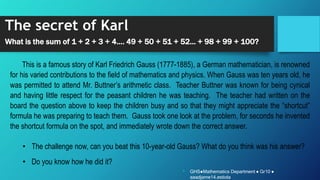
What is the sum of 1 + 2 + 3 + 4…. 49 + 50 + 51 + 52… + 98 + 99 + 100?
This is a famous story of Karl Friedrich Gauss (1777-1885), a German mathematician, is renowned
for his varied contributions to the field of mathematics and physics. When Gauss was ten years old, he
was permitted to attend Mr. Buttner’s arithmetic class. Teacher Buttner was known for being cynical
and having little respect for the peasant children he was teaching. The teacher had written on the
board the question above to keep the children busy and so that they might appreciate the “shortcut”
formula he was preparing to teach them. Gauss took one look at the problem, for seconds he invented
the shortcut formula on the spot, and immediately wrote down the correct answer.
• The challenge now, can you beat this 10-year-old Gauss? What do you think was his answer?
• Do you know how he did it?
• GHS●Mathematics Department ● Gr10 ●
aaadjame14.estiola
The secret of Karl
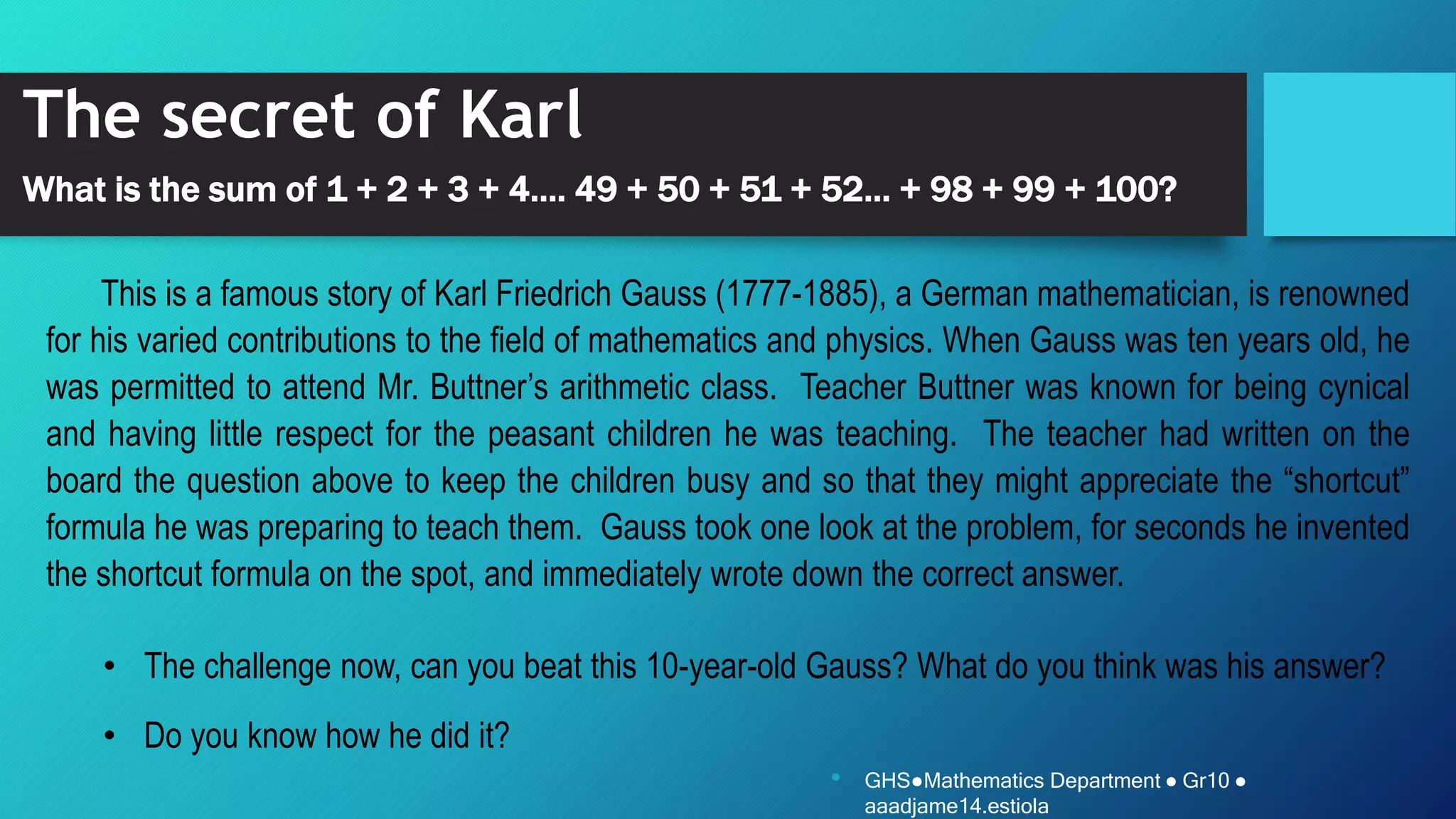
What is the sum of 1 + 2 + 3 + 4…. 49 + 50 + 51 + 52… + 98 + 99 + 100?
• Summing up the pairs:
1 + 2 + 3 + …. 49 + 50 + 51 + 52… + 98 + 99 + 100?
101
What is the total?
• How many pairs are there in the sequence above? 50 pairs
• Base from the answers above, how do you find the sum of the
integers from 1 to 100?
• GHS●Mathematics Department ● Gr10 ●
aaadjame14.estiola
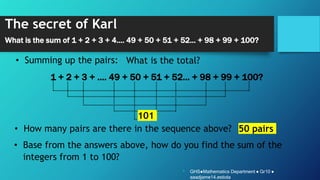
SUM OF ARITHMETIC Sequence
OBJECTIVES:
1. Discuss how to determine the sum of an arithmetic sequence
2. Find the sum of an arithmetic sequence
1 + 2 + 3 + …. 49 + 50 + 51 + 52… + 98 + 99 + 100?
• GHS●Mathematics Department ● Gr10 ●
aaadjame14.estiola
ALLEN M. ESTIOLA
Master Teacher I, GUN-OB HS, LLC Division
SUM OF ARITHMETIC Sequence
The formula for the SUM of an Arithmetic Sequence is
where: S = the sum of an Arithmetic sequence
n = the number of terms
a1 = the 1st term
d = the common difference
Sn =
𝒏
𝟐
[2a1 + (n – 1)d] Sn =
𝒏
𝟐
[a1 + an]
an = the last term
• GHS●Mathematics Department ● Gr10 ●
aaadjame14.estiola
ILLUSTRATIVE EXAMPLES
Find the sum
of the first 70
terms of the
arithmetic
sequence if
the first term
is 22 and the
twentieth
term is 155?
22, … 155, … a70,
S1 Given: a1 = 22
n = 20
S2 Find: d,
S4 Solve for S70 using the formula
S70 =
70
2
[2(22) + (70 – 1)(7)]
Sn =
𝑛
2
[2a1 + (n – 1)d]
S70 = 35[44 + (69)(7)]
S70 = 35[44 + 483]
S70 = 35[527]
S70 = 18 445
S5 Therefore the sum of the 1st 70
terms is 18 445.
a20 = 155 
n = 70
S70
S3 Find d
an = a1 + n − 1 d
𝑎20 = 22 + 20 − 1 𝑑
155 = 22 + 19𝑑
155 − 22 = 19𝑑
133 = 19𝑑
𝑑 = 7
GHS●Mathematics Department ● Gr10 ●
ILLUSTRATIVE EXAMPLES
A conference hall
has 10 rows of
seats. The first row
contains 30 seats,
the second row
contains 42 seats,
the third row
contains 54 seats,
and so on. Find the
total number of
seats in the
conference hall.
30, 42, 54, …
S1 Given: a1 = 30
d = 12
n = 10
S2 Find: S10
S3 Solve for S10 using the formula
S10 =
10
2
[2(30) + (10 – 1)(12)]
Sn =
𝑛
2
[2a1 + (n – 1)d]
S10 = 5[60 + (9)(12)]
S10 = 5[60 + 108]
S10 = 5[168]
S10 = 840
S4 Therefore the total number of
seats in the conference hall is 840.
• GHS●Mathematics Department ● Gr10 ●
aaadjame14.estiola
Given:
ILLUSTRATIVE EXAMPLES
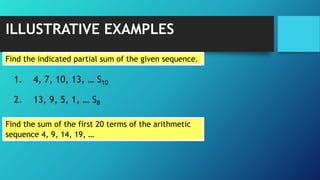
Find the indicated partial sum of the given sequence.
1. 4, 7, 10, 13, … S10
2. 13, 9, 5, 1, … S8
Find the sum of the first 20 terms of the arithmetic
sequence 4, 9, 14, 19, …
Application
SET A. A group of hikers has a trek of
10 hours to reach Mt. Manunggal.
They traveled 25km on the 1st hour, 23
km on the 2nd hour, 21 on the 3rd hour,
and so on. How many kilometers did
they travel to reach Mt. Manunggal?
• GHS●Mathematics Department ● Gr10 ●
aaadjame14.estiola
SET B. A househelp receives a salary
of 36 000php a year with contract of
250 annual increase of 7 years. What
is his total income for 7 years?
Assessment
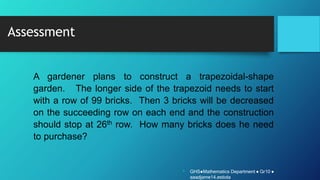
A gardener plans to construct a trapezoidal-shape
garden. The longer side of the trapezoid needs to start
with a row of 99 bricks. Then 3 bricks will be decreased
on the succeeding row on each end and the construction
should stop at 26th row. How many bricks does he need
to purchase?
• GHS●Mathematics Department ● Gr10 ●
aaadjame14.estiola
Assignment
Study and prepare for a Long test tomorrow
• Generating the general rule
• Arithmetic Sequence
• Arithmetic Mean
• Sum of Arithmetic Sequence
• GHS●Mathematics Department ● Gr10 ●
aaadjame14.estiola

G10 Q1 W2 L3. Arithmetic SUM SLIDE.pptx

  • 1.
    The secret ofKarl What is the sum of 1 + 2 + 3 + 4…. 49 + 50 + 51 + 52… + 98 + 99 + 100? This is a famous story of Karl Friedrich Gauss (1777-1885), a German mathematician, is renowned for his varied contributions to the field of mathematics and physics. When Gauss was ten years old, he was permitted to attend Mr. Buttner’s arithmetic class. Teacher Buttner was known for being cynical and having little respect for the peasant children he was teaching. The teacher had written on the board the question above to keep the children busy and so that they might appreciate the “shortcut” formula he was preparing to teach them. Gauss took one look at the problem, for seconds he invented the shortcut formula on the spot, and immediately wrote down the correct answer. • The challenge now, can you beat this 10-year-old Gauss? What do you think was his answer? • Do you know how he did it? • GHS●Mathematics Department ● Gr10 ● aaadjame14.estiola
  • 2.
    The secret ofKarl What is the sum of 1 + 2 + 3 + 4…. 49 + 50 + 51 + 52… + 98 + 99 + 100? • Summing up the pairs: 1 + 2 + 3 + …. 49 + 50 + 51 + 52… + 98 + 99 + 100? 101 What is the total? • How many pairs are there in the sequence above? 50 pairs • Base from the answers above, how do you find the sum of the integers from 1 to 100? • GHS●Mathematics Department ● Gr10 ● aaadjame14.estiola
  • 3.
    SUM OF ARITHMETICSequence OBJECTIVES: 1. Discuss how to determine the sum of an arithmetic sequence 2. Find the sum of an arithmetic sequence 1 + 2 + 3 + …. 49 + 50 + 51 + 52… + 98 + 99 + 100? • GHS●Mathematics Department ● Gr10 ● aaadjame14.estiola ALLEN M. ESTIOLA Master Teacher I, GUN-OB HS, LLC Division
  • 4.
    SUM OF ARITHMETICSequence The formula for the SUM of an Arithmetic Sequence is where: S = the sum of an Arithmetic sequence n = the number of terms a1 = the 1st term d = the common difference Sn = 𝒏 𝟐 [2a1 + (n – 1)d] Sn = 𝒏 𝟐 [a1 + an] an = the last term • GHS●Mathematics Department ● Gr10 ● aaadjame14.estiola
  • 5.
    ILLUSTRATIVE EXAMPLES Find thesum of the first 70 terms of the arithmetic sequence if the first term is 22 and the twentieth term is 155? 22, … 155, … a70, S1 Given: a1 = 22 n = 20 S2 Find: d, S4 Solve for S70 using the formula S70 = 70 2 [2(22) + (70 – 1)(7)] Sn = 𝑛 2 [2a1 + (n – 1)d] S70 = 35[44 + (69)(7)] S70 = 35[44 + 483] S70 = 35[527] S70 = 18 445 S5 Therefore the sum of the 1st 70 terms is 18 445. a20 = 155  n = 70 S70 S3 Find d an = a1 + n − 1 d 𝑎20 = 22 + 20 − 1 𝑑 155 = 22 + 19𝑑 155 − 22 = 19𝑑 133 = 19𝑑 𝑑 = 7 GHS●Mathematics Department ● Gr10 ●
  • 6.
    ILLUSTRATIVE EXAMPLES A conferencehall has 10 rows of seats. The first row contains 30 seats, the second row contains 42 seats, the third row contains 54 seats, and so on. Find the total number of seats in the conference hall. 30, 42, 54, … S1 Given: a1 = 30 d = 12 n = 10 S2 Find: S10 S3 Solve for S10 using the formula S10 = 10 2 [2(30) + (10 – 1)(12)] Sn = 𝑛 2 [2a1 + (n – 1)d] S10 = 5[60 + (9)(12)] S10 = 5[60 + 108] S10 = 5[168] S10 = 840 S4 Therefore the total number of seats in the conference hall is 840. • GHS●Mathematics Department ● Gr10 ● aaadjame14.estiola Given:
  • 7.
    ILLUSTRATIVE EXAMPLES Find theindicated partial sum of the given sequence. 1. 4, 7, 10, 13, … S10 2. 13, 9, 5, 1, … S8 Find the sum of the first 20 terms of the arithmetic sequence 4, 9, 14, 19, …
  • 8.
    Application SET A. Agroup of hikers has a trek of 10 hours to reach Mt. Manunggal. They traveled 25km on the 1st hour, 23 km on the 2nd hour, 21 on the 3rd hour, and so on. How many kilometers did they travel to reach Mt. Manunggal? • GHS●Mathematics Department ● Gr10 ● aaadjame14.estiola SET B. A househelp receives a salary of 36 000php a year with contract of 250 annual increase of 7 years. What is his total income for 7 years?
  • 9.
    Assessment A gardener plansto construct a trapezoidal-shape garden. The longer side of the trapezoid needs to start with a row of 99 bricks. Then 3 bricks will be decreased on the succeeding row on each end and the construction should stop at 26th row. How many bricks does he need to purchase? • GHS●Mathematics Department ● Gr10 ● aaadjame14.estiola
  • 10.
    Assignment Study and preparefor a Long test tomorrow • Generating the general rule • Arithmetic Sequence • Arithmetic Mean • Sum of Arithmetic Sequence • GHS●Mathematics Department ● Gr10 ● aaadjame14.estiola