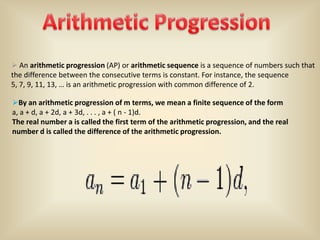
 An arithmetic progression (AP) or arithmetic sequence is a sequence of numbers such that
the difference between the consecutive terms is constant. For instance, the sequence
5, 7, 9, 11, 13, … is an arithmetic progression with common difference of 2.

By an arithmetic progression of m terms, we mean a finite sequence of the form
a, a + d, a + 2d, a + 3d, . . . , a + ( n - 1)d.
The real number a is called the first term of the arithmetic progression, and the real
number d is called the difference of the arithmetic progression.
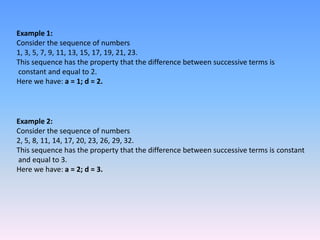
Example 1:
Consider the sequence of numbers
1, 3, 5, 7, 9, 11, 13, 15, 17, 19, 21, 23.
This sequence has the property that the difference between successive terms is
constant and equal to 2.
Here we have: a = 1; d = 2.


Example 2:
Consider the sequence of numbers
2, 5, 8, 11, 14, 17, 20, 23, 26, 29, 32.
This sequence has the property that the difference between successive terms is constant
and equal to 3.
Here we have: a = 2; d = 3.
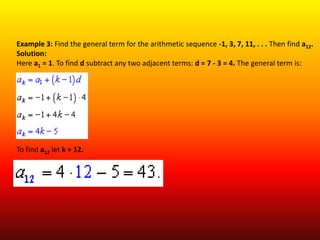
Example 3: Find the general term for the arithmetic sequence -1, 3, 7, 11, . . . Then find a12.
Solution:
Here a1 = 1. To find d subtract any two adjacent terms: d = 7 - 3 = 4. The general term is:


To find a12 let k = 12.
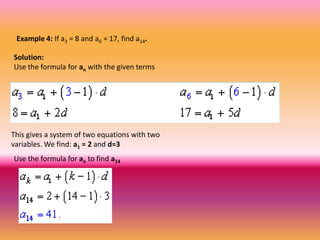
Example 4: If a3 = 8 and a6 = 17, find a14.

Solution:
Use the formula for an with the given terms


This gives a system of two equations with two
variables. We find: a1 = 2 and d=3
Use the formula for an to find a14
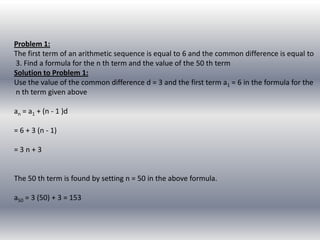
Problem 1:
The first term of an arithmetic sequence is equal to 6 and the common difference is equal to
3. Find a formula for the n th term and the value of the 50 th term
Solution to Problem 1:
Use the value of the common difference d = 3 and the first term a1 = 6 in the formula for the
n th term given above

an = a1 + (n - 1 )d

= 6 + 3 (n - 1)

=3n+3


The 50 th term is found by setting n = 50 in the above formula.

a50 = 3 (50) + 3 = 153
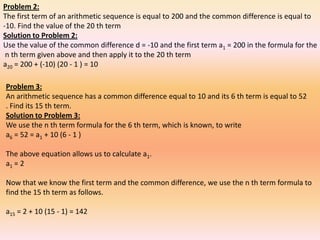
Problem 2:
The first term of an arithmetic sequence is equal to 200 and the common difference is equal to
-10. Find the value of the 20 th term
Solution to Problem 2:
Use the value of the common difference d = -10 and the first term a1 = 200 in the formula for the
 n th term given above and then apply it to the 20 th term
a20 = 200 + (-10) (20 - 1 ) = 10

Problem 3:
An arithmetic sequence has a common difference equal to 10 and its 6 th term is equal to 52
. Find its 15 th term.
Solution to Problem 3:
We use the n th term formula for the 6 th term, which is known, to write
a6 = 52 = a1 + 10 (6 - 1 )

The above equation allows us to calculate a1.
a1 = 2

Now that we know the first term and the common difference, we use the n th term formula to
find the 15 th term as follows.

a15 = 2 + 10 (15 - 1) = 142
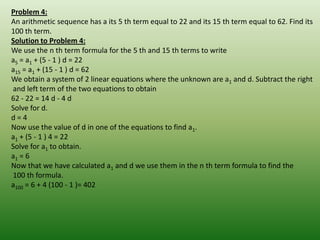
Problem 4:
An arithmetic sequence has a its 5 th term equal to 22 and its 15 th term equal to 62. Find its
100 th term.
Solution to Problem 4:
We use the n th term formula for the 5 th and 15 th terms to write
a5 = a1 + (5 - 1 ) d = 22
a15 = a1 + (15 - 1 ) d = 62
We obtain a system of 2 linear equations where the unknown are a1 and d. Subtract the right
and left term of the two equations to obtain
62 - 22 = 14 d - 4 d
Solve for d.
d=4
Now use the value of d in one of the equations to find a1.
a1 + (5 - 1 ) 4 = 22
Solve for a1 to obtain.
a1 = 6
Now that we have calculated a1 and d we use them in the n th term formula to find the
100 th formula.
a100 = 6 + 4 (100 - 1 )= 402
1. Find the 10th term of -5,-8,-11,......        5.Find the 100th term. if the first term is 4 and
[A] -28                                          the common difference is 7?
[C] -32                                          [A] 150
[B] -18                                          [C] 800
[D] -20                                          [B] 120
2. Find the 32nd term in the following series [D] 697
3,7,11,.......                                   6.Find the number of terms in the series
[A] 120                                          8,11,14,....95
[C] 220                                          [A] 25
[B] 230                                          [C] 27
[D] 127                                          [B] 26
                                                 [D] 30
3.Find the position of 98 in the following
                                                 7.Find the number of terms in the series
series 3,8,13 ....?
                                                 11,6,1,...-54?
[A] 20th term
                                                 [A] 12
[C] 12th term
                                                 [C] 14
[B] 36th term
                                                 [B] 13
[D] 34th term
                                                 [D] 15
4. Find the 35th term if the first term is 8 and 8.Find the number of terms in the series
common difference is 1.5                         2,3.5,5,...62 ?
[A] 35                                           [A] 50
[C] 18                                           [C] 41
[B] 59                                           [B] 62
[D] 24                                           [D] 42
9.Find the values of x in the Arithmetic series    10. In an A.P the 12th term is 61 and common
3x+1,5x-1,5x+1,......                              difference is 5 then find the series
[A] 2                                              [A] 6,11,16
[C] 8                                              [C] 5,8,11
[B] 3                                              [B] 4,7,11
[D] 7                                              [D] 3,9,12


                                 1. : [C]           6. : [D]
                                 2 : [D]            7. : [C]
                                 3. : [A]           8. : [C]
                                 4. : [B]          9. : [A]
                                 5. : [D]         10. : [A]
Calculate the sum of a given A.P
             FORMULA
         Sn=n/2x[2a+(n-1)d]
    Where Sn=Sum of the given A.P
     Where a=first term of the A.P
Where n=number of terms in the given A.P
 Where d=common difference of the A.P
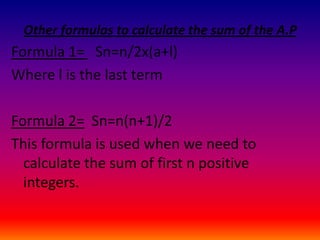
Other formulas to calculate the sum of the A.P
Formula 1= Sn=n/2x(a+l)
Where l is the last term

Formula 2= Sn=n(n+1)/2
This formula is used when we need to
  calculate the sum of first n positive
  integers.
EXAMPLES
Example 1: Find the sum of first 28 terms of the A.P:8,3,-2……..
Solution- No. of terms=28
          calculate d =
          3-8=-5
          a=8
          put these values in the Sn formula=n/2x[2a+(n-1)d] and
   calculate the sum
        Sn(S28)= 28/2x[2x8+(28-1)x-5]
          14x{16+(27x-5)}
          14x(16-135)
          14x(-119)
          =-1666
So S28=-1666 for the given A.P
Example 2: If the sum of the first 14 terms of an AP is 1050 and its first term is
   10,find the 20th term.
Solution- n=14
           Sn(S14)=1050
           a=10
     From the Sn formula=n/2x[2a+(n-1)d] calculate d by equating the Sn value
   to the formula.
     1050=14/2x[2x10+(14-1)d]
     1050=7x[20+13d]
     1050=140=91d
     1050-140=91d
     d=910/91=10
So d=10
       From the An formula=a+(n-1)d calculate the value of a20
       A20=10+(20-1)x10
       =10+190
       =200
So a20=200
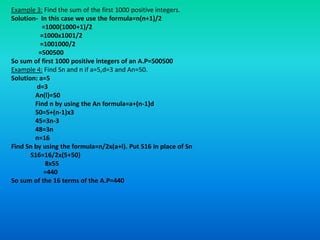
Example 3: Find the sum of the first 1000 positive integers.
Solution- In this case we use the formula=n(n+1)/2
           =1000(1000+1)/2
          =1000x1001/2
          =1001000/2
          =500500
So sum of first 1000 positive integers of an A.P=500500
Example 4: Find Sn and n if a=5,d=3 and An=50.
Solution: a=5
         d=3
        An(l)=50
        Find n by using the An formula=a+(n-1)d
        50=5+(n-1)x3
        45=3n-3
        48=3n
        n=16
Find Sn by using the formula=n/2x(a+l). Put S16 in place of Sn
       S16=16/2x(5+50)
            8x55
           =440
So sum of the 16 terms of the A.P=440
Example 5: Find the sum of the series 5+7+9+11+13……to 40 terms.
Solution- a=5
          d=7-5=2
            9-7=2
          n=40
          Put these values in the formula=n/2x[2a+(n-1)d]
          Sn=40/2x[2x5+(40-1)x2]
            =20x[10+39x2]
           =20x(10+78)
           =20x88
           =1760
So the sum of 40 terms of the A.P=1760
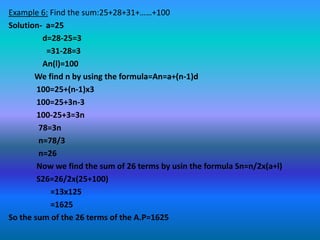
Example 6: Find the sum:25+28+31+……+100
Solution- a=25
         d=28-25=3
          =31-28=3
         An(l)=100
       We find n by using the formula=An=a+(n-1)d
        100=25+(n-1)x3
        100=25+3n-3
        100-25+3=3n
        78=3n
        n=78/3
        n=26
        Now we find the sum of 26 terms by usin the formula Sn=n/2x(a+l)
        S26=26/2x(25+100)
           =13x125
           =1625
So the sum of the 26 terms of the A.P=1625
QUESTIONS-
(Q1)Find the sum of first 21 terms of the A.P whose 2nd term is 8 and 4th term is 14
(Ans-1) a2=8
         a4=14
         a2=8 can be written as a+d=8 and a4=14 can be written as a+3d=14.
         Solve a+d=8,a+3d=14 by elimination method and find the common
    difference d.
            a+d=8
            a+3d=14
             d=3
            a=a2-3
               8-3
              =5
A.P:5,8,11,14…….
We now put the values of a,d and n in the formula n/2[2a+(n-1)D] to find S21
S21=21/2x[2x5+(21-1)x3]
     21/2x(10+20x3)
     21/2(70)
     21x35=735
So the sum of 21 terms of the A.P=735
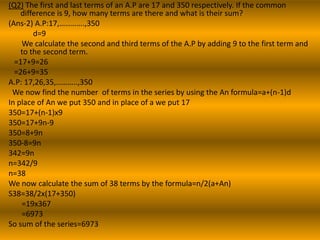
(Q2) The first and last terms of an A.P are 17 and 350 respectively. If the common
    difference is 9, how many terms are there and what is their sum?
(Ans-2) A.P:17,………….,350
        d=9
    We calculate the second and third terms of the A.P by adding 9 to the first term and
    to the second term.
  =17+9=26
  =26+9=35
A.P: 17,26,35,………..,350
 We now find the number of terms in the series by using the An formula=a+(n-1)d
In place of An we put 350 and in place of a we put 17
350=17+(n-1)x9
350=17+9n-9
350=8+9n
350-8=9n
342=9n
n=342/9
n=38
We now calculate the sum of 38 terms by the formula=n/2(a+An)
S38=38/2x(17+350)
    =19x367
    =6973
So sum of the series=6973
(Q3) Find the sum of the first 40 positive integers divisible by 6.
(Ans-3) Smallest positive integer divisible by 6=6
  A.P=6,12,18,24……….
  d=6
  a=6
We fin the sum of 40 terms in this series by using the Sn formula=n/2x[2a+(n-1)xd]
S40=40/2x[2x6+(40-1)x6]
   =20x[12+39x6]
   =20[12+234]
   =20x[246]
   =4920
So the sum of 40 integers divisible by 6=4920
(Q4) Find the sum of first 80 negative terms divisible by 10.
(Ans-4) Smallest negative number divisible by 10=-10
 A.P:-10,-20,-30…………
  d=-10
  a=-10
We now calculate the sum of 80 terms of this series by using the
   formula=n/2x[2a+(n-1)xd]
  S80=80/2x[2x-10+(80-1)x-10]
      =40x[-20+79x-10]
      =40x[-20-790]
      =40x[-810]
      =-32,400
(Q5) How many terms of the A.P, 9,17,25... Must be taken to give a sum of 636?
(Ans-5) A.P: 9,17,25…
       d=17-9=8
        =25-17=8
   a= 9
 Sn=636
We calculate the number of terms by the formula=n/2x[2a+(n-1)xd]. In place of Sn
   we put 636.
 636=n/2x[2x9+(n-1)x8]
 636=n/2[18+8n-8]
 636=n/2x(10+8n)
 636x2=10n+8n sq.
 1272=10n+8n sq.
8n sq.+10n-1272=0
Solve this by quadratic formula and calculate n.
By solving the equation,2 values of n are calculated. N=12, n=-12
N=-12 has to be rejected because the no. of terms cannot be in negative.
So the no. of terms in this series=12.
(Q6) In an A.P, the sum of its first ten terms is -150 and the sum of its next ten terms is -
    550. Find the A.P
(Ans-6) S10=-150
         S11 to 20=-550
 S10 can be written as= 10/2x[2a+(10-1)xd]
 S11 to 20 can be written as= S20-S10
                              = 20/2x[2a+(20-1)xd]-10/2x[2a+(10-1)xd]
 S10= 10/2x[2a+(10-1)xd]
 -150=5x(2a+9d)
  150=10a+45d →1
S20-S10= 20/2x[2a+(20-1)xd]-10/2x[2a+(10-1)xd]
    -550= 10x(2a+19d)-5x(2a+9d)
    -550=20a+190d-10a-45d
    -550=10a+145d→2
Solve equation 1 and 2 to get a and d by elimination method.
             10a+45d=-150
             10a+145d=-550
By solving the equations d=-4 and a=3.
A.P:3,-1,-5,-9………
(Q7) Find the sum of first 22 terms of the A.P in which d=7 and 22nd term is 149.
(Ans-7) d=7
       a22=149
A22 can be written as=a+21d
  149=a+21d
  149=a+21x7
  149=a+147
  a=149-147
  a=2
A.P:2,9,16…………….
Calculate the sum of 22 terms of this A.P by the formula=n/2x[2a+(n-1)xd]
S22=22/2x[2x2+(22-1)x7]
    =11x(4+21x7)
    =11x(4+147)
    =11x(151)
    =1661
So the sum of 22 terms of the A.P=1661
(Q8) A contract on construction job specifies a penalty for delay of completion
   beyond a certain date as follows: Rs 200 for the first day, Rs 250 for the second
   day, Rs 300 for the third day, etc. , the penalty for each succeeding day being Rs
   50 more than for the preceding day. How much money the contractor has to
   pay as penalty, if he has delayed the work by 30 days?
(Ans-8) A.P formed= 200,250,300……
       d=50 , a=200
      Work delayed by=30 days
      Work delayed=n
       n=30
Amount to be paid in 30 days =S30
Calculate the total amount of money in 30 days by the formula=n/2x[2a+(n-1)xd]
S30=30/2x[2x200+(30-1)x50]
   =15x[400+29x50]
   =15x[400+1450]
   =15x[1850]
   =27750
So the amount to be paid in 30 days= Rs 27750
CLASS- 10th D
Group Members-
1. Rachit Mehta
2. Siddhant Dey
3. Abhishek Chauhan
4. Ramit Chauhan
5. Tushar Behl

Starr pvt. ltd. rachit's group ppt (1)

  • 2.
     An arithmeticprogression (AP) or arithmetic sequence is a sequence of numbers such that the difference between the consecutive terms is constant. For instance, the sequence 5, 7, 9, 11, 13, … is an arithmetic progression with common difference of 2. By an arithmetic progression of m terms, we mean a finite sequence of the form a, a + d, a + 2d, a + 3d, . . . , a + ( n - 1)d. The real number a is called the first term of the arithmetic progression, and the real number d is called the difference of the arithmetic progression.
  • 3.
    Example 1: Consider thesequence of numbers 1, 3, 5, 7, 9, 11, 13, 15, 17, 19, 21, 23. This sequence has the property that the difference between successive terms is constant and equal to 2. Here we have: a = 1; d = 2. Example 2: Consider the sequence of numbers 2, 5, 8, 11, 14, 17, 20, 23, 26, 29, 32. This sequence has the property that the difference between successive terms is constant and equal to 3. Here we have: a = 2; d = 3.
  • 4.
    Example 3: Findthe general term for the arithmetic sequence -1, 3, 7, 11, . . . Then find a12. Solution: Here a1 = 1. To find d subtract any two adjacent terms: d = 7 - 3 = 4. The general term is: To find a12 let k = 12.
  • 5.
    Example 4: Ifa3 = 8 and a6 = 17, find a14. Solution: Use the formula for an with the given terms This gives a system of two equations with two variables. We find: a1 = 2 and d=3 Use the formula for an to find a14
  • 6.
    Problem 1: The firstterm of an arithmetic sequence is equal to 6 and the common difference is equal to 3. Find a formula for the n th term and the value of the 50 th term Solution to Problem 1: Use the value of the common difference d = 3 and the first term a1 = 6 in the formula for the n th term given above an = a1 + (n - 1 )d = 6 + 3 (n - 1) =3n+3 The 50 th term is found by setting n = 50 in the above formula. a50 = 3 (50) + 3 = 153
  • 7.
    Problem 2: The firstterm of an arithmetic sequence is equal to 200 and the common difference is equal to -10. Find the value of the 20 th term Solution to Problem 2: Use the value of the common difference d = -10 and the first term a1 = 200 in the formula for the n th term given above and then apply it to the 20 th term a20 = 200 + (-10) (20 - 1 ) = 10 Problem 3: An arithmetic sequence has a common difference equal to 10 and its 6 th term is equal to 52 . Find its 15 th term. Solution to Problem 3: We use the n th term formula for the 6 th term, which is known, to write a6 = 52 = a1 + 10 (6 - 1 ) The above equation allows us to calculate a1. a1 = 2 Now that we know the first term and the common difference, we use the n th term formula to find the 15 th term as follows. a15 = 2 + 10 (15 - 1) = 142
  • 8.
    Problem 4: An arithmeticsequence has a its 5 th term equal to 22 and its 15 th term equal to 62. Find its 100 th term. Solution to Problem 4: We use the n th term formula for the 5 th and 15 th terms to write a5 = a1 + (5 - 1 ) d = 22 a15 = a1 + (15 - 1 ) d = 62 We obtain a system of 2 linear equations where the unknown are a1 and d. Subtract the right and left term of the two equations to obtain 62 - 22 = 14 d - 4 d Solve for d. d=4 Now use the value of d in one of the equations to find a1. a1 + (5 - 1 ) 4 = 22 Solve for a1 to obtain. a1 = 6 Now that we have calculated a1 and d we use them in the n th term formula to find the 100 th formula. a100 = 6 + 4 (100 - 1 )= 402
  • 9.
    1. Find the10th term of -5,-8,-11,...... 5.Find the 100th term. if the first term is 4 and [A] -28 the common difference is 7? [C] -32 [A] 150 [B] -18 [C] 800 [D] -20 [B] 120 2. Find the 32nd term in the following series [D] 697 3,7,11,....... 6.Find the number of terms in the series [A] 120 8,11,14,....95 [C] 220 [A] 25 [B] 230 [C] 27 [D] 127 [B] 26 [D] 30 3.Find the position of 98 in the following 7.Find the number of terms in the series series 3,8,13 ....? 11,6,1,...-54? [A] 20th term [A] 12 [C] 12th term [C] 14 [B] 36th term [B] 13 [D] 34th term [D] 15 4. Find the 35th term if the first term is 8 and 8.Find the number of terms in the series common difference is 1.5 2,3.5,5,...62 ? [A] 35 [A] 50 [C] 18 [C] 41 [B] 59 [B] 62 [D] 24 [D] 42
  • 10.
    9.Find the valuesof x in the Arithmetic series 10. In an A.P the 12th term is 61 and common 3x+1,5x-1,5x+1,...... difference is 5 then find the series [A] 2 [A] 6,11,16 [C] 8 [C] 5,8,11 [B] 3 [B] 4,7,11 [D] 7 [D] 3,9,12 1. : [C] 6. : [D] 2 : [D] 7. : [C] 3. : [A] 8. : [C] 4. : [B] 9. : [A] 5. : [D] 10. : [A]
  • 11.
    Calculate the sumof a given A.P FORMULA Sn=n/2x[2a+(n-1)d] Where Sn=Sum of the given A.P Where a=first term of the A.P Where n=number of terms in the given A.P Where d=common difference of the A.P
  • 12.
    Other formulas tocalculate the sum of the A.P Formula 1= Sn=n/2x(a+l) Where l is the last term Formula 2= Sn=n(n+1)/2 This formula is used when we need to calculate the sum of first n positive integers.
  • 13.
    EXAMPLES Example 1: Findthe sum of first 28 terms of the A.P:8,3,-2…….. Solution- No. of terms=28 calculate d = 3-8=-5 a=8 put these values in the Sn formula=n/2x[2a+(n-1)d] and calculate the sum Sn(S28)= 28/2x[2x8+(28-1)x-5] 14x{16+(27x-5)} 14x(16-135) 14x(-119) =-1666 So S28=-1666 for the given A.P
  • 14.
    Example 2: Ifthe sum of the first 14 terms of an AP is 1050 and its first term is 10,find the 20th term. Solution- n=14 Sn(S14)=1050 a=10 From the Sn formula=n/2x[2a+(n-1)d] calculate d by equating the Sn value to the formula. 1050=14/2x[2x10+(14-1)d] 1050=7x[20+13d] 1050=140=91d 1050-140=91d d=910/91=10 So d=10 From the An formula=a+(n-1)d calculate the value of a20 A20=10+(20-1)x10 =10+190 =200 So a20=200
  • 15.
    Example 3: Findthe sum of the first 1000 positive integers. Solution- In this case we use the formula=n(n+1)/2 =1000(1000+1)/2 =1000x1001/2 =1001000/2 =500500 So sum of first 1000 positive integers of an A.P=500500 Example 4: Find Sn and n if a=5,d=3 and An=50. Solution: a=5 d=3 An(l)=50 Find n by using the An formula=a+(n-1)d 50=5+(n-1)x3 45=3n-3 48=3n n=16 Find Sn by using the formula=n/2x(a+l). Put S16 in place of Sn S16=16/2x(5+50) 8x55 =440 So sum of the 16 terms of the A.P=440
  • 16.
    Example 5: Findthe sum of the series 5+7+9+11+13……to 40 terms. Solution- a=5 d=7-5=2 9-7=2 n=40 Put these values in the formula=n/2x[2a+(n-1)d] Sn=40/2x[2x5+(40-1)x2] =20x[10+39x2] =20x(10+78) =20x88 =1760 So the sum of 40 terms of the A.P=1760
  • 17.
    Example 6: Findthe sum:25+28+31+……+100 Solution- a=25 d=28-25=3 =31-28=3 An(l)=100 We find n by using the formula=An=a+(n-1)d 100=25+(n-1)x3 100=25+3n-3 100-25+3=3n 78=3n n=78/3 n=26 Now we find the sum of 26 terms by usin the formula Sn=n/2x(a+l) S26=26/2x(25+100) =13x125 =1625 So the sum of the 26 terms of the A.P=1625
  • 18.
    QUESTIONS- (Q1)Find the sumof first 21 terms of the A.P whose 2nd term is 8 and 4th term is 14 (Ans-1) a2=8 a4=14 a2=8 can be written as a+d=8 and a4=14 can be written as a+3d=14. Solve a+d=8,a+3d=14 by elimination method and find the common difference d. a+d=8 a+3d=14 d=3 a=a2-3 8-3 =5 A.P:5,8,11,14……. We now put the values of a,d and n in the formula n/2[2a+(n-1)D] to find S21 S21=21/2x[2x5+(21-1)x3] 21/2x(10+20x3) 21/2(70) 21x35=735 So the sum of 21 terms of the A.P=735
  • 19.
    (Q2) The firstand last terms of an A.P are 17 and 350 respectively. If the common difference is 9, how many terms are there and what is their sum? (Ans-2) A.P:17,………….,350 d=9 We calculate the second and third terms of the A.P by adding 9 to the first term and to the second term. =17+9=26 =26+9=35 A.P: 17,26,35,………..,350 We now find the number of terms in the series by using the An formula=a+(n-1)d In place of An we put 350 and in place of a we put 17 350=17+(n-1)x9 350=17+9n-9 350=8+9n 350-8=9n 342=9n n=342/9 n=38 We now calculate the sum of 38 terms by the formula=n/2(a+An) S38=38/2x(17+350) =19x367 =6973 So sum of the series=6973
  • 20.
    (Q3) Find thesum of the first 40 positive integers divisible by 6. (Ans-3) Smallest positive integer divisible by 6=6 A.P=6,12,18,24………. d=6 a=6 We fin the sum of 40 terms in this series by using the Sn formula=n/2x[2a+(n-1)xd] S40=40/2x[2x6+(40-1)x6] =20x[12+39x6] =20[12+234] =20x[246] =4920 So the sum of 40 integers divisible by 6=4920
  • 21.
    (Q4) Find thesum of first 80 negative terms divisible by 10. (Ans-4) Smallest negative number divisible by 10=-10 A.P:-10,-20,-30………… d=-10 a=-10 We now calculate the sum of 80 terms of this series by using the formula=n/2x[2a+(n-1)xd] S80=80/2x[2x-10+(80-1)x-10] =40x[-20+79x-10] =40x[-20-790] =40x[-810] =-32,400
  • 22.
    (Q5) How manyterms of the A.P, 9,17,25... Must be taken to give a sum of 636? (Ans-5) A.P: 9,17,25… d=17-9=8 =25-17=8 a= 9 Sn=636 We calculate the number of terms by the formula=n/2x[2a+(n-1)xd]. In place of Sn we put 636. 636=n/2x[2x9+(n-1)x8] 636=n/2[18+8n-8] 636=n/2x(10+8n) 636x2=10n+8n sq. 1272=10n+8n sq. 8n sq.+10n-1272=0 Solve this by quadratic formula and calculate n. By solving the equation,2 values of n are calculated. N=12, n=-12 N=-12 has to be rejected because the no. of terms cannot be in negative. So the no. of terms in this series=12.
  • 23.
    (Q6) In anA.P, the sum of its first ten terms is -150 and the sum of its next ten terms is - 550. Find the A.P (Ans-6) S10=-150 S11 to 20=-550 S10 can be written as= 10/2x[2a+(10-1)xd] S11 to 20 can be written as= S20-S10 = 20/2x[2a+(20-1)xd]-10/2x[2a+(10-1)xd] S10= 10/2x[2a+(10-1)xd] -150=5x(2a+9d) 150=10a+45d →1 S20-S10= 20/2x[2a+(20-1)xd]-10/2x[2a+(10-1)xd] -550= 10x(2a+19d)-5x(2a+9d) -550=20a+190d-10a-45d -550=10a+145d→2 Solve equation 1 and 2 to get a and d by elimination method. 10a+45d=-150 10a+145d=-550 By solving the equations d=-4 and a=3. A.P:3,-1,-5,-9………
  • 24.
    (Q7) Find thesum of first 22 terms of the A.P in which d=7 and 22nd term is 149. (Ans-7) d=7 a22=149 A22 can be written as=a+21d 149=a+21d 149=a+21x7 149=a+147 a=149-147 a=2 A.P:2,9,16……………. Calculate the sum of 22 terms of this A.P by the formula=n/2x[2a+(n-1)xd] S22=22/2x[2x2+(22-1)x7] =11x(4+21x7) =11x(4+147) =11x(151) =1661 So the sum of 22 terms of the A.P=1661
  • 25.
    (Q8) A contracton construction job specifies a penalty for delay of completion beyond a certain date as follows: Rs 200 for the first day, Rs 250 for the second day, Rs 300 for the third day, etc. , the penalty for each succeeding day being Rs 50 more than for the preceding day. How much money the contractor has to pay as penalty, if he has delayed the work by 30 days? (Ans-8) A.P formed= 200,250,300…… d=50 , a=200 Work delayed by=30 days Work delayed=n n=30 Amount to be paid in 30 days =S30 Calculate the total amount of money in 30 days by the formula=n/2x[2a+(n-1)xd] S30=30/2x[2x200+(30-1)x50] =15x[400+29x50] =15x[400+1450] =15x[1850] =27750 So the amount to be paid in 30 days= Rs 27750
  • 26.
    CLASS- 10th D GroupMembers- 1. Rachit Mehta 2. Siddhant Dey 3. Abhishek Chauhan 4. Ramit Chauhan 5. Tushar Behl