Prepared by:
Kevin P. Gabisay
Joan C. Tonacao
Jezreel A. Carbonquillo
Arithmetic Sequence
Learning Objectives:
I can identify arithmetic sequences
I can calculate the nth term in arithmetic
sequences
I can find the number of terms in an
arithmetic sequences
Arithmetic Sequence
-is a sequence where each new term after the first is
obtained by adding a constant d, to the preceding term.
Identifying an Arithmetic Sequence
Sequences of numbers that follow a pattern of
adding a fixed number from one term to the next are
called arithmetic sequences. The following sequences
are arithmetic sequences:
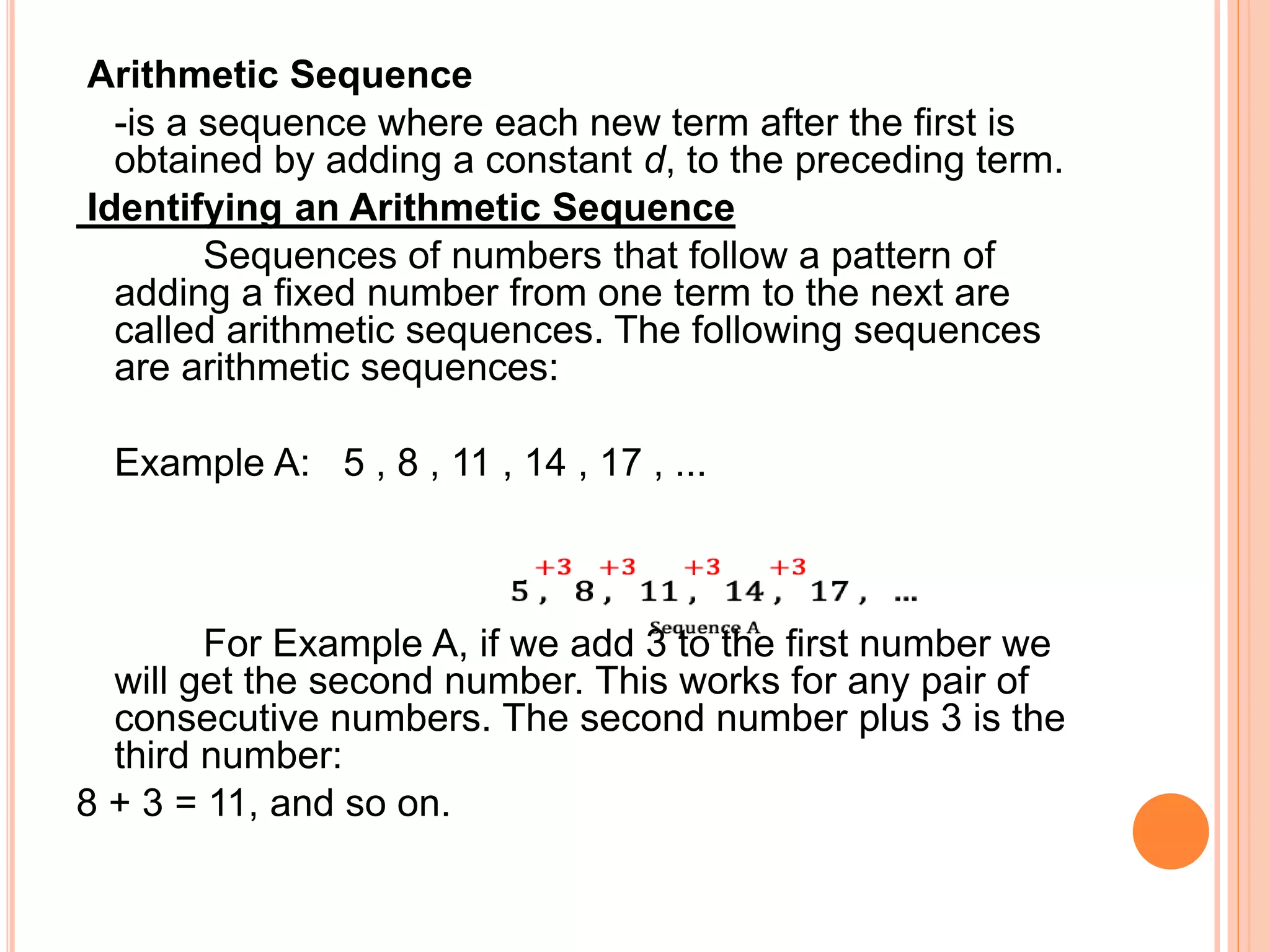
Example A: 5 , 8 , 11 , 14 , 17 , ...
For Example A, if we add 3 to the first number we
will get the second number. This works for any pair of
consecutive numbers. The second number plus 3 is the
third number:
8 + 3 = 11, and so on.
Example B:
Write down the first 5 term of arithmetic
sequence with first term 8 and common difference
of 7.
Answer:
8, 15, 22, 29, 36
Because this sequence behave according to
this simple rule of adding a constant number to one
term to get to another, they are called arithmetic
sequence. So that we can examine these sequence
to greater depth, we must know that the fixed
numbers that bind each sequence together are
called the common difference. Sometimes
mathematicians use the letter d when referring to
these types of sequence.
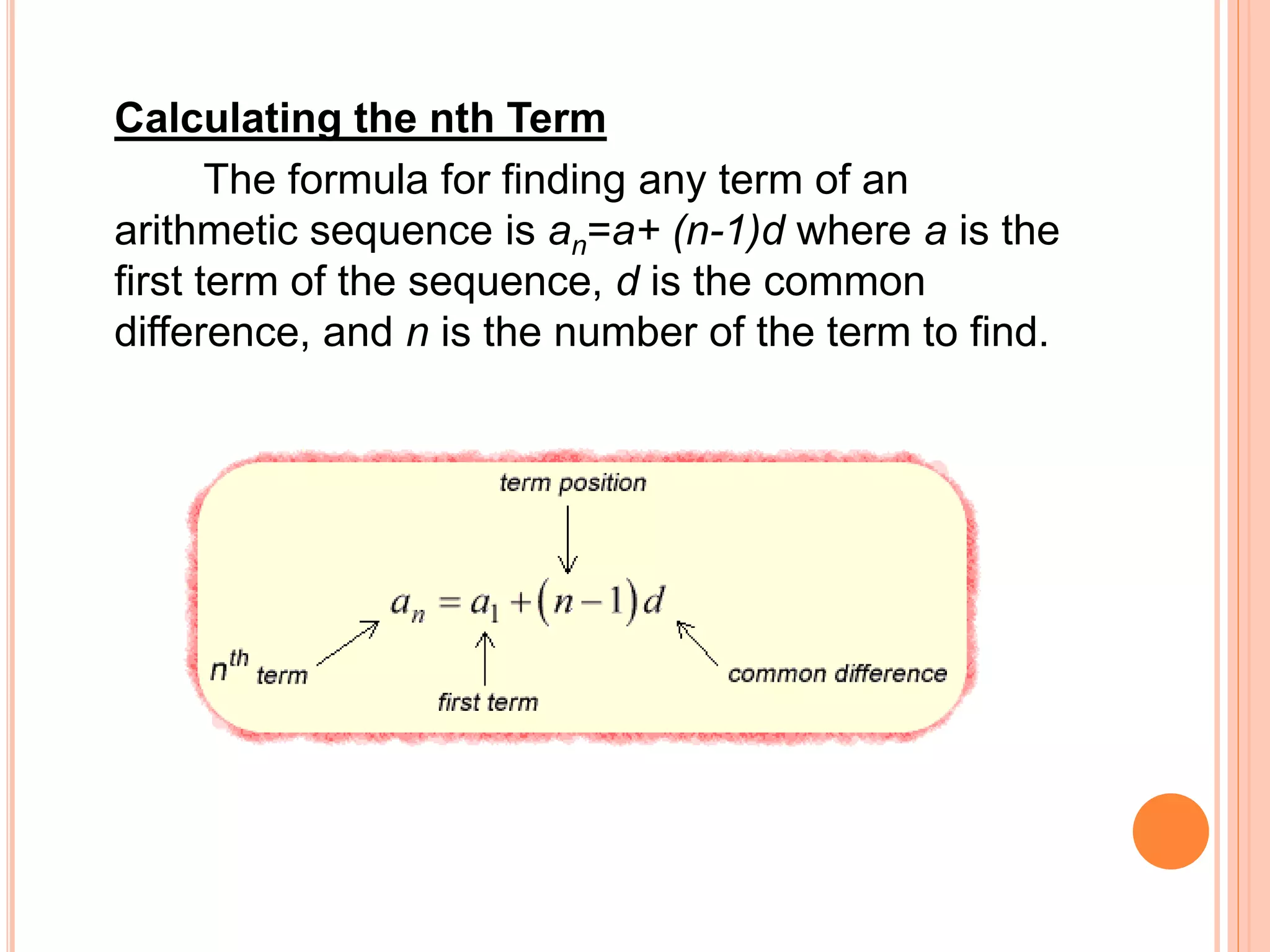
Calculating the nth Term
The formula for finding any term of an
arithmetic sequence is an=a+ (n-1)d where a is the
first term of the sequence, d is the common
difference, and n is the number of the term to find.
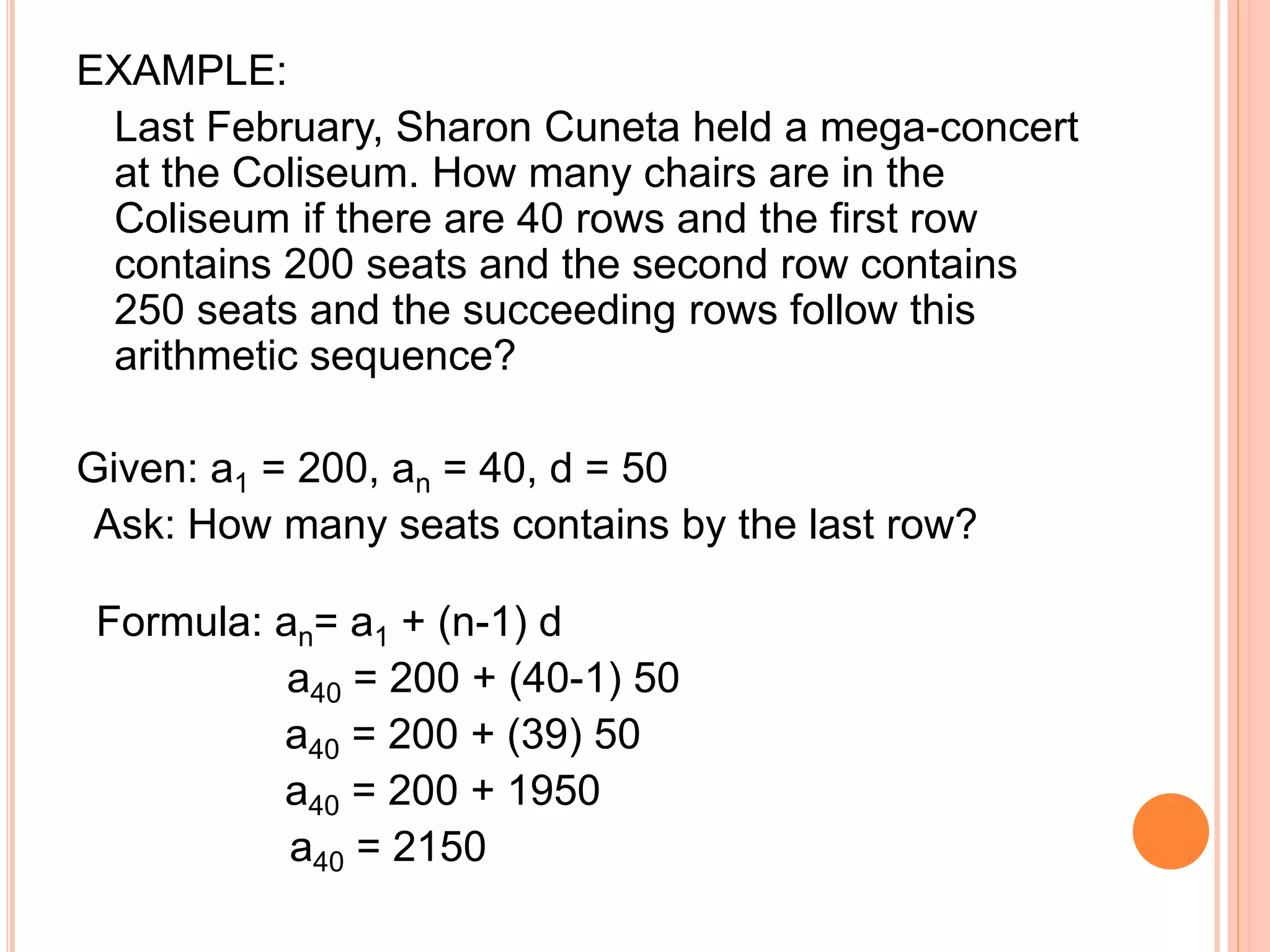
EXAMPLE:
Last February, Sharon Cuneta held a mega-concert
at the Coliseum. How many chairs are in the
Coliseum if there are 40 rows and the first row
contains 200 seats and the second row contains
250 seats and the succeeding rows follow this
arithmetic sequence?
Given: a1 = 200, an = 40, d = 50
Ask: How many seats contains by the last row?
Formula: an= a1 + (n-1) d
a40 = 200 + (40-1) 50
a40 = 200 + (39) 50
a40 = 200 + 1950
a40 = 2150
There is also another formula to use:
an = dn + the number before the first term
where: d – is the difference between the first term
an/n – the term that is ask to find out
Base on the given problem:
Given: a1 = 200, an /n = 40, d = 50
Formula: an = dn + the number before the first term
a40 = 50 (40) + 150
a40 = 2000 + 150
a40 = 2150
Evaluation:
Direction: Solve what is ask?
1. Write down the 50th and 60th terms of
arithmetic sequence 7,15,23,…
2. Find the sum of all integers from 1 to 1,000.
3. Find the sum of the first 100 terms of even
integers.
4. Write down the 101th term of arithmetic
sequence 2/15,7/15,12/15,…
5. An arithmetic sequence has first term 4 with
the difference of ½. Find the sum of first 120
terms.
References:
 http://www.mathguide.com/lessons/SequenceArithmeti
c.html
 Exploring Mathematics II (Intermediate Algebra), by
Orlando A. Oronce and Marilyn O. Mendoza

Arithmetic Sequence

  • 1.
    Prepared by: Kevin P.Gabisay Joan C. Tonacao Jezreel A. Carbonquillo Arithmetic Sequence
  • 2.
    Learning Objectives: I canidentify arithmetic sequences I can calculate the nth term in arithmetic sequences I can find the number of terms in an arithmetic sequences
  • 3.
    Arithmetic Sequence -is asequence where each new term after the first is obtained by adding a constant d, to the preceding term. Identifying an Arithmetic Sequence Sequences of numbers that follow a pattern of adding a fixed number from one term to the next are called arithmetic sequences. The following sequences are arithmetic sequences: Example A: 5 , 8 , 11 , 14 , 17 , ... For Example A, if we add 3 to the first number we will get the second number. This works for any pair of consecutive numbers. The second number plus 3 is the third number: 8 + 3 = 11, and so on.
  • 4.
    Example B: Write downthe first 5 term of arithmetic sequence with first term 8 and common difference of 7. Answer: 8, 15, 22, 29, 36 Because this sequence behave according to this simple rule of adding a constant number to one term to get to another, they are called arithmetic sequence. So that we can examine these sequence to greater depth, we must know that the fixed numbers that bind each sequence together are called the common difference. Sometimes mathematicians use the letter d when referring to these types of sequence.
  • 5.
    Calculating the nthTerm The formula for finding any term of an arithmetic sequence is an=a+ (n-1)d where a is the first term of the sequence, d is the common difference, and n is the number of the term to find.
  • 6.
    EXAMPLE: Last February, SharonCuneta held a mega-concert at the Coliseum. How many chairs are in the Coliseum if there are 40 rows and the first row contains 200 seats and the second row contains 250 seats and the succeeding rows follow this arithmetic sequence? Given: a1 = 200, an = 40, d = 50 Ask: How many seats contains by the last row? Formula: an= a1 + (n-1) d a40 = 200 + (40-1) 50 a40 = 200 + (39) 50 a40 = 200 + 1950 a40 = 2150
  • 7.
    There is alsoanother formula to use: an = dn + the number before the first term where: d – is the difference between the first term an/n – the term that is ask to find out Base on the given problem: Given: a1 = 200, an /n = 40, d = 50 Formula: an = dn + the number before the first term a40 = 50 (40) + 150 a40 = 2000 + 150 a40 = 2150
  • 8.
    Evaluation: Direction: Solve whatis ask? 1. Write down the 50th and 60th terms of arithmetic sequence 7,15,23,… 2. Find the sum of all integers from 1 to 1,000. 3. Find the sum of the first 100 terms of even integers. 4. Write down the 101th term of arithmetic sequence 2/15,7/15,12/15,… 5. An arithmetic sequence has first term 4 with the difference of ½. Find the sum of first 120 terms.
  • 9.
    References:  http://www.mathguide.com/lessons/SequenceArithmeti c.html  ExploringMathematics II (Intermediate Algebra), by Orlando A. Oronce and Marilyn O. Mendoza