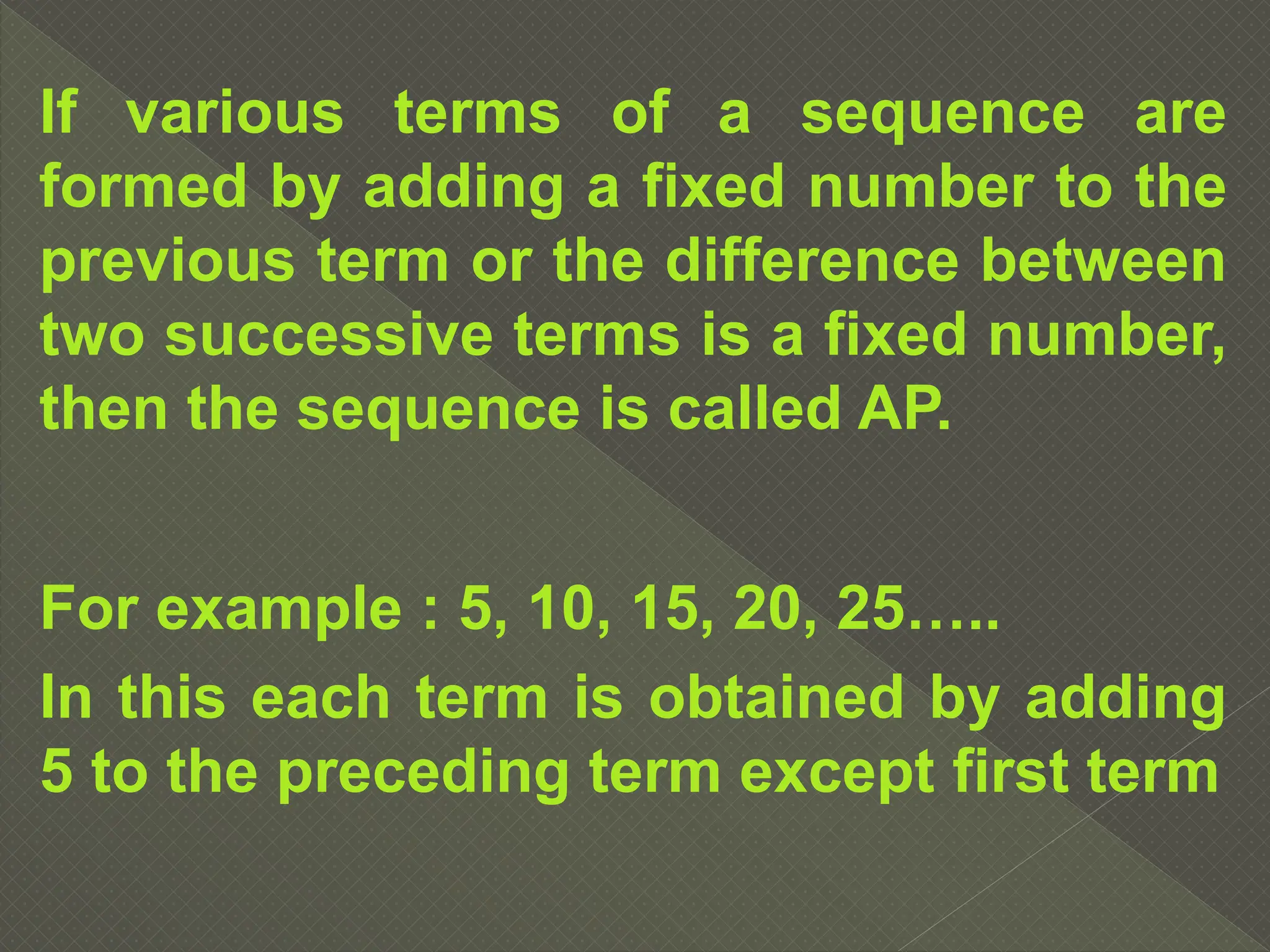
If various terms of a sequence are
formed by adding a fixed number to the
previous term or the difference between
two successive terms is a fixed number,
then the sequence is called AP.
For example : 5, 10, 15, 20, 25…..
In this each term is obtained by adding
5 to the preceding term except first term
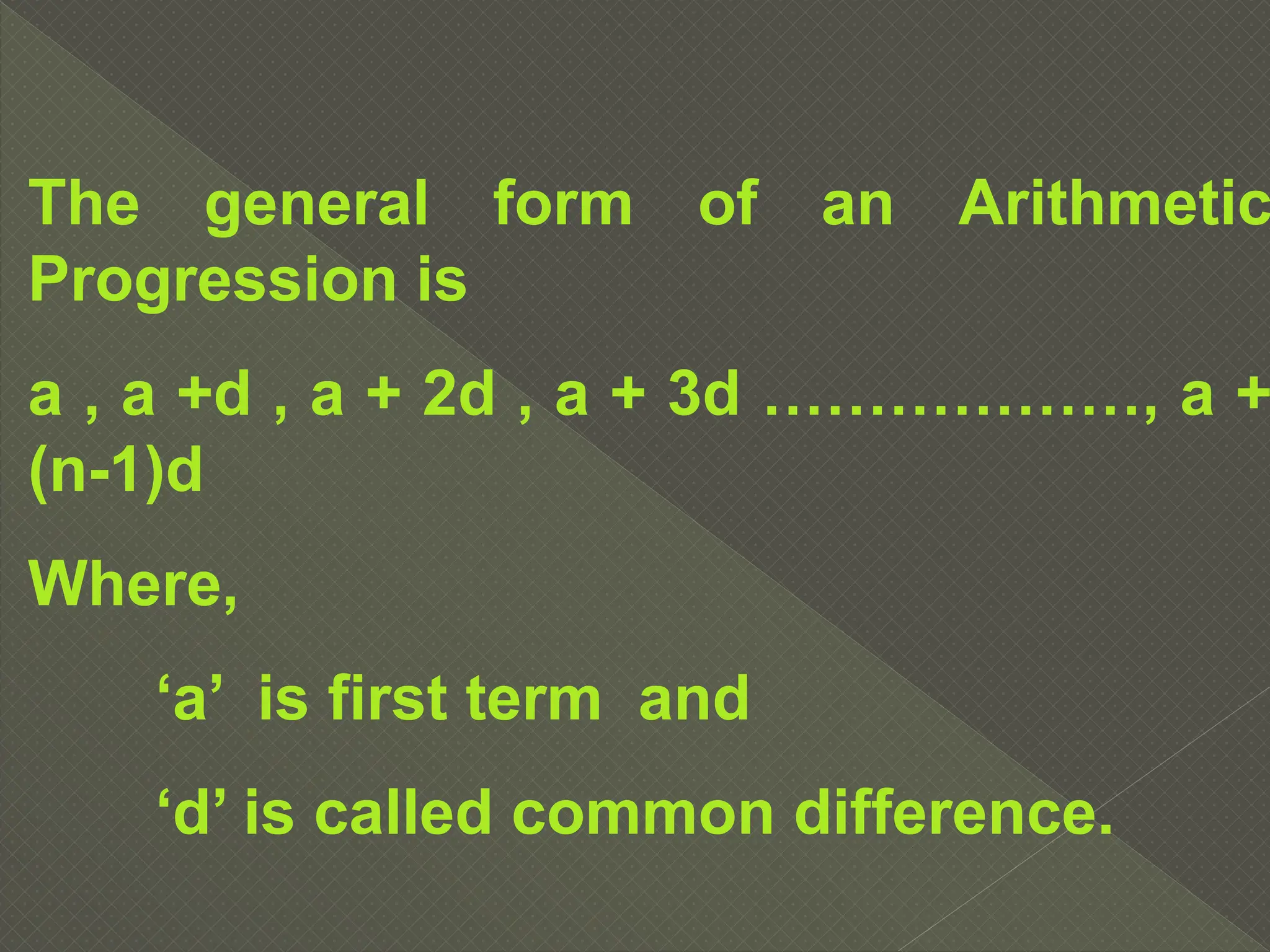
The general form of an Arithmetic
Progression is
a , a +d , a + 2d , a + 3d ………………, a +
(n-1)d
Where,
‘a’ is first term and
‘d’ is called common difference.
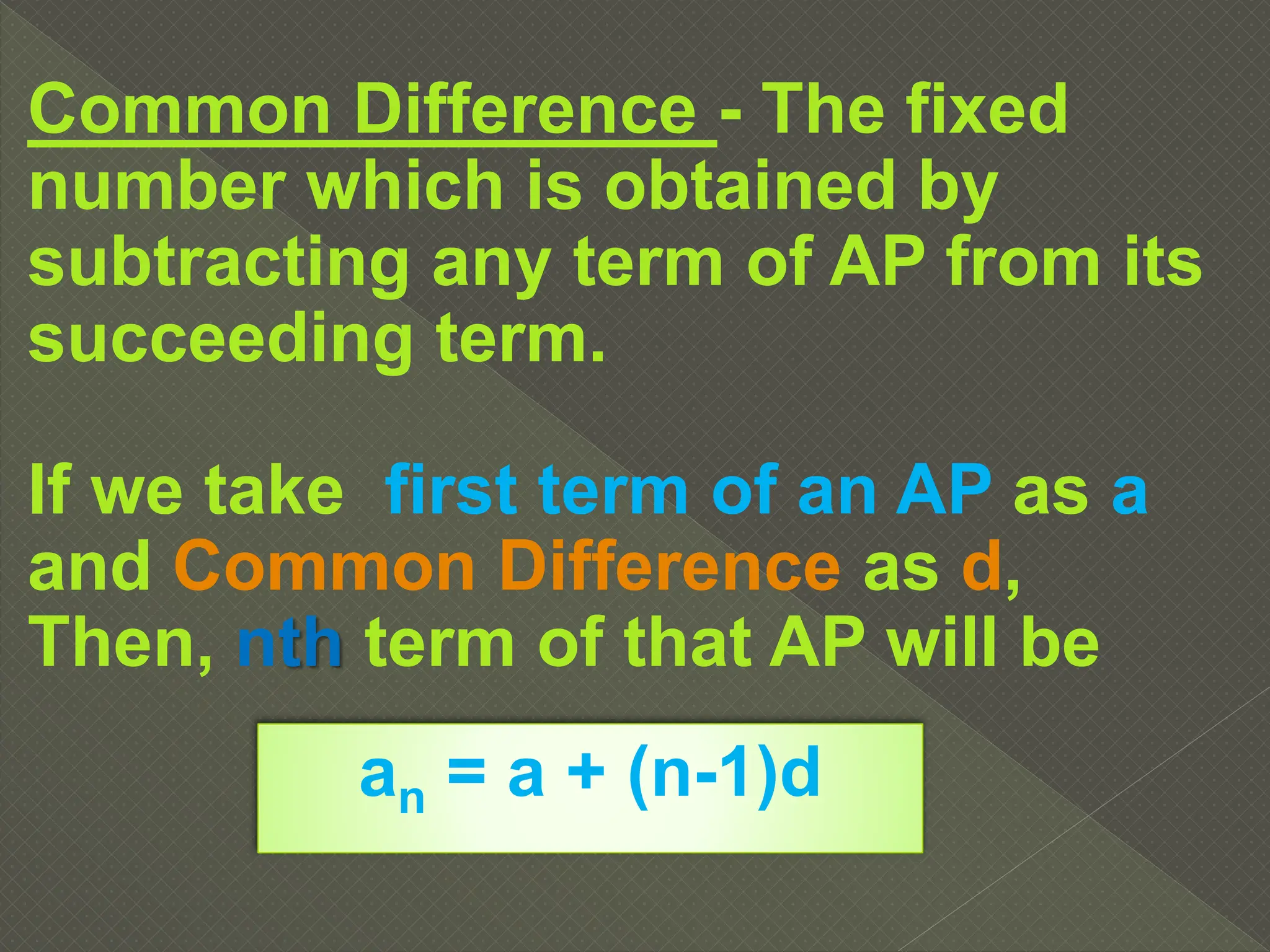
Common Difference - The fixed
number which is obtained by
subtracting any term of AP from its
succeeding term.
If we take first term of an AP as a
and Common Difference as d,
Then, nth term of that AP will be
an = a + (n-1)d
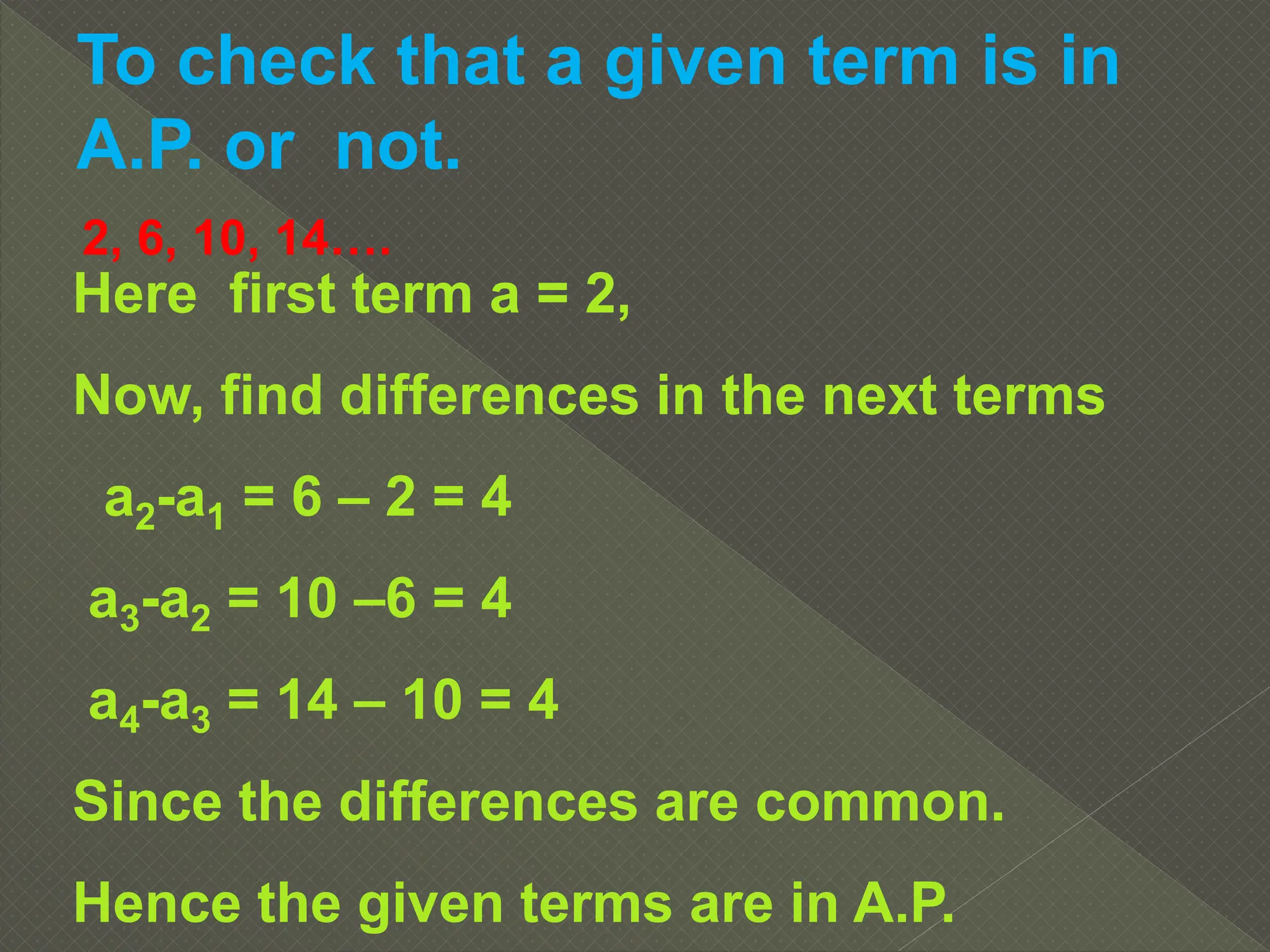
To check that a given term is in
A.P. or not.
2, 6, 10, 14….
Here first term a = 2,
Now, find differences in the next terms
a2-a1 = 6 – 2 = 4
a3-a2 = 10 –6 = 4
a4-a3 = 14 – 10 = 4
Since the differences are common.
Hence the given terms are in A.P.
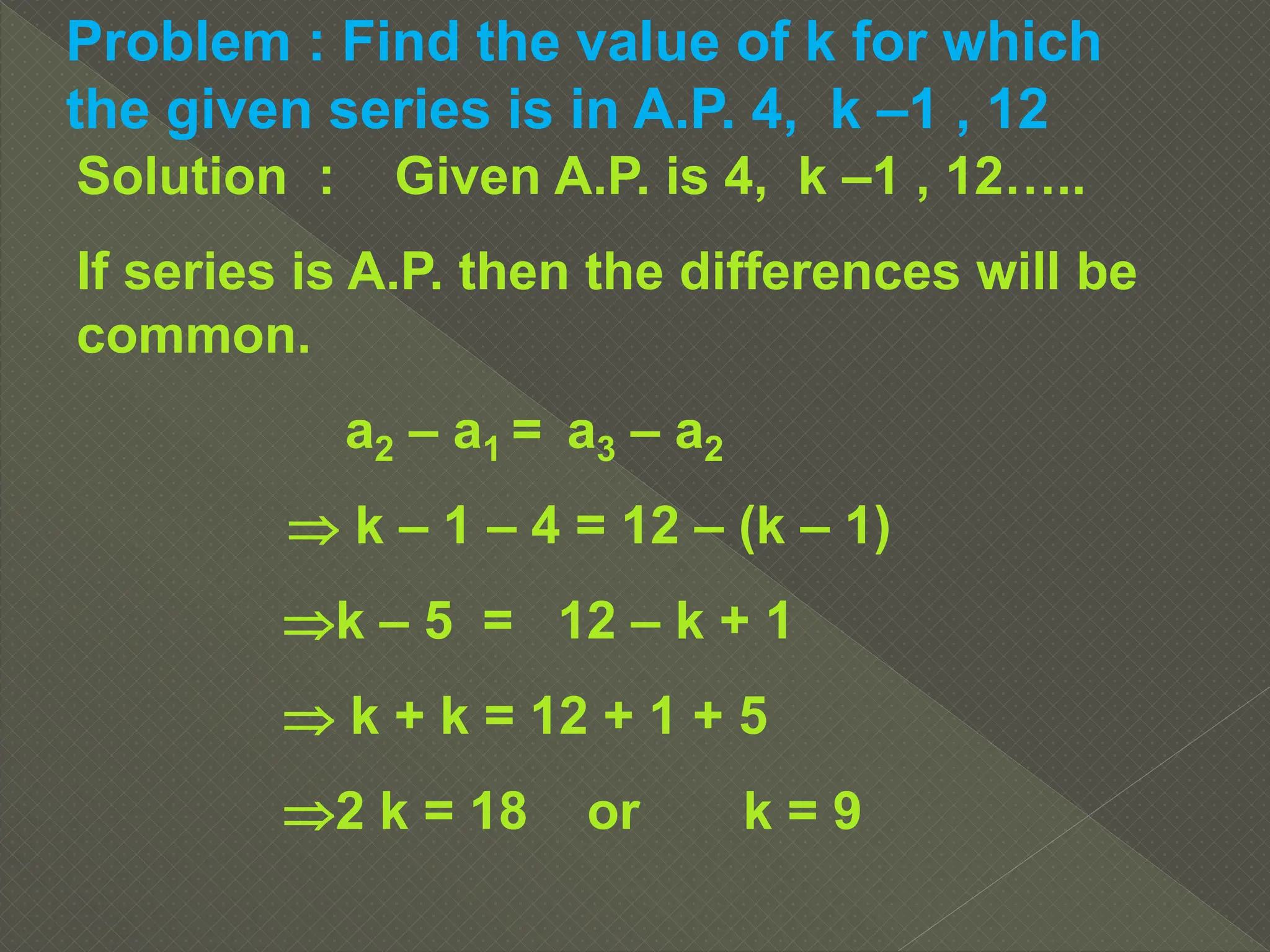
Problem : Find the value of k for which
the given series is in A.P. 4, k –1 , 12
Solution : Given A.P. is 4, k –1 , 12…..
If series is A.P. then the differences will be
common.
a2 – a1 = a3 – a2
 k – 1 – 4 = 12 – (k – 1)
k – 5 = 12 – k + 1
 k + k = 12 + 1 + 5
2 k = 18 or k = 9
Its formula is
SUM OF n TERMS OF AN
ARITHMETIC
PROGRESSION
It can also be written as
Sn = ½ n [ 2a + (n - 1)d ]
Sn = ½ n [ a + an ]
DERIVATION
The sum to n terms is given by:
Sn = a + (a + d) + (a + 2d) + … + [a + (n – 1)d] (1)
If we write this out backwards, we get:
Sn = [a + (n – 1)d] + (a + (n – 2)d) + … +a (2)
Now let’s add (1) and (2):
2Sn = [2a + (n – 1)d] + [2a + (n – 1)d] + …
……… + [2a + (n – 1)d]
So, Sn = ½ n [2a + (n – 1)d]
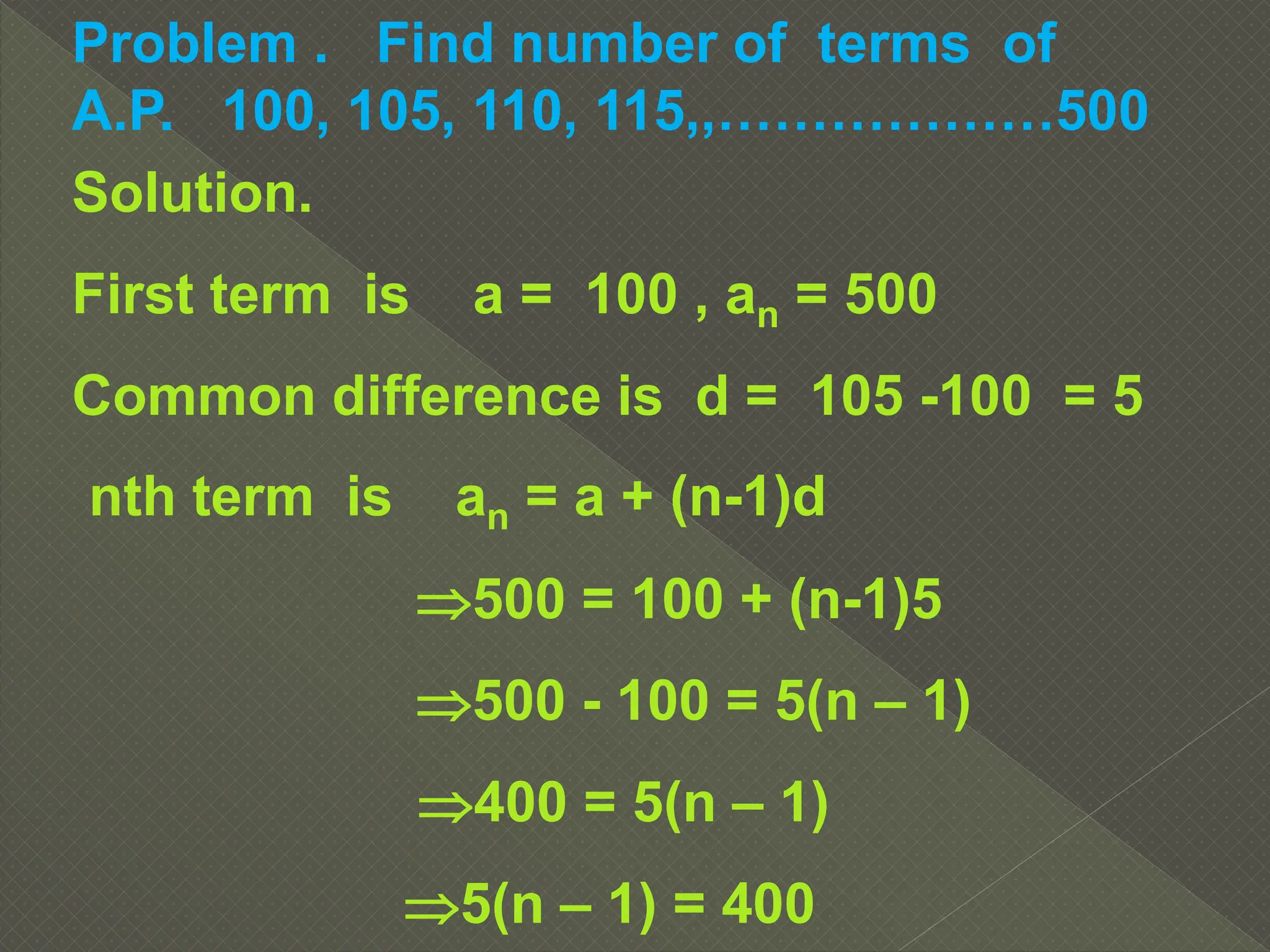
Problem . Find number of terms of
A.P. 100, 105, 110, 115,,………………500
Solution.
First term is a = 100 , an = 500
Common difference is d = 105 -100 = 5
nth term is an = a + (n-1)d
500 = 100 + (n-1)5
500 - 100 = 5(n – 1)
400 = 5(n – 1)
5(n – 1) = 400
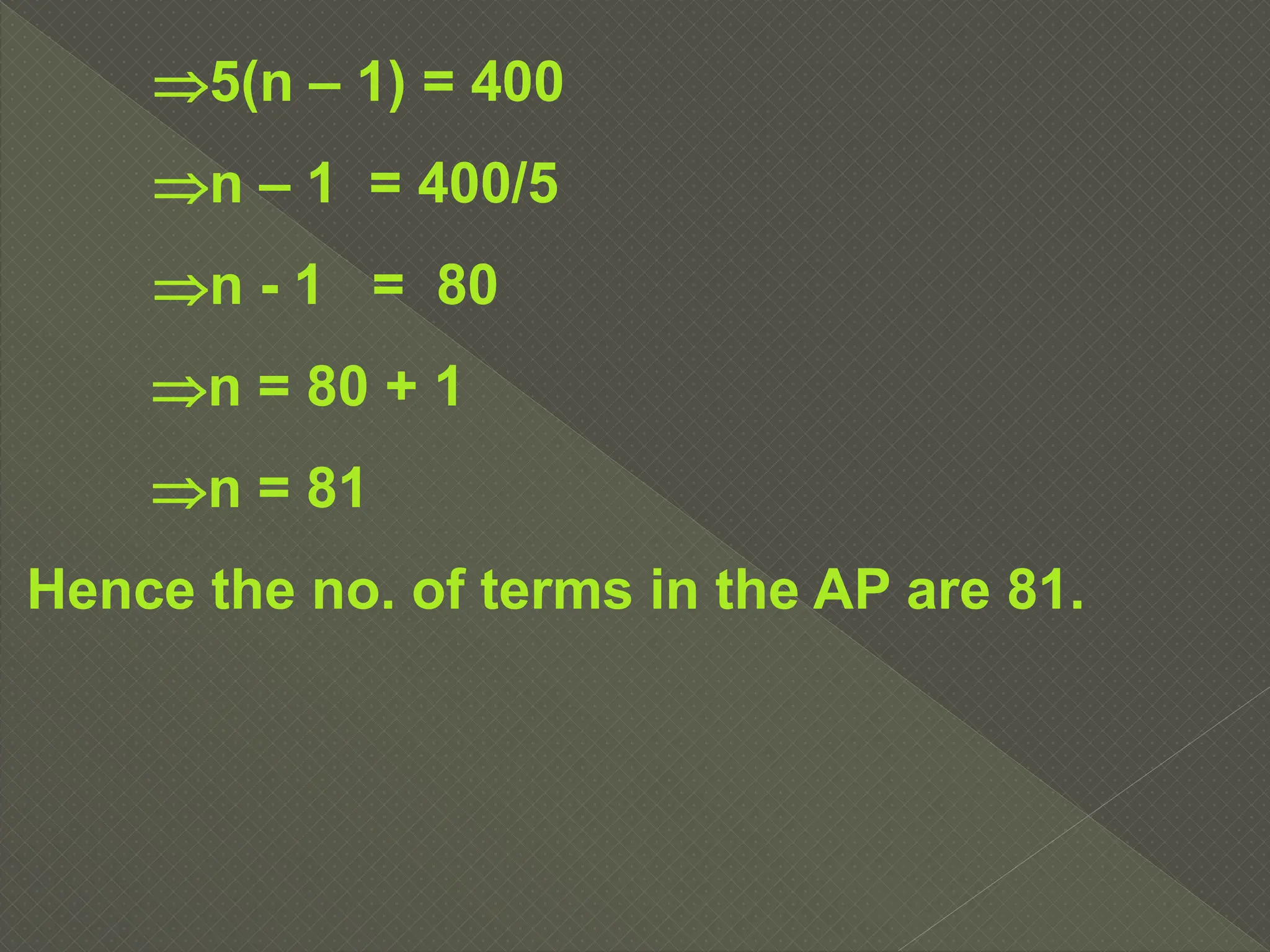
5(n – 1) = 400
n – 1 = 400/5
n - 1 = 80
n = 80 + 1
n = 81
Hence the no. of terms in the AP are 81.
Problem
Find the sum of 30 terms of given A.P. ,12 ,
20 , 28 , 36………
Solution : Given A.P. is 12 , 20, 28 , 36
Its first term is a = 12
Common difference is d = 20 – 12 = 8
The sum to n terms of an AP
Sn = ½ n [ 2a + (n - 1)d ]
= ½ x 30 [ 2 x 12 + (30-1)x 8]
= 15 [ 24 + 29 x 8]
= 15[24 + 232]
= 15 x 246
= 3690
THE SUM OF TERMS IS 3690
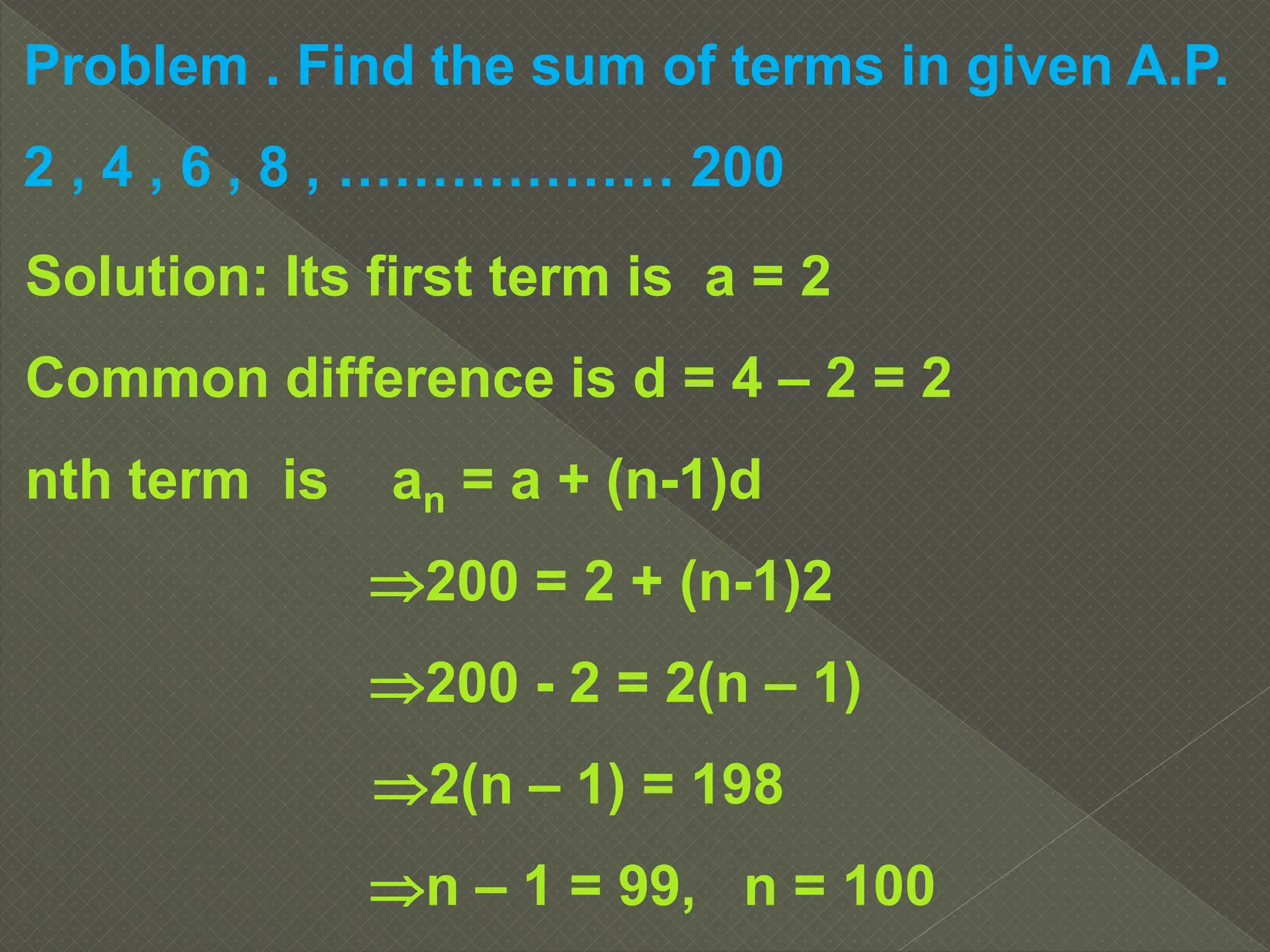
Problem . Find the sum of terms in given A.P.
2 , 4 , 6 , 8 , ……………… 200
Solution: Its first term is a = 2
Common difference is d = 4 – 2 = 2
nth term is an = a + (n-1)d
200 = 2 + (n-1)2
200 - 2 = 2(n – 1)
2(n – 1) = 198
n – 1 = 99, n = 100
Now, the sum to n terms of an arithmetic
progression
Sn = ½ n [ 2a + (n - 1)d ]
S100 = ½ x 100 [ 2x 2 + (100-1)x 2]
= 50 [ 4 + 198]
= 50[202]
= 10100

Arithmetic-Progressions bvgc cfdfd cg-4.pptx

  • 2.
    If various termsof a sequence are formed by adding a fixed number to the previous term or the difference between two successive terms is a fixed number, then the sequence is called AP. For example : 5, 10, 15, 20, 25….. In this each term is obtained by adding 5 to the preceding term except first term
  • 3.
    The general formof an Arithmetic Progression is a , a +d , a + 2d , a + 3d ………………, a + (n-1)d Where, ‘a’ is first term and ‘d’ is called common difference.
  • 4.
    Common Difference -The fixed number which is obtained by subtracting any term of AP from its succeeding term. If we take first term of an AP as a and Common Difference as d, Then, nth term of that AP will be an = a + (n-1)d
  • 5.
    To check thata given term is in A.P. or not. 2, 6, 10, 14…. Here first term a = 2, Now, find differences in the next terms a2-a1 = 6 – 2 = 4 a3-a2 = 10 –6 = 4 a4-a3 = 14 – 10 = 4 Since the differences are common. Hence the given terms are in A.P.
  • 6.
    Problem : Findthe value of k for which the given series is in A.P. 4, k –1 , 12 Solution : Given A.P. is 4, k –1 , 12….. If series is A.P. then the differences will be common. a2 – a1 = a3 – a2  k – 1 – 4 = 12 – (k – 1) k – 5 = 12 – k + 1  k + k = 12 + 1 + 5 2 k = 18 or k = 9
  • 7.
    Its formula is SUMOF n TERMS OF AN ARITHMETIC PROGRESSION It can also be written as Sn = ½ n [ 2a + (n - 1)d ] Sn = ½ n [ a + an ]
  • 8.
    DERIVATION The sum ton terms is given by: Sn = a + (a + d) + (a + 2d) + … + [a + (n – 1)d] (1) If we write this out backwards, we get: Sn = [a + (n – 1)d] + (a + (n – 2)d) + … +a (2) Now let’s add (1) and (2): 2Sn = [2a + (n – 1)d] + [2a + (n – 1)d] + … ……… + [2a + (n – 1)d] So, Sn = ½ n [2a + (n – 1)d]
  • 9.
    Problem . Findnumber of terms of A.P. 100, 105, 110, 115,,………………500 Solution. First term is a = 100 , an = 500 Common difference is d = 105 -100 = 5 nth term is an = a + (n-1)d 500 = 100 + (n-1)5 500 - 100 = 5(n – 1) 400 = 5(n – 1) 5(n – 1) = 400
  • 10.
    5(n – 1)= 400 n – 1 = 400/5 n - 1 = 80 n = 80 + 1 n = 81 Hence the no. of terms in the AP are 81.
  • 11.
    Problem Find the sumof 30 terms of given A.P. ,12 , 20 , 28 , 36……… Solution : Given A.P. is 12 , 20, 28 , 36 Its first term is a = 12 Common difference is d = 20 – 12 = 8 The sum to n terms of an AP Sn = ½ n [ 2a + (n - 1)d ] = ½ x 30 [ 2 x 12 + (30-1)x 8]
  • 12.
    = 15 [24 + 29 x 8] = 15[24 + 232] = 15 x 246 = 3690 THE SUM OF TERMS IS 3690
  • 13.
    Problem . Findthe sum of terms in given A.P. 2 , 4 , 6 , 8 , ……………… 200 Solution: Its first term is a = 2 Common difference is d = 4 – 2 = 2 nth term is an = a + (n-1)d 200 = 2 + (n-1)2 200 - 2 = 2(n – 1) 2(n – 1) = 198 n – 1 = 99, n = 100
  • 14.
    Now, the sumto n terms of an arithmetic progression Sn = ½ n [ 2a + (n - 1)d ] S100 = ½ x 100 [ 2x 2 + (100-1)x 2] = 50 [ 4 + 198] = 50[202] = 10100