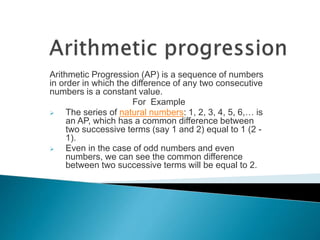
Arithmetic Progression (AP) is a sequence of numbers
in order in which the difference of any two consecutive
numbers is a constant value.
For Example
 The series of natural numbers: 1, 2, 3, 4, 5, 6,… is
an AP, which has a common difference between
two successive terms (say 1 and 2) equal to 1 (2 -
1).
 Even in the case of odd numbers and even
numbers, we can see the common difference
between two successive terms will be equal to 2.
If we observe in our regular lives, we come
across Arithmetic progression quite often. For
example, Roll numbers of students in a class,
days in a week or months in a year. This pattern
of series and sequences has been generalized in
Maths as progressions..
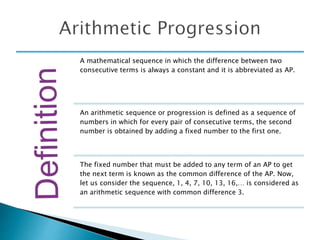
A mathematical sequence in which the difference between two
consecutive terms is always a constant and it is abbreviated as AP.
An arithmetic sequence or progression is defined as a sequence of
numbers in which for every pair of consecutive terms, the second
number is obtained by adding a fixed number to the first one.
The fixed number that must be added to any term of an AP to get
the next term is known as the common difference of the AP. Now,
let us consider the sequence, 1, 4, 7, 10, 13, 16,… is considered as
an arithmetic sequence with common difference 3.
Common difference (d)
nth Term (an)
Sum of the first n terms (Sn)
 In this progression, for a given series, the
terms used are the first term, the common
difference between the two terms and nth
term. Suppose, a1, a2, a3, ……………., an is
an AP, then; the common difference “ d
” can be obtained as;
d = a2 – a1 = a3 – a2 = ……. = an – an – 1
Where “d” is a common difference. It can be
positive, negative or zero
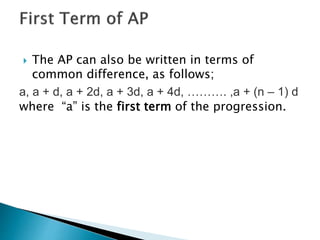
 The AP can also be written in terms of
common difference, as follows;
a, a + d, a + 2d, a + 3d, a + 4d, ………. ,a + (n – 1) d
where “a” is the first term of the progression.
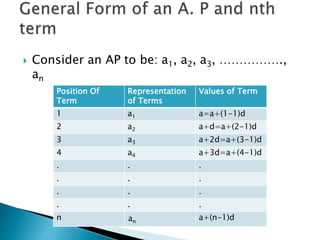
 Consider an AP to be: a1, a2, a3, …………….,
an
Position Of
Term
Representation
of Terms
Values of Term
1 a1 a=a+(1-1)d
2 a2 a+d=a+(2-1)d
3 a3 a+2d=a+(3-1)d
4 a4 a+3d=a+(4-1)d
. . .
. . .
. . .
. . .
n an
a+(n-1)d
There are two major formulas we come across
when we learn about Arithmetic Progression,
which is related to:
 The nth term of AP
 Sum of the first n terms
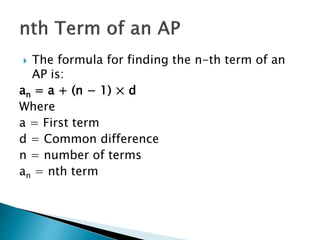
 The formula for finding the n-th term of an
AP is:
an = a + (n − 1) × d
Where
a = First term
d = Common difference
n = number of terms
an = nth term
Solution:
Given, AP: 1, 2, 3, 4, 5…., an
n=15
By the formula we know, an = a+(n-1)d
First-term, a =1
Common difference, d=2-1 =1
Therefore, an = 1+(15-1)1 = 1+14 = 15
 For any progression, the sum of n terms can be easily
calculated. For an AP, the sum of the first n terms can be
calculated if the first term and the total terms are known.
The formula for the arithmetic progression sum is
explained below:
Consider an AP consisting “n” terms.
S = n/2[2a + (n − 1) × d]
This is the AP sum formula to find the sum of n terms
in series.
 Consider an AP consisting “n” terms having the
sequence a, a + d, a + 2d, ………….,a + (n – 1) × d
 Sum of first n terms = a + (a + d) + (a + 2d) +
………. + [a + (n – 1) × d] ——————-(i)
 Writing the terms in reverse order,we have:
 S = [a + (n – 1) × d] + [a + (n – 2) × d] + [a + (n –
3) × d] + ……. (a) ———–(ii)
 Adding both the equations term wise, we have:
 2S = [2a + (n – 1) × d] + [2a + (n – 1) × d] + [2a +
(n – 1) × d] + …………. + [2a + (n – 1) ×d] (n-
terms)
 2S = n × [2a + (n – 1) × d]
 S = n/2[2a + (n − 1) × d]
 Formula to find the sum of AP when first and
last terms are given as follows:
S = n/2 (first term + last term)
 The list of formulas is given in a tabular
form used in AP. These formulas are useful
to solve problems based on the series and
sequence concept.
General Form of AP a, a + d, a + 2d, a + 3d, .
. .
The nth term of AP an = a + (n – 1) × d
Sum of n terms in AP S = n/2[2a + (n − 1) × d]
Sum of all terms in a finite AP with the last term
as ‘l’
n/2(a + l)

Arithmetic progression

  • 2.
    Arithmetic Progression (AP)is a sequence of numbers in order in which the difference of any two consecutive numbers is a constant value. For Example  The series of natural numbers: 1, 2, 3, 4, 5, 6,… is an AP, which has a common difference between two successive terms (say 1 and 2) equal to 1 (2 - 1).  Even in the case of odd numbers and even numbers, we can see the common difference between two successive terms will be equal to 2.
  • 3.
    If we observein our regular lives, we come across Arithmetic progression quite often. For example, Roll numbers of students in a class, days in a week or months in a year. This pattern of series and sequences has been generalized in Maths as progressions..
  • 4.
    A mathematical sequencein which the difference between two consecutive terms is always a constant and it is abbreviated as AP. An arithmetic sequence or progression is defined as a sequence of numbers in which for every pair of consecutive terms, the second number is obtained by adding a fixed number to the first one. The fixed number that must be added to any term of an AP to get the next term is known as the common difference of the AP. Now, let us consider the sequence, 1, 4, 7, 10, 13, 16,… is considered as an arithmetic sequence with common difference 3.
  • 5.
    Common difference (d) nthTerm (an) Sum of the first n terms (Sn)
  • 6.
     In thisprogression, for a given series, the terms used are the first term, the common difference between the two terms and nth term. Suppose, a1, a2, a3, ……………., an is an AP, then; the common difference “ d ” can be obtained as; d = a2 – a1 = a3 – a2 = ……. = an – an – 1 Where “d” is a common difference. It can be positive, negative or zero
  • 7.
     The APcan also be written in terms of common difference, as follows; a, a + d, a + 2d, a + 3d, a + 4d, ………. ,a + (n – 1) d where “a” is the first term of the progression.
  • 8.
     Consider anAP to be: a1, a2, a3, ……………., an Position Of Term Representation of Terms Values of Term 1 a1 a=a+(1-1)d 2 a2 a+d=a+(2-1)d 3 a3 a+2d=a+(3-1)d 4 a4 a+3d=a+(4-1)d . . . . . . . . . . . . n an a+(n-1)d
  • 9.
    There are twomajor formulas we come across when we learn about Arithmetic Progression, which is related to:  The nth term of AP  Sum of the first n terms
  • 10.
     The formulafor finding the n-th term of an AP is: an = a + (n − 1) × d Where a = First term d = Common difference n = number of terms an = nth term
  • 11.
    Solution: Given, AP: 1,2, 3, 4, 5…., an n=15 By the formula we know, an = a+(n-1)d First-term, a =1 Common difference, d=2-1 =1 Therefore, an = 1+(15-1)1 = 1+14 = 15
  • 12.
     For anyprogression, the sum of n terms can be easily calculated. For an AP, the sum of the first n terms can be calculated if the first term and the total terms are known. The formula for the arithmetic progression sum is explained below: Consider an AP consisting “n” terms. S = n/2[2a + (n − 1) × d] This is the AP sum formula to find the sum of n terms in series.
  • 13.
     Consider anAP consisting “n” terms having the sequence a, a + d, a + 2d, ………….,a + (n – 1) × d  Sum of first n terms = a + (a + d) + (a + 2d) + ………. + [a + (n – 1) × d] ——————-(i)  Writing the terms in reverse order,we have:  S = [a + (n – 1) × d] + [a + (n – 2) × d] + [a + (n – 3) × d] + ……. (a) ———–(ii)  Adding both the equations term wise, we have:  2S = [2a + (n – 1) × d] + [2a + (n – 1) × d] + [2a + (n – 1) × d] + …………. + [2a + (n – 1) ×d] (n- terms)  2S = n × [2a + (n – 1) × d]  S = n/2[2a + (n − 1) × d]
  • 14.
     Formula tofind the sum of AP when first and last terms are given as follows: S = n/2 (first term + last term)
  • 15.
     The listof formulas is given in a tabular form used in AP. These formulas are useful to solve problems based on the series and sequence concept. General Form of AP a, a + d, a + 2d, a + 3d, . . . The nth term of AP an = a + (n – 1) × d Sum of n terms in AP S = n/2[2a + (n − 1) × d] Sum of all terms in a finite AP with the last term as ‘l’ n/2(a + l)