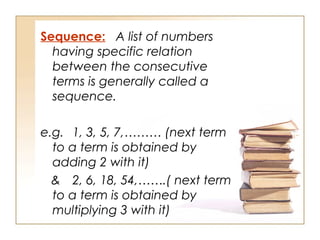
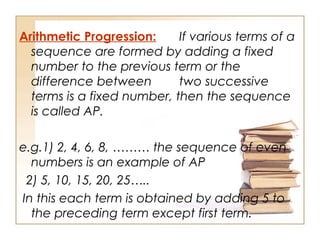
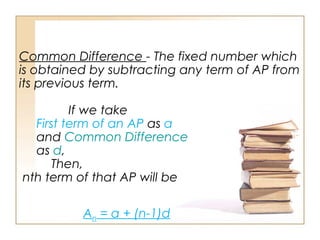
- An arithmetic progression (AP) is a sequence of numbers where the difference between consecutive terms is constant.
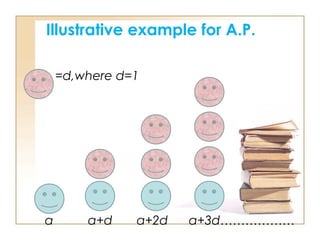
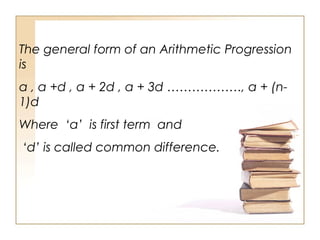
- The general form of an AP is: a, a + d, a + 2d, a + 3d, ..., a + (n - 1)d
- Where a is the first term and d is the common difference, which is the amount each term increases by.
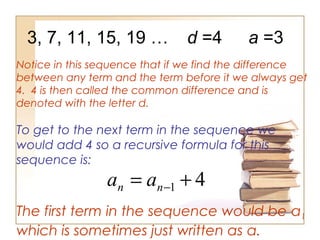
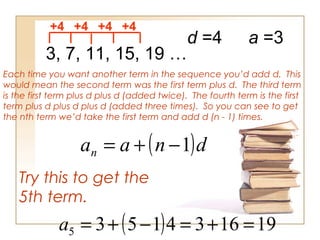
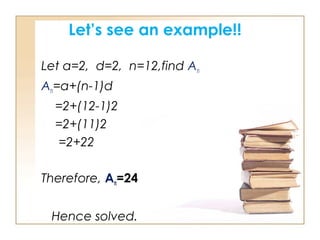
- To find the nth term, the formula is: an = a + (n - 1)d
- The sum of the first n terms of an AP can be calculated as: Sn = n/2 * (2a + (n - 1)d)


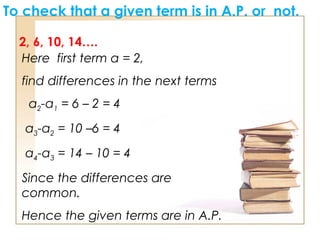
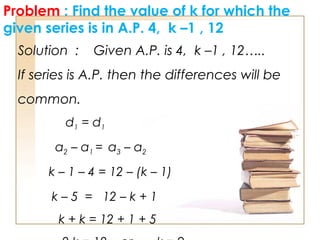
![The sum of n terms, we find as,
Sum = n X [(first term + last term) / 2]
Now last term will be = a + (n-1) d
Therefore,
Sum(Sn
) =n X [{a + a + (n-1) d } /2 ]
= n/2 [ 2a + (n+1)d]](https://image.slidesharecdn.com/aapp-220823112932-9e3dc9cd/85/aapp-pdf-12-320.jpg)
![DERIVATION
The sum to n terms is given by:
Sn
= a + (a + d) + (a + 2d) + … + (a + (n – 1)d) (1)
If we write this out backwards, we get:
Sn
= (a + (n – 1)d) + (a + (n – 2)d) + … +a (2)
Now let’s add (1) and (2):
2Sn
= [2a + (n – 1)d] + [2a + (n – 1)d] + …
……… + [2a + (n – 1)d]
So, S = n/2 [2a + (n – 1)d]](https://image.slidesharecdn.com/aapp-220823112932-9e3dc9cd/85/aapp-pdf-13-320.jpg)
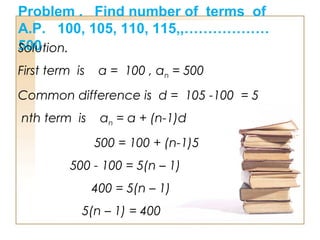
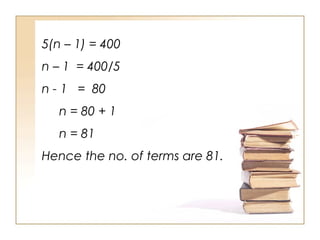
![Problem . Find the sum of 30 terms of given
A.P. ,12 , 20 , 28 , 36………
Solution : Given A.P. is 12 , 20, 28 , 36
Its first term is a = 12
Common difference is d = 20 – 12 = 8
The sum to n terms of an arithmetic progression
Sn
= n/2 [ 2a + (n - 1)d ]
= ½ x 30 [ 2x 12 + (30-1)x 8]
= 15 [ 24 + 29 x8]](https://image.slidesharecdn.com/aapp-220823112932-9e3dc9cd/85/aapp-pdf-16-320.jpg)
![= 15[24 + 232]
= 15 x 246
= 3690
THE SUM OF TERMS IS 3690](https://image.slidesharecdn.com/aapp-220823112932-9e3dc9cd/85/aapp-pdf-17-320.jpg)
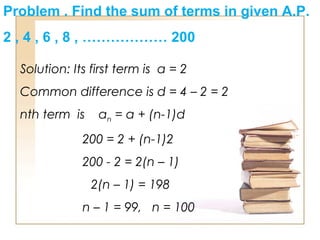
![The sum to n terms of an arithmetic progression
Sn
= n/2[ 2a + (n - 1)d ]
S100
= 100/2 [ 2x 2 + (100-1)x 2]
= 50 [ 4 + 198]
= 50[202]
= 10100](https://image.slidesharecdn.com/aapp-220823112932-9e3dc9cd/85/aapp-pdf-19-320.jpg)



![제 23회 보아즈(BOAZ) 빅데이터 컨퍼런스 - [MBOAX] : ABSA를 활용한 소비자 반응 분석 기반 운영 효율화 대시보드 설계](https://cdn.slidesharecdn.com/ss_thumbnails/3-1boaz23rdconferencemboax-260203102709-9d519923-thumbnail.jpg?width=640&height=640&fit=bounds)


![Hacking-Uncovered-How-People-Get-Hacked-and-How-to-Stay-Safe[1].pptx](https://cdn.slidesharecdn.com/ss_thumbnails/hacking-uncovered-how-people-get-hacked-and-how-to-stay-safe1-260130170011-4883a9c7-thumbnail.jpg?width=640&height=640&fit=bounds)


