1
AKNOWLEDGEMENT 
I Nikhil Gogate & my friend Navin Patle gratefully acknowledges 
for making this PowerPoint presentation informative and attractive 
Special thanks to MR. MAHESH GOUR 
(MATHEMATICS TEACHER) 
For his valuable guidance and his kind support 
We also acknowledge to 
MR.C.B.PATLE(PRINCIPAL OF GPS) 
We would like to give special thanks to all mathematics teacher from 
primary high school who guided us.
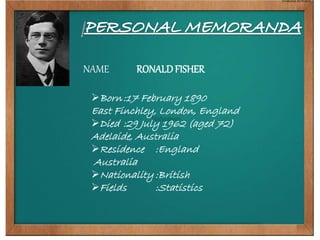
NAME RONALD FISHER 
Born:17 February 1890 
East Finchley, London, England 
Died :29 July 1962 (aged 72) 
Adelaide, Australia 
Residence :England 
Australia 
Nationality :British 
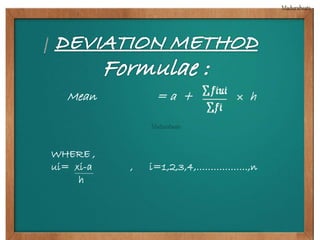
Fields :Statistics
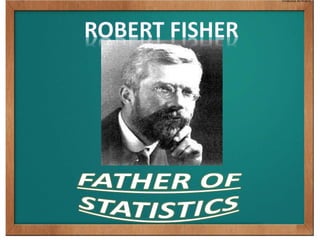
Fisher was born in East Finchley in 
London, England, to George and Katie 
Fisher. His father was a successful fine 
arts dealer. He had a happy childhood, 
being doted on by three older sisters, an 
older brother, and his mother, who died 
when Fisher was 14. His father lost his 
business in several ill-considered 
transactions only 18 months later, 
according to the biography by Fisher's 
daughter, Joan. Joan Fisher's biography 
is the main source of information on her 
father's early life; it was published under 
her married name and with the 
statistical advice of her husband, George 
E. P. Box.
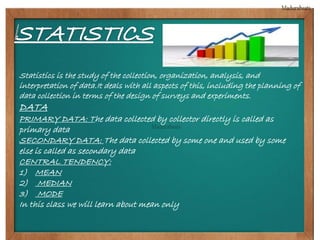
Statistics is the study of the collection, organization, analysis, and 
interpretation of data.It deals with all aspects of this, including the planning of 
data collection in terms of the design of surveys and experiments. 
DATA 
PRIMARY DATA: The data collected by collector directly is called as 
primary data 
SECONDARY DATA: The data collected by some one and used by some 
else is called as secondary data 
CENTRAL TENDENCY: 
1) MEAN 
2) MEDIAN 
3) MODE 
In this class we will learn about mean only
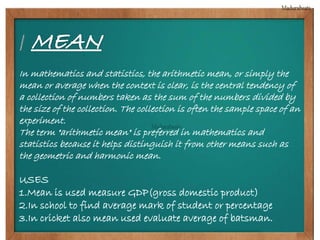
In mathematics and statistics, the arithmetic mean, or simply the 
mean or average when the context is clear, is the central tendency of 
a collection of numbers taken as the sum of the numbers divided by 
the size of the collection. The collection is often the sample space of an 
experiment. 
The term "arithmetic mean" is preferred in mathematics and 
statistics because it helps distinguish it from other means such as 
the geometric and harmonic mean. 
USES 
1.Mean is used measure GDP(gross domestic product) 
2.In school to find average mark of student or percentage 
3.In cricket also mean used evaluate average of batsman.
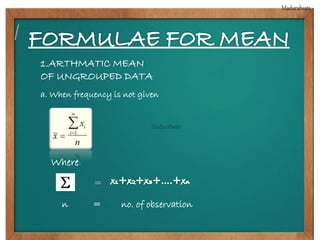
1.ARTHMATIC MEAN 
OF UNGROUPED DATA 
a. When frequency is not given 
Where: 
= 
n = no. of observation
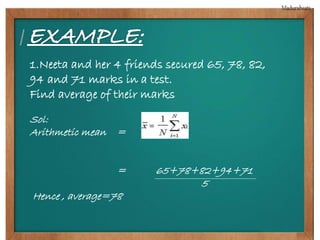
1.Neeta and her 4 friends secured 65, 78, 82, 
94 and 71 marks in a test. 
Find average of their marks 
Sol: 
Arithmetic mean = 
= 65+78+82+94+71 
5 
Hence , average=78
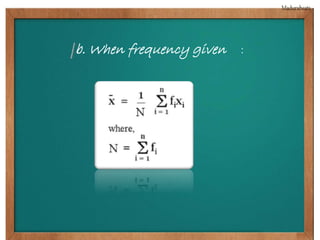
b. When frequency given :
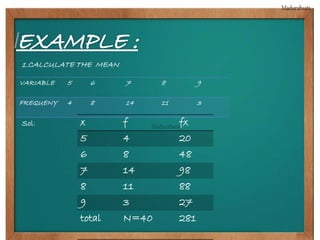
1.CALCULATE THE MEAN 
VARIABLE 5 6 7 8 9 
FREQUENY 4 8 14 11 3 
Sol: x f fx 
5 4 20 
6 8 48 
7 14 98 
8 11 88 
9 3 27 
total N=40 281
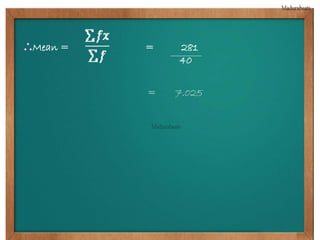
Mean = = 281 
40 
= 7.025
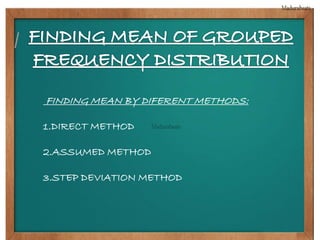
FINDING MEAN BY DIFERENT METHODS: 
1.DIRECT METHOD 
2.ASSUMED METHOD 
3.STEP DEVIATION METHOD
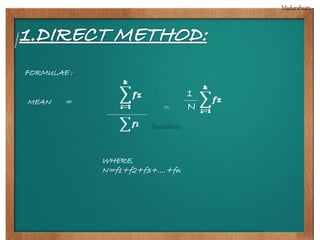
FORMULAE : 
MEAN = 
= 
1 
N 
WHERE, 
N=f1+f2+f3+….+fn
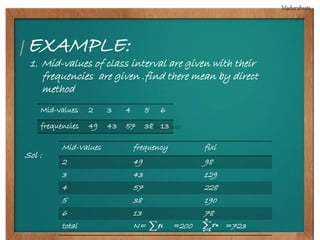
EXAMPLE: 
1. Mid-values of class interval are given with their 
frequencies are given .find there mean by direct 
method 
Mid-values 2 3 4 5 6 
frequencies 49 43 57 38 13 
Sol : 
Mid-Values frequency fixi 
2 49 98 
3 43 129 
4 57 228 
5 38 190 
6 13 78 
total N= =200 =723
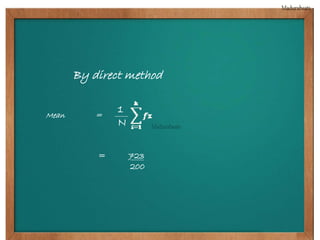
By direct method 
1 
N 
Mean = 
= 723 
200
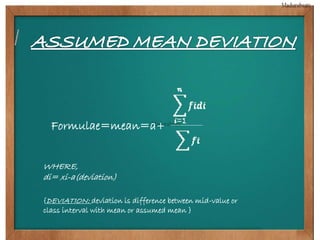
Formulae=mean=a+ 
WHERE, 
di= xi-a(deviation) 
{DEVIATION: deviation is difference between mid-value or 
class interval with mean or assumed mean }
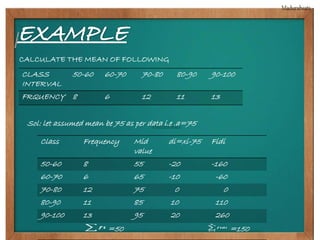
CALCULATE THE MEAN OF FOLLOWING 
CLASS 
INTERVAL 
50-60 60-70 70-80 80-90 90-100 
FRQUENCY 8 6 12 11 13 
Sol: let assumed mean be 75 as per data i.e .a=75 
Class Frequency Mid 
value 
di=xi-75 Fidi 
50-60 8 55 -20 -160 
60-70 6 65 -10 -60 
70-80 12 75 0 0 
80-90 11 85 10 110 
90-100 13 95 20 260 
=50 =150
Mean = a + h 
WHERE , 
ui= xi-a , i=1,2,3,4,………………,n 
h
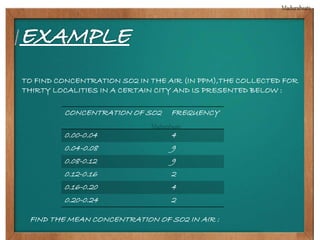
TO FIND CONCENTRATION SO2 IN THE AIR (IN PPM),THE COLLECTED FOR 
THIRTY LOCALITIES IN A CERTAIN CITY AND IS PRESENTED BELOW : 
CONCENTRATION OF SO2 FREQUENCY 
0.00-0.04 4 
0.04-0.08 9 
0.08-0.12 9 
0.12-0.16 2 
0.16-0.20 4 
0.20-0.24 2 
FIND THE MEAN CONCENTRATION OF SO2 IN AIR :
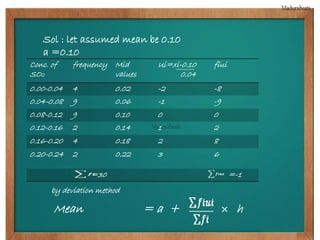
Sol : let assumed mean be 0.10 
a =0.10 
Conc. of 
SO2 
frequency Mid 
values 
Ui=xi-0.10 
0.04 
fiui 
0.00-0.04 4 0.02 -2 -8 
0.04-0.08 9 0.06 -1 -9 
0.08-0.12 9 0.10 0 0 
0.12-0.16 2 0.14 1 2 
0.16-0.20 4 0.18 2 8 
0.20-0.24 2 0.22 3 6 
=30 =-1 
by deviation method 
Mean = a + h
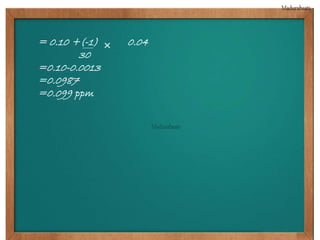
= 0.10 +(-1) 0.04 
30 
=0.10-0.0013 
=0.0987 
=0.099 ppm
Statistics

Statistics

  • 1.
  • 2.
    AKNOWLEDGEMENT I NikhilGogate & my friend Navin Patle gratefully acknowledges for making this PowerPoint presentation informative and attractive Special thanks to MR. MAHESH GOUR (MATHEMATICS TEACHER) For his valuable guidance and his kind support We also acknowledge to MR.C.B.PATLE(PRINCIPAL OF GPS) We would like to give special thanks to all mathematics teacher from primary high school who guided us.
  • 4.
    NAME RONALD FISHER Born:17 February 1890 East Finchley, London, England Died :29 July 1962 (aged 72) Adelaide, Australia Residence :England Australia Nationality :British Fields :Statistics
  • 5.
    Fisher was bornin East Finchley in London, England, to George and Katie Fisher. His father was a successful fine arts dealer. He had a happy childhood, being doted on by three older sisters, an older brother, and his mother, who died when Fisher was 14. His father lost his business in several ill-considered transactions only 18 months later, according to the biography by Fisher's daughter, Joan. Joan Fisher's biography is the main source of information on her father's early life; it was published under her married name and with the statistical advice of her husband, George E. P. Box.
  • 6.
    Statistics is thestudy of the collection, organization, analysis, and interpretation of data.It deals with all aspects of this, including the planning of data collection in terms of the design of surveys and experiments. DATA PRIMARY DATA: The data collected by collector directly is called as primary data SECONDARY DATA: The data collected by some one and used by some else is called as secondary data CENTRAL TENDENCY: 1) MEAN 2) MEDIAN 3) MODE In this class we will learn about mean only
  • 7.
    In mathematics andstatistics, the arithmetic mean, or simply the mean or average when the context is clear, is the central tendency of a collection of numbers taken as the sum of the numbers divided by the size of the collection. The collection is often the sample space of an experiment. The term "arithmetic mean" is preferred in mathematics and statistics because it helps distinguish it from other means such as the geometric and harmonic mean. USES 1.Mean is used measure GDP(gross domestic product) 2.In school to find average mark of student or percentage 3.In cricket also mean used evaluate average of batsman.
  • 8.
    1.ARTHMATIC MEAN OFUNGROUPED DATA a. When frequency is not given Where: = n = no. of observation
  • 9.
    1.Neeta and her4 friends secured 65, 78, 82, 94 and 71 marks in a test. Find average of their marks Sol: Arithmetic mean = = 65+78+82+94+71 5 Hence , average=78
  • 10.
  • 11.
    1.CALCULATE THE MEAN VARIABLE 5 6 7 8 9 FREQUENY 4 8 14 11 3 Sol: x f fx 5 4 20 6 8 48 7 14 98 8 11 88 9 3 27 total N=40 281
  • 12.
    Mean = =281 40 = 7.025
  • 13.
    FINDING MEAN BYDIFERENT METHODS: 1.DIRECT METHOD 2.ASSUMED METHOD 3.STEP DEVIATION METHOD
  • 14.
    FORMULAE : MEAN= = 1 N WHERE, N=f1+f2+f3+….+fn
  • 15.
    EXAMPLE: 1. Mid-valuesof class interval are given with their frequencies are given .find there mean by direct method Mid-values 2 3 4 5 6 frequencies 49 43 57 38 13 Sol : Mid-Values frequency fixi 2 49 98 3 43 129 4 57 228 5 38 190 6 13 78 total N= =200 =723
  • 16.
    By direct method 1 N Mean = = 723 200
  • 17.
    Formulae=mean=a+ WHERE, di=xi-a(deviation) {DEVIATION: deviation is difference between mid-value or class interval with mean or assumed mean }
  • 18.
    CALCULATE THE MEANOF FOLLOWING CLASS INTERVAL 50-60 60-70 70-80 80-90 90-100 FRQUENCY 8 6 12 11 13 Sol: let assumed mean be 75 as per data i.e .a=75 Class Frequency Mid value di=xi-75 Fidi 50-60 8 55 -20 -160 60-70 6 65 -10 -60 70-80 12 75 0 0 80-90 11 85 10 110 90-100 13 95 20 260 =50 =150
  • 19.
    Mean = a+ h WHERE , ui= xi-a , i=1,2,3,4,………………,n h
  • 20.
    TO FIND CONCENTRATIONSO2 IN THE AIR (IN PPM),THE COLLECTED FOR THIRTY LOCALITIES IN A CERTAIN CITY AND IS PRESENTED BELOW : CONCENTRATION OF SO2 FREQUENCY 0.00-0.04 4 0.04-0.08 9 0.08-0.12 9 0.12-0.16 2 0.16-0.20 4 0.20-0.24 2 FIND THE MEAN CONCENTRATION OF SO2 IN AIR :
  • 21.
    Sol : letassumed mean be 0.10 a =0.10 Conc. of SO2 frequency Mid values Ui=xi-0.10 0.04 fiui 0.00-0.04 4 0.02 -2 -8 0.04-0.08 9 0.06 -1 -9 0.08-0.12 9 0.10 0 0 0.12-0.16 2 0.14 1 2 0.16-0.20 4 0.18 2 8 0.20-0.24 2 0.22 3 6 =30 =-1 by deviation method Mean = a + h
  • 22.
    = 0.10 +(-1)0.04 30 =0.10-0.0013 =0.0987 =0.099 ppm