Arithmetic
Progression
Class 10
Chapter 5
Prepared by:
Sharda Chauhan
TGT Mathematics
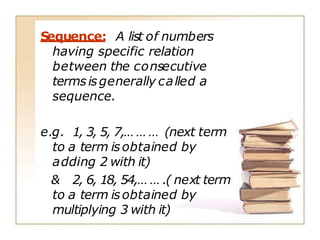
Sequence: A list of numbers
having specific relation
between the consecutive
termsisgenerally called a
sequence.
e.g. 1, 3, 5, 7,… … … (next term
to a term isobtained by
adding 2 with it)
& 2, 6, 18, 54,… … .( next term
to a term isobtained by
multiplying 3 with it)
Arithm
etic P
rogression: If varioustermsof a
sequence are formed by adding a fixed
number to the previous term or the
difference between two successive
termsisa fixed number, then the sequence
iscalled AP.
e.g.1) 2, 4, 6, 8, … … … the sequence of even
numbersisan example of AP
2) 5, 10, 15, 20, 25…..
In thiseach term isobtained by adding 5 to
the preceding term except first term.
I
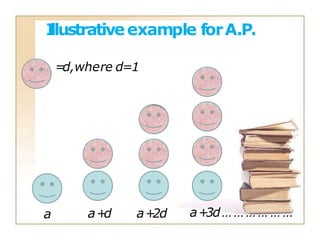
llustrativeexample forA.P.
=
d,where d=1
a a+
d a+
2d a+
3d……… … … …
The general form of an Arithmetic Progression
is
a , a +
d , a +2d , a +3d … … … … … …, a +(n-
1)d
Where ‘a’ is first term and
‘d’ iscalled common difference.
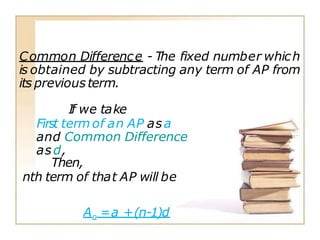
Common Difference - The fixed number which
is obtained by subtracting any term of AP from
its previous term.
If we take
First term of an AP asa
and Common Difference
asd,
Then,
nth term of that AP will be
An =a +(n-1)d
Notice in thissequence that if we find the difference
between any term and the term before it we always
get 4.
4 isthen called the common difference and is
denoted with the letter d.
To get to the next term in the sequence
we would add 4 so a recursive formula
for this sequence is:
an  an1  4
The first term in the sequence would be a1 whic h
issometimes just written as a.
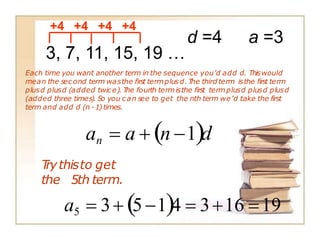
3, 7, 11, 15, 19 … d =4 a =3
+4 +4 +4 +4
3, 7, 11, 15, 19 …
d =4 a =3
Each time you want another term in the sequence you’d add d. Thiswould
mean the sec ond term wasthe first termplusd.T
he third term isthe first term
plusd plusd (added twic e). T
he fourth termisthe first termplusd plusd plusd
(added three times). S
o you c an see to get the nth term we’d take the first
term and add d (n -1)times.
an  a  n 1d
T
rythisto get
the 5th term.
a5  3 514  316 19
Let’ssee an example!!
Let a=
2, d=
2, n=
12,find
AnAn=a+(n-1)d
=2+(12-1)2
=2+(11)2
=2+22
Therefore, An
=24
Hence solved.
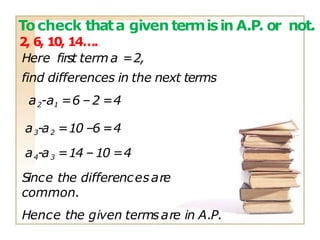
Tocheck thata given termisin A.P. or not.
2, 6, 10, 14….
Here first term a =2,
find differences in the next terms
a2-a1 =6 –2 =4
a3-a2 =10 –6 =4
a4-a3 =14 –10 =4
Since the differencesare
common.
Hence the given termsare in A.P.
Problem : Find the value ofk forwhich
the given series isin A.P. 4, k –1, 12
Solution : Given A.P. is4, k –1 , 12… ..
If series is A.P. then the differences will be
common.
d1 =d1
a2 –a1 = a3 –a2
k –1 –4 =12 –(k –1)
k –5 = 12 –k +1
k +k =12 +1 +5
The sumofn term
s, we find as,
Sum =n X [(first term +last term) / 2]
Now last term will be =a +(n-1) d
Therefore,
Sum(Sn
) =n X [{
a +a +(n-1) d }/2 ]
=n/2 [2a +(n+1)d]
DERIVATION
T
he sum to n termsisgiven by:
Sn =a +(a +d) +(a +2d) +… +(a +(n –1)d) (1)
Ifwe write this out backwards, we get:
Sn =(a +(n –1)d) +(a +(n –2)d) +… +a (2)
Now let’sadd (1) and (2):
2Sn =[2a +(n –1)d] +[2a +(n –1)d] +…
… … … +[2a +(n –1)d]
So, Sn = n/2[2
a +(n –1)d]
Problem . Find number of terms of
A.P.100, 105, 110, 115,………500
Solution:
First term is a = 100 , an =500
Common difference is d = 105 -100 =5
nth term is an =a +(n-1)d
500 =100 +(n-1)5
500 - 100 =5(n –1)
400 =5(n –1)
5(n –1) =400
5(n –1) =400
n –1 =400/5
n - 1 = 80
n =80 +1
n =81
Hence the no. of termsare 81.
Problem . Find the sum of 30 terms of given
A.P. ,12 , 20 , 28 , 36………
Solution :Given A.P. is12 , 20, 28 , 36
Its first term is a =12
Common difference isd =20 –12 =8
The sum to n termsof an arithmetic progression
Sn =n/2 [ 2a +(n - 1)d ]
=½x 30 [ 2x 12 +(30-1)x 8]
=15 [ 24 +29 x8]
=15[24 +232]
=15 x 246
=3690
THE SUM OF TERMS IS 3690
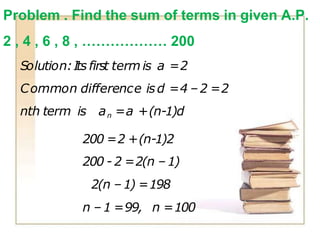
Problem . Find the sum of terms in given A.P.
2 , 4 , 6 , 8 , ……………… 200
Solution:Its first term is a =2
Common difference isd =4 –2 =2
nth term is an =a +(n-1)d
200 =2 +(n-1)2
200 - 2 =2(n –1)
2(n –1) =198
n –1 =99, n =100
The sum to n terms of an arithmetic
progression Sn =n/2[ 2a +(n - 1)d ]
S100 =100/2 [ 2x 2 +(100-1)x 2]
=50 [ 4 +198]
=50[202]
=10100
T
he difference betw
een tw
o termsofan
APcan be formulated asbelow:-
nthterm –kthterm
=t(n)–t(k)
={
a +(n-1)d}–{a +(k-1)d }
=a +nd –d –a –kd +d =nd –kd
Hence,
t(n)–t(k) =(n –k)d
Any Questions?
ASK!
Thank You!

arithmatic progression.pptx

  • 1.
    Arithmetic Progression Class 10 Chapter 5 Preparedby: Sharda Chauhan TGT Mathematics
  • 2.
    Sequence: A listof numbers having specific relation between the consecutive termsisgenerally called a sequence. e.g. 1, 3, 5, 7,… … … (next term to a term isobtained by adding 2 with it) & 2, 6, 18, 54,… … .( next term to a term isobtained by multiplying 3 with it)
  • 3.
    Arithm etic P rogression: Ifvarioustermsof a sequence are formed by adding a fixed number to the previous term or the difference between two successive termsisa fixed number, then the sequence iscalled AP. e.g.1) 2, 4, 6, 8, … … … the sequence of even numbersisan example of AP 2) 5, 10, 15, 20, 25….. In thiseach term isobtained by adding 5 to the preceding term except first term.
  • 4.
    I llustrativeexample forA.P. = d,where d=1 aa+ d a+ 2d a+ 3d……… … … …
  • 5.
    The general formof an Arithmetic Progression is a , a + d , a +2d , a +3d … … … … … …, a +(n- 1)d Where ‘a’ is first term and ‘d’ iscalled common difference.
  • 6.
    Common Difference -The fixed number which is obtained by subtracting any term of AP from its previous term. If we take First term of an AP asa and Common Difference asd, Then, nth term of that AP will be An =a +(n-1)d
  • 7.
    Notice in thissequencethat if we find the difference between any term and the term before it we always get 4. 4 isthen called the common difference and is denoted with the letter d. To get to the next term in the sequence we would add 4 so a recursive formula for this sequence is: an  an1  4 The first term in the sequence would be a1 whic h issometimes just written as a. 3, 7, 11, 15, 19 … d =4 a =3
  • 8.
    +4 +4 +4+4 3, 7, 11, 15, 19 … d =4 a =3 Each time you want another term in the sequence you’d add d. Thiswould mean the sec ond term wasthe first termplusd.T he third term isthe first term plusd plusd (added twic e). T he fourth termisthe first termplusd plusd plusd (added three times). S o you c an see to get the nth term we’d take the first term and add d (n -1)times. an  a  n 1d T rythisto get the 5th term. a5  3 514  316 19
  • 9.
    Let’ssee an example!! Leta= 2, d= 2, n= 12,find AnAn=a+(n-1)d =2+(12-1)2 =2+(11)2 =2+22 Therefore, An =24 Hence solved.
  • 10.
    Tocheck thata giventermisin A.P. or not. 2, 6, 10, 14…. Here first term a =2, find differences in the next terms a2-a1 =6 –2 =4 a3-a2 =10 –6 =4 a4-a3 =14 –10 =4 Since the differencesare common. Hence the given termsare in A.P.
  • 11.
    Problem : Findthe value ofk forwhich the given series isin A.P. 4, k –1, 12 Solution : Given A.P. is4, k –1 , 12… .. If series is A.P. then the differences will be common. d1 =d1 a2 –a1 = a3 –a2 k –1 –4 =12 –(k –1) k –5 = 12 –k +1 k +k =12 +1 +5
  • 12.
    The sumofn term s,we find as, Sum =n X [(first term +last term) / 2] Now last term will be =a +(n-1) d Therefore, Sum(Sn ) =n X [{ a +a +(n-1) d }/2 ] =n/2 [2a +(n+1)d]
  • 13.
    DERIVATION T he sum ton termsisgiven by: Sn =a +(a +d) +(a +2d) +… +(a +(n –1)d) (1) Ifwe write this out backwards, we get: Sn =(a +(n –1)d) +(a +(n –2)d) +… +a (2) Now let’sadd (1) and (2): 2Sn =[2a +(n –1)d] +[2a +(n –1)d] +… … … … +[2a +(n –1)d] So, Sn = n/2[2 a +(n –1)d]
  • 14.
    Problem . Findnumber of terms of A.P.100, 105, 110, 115,………500 Solution: First term is a = 100 , an =500 Common difference is d = 105 -100 =5 nth term is an =a +(n-1)d 500 =100 +(n-1)5 500 - 100 =5(n –1) 400 =5(n –1) 5(n –1) =400
  • 15.
    5(n –1) =400 n–1 =400/5 n - 1 = 80 n =80 +1 n =81 Hence the no. of termsare 81.
  • 16.
    Problem . Findthe sum of 30 terms of given A.P. ,12 , 20 , 28 , 36……… Solution :Given A.P. is12 , 20, 28 , 36 Its first term is a =12 Common difference isd =20 –12 =8 The sum to n termsof an arithmetic progression Sn =n/2 [ 2a +(n - 1)d ] =½x 30 [ 2x 12 +(30-1)x 8] =15 [ 24 +29 x8]
  • 17.
    =15[24 +232] =15 x246 =3690 THE SUM OF TERMS IS 3690
  • 18.
    Problem . Findthe sum of terms in given A.P. 2 , 4 , 6 , 8 , ……………… 200 Solution:Its first term is a =2 Common difference isd =4 –2 =2 nth term is an =a +(n-1)d 200 =2 +(n-1)2 200 - 2 =2(n –1) 2(n –1) =198 n –1 =99, n =100
  • 19.
    The sum ton terms of an arithmetic progression Sn =n/2[ 2a +(n - 1)d ] S100 =100/2 [ 2x 2 +(100-1)x 2] =50 [ 4 +198] =50[202] =10100
  • 20.
    T he difference betw eentw o termsofan APcan be formulated asbelow:- nthterm –kthterm =t(n)–t(k) ={ a +(n-1)d}–{a +(k-1)d } =a +nd –d –a –kd +d =nd –kd Hence, t(n)–t(k) =(n –k)d
  • 21.