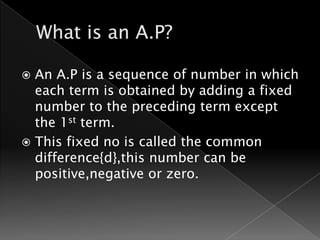
 An A.P is a sequence of number in which
  each term is obtained by adding a fixed
  number to the preceding term except
  the 1st term.
 This fixed no is called the common
  difference{d},this number can be
  positive,negative or zero.
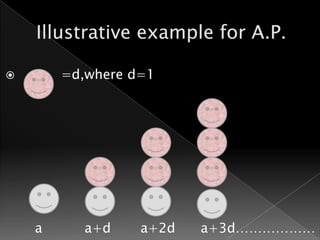
       =d,where d=1


    a      a+d    a+2d   a+3d………………
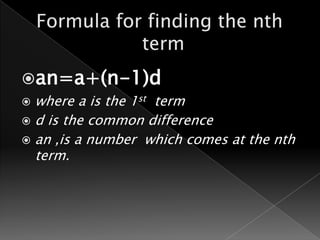
an=a+(n-1)d
 where a is the 1st term
 d is the common difference
 an ,is a number which comes at the nth
  term.
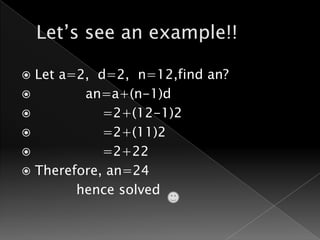
 Let a=2, d=2, n=12,find an?
        an=a+(n-1)d
           =2+(12-1)2
           =2+(11)2
           =2+22
 Therefore, an=24
        hence solved
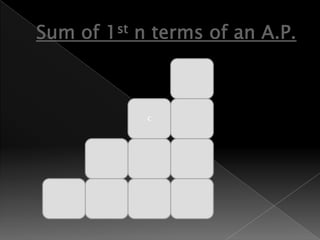
c
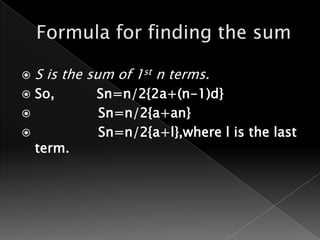
   S is the sum of 1st n terms.
   So,      Sn=n/2{2a+(n-1)d}
            Sn=n/2{a+an}
            Sn=n/2{a+l},where l is the last
    term.
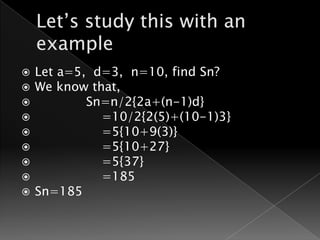
   Let a=5, d=3, n=10, find Sn?
   We know that,
           Sn=n/2{2a+(n-1)d}
             =10/2{2(5)+(10-1)3}
             =5{10+9(3)}
             =5{10+27}
             =5{37}
             =185
   Sn=185
CREDIT


          TO
               K.K SIR

Arithmetic progression

  • 2.
     An A.Pis a sequence of number in which each term is obtained by adding a fixed number to the preceding term except the 1st term.  This fixed no is called the common difference{d},this number can be positive,negative or zero.
  • 3.
    =d,where d=1 a a+d a+2d a+3d………………
  • 4.
    an=a+(n-1)d  where ais the 1st term  d is the common difference  an ,is a number which comes at the nth term.
  • 5.
     Let a=2,d=2, n=12,find an?  an=a+(n-1)d  =2+(12-1)2  =2+(11)2  =2+22  Therefore, an=24 hence solved
  • 6.
  • 7.
    S is the sum of 1st n terms.  So, Sn=n/2{2a+(n-1)d}  Sn=n/2{a+an}  Sn=n/2{a+l},where l is the last term.
  • 8.
    Let a=5, d=3, n=10, find Sn?  We know that,  Sn=n/2{2a+(n-1)d}  =10/2{2(5)+(10-1)3}  =5{10+9(3)}  =5{10+27}  =5{37}  =185  Sn=185
  • 10.
    CREDIT TO K.K SIR