UNDERSTANDING  ARISTOTLE’S  POLITICS
Overview Who was  Aristotle ? What were the  key assumptions  behind the  Politics ? Which  ideas  of Aristotle are relevant to the study of  politics  and  democracy ?
Aristotle: A Profile Born in  384 BC  in  Stagira He was interested in a  broad array of subjects  (mostly sciences) Founded the  Lyceum Tutor of  Alexander the Great
Aristotle’s Politics: Key Assumptions The concept of “ Nature ” There is a certain  natural order  to things All things have a specific  function  or  purpose  to fulfill
Aristotle’s approach is  teleological  in nature All things have an  end  to which they are  ordained To  achieve  that end is  good Aristotle’s Politics: Key Assumptions
The  whole  is greater than the  sum of its parts The whole takes  primacy  over its individual parts Collective achievements  can surpass individual ones Aristotle’s Politics: Key Assumptions
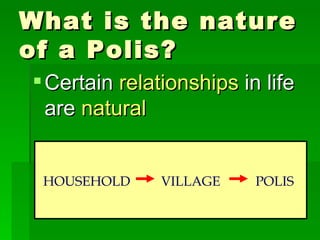
What is the nature of a Polis? Certain  relationships  in life are  natural HOUSEHOLD VILLAGE POLIS
Aristotle contends that the  Polis  is a  natural organization Men  strive to be  self-sufficient  but  cannot  be so alone The nature of the  polis  is to be  self-sufficing What is the nature of a Polis?
“ It grows for the sake of mere life, and  it exists for the sake of the good life .” (Curtis, p. 65) What is the nature of a Polis?
The Good Life Distinguishes the polis from other social organizations Understood as  happiness  but  not pleasure Rooted in  virtue To live the good life is in man’s  common interest
Therefore… Man is a  political animal Man engages in politics to achieve the  common good
On forms of rule… Various kinds of rule are natural to man: Family Slavery Political Rule
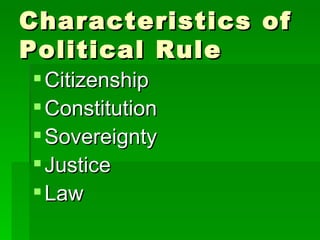
Characteristics of Political Rule Citizenship Constitution Sovereignty Justice Law
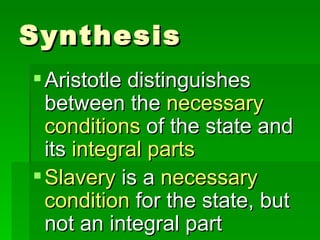
Synthesis Aristotle distinguishes between the  necessary conditions  of the state and its  integral parts Slavery  is a  necessary condition  for the state, but not an integral part
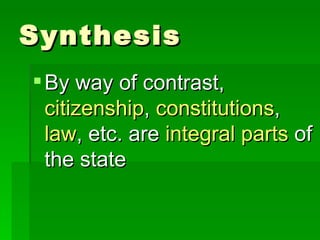
Synthesis By way of contrast,  citizenship ,  constitutions ,  law , etc. are  integral parts  of the state
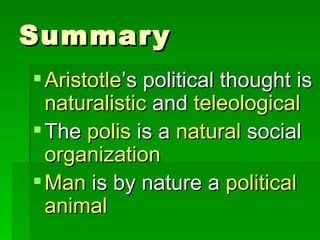
Summary Aristotle ’s political thought is  naturalistic  and  teleological The  polis  is a  natural  social  organization Man  is by nature a  political animal
Summary The objective of  politics  is to achieve the  good life Various kinds of  rule  are  natural Political rule  is rule by  equals over equals
Summary Aristotle distinguishes between the “ parts ” of the state and its  necessary conditions

Aristotle's Politics

  • 1.
  • 2.
    Overview Who was Aristotle ? What were the key assumptions behind the Politics ? Which ideas of Aristotle are relevant to the study of politics and democracy ?
  • 3.
    Aristotle: A ProfileBorn in 384 BC in Stagira He was interested in a broad array of subjects (mostly sciences) Founded the Lyceum Tutor of Alexander the Great
  • 4.
    Aristotle’s Politics: KeyAssumptions The concept of “ Nature ” There is a certain natural order to things All things have a specific function or purpose to fulfill
  • 5.
    Aristotle’s approach is teleological in nature All things have an end to which they are ordained To achieve that end is good Aristotle’s Politics: Key Assumptions
  • 6.
    The whole is greater than the sum of its parts The whole takes primacy over its individual parts Collective achievements can surpass individual ones Aristotle’s Politics: Key Assumptions
  • 7.
    What is thenature of a Polis? Certain relationships in life are natural HOUSEHOLD VILLAGE POLIS
  • 8.
    Aristotle contends thatthe Polis is a natural organization Men strive to be self-sufficient but cannot be so alone The nature of the polis is to be self-sufficing What is the nature of a Polis?
  • 9.
    “ It growsfor the sake of mere life, and it exists for the sake of the good life .” (Curtis, p. 65) What is the nature of a Polis?
  • 10.
    The Good LifeDistinguishes the polis from other social organizations Understood as happiness but not pleasure Rooted in virtue To live the good life is in man’s common interest
  • 11.
    Therefore… Man isa political animal Man engages in politics to achieve the common good
  • 12.
    On forms ofrule… Various kinds of rule are natural to man: Family Slavery Political Rule
  • 13.
    Characteristics of PoliticalRule Citizenship Constitution Sovereignty Justice Law
  • 14.
    Synthesis Aristotle distinguishesbetween the necessary conditions of the state and its integral parts Slavery is a necessary condition for the state, but not an integral part
  • 15.
    Synthesis By wayof contrast, citizenship , constitutions , law , etc. are integral parts of the state
  • 16.
    Summary Aristotle ’spolitical thought is naturalistic and teleological The polis is a natural social organization Man is by nature a political animal
  • 17.
    Summary The objectiveof politics is to achieve the good life Various kinds of rule are natural Political rule is rule by equals over equals
  • 18.
    Summary Aristotle distinguishesbetween the “ parts ” of the state and its necessary conditions

Editor's Notes

  • #2 Learning Objectives: 1.) To become acquainted with some of the ideas in Aristotle’s Politics and situate this within the context of Aristotle’s life. 2.) To understand the key assumptions that underlie Aristotle’s political thought. 3.) To elucidate on the necessary conditions of the state. 4.) To identify strands in Aristotle’s political thought with potential practical relevance to the conduct of politics and to our understanding of democracy.