Aristotle, 
Politics 
STAATSLEHRE PRÄSENTATION // 22.10.2014
CONTENTS 
ABOUT 
the book 
POLITICS 
relevant notes
INTRODUCTION 
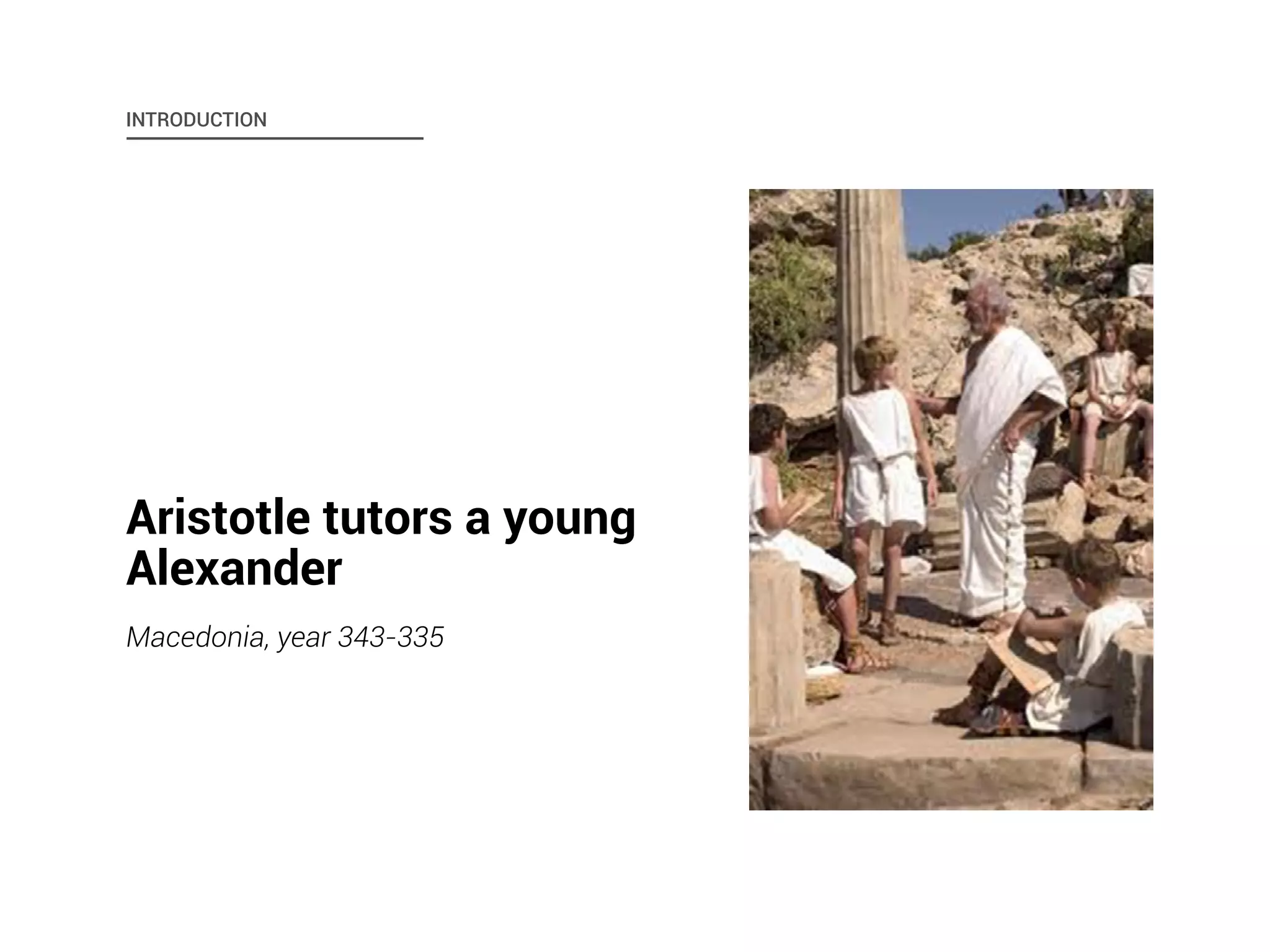
Aristotle tutors a young 
Alexander 
Macedonia, year 343-335
STATE – A CREATION OF NATURE
STATE – A CREATION OF NATURE 
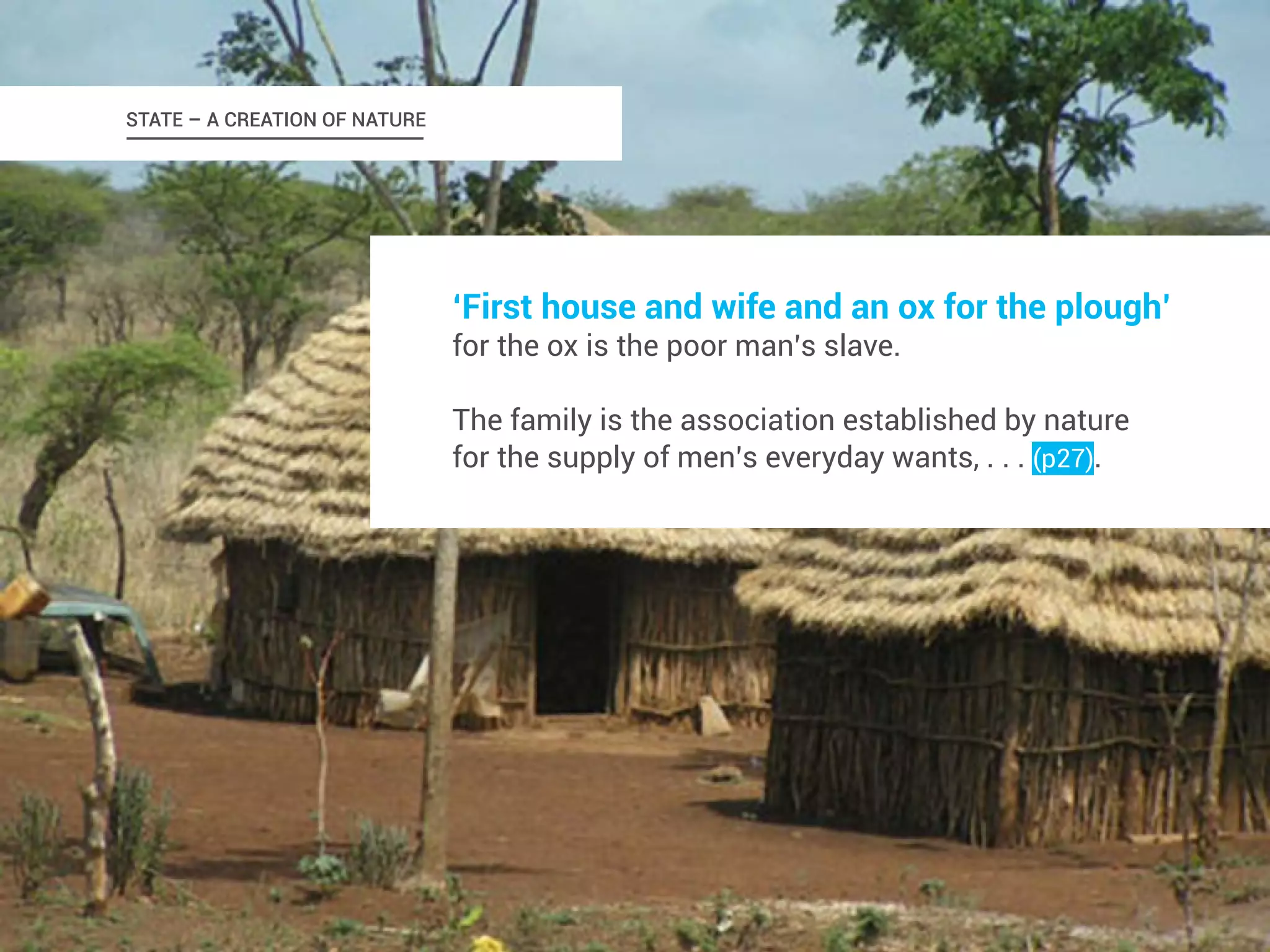
‘First house and wife and an ox for the plough’ 
for the ox is the poor man’s slave. 
The family is the association established by nature 
for the supply of men’s everyday wants, . . . (p27).
‘First house and wife and an ox for the plough’ 
for the ox is the poor man’s slave. 
The family is the association established by nature 
for the supply of men’s everyday wants, . . . (p27). 
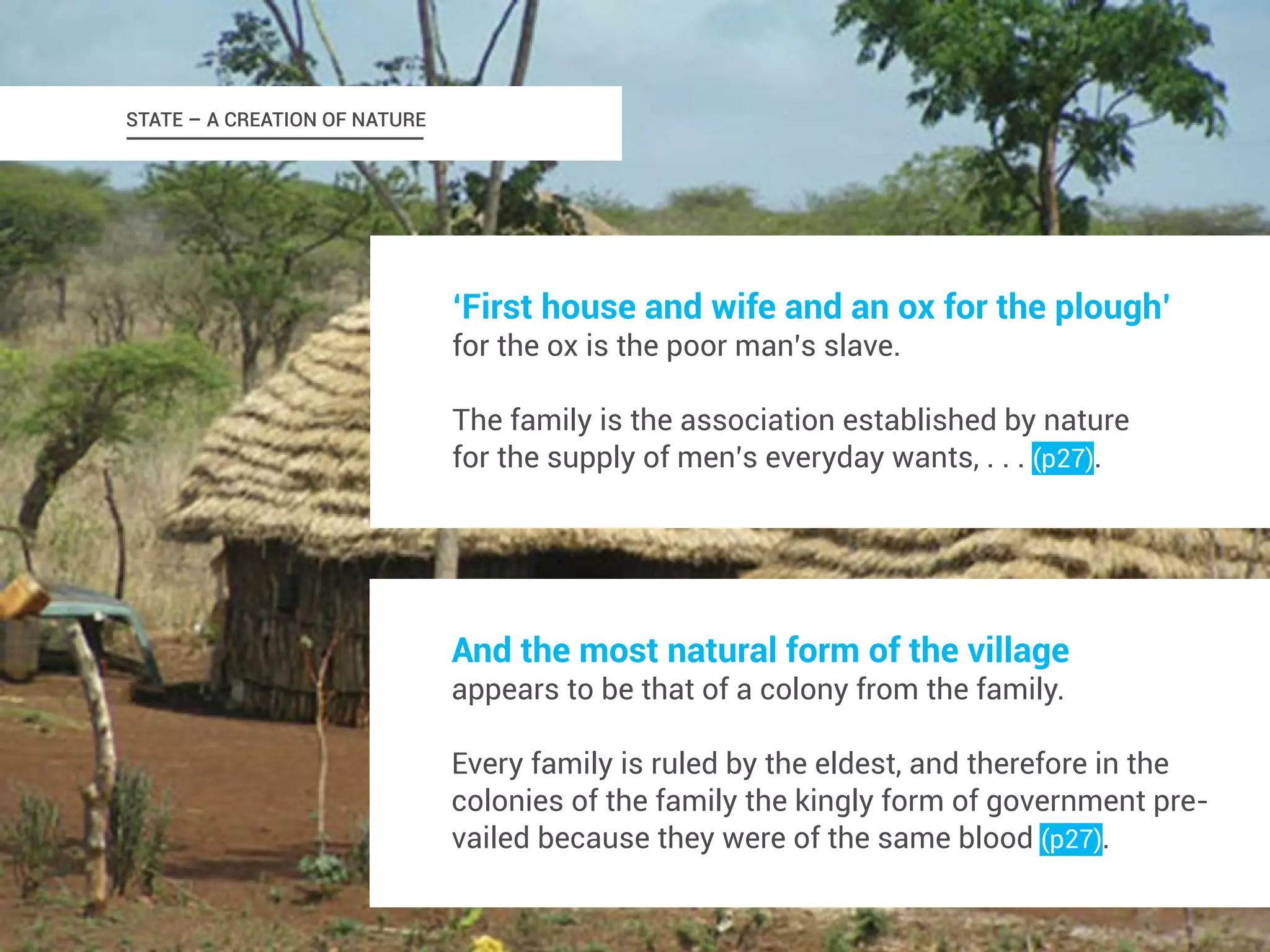
And the most natural form of the village 
appears to be that of a colony from the family. 
Every family is ruled by the eldest, and therefore in the 
colonies of the family the kingly form of government pre-vailed 
because they were of the same blood (p27). 
STATE – A CREATION OF NATURE
SLAVERY
SLAVERY 
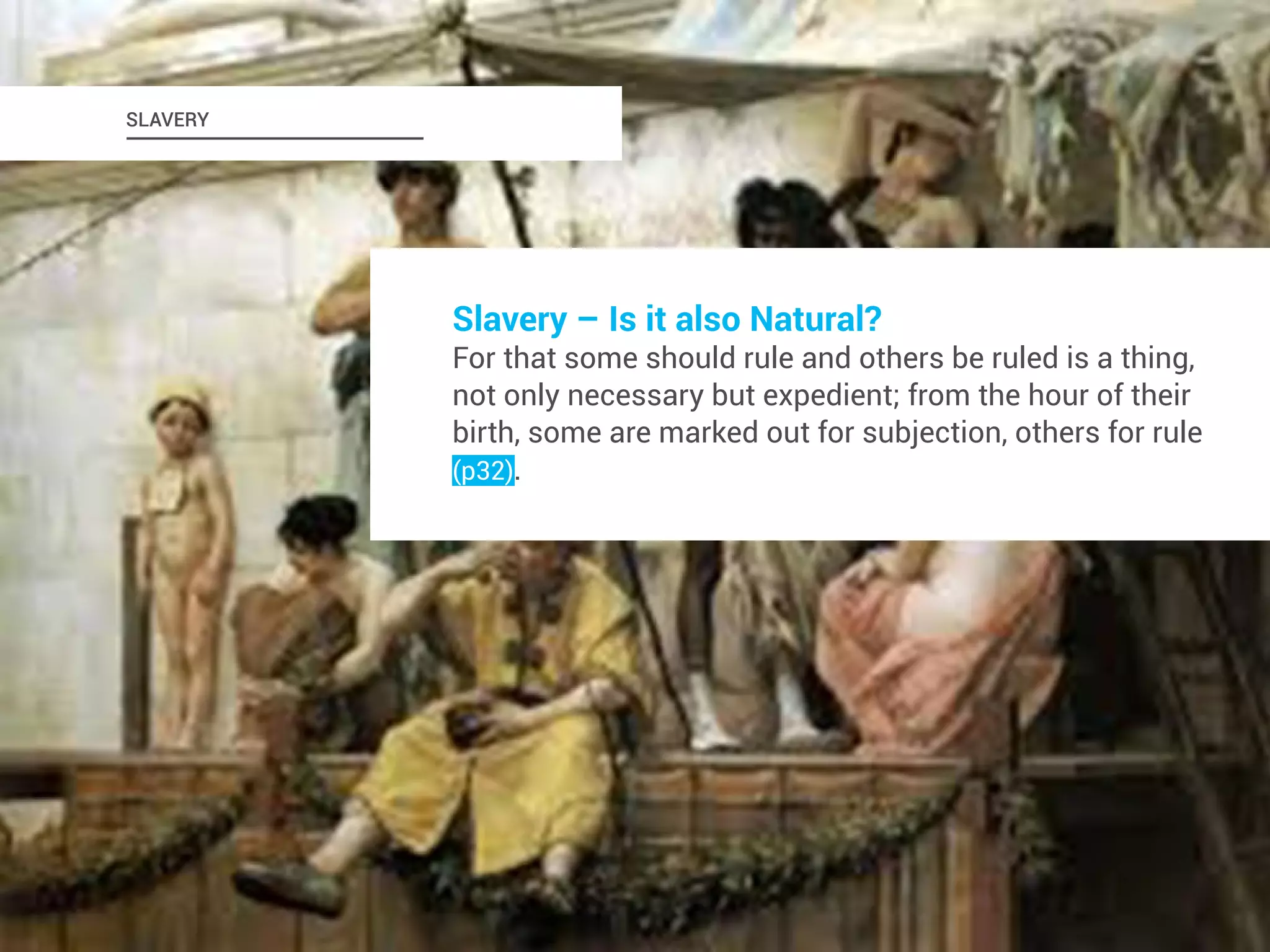
Slavery – Is it also Natural? 
For that some should rule and others be ruled is a thing, 
not only necessary but expedient; from the hour of their 
birth, some are marked out for subjection, others for rule 
(p32).
SLAVERY 
Slavery – Is it also Natural? 
For that some should rule and others be ruled is a thing, 
not only necessary but expedient; from the hour of their 
birth, some are marked out for subjection, others for rule 
(p32). 
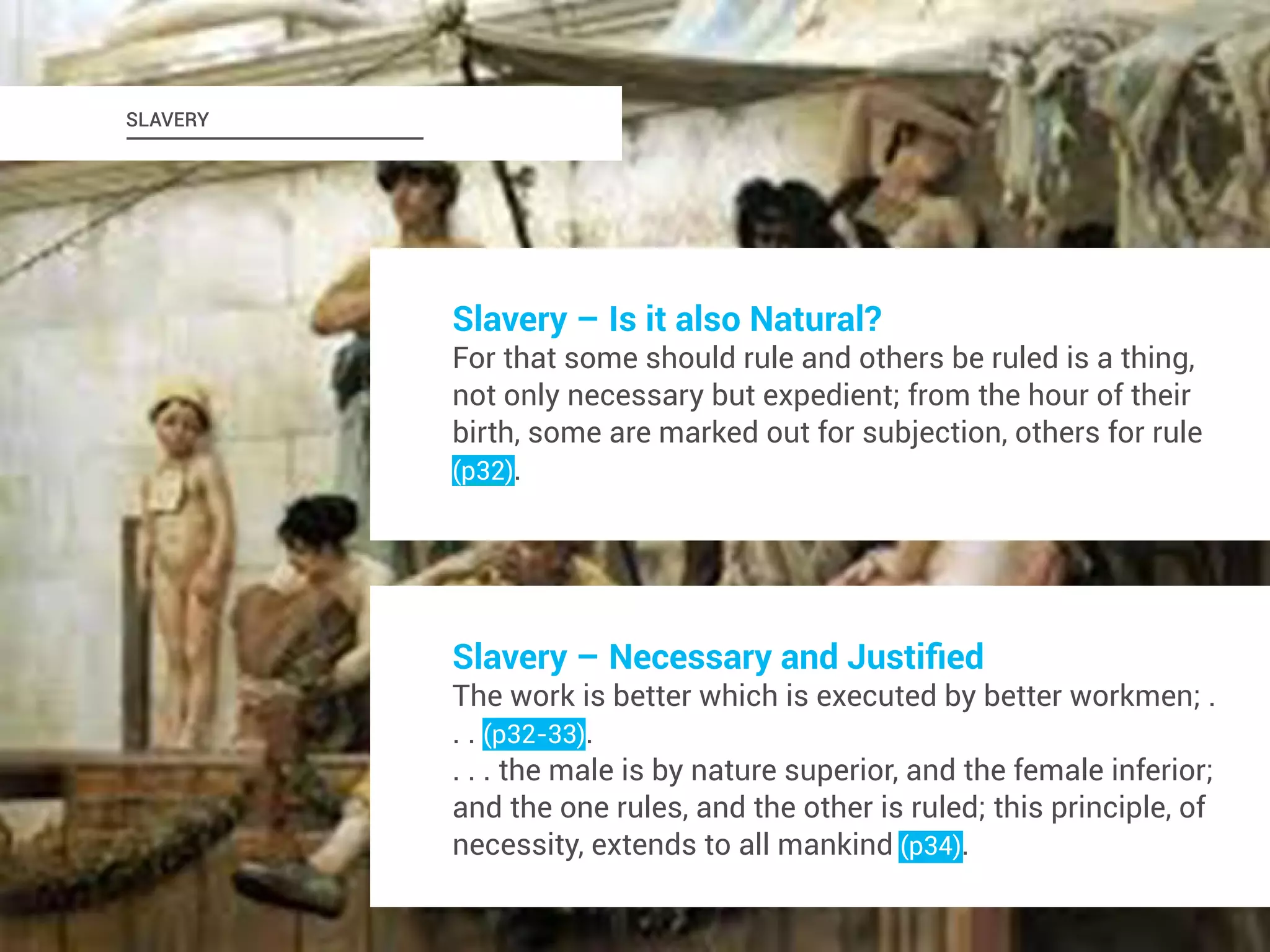
Slavery – Necessary and Justified 
The work is better which is executed by better workmen; . 
. . (p32-33). 
. . . the male is by nature superior, and the female inferior; 
and the one rules, and the other is ruled; this principle, of 
necessity, extends to all mankind (p34).
the form of 
government
Some, indeed, say that the best constitution 
is a combination of all existing forms, 
THE FORM OF GOVERNMENT
Some, indeed, say that the best constitution 
is a combination of all existing forms, 
and they praise the Lacedaemonian because it made up 
of oligarchy, monarchy, democracy, 
the king forming the monarchy, and the council of 
elders the oligarchy, while the democratic element is 
represented by the Ephors; for the Ephors are selected 
from the people (p70-71). 
THE FORM OF GOVERNMENT
SPARTA
MAP OF ANCIENT GREECE
SPARTA – INEQUALITY OF PROPERTY 
Nearly two-fifths of the country are held by 
women; 
this is owing to the number of heiresses and to the large 
dowries which are customary (p84-85).
SPARTA – INEQUALITY OF PROPERTY 
Nearly two-fifths of the country are held by 
women; 
this is owing to the number of heiresses and to the large 
dowries which are customary (p84-85). 
Hence, although the country is able to maintain 
1,500 cavalry and 30,000 hoplites, 
the whole number of Spartan citizens [at the time of the 
Theban invasion] fell below 1,000. The result proves the 
faulty nature of their laws respecting property; for the city 
sank under a single defeat; . . . (p84-85).
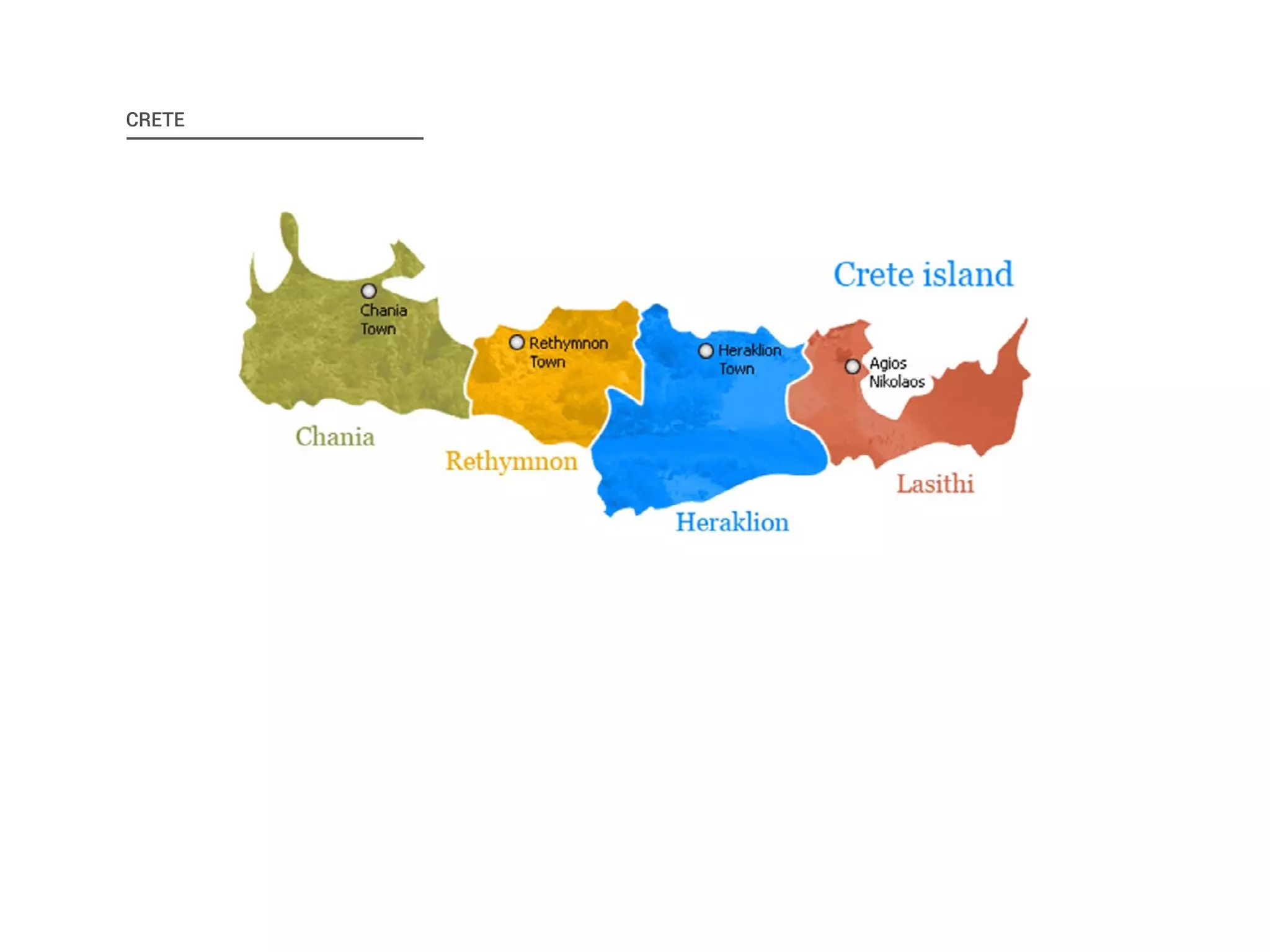
CRETE
Crete resembles Lacedaemon, yet different 
. . . the office of the Ephors is the same as that of the 
Cretan Cosmi, the only difference being that whereas 
the Ephors are five, the Cosmi are ten in number. 
But the common meals are better managed . . . so that 
men, women, and children are all supported out of a 
common stock (p90). 
CRETE
MAP OF ANCIENT GREECE
CARTHAGE
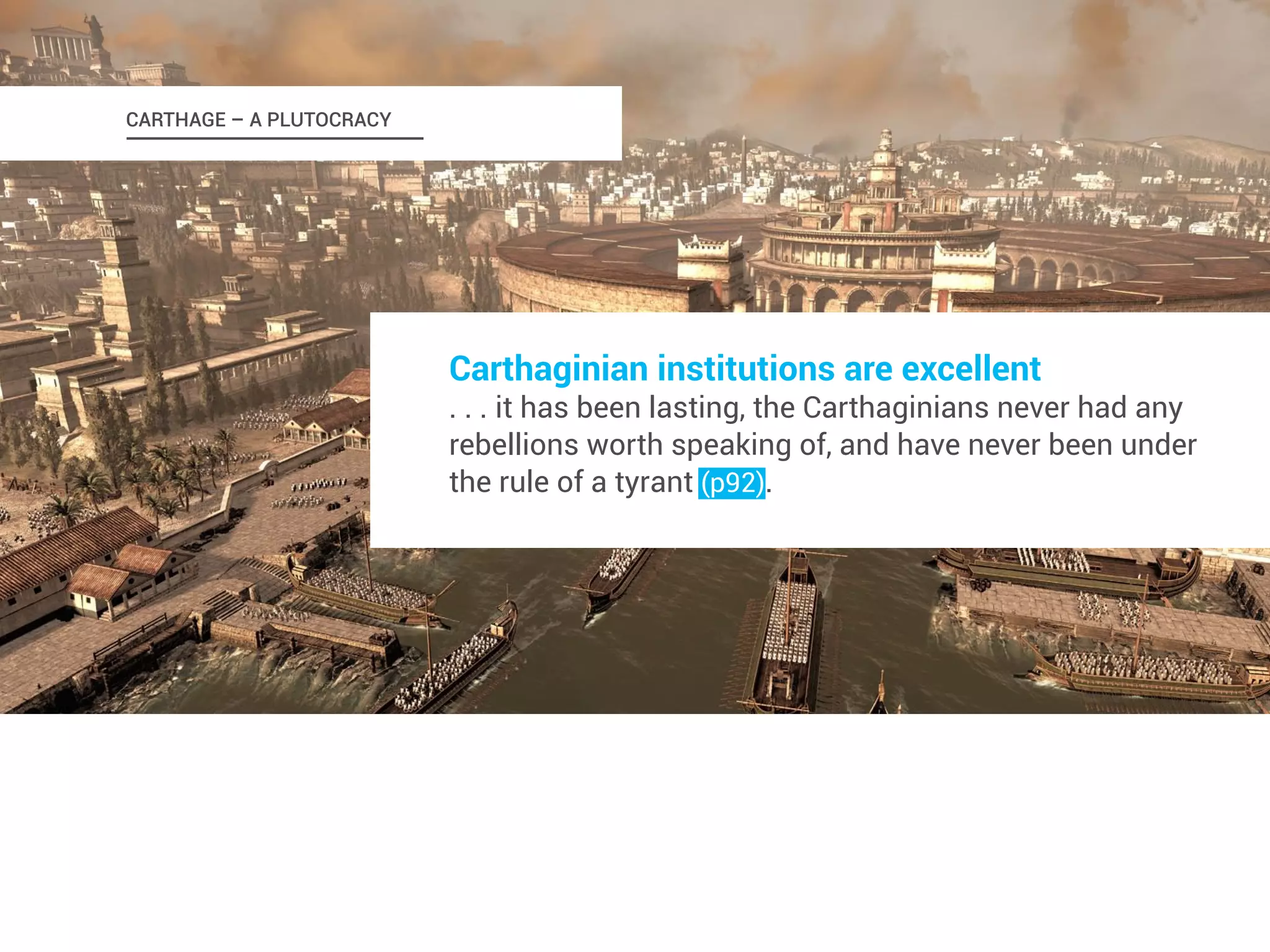
Carthaginian institutions are excellent 
. . . it has been lasting, the Carthaginians never had any 
rebellions worth speaking of, and have never been under 
the rule of a tyrant (p92). 
CARTHAGE – A PLUTOCRACY
Carthaginian institutions are excellent 
. . . it has been lasting, the Carthaginians never had any 
rebellions worth speaking of, and have never been under 
the rule of a tyrant (p92). 
CARTHAGE – A PLUTOCRACY 
. . . whereas the Ephors are any chance persons, . . . 
the [104] magistrates of the Carthaginians are elected according to merit – 
this is an improvement (p92).
CARTHAGE – A PLUTOCRACY 
If, then, election of magistrates for their wealth be 
characteristic of oligarchy, and election for merit of 
aristocracy, 
there will be a third form under which the constitution of Carthage 
is comprehended; for the Carthaginians choose their magistrates, 
and particularly the highest of them – their kings and generals – 
with an eye both to merit and to wealth (p94).
ROMAN EMPIRE 100 AD
true 
the form of 
government
THE TRUE FORMS OF GOVERNMENT 
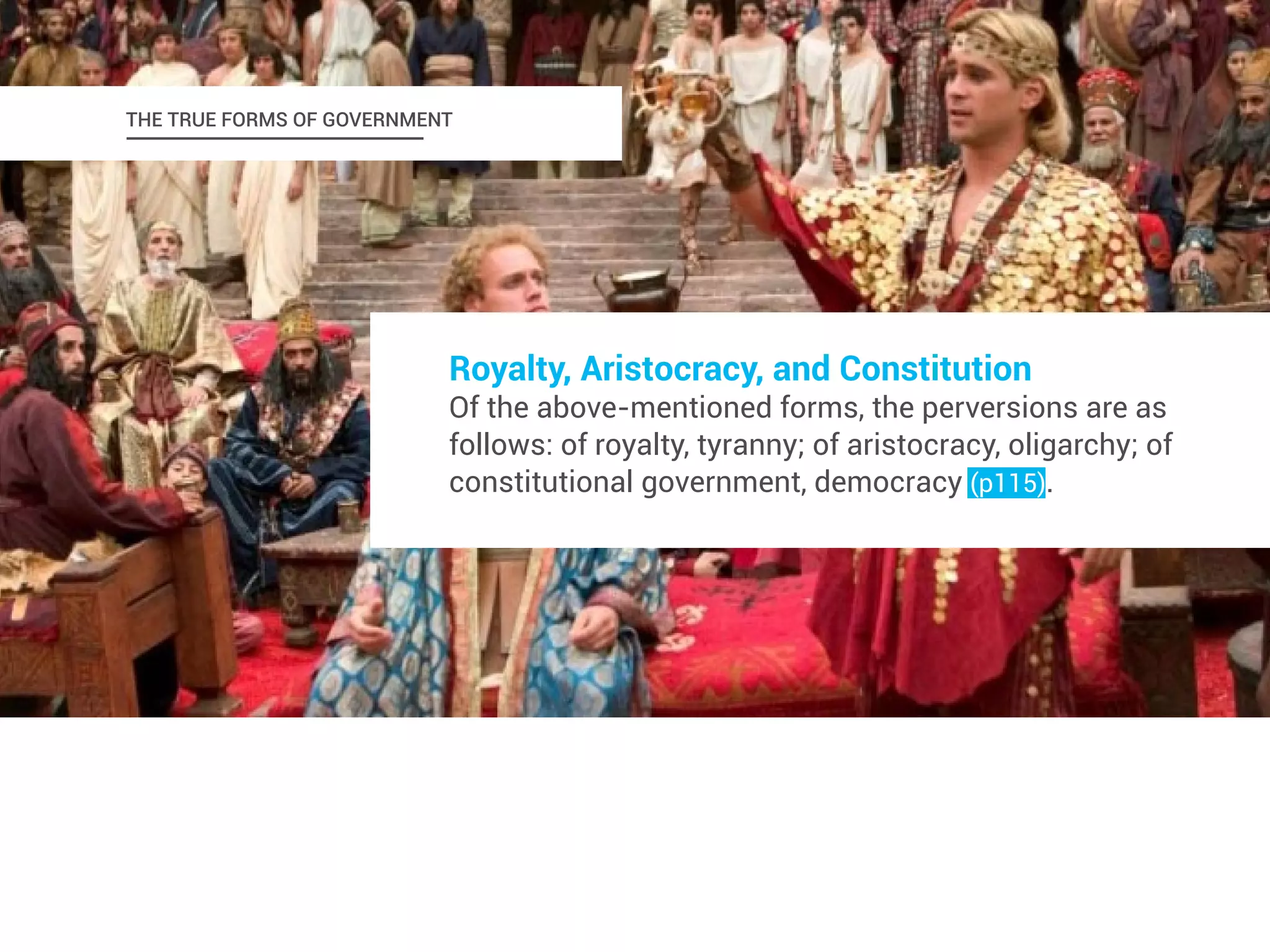
Royalty, Aristocracy, and Constitution 
Of the above-mentioned forms, the perversions are as 
follows: of royalty, tyranny; of aristocracy, oligarchy; of 
constitutional government, democracy (p115).
THE TRUE FORMS OF GOVERNMENT 
Royalty, Aristocracy, and Constitution 
Of the above-mentioned forms, the perversions are as 
follows: of royalty, tyranny; of aristocracy, oligarchy; of 
constitutional government, democracy (p115). 
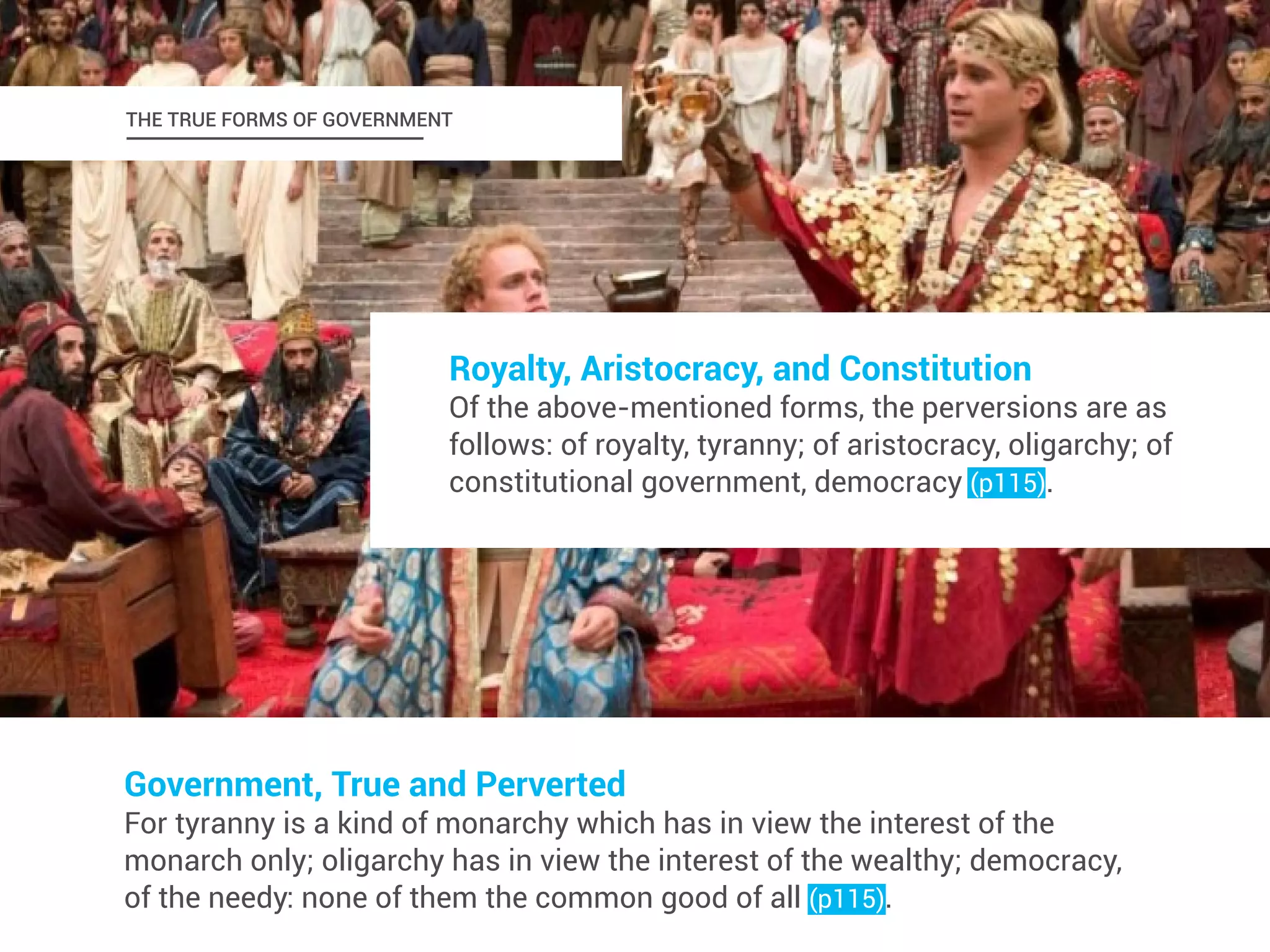
Government, True and Perverted 
For tyranny is a kind of monarchy which has in view the interest of the 
monarch only; oligarchy has in view the interest of the wealthy; democracy, 
of the needy: none of them the common good of all (p115).
GOVERNMENT – TWO PRINCIPAL FORMS 
DEMOCRACY 
1. 
OLIGARCHY 
2.
GOVERNMENT – MIXED CONSTITUTIONS 
DEMOCRACY 
1. 
OLIGARCHY 
2. 
CONSTITUTIONAL 
GOVERNMENT 
1. + 2. = 3.
ARISTOCRACY – GOVERNMENT OF THE BEST 
DEMOCRACY 
OLIGARCHY 
CONSTITUTIONAL 
GOVERNMENT 
ARISTOCRACY 
1. + 2. + 3. 
= 4. 
1. 
2. 
1. + 2. = 3.
THE RULE OF THE MIDDLE CLASS
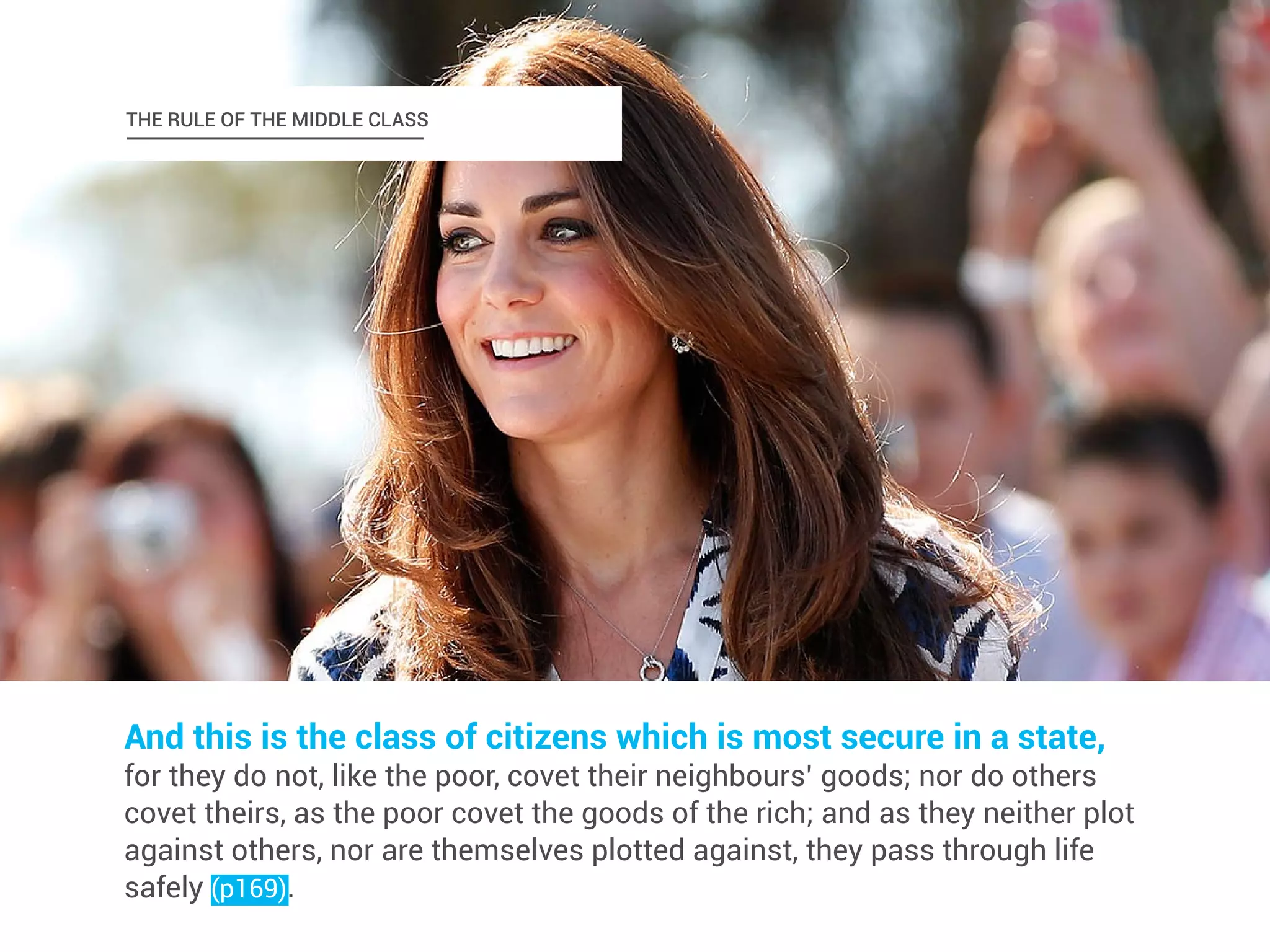
THE RULE OF THE MIDDLE CLASS 
And this is the class of citizens which is most secure in a state, 
for they do not, like the poor, covet their neighbours’ goods; nor do others 
covet theirs, as the poor covet the goods of the rich; and as they neither plot 
against others, nor are themselves plotted against, they pass through life 
safely (p169).
GOVERNMENT – TWO PRINCIPAL FORMS 
DEMOCRACY 
1. 
OLIGARCHY 
2. 
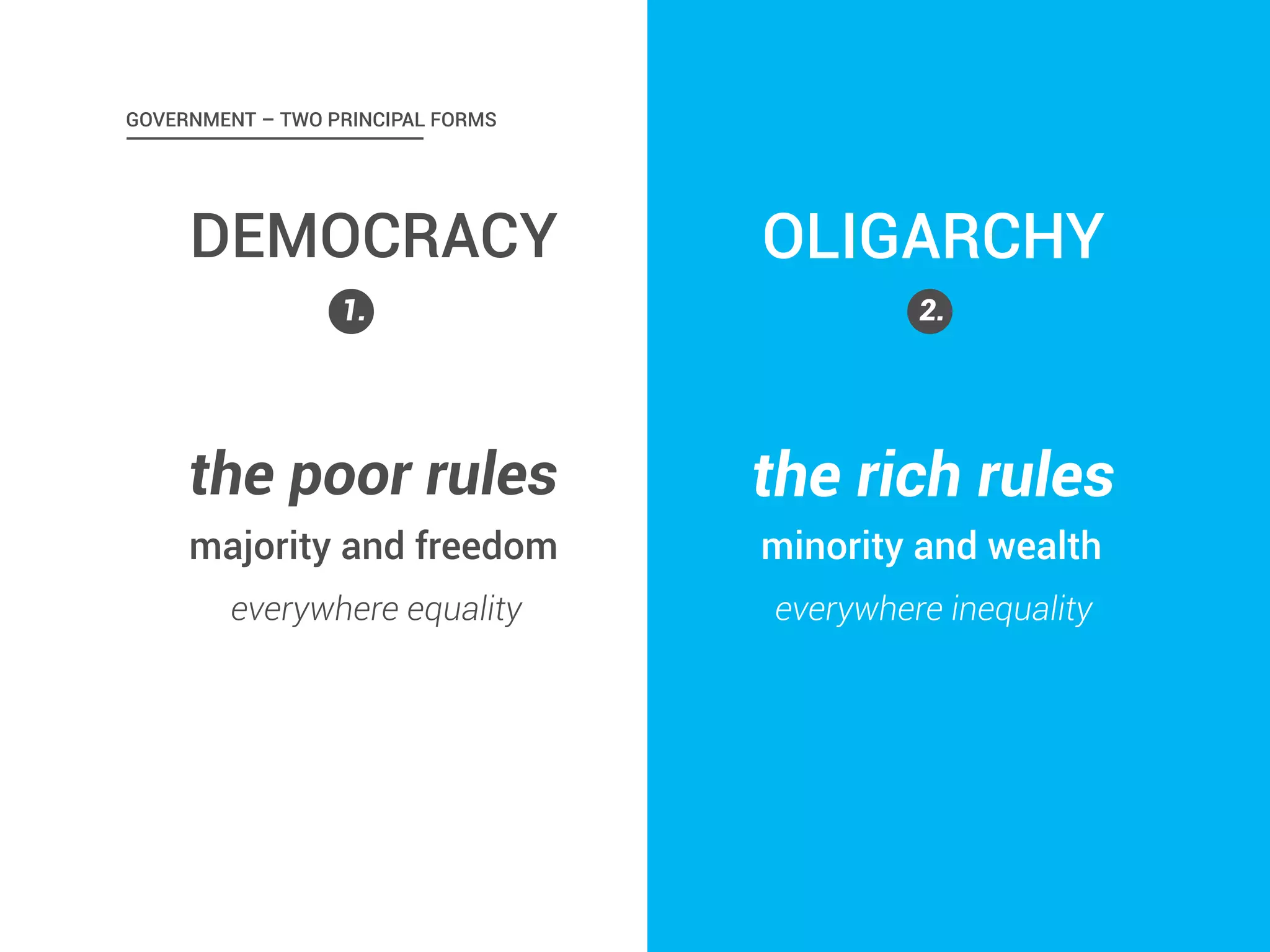
the poor rules the rich rules 
majority and freedom minority and wealth 
everywhere equality everywhere inequality
GOVERNMENT – MIXED CONSTITUTIONS 
DEMOCRACY 
1. 
OLIGARCHY 
2. 
CONSTITUTIONAL 
GOVERNMENT 
1. + 2. = 3.
THANK 
YOU 
FOR 
LISTENING!

Politics by Aristotle

  • 1.
    Aristotle, Politics STAATSLEHREPRÄSENTATION // 22.10.2014
  • 2.
    CONTENTS ABOUT thebook POLITICS relevant notes
  • 3.
    INTRODUCTION Aristotle tutorsa young Alexander Macedonia, year 343-335
  • 4.
    STATE – ACREATION OF NATURE
  • 5.
    STATE – ACREATION OF NATURE ‘First house and wife and an ox for the plough’ for the ox is the poor man’s slave. The family is the association established by nature for the supply of men’s everyday wants, . . . (p27).
  • 6.
    ‘First house andwife and an ox for the plough’ for the ox is the poor man’s slave. The family is the association established by nature for the supply of men’s everyday wants, . . . (p27). And the most natural form of the village appears to be that of a colony from the family. Every family is ruled by the eldest, and therefore in the colonies of the family the kingly form of government pre-vailed because they were of the same blood (p27). STATE – A CREATION OF NATURE
  • 7.
  • 8.
    SLAVERY Slavery –Is it also Natural? For that some should rule and others be ruled is a thing, not only necessary but expedient; from the hour of their birth, some are marked out for subjection, others for rule (p32).
  • 9.
    SLAVERY Slavery –Is it also Natural? For that some should rule and others be ruled is a thing, not only necessary but expedient; from the hour of their birth, some are marked out for subjection, others for rule (p32). Slavery – Necessary and Justified The work is better which is executed by better workmen; . . . (p32-33). . . . the male is by nature superior, and the female inferior; and the one rules, and the other is ruled; this principle, of necessity, extends to all mankind (p34).
  • 10.
    the form of government
  • 11.
    Some, indeed, saythat the best constitution is a combination of all existing forms, THE FORM OF GOVERNMENT
  • 12.
    Some, indeed, saythat the best constitution is a combination of all existing forms, and they praise the Lacedaemonian because it made up of oligarchy, monarchy, democracy, the king forming the monarchy, and the council of elders the oligarchy, while the democratic element is represented by the Ephors; for the Ephors are selected from the people (p70-71). THE FORM OF GOVERNMENT
  • 13.
  • 14.
  • 15.
    SPARTA – INEQUALITYOF PROPERTY Nearly two-fifths of the country are held by women; this is owing to the number of heiresses and to the large dowries which are customary (p84-85).
  • 16.
    SPARTA – INEQUALITYOF PROPERTY Nearly two-fifths of the country are held by women; this is owing to the number of heiresses and to the large dowries which are customary (p84-85). Hence, although the country is able to maintain 1,500 cavalry and 30,000 hoplites, the whole number of Spartan citizens [at the time of the Theban invasion] fell below 1,000. The result proves the faulty nature of their laws respecting property; for the city sank under a single defeat; . . . (p84-85).
  • 17.
  • 18.
    Crete resembles Lacedaemon,yet different . . . the office of the Ephors is the same as that of the Cretan Cosmi, the only difference being that whereas the Ephors are five, the Cosmi are ten in number. But the common meals are better managed . . . so that men, women, and children are all supported out of a common stock (p90). CRETE
  • 19.
  • 20.
  • 21.
    Carthaginian institutions areexcellent . . . it has been lasting, the Carthaginians never had any rebellions worth speaking of, and have never been under the rule of a tyrant (p92). CARTHAGE – A PLUTOCRACY
  • 22.
    Carthaginian institutions areexcellent . . . it has been lasting, the Carthaginians never had any rebellions worth speaking of, and have never been under the rule of a tyrant (p92). CARTHAGE – A PLUTOCRACY . . . whereas the Ephors are any chance persons, . . . the [104] magistrates of the Carthaginians are elected according to merit – this is an improvement (p92).
  • 23.
    CARTHAGE – APLUTOCRACY If, then, election of magistrates for their wealth be characteristic of oligarchy, and election for merit of aristocracy, there will be a third form under which the constitution of Carthage is comprehended; for the Carthaginians choose their magistrates, and particularly the highest of them – their kings and generals – with an eye both to merit and to wealth (p94).
  • 24.
  • 25.
    true the formof government
  • 26.
    THE TRUE FORMSOF GOVERNMENT Royalty, Aristocracy, and Constitution Of the above-mentioned forms, the perversions are as follows: of royalty, tyranny; of aristocracy, oligarchy; of constitutional government, democracy (p115).
  • 27.
    THE TRUE FORMSOF GOVERNMENT Royalty, Aristocracy, and Constitution Of the above-mentioned forms, the perversions are as follows: of royalty, tyranny; of aristocracy, oligarchy; of constitutional government, democracy (p115). Government, True and Perverted For tyranny is a kind of monarchy which has in view the interest of the monarch only; oligarchy has in view the interest of the wealthy; democracy, of the needy: none of them the common good of all (p115).
  • 28.
    GOVERNMENT – TWOPRINCIPAL FORMS DEMOCRACY 1. OLIGARCHY 2.
  • 29.
    GOVERNMENT – MIXEDCONSTITUTIONS DEMOCRACY 1. OLIGARCHY 2. CONSTITUTIONAL GOVERNMENT 1. + 2. = 3.
  • 30.
    ARISTOCRACY – GOVERNMENTOF THE BEST DEMOCRACY OLIGARCHY CONSTITUTIONAL GOVERNMENT ARISTOCRACY 1. + 2. + 3. = 4. 1. 2. 1. + 2. = 3.
  • 31.
    THE RULE OFTHE MIDDLE CLASS
  • 32.
    THE RULE OFTHE MIDDLE CLASS And this is the class of citizens which is most secure in a state, for they do not, like the poor, covet their neighbours’ goods; nor do others covet theirs, as the poor covet the goods of the rich; and as they neither plot against others, nor are themselves plotted against, they pass through life safely (p169).
  • 33.
    GOVERNMENT – TWOPRINCIPAL FORMS DEMOCRACY 1. OLIGARCHY 2. the poor rules the rich rules majority and freedom minority and wealth everywhere equality everywhere inequality
  • 34.
    GOVERNMENT – MIXEDCONSTITUTIONS DEMOCRACY 1. OLIGARCHY 2. CONSTITUTIONAL GOVERNMENT 1. + 2. = 3.
  • 35.
    THANK YOU FOR LISTENING!