Rousseau’s “Social Contract”
    A.K.A. ‘How to Fix France...Maybe!’


                                          1
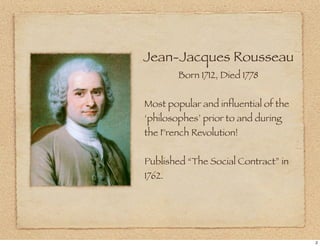
Jean-Jacques Rousseau
        Born 1712, Died 1778


Most popular and influential of the
‘philosophes’ prior to and during
the French Revolution!


Published “The Social Contract” in
1762.


                                      2
Rousseau’s ‘Problems’


Can there be legitimate political authority?


How is freedom possible in civil society?


                                               3
A Few Assumptions...

Our Nature = total physical freedom, no
restraints on behaviour
T be human, we must be active in a ‘society’
 o
Each member of society must enter into a
‘social contract’ with all of the others


                                               4
What is a ‘social contract’?

 the agreement through which each person
 enters into civil society
 The contract binds people into a community
 that exists for mutual preservation.
 We sacrifice physical freedom to gain civil
 freedom (rational thought!)


                                               5
In the political sphere...


Everyone will be ‘free’ because everyone will
forfeit the same amount of freedom and
receive the same amount of responsibility.


                                                6
Administration: T Parts
                 wo

sovereign - the voice of the law and absolute
authority within the state. In Rousseau’s
words, the sovereign is “the people speaking
together” (GENERAL WILL)
government - charged with application of
the law toward particular matters
(PARTICULAR WILLS)


                                                7
Quotes


“Man is born free, and everywhere he is
in chains.”


                                          8
Quotes

“The Sovereign, having no force other
than the legislative power, acts only by
means of the laws; and the laws being
solely the authentic acts of the general
will, the Sovereign cannot act save when
the people is assembled.”


                                           9
Quotes


“Every law the people have not ratified
in person is null and void -- is, in fact,
not a law.”


                                             10
Quotes


“The legislative power belongs to the
people, and can belong to it alone.”


                                        11
Liberty, Equality, Fraternity

“For a young people to be able to relish sound
principles of political theory and follow the
fundamental rules of statecraft, the effect would
have to become the cause; the social spirit, which
should be created by these institutions, would have
to preside over their very foundation; and men would
have to be before law what they should become by
means of law.”


                                                       12
Liberty, Equality, Fraternity

How can liberty, equality, fraternity be
written into law if man does not already
possess these values/attributes? If the
French people have NEVER experienced
these things before, how equipped are
they to institute them ?


                                           13

Rousseau's 'Social Contract'

  • 1.
    Rousseau’s “Social Contract” A.K.A. ‘How to Fix France...Maybe!’ 1
  • 2.
    Jean-Jacques Rousseau Born 1712, Died 1778 Most popular and influential of the ‘philosophes’ prior to and during the French Revolution! Published “The Social Contract” in 1762. 2
  • 3.
    Rousseau’s ‘Problems’ Can therebe legitimate political authority? How is freedom possible in civil society? 3
  • 4.
    A Few Assumptions... OurNature = total physical freedom, no restraints on behaviour T be human, we must be active in a ‘society’ o Each member of society must enter into a ‘social contract’ with all of the others 4
  • 5.
    What is a‘social contract’? the agreement through which each person enters into civil society The contract binds people into a community that exists for mutual preservation. We sacrifice physical freedom to gain civil freedom (rational thought!) 5
  • 6.
    In the politicalsphere... Everyone will be ‘free’ because everyone will forfeit the same amount of freedom and receive the same amount of responsibility. 6
  • 7.
    Administration: T Parts wo sovereign - the voice of the law and absolute authority within the state. In Rousseau’s words, the sovereign is “the people speaking together” (GENERAL WILL) government - charged with application of the law toward particular matters (PARTICULAR WILLS) 7
  • 8.
    Quotes “Man is bornfree, and everywhere he is in chains.” 8
  • 9.
    Quotes “The Sovereign, havingno force other than the legislative power, acts only by means of the laws; and the laws being solely the authentic acts of the general will, the Sovereign cannot act save when the people is assembled.” 9
  • 10.
    Quotes “Every law thepeople have not ratified in person is null and void -- is, in fact, not a law.” 10
  • 11.
    Quotes “The legislative powerbelongs to the people, and can belong to it alone.” 11
  • 12.
    Liberty, Equality, Fraternity “Fora young people to be able to relish sound principles of political theory and follow the fundamental rules of statecraft, the effect would have to become the cause; the social spirit, which should be created by these institutions, would have to preside over their very foundation; and men would have to be before law what they should become by means of law.” 12
  • 13.
    Liberty, Equality, Fraternity Howcan liberty, equality, fraternity be written into law if man does not already possess these values/attributes? If the French people have NEVER experienced these things before, how equipped are they to institute them ? 13